
Where Has All the Water Gone?
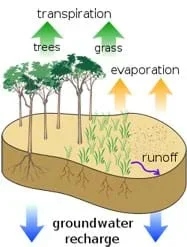 Evaporation and transpiration return liquid water to the water vapor state as part of the Earth's hydrologic cycle.Copyright 2007 Mtwoews, Wikimedia Commons http://commons.wikimedia.org/wiki/File:Surface_water_cycle.svg
Students learn about the Earth's water cycle, especially about evaporation. Once a dam is constructed, its reservoir becomes a part of the region's natural hydrologic cycle by receiving precipitation, storing runoff water and evaporating water. Although almost impossible to see, and not as familiar to most people as precipitation, evaporation plays a critical role in the hydrologic cycle, and is especially of interest to engineers designing new dams and reservoirs, such as those that Splash Engineering is designing for Thirsty County.
Engineers must consider evaporation in the design and operation of dams. Evaporation is an important factor in the site selection and operation of dams, as it can cause serious water loss, especially in hot, dry environments. Ideal reservoir locations are deep, narrow canyons that provide large storage with minimal exposed surface area, which minimizes the potential for water loss due to evaporation. Typically, engineers and hydrologists use computer models and spreadsheets to estimate a reservoir's water "budget," which takes into account the effects of evaporation on its storage.
After this lesson, students should be able to:
- Define precipitation, evaporation and transpiration.
- Grasp the important role of evaporation in the hydrologic (water) cycle.
- Describe how evaporation affects the reservoir behind a dam and why engineers must consider evaporation in their designs of dams.
- Gather and analyze data from a variety of print resources and investigations to account for local and world-wide water circulation and distribution patterns
Grade 6
Do you agree with this alignment? - Describe where water goes after it is used in houses or buildings
Grade 6
Do you agree with this alignment?
- STEL-3E Analyze how different technological systems often interact with economic, environmental, and social systems.
Grades 6-8
Do you agree with this alignment? - STEL-7S Create solutions to problems by identifying and applying human factors in design.
Grades 6-8
Do you agree with this alignment?
- MS-ESS2-4 Develop a model to describe the cycling of water through Earth's systems driven by energy from the sun and the force of gravity.
Grades 6-8
This resource focuses on the following Three Dimensional Learning aspects of NGSS:
Science & Engineering Practices- Develop a model to describe unobservable mechanisms.Do you agree with this alignment?
Disciplinary Core Ideas- Water continually cycles among land, ocean, and atmosphere via transpiration, evaporation, condensation and crystallization, and precipitation, as well as downhill flows on land.Do you agree with this alignment?
- Global movements of water and its changes in form are propelled by sunlight and gravity.Do you agree with this alignment?
Crosscutting Concepts- Within a natural or designed system, the transfer of energy drives the motion and/or cycling of matter.Do you agree with this alignment?
Do you agree with this alignment? - Develop a model to describe unobservable mechanisms.
Some familiarity with the hydrologic (water) cycle.
Hydrology is the science that encompasses the occurrence, distribution, movement and properties of the waters of the Earth and their relationship with the environment within each phase of the hydrologic cycle. The hydrologic (water) cycle is a continuous process by which water is purified by evaporation and transported from the Earth's surface (including the oceans) to the atmosphere and back to the land and oceans. All the physical, chemical and biological processes involving water as it travels its various paths in the atmosphere, over and beneath the Earth's surface and through growing plants, are of interest to those who study the hydrologic cycle. Water may take many pathways in its continuous cycle of falling as rainfall or snowfall and returning to the atmosphere. It may be captured for millions of years in polar ice caps. It may flow to rivers and finally to the sea. It may soak into the soil to be evaporated directly from the soil surface as it dries, or it may be transpired by growing plants. It may percolate through the soil and rocks and collect in groundwater reservoirs (aquifers), or it may flow to wells or springs or back to streams by seepage. The cycle for a drop of water may be short, or it may take millions of years. See The Water Cycle Visual Aid (PDF)for a diagram of the hydrologic cycle.
People tap the water cycle for their own uses. Water is diverted temporarily from one part of the cycle by pumping it from the ground or drawing it from a river, lake, well or aquifer. It is used for a wide range of activities, such as household, business and industry; for agricultural and parkland irrigation; and for the generation of electric power. After use, water is returned to another part of the cycle: perhaps discharged downstream or released to soak into the ground.
While evaporation is just one part of the hydrologic cycle, it is a crucial link between water on the Earth's surface and water vapor and clouds in the atmosphere. Many people do not realize how evaporation is just as important as precipitation to the water cycle.
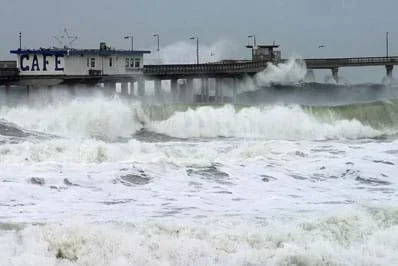 Crashing waves aid water evaporation from the ocean.Copyright Jon Sullivan, photo courtesy PDPhoto.org (public domain photograph) http://pdphoto.org/PictureDetail.php?mat=&pg=5560
Water evaporates from streams, lakes, oceans and even the soil beneath our feet. Most people understand precipitation, which returns water to the Earth's surface, providing us with opportunities play in the rain and build snowmen. But, evaporation is less understood. To our eyes, it looks like water just disappears when it evaporates. Evaporation can be visualized by thinking of boiling water and the resulting vapor that you can see and feel. But, evaporation does not have to occur at such high temperatures (boiling); evaporation from lakes, rivers and oceans takes place at much lower temperatures. Evaporation only takes place at the surface of the water. The thin layer of water molecules that are exposed to the air and sun are the ones that evaporate. Therefore, an amount of water with a large, exposed surface area evaporates faster than one with a smaller surface area exposed at the same temperature and pressure.
The operation of a reservoir is impacted by evaporation. People who analyze the water budget of a reservoir, usually in the form of a computer model, take evaporation into account when determining how much water should be in the reservoir today, as well as how much is expected and needed to be in the reservoir next month. This budget, in turn, affects the supply of water available for irrigation, domestic and industrial use.
(Introduce or review the concept of the hydrologic cycle. Draw a sketch on the board that includes clouds, rain, rivers, lakes, infiltration, and evaporation. Or, reproduce at a larger size or show with an overhead projector The Water Cycle Visual Aid (PDF)[a diagram of the hydrologic cycle] to display in the classroom. Elicit from students how water travels in the natural environment. A logical starting point is precipitation as rain or snow. Precipitation collects as water in lakes and streams and may, at some point, reach the ocean. Some of this water evaporates into the air. Plants take up some water for their own survival, and then release it as water vapor into the atmosphere through transpiration. Clouds of water vapor collect and return water to the Earth's surface through precipitation.)
How do clouds get created? How do they get replenished? Evaporation transforms water from the ground, streams, lakes and oceans into water vapor in the air that eventually forms clouds. Evaporation is the process whereby liquid water is converted to water vapor.
It is estimated that over the course of 100 years, a water molecule spends 98 years in the ocean, about 20 months in the form of ice, two weeks in lakes and rivers, and less than seven days in the atmosphere. (Source: LDEQ)
Some quick hydrologic facts to consider:
- The Earth holds more than 300 million cubic miles (1,250 cubic million kms) of water (underground, on the surface, and in the atmosphere).
- 70% of the Earth's surface is covered by water.
- 97% of the Earth's water is found in oceans.
- About 80% of all evaporation is from oceans, and 20% comes from inland water and vegetation. (Even though 97% of the Earth's water is found in oceans, only 80% of the total water evaporation from the Earth comes from oceans because they are very deep and only surface water can evaporate.)
Help me think of all the purposes for which we need water from the water cycle. (Take suggestions from students. Answers might include: Household drinking and cleaning, business and schools, industry and factories, farm and park irrigation, recreation [pools, boating], and electricity generation.) From what step of the water cycle do we usually use water? (Answer: From the liquid state found on Earth in rivers, lakes, wells, springs, aquifers, oceans, etc.) As the engineers for Splash Engineering, Thirsty County has hired you to conduct an evaporation study for their region. Pretend that our classroom, where you will be conducting the tests, is located in Thirsty County. Your experiments will tell you how much water evaporates in Thirsty County air. As engineers, you will need to explain the results of your study to your client – the government of Thirsty County – and help them understand why this information is important to the dams you are designing for them. (Next, conduct the associated activity Witnessing Evaporation where students learn about evaporation and transpiration as they fill pans with water, soil and/or growing plants, and observe and measure the difference in water weight during one week. .)
Let's review what we've learned about the water cycle and how dams are part of the water cycle, in Thirsty County and elsewhere. (Also use additional questions in the Assessment section.)
What is precipitation? What is evaporation? What is transpiration? How do they fit together into the water cycle on our planet? (Take suggestions from students, correcting as necessary.) What would happen if evaporation was removed from the water cycle? (Answer: Water would never be returned as vapor to the atmosphere, which is important for purification of the water and continuation of the water cycle so clouds would be created and precipitation could continue.)
What are the beneficial uses of reservoir water? (Answer: For irrigation, household water supply, factory processes, recreation, flood control, electricity generation.) Why is evaporation important to engineers who are planning a dam and reservoir? (Answer: Engineers must take evaporation into consideration when determining how much water will be in the reservoir at any given time. If engineers underestimate evaporation, enough water may not be available for irrigation and daily water needs.)
- aquifer
- An underground bed or layer of permeable rock, sediment or soil that contains or conducts groundwater. Source of water for springs and wells.
- engineer
- A person who applies her/his understanding of science and mathematics to creating things for the benefit of humanity and our world.
- evaporation
- The process whereby liquid water is converted to water vapor.
- groundwater
- The water under the Earth's surface, consisting largely of surface water that has seeped down and is stored within saturated soil and rock. (In this usage, saturated means full of water.) The source of water in springs and wells.
- hydrologic cycle
- The natural continuous process through which water evaporates and is transported from the Earth's surface (including the oceans) into the atmosphere as water vapor, and precipitates back to the Earth's land and oceans in liquid or solid form. Also called the water cycle.
- hydrology
- The science that encompasses the occurrence, distribution, movement and properties of the waters of the Earth and their relationship with the environment across all phases of the hydrologic cycle.
- permeable
- When something allows liquids or gases to pass through it using a network of connected pores or empty spaces, like a sponge or honeycomb.
- precipitation
- Any product of the condensation of water vapor that is deposited on the Earth's surface. Occurs in different forms: rain, sleet, snow, hail, etc.
- surface area
- The extent of a two-dimensional surface enclosed within a boundary. Think of "the area of a rectangle."
- transpiration
- The passage of watery vapor from a plant through its pores to the atmosphere.
- water vapor
- The state of water (H2O) as a gas.
Pre-Lesson Assessment
Question/Answer: Ask the students and discuss as a class:
- What are all the parts of the hydrologic cycle? (Answer: Precipitation, infiltration, evaporation, condensation, transpiration, runoff, and storage in rivers, lakes, oceans, aquifers and clouds.)
Post-Introduction Assessment
Voting: Ask a true/false question and have students vote by holding thumbs up for true and thumbs down for false. Tally the votes and write the totals on the board. Give the right answer.
- True or False: In the water cycle, water always leaves the ground by evaporating. (Answer: False. Surface water can also leave the ground by transpiration or sublimation.)
- True or False: Condensation happens when water goes from a vapor state to a liquid state. (Answer: True)
Lesson Summary Assessment
Drawing: Assign students to draw pictures of the water cycle. Ask them to use arrows to indicate the direction of water transport and name as many of the water cycle steps as they can.
Discussion Questions: Lead a class discussion to gauge students' understanding of the subject matter. Ask the students:
- What does evaporation have to do with clouds? (Answer: Evaporation transforms liquid water from the soil, streams, lakes and oceans into water vapor in the air that eventually forms clouds.)
- What is transpiration? And what does transpiration have to do with clouds? (Answer: Transpiration is when live plant material [grass, trees, shrubs, weeds, bushes] releases water vapor from its pores into the atmosphere, which contributes to the formation of clouds.)
- From what step of the water cycle do we usually use water? (Answer: From the liquid state found on the Earth in rivers, lakes, wells, oceans, etc.)
- What would happen if engineers did not design a dam's reservoir to account for natural evaporation as part of the water cycle? (Answer: There might be times when not enough water is available for a community's irrigation and daily water needs.)
- When we use water, is it used up forever? (Answer: No, our water use is only a temporary diversion from the bigger water cycle. Even after we use water, it is re-used again and again in some form.)
Extra Credit Questions: How is a reservoir with a large surface area different than one with a small surface area, in terms of evaporation? (Answer: The surface area is the very top layer of the water that is in contact with the air. A reservoir with a large surface area is one that is more spread out, with more of its water in contact with the air, so it has the potential for more evaporation than a reservoir with a smaller surface area.) How does surface area figure into engineers' calculations in planning a dam and reservoir? (Answer: More surface area increases the amount of evaporation, so to minimize evaporation, engineers look for ideal reservoir locations — deep, narrow canyons — so that as little reservoir water surface area as possible is created by the dam.)
Introduce or review the water cycle with an excellent one-minute animated video at the US Environmental Protection Agency's Drinking Water & Ground Water Kids' Stuff website: http://www.epa.gov/.
See a simple water cycle diagram at Windows to the Universe's Earth's Water Cycle page: http://www.windows.ucar.edu/.
Changes of State: Solids, Liquids, and Gases. Last modified December 31, 2002. Windows to the Universe, University Corporation for Atmospheric Research (UCAR). Accessed September 29, 2009. http://www.windows.ucar.edu/
Dictionary.com. Lexico Publishing Group, LLC., www.dictionary. com, accessed September 29, 2009.
Glossary - NOAA's National Weather Service. Last modified June 25, 2009. National Oceanic and Atmospheric Administration. Accessed September 29, 2009. (Source of some vocabulary definitions, with some modifications) http://www.nws.noaa.gov/
Hydrology Primer. Last modified March 7, 2008. Washington Water Science Center, US Geological Survey, US Department of the Interior. Accessed September 29, 2009. (Excellent resource) http://wa.water.usgs.gov/
States of Matter. Last modified February 13, 2008. Windows to the Universe, University Corporation for Atmospheric Research (UCAR). Accessed September 29, 2009. http://www.windows.ucar.edu/
Water Facts and Figures. Louisiana Department of Environmental Quality (LDEQ), Baton Rouge, LA. Accessed July 19, 2016. (Quotation about water molecule locations during 100 years) http://www.deq.louisiana.gov/portal/Portals/0/evaluation/aeps/DWPP/water-facts-figures.pdf
Contributors
Jeff Lyng; Kristin Field; Denise W. Carlson
Supporting Program
Integrated Teaching and Learning Program, College of Engineering, University of Colorado Boulder
Acknowledgements
The contents of this digital library curriculum were developed under grants from the Fund for the Improvement of Postsecondary Education (FIPSE), U.S. Department of Education and National Science Foundation (GK-12 grant no. 0338326). However, these contents do not necessarily represent the policies of the Department of Education or National Science Foundation, and you should not assume endorsement by the federal government.
Copyright
2008 by Regents of the University of Colorado