
Clean Energy: Hydropower
Using the associated activities, Hydropower generation is introduced to students as a common purpose and benefit of constructing dams. Through an introduction to kinetic and potential energy, students come to understand how a dam creates electricity. They also learn the difference between renewable and non-renewable energy.
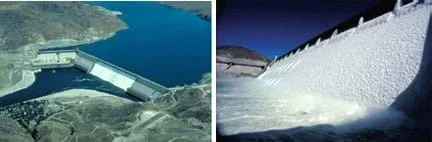 Grand Coulee Dam, Washington.Copyright Bonneville Power Administration http://www.bpa.gov/corporate/BPANews/Library/images/Dams/Coulee.jpg
Civil, environmental, mechanical and electrical engineers all cooperate to design dams. They consider an array of variables that range from environmental impact to maximum amount of energy generation. After considering the complex interaction of these variables, they optimize their design for the greatest societal benefit.
After this lesson, students should be able to:
- Describe how a dam produces electricity.
- Differentiate between renewable and non-renewable energy.
- Energy comes in many forms such as light, heat, sound, magnetic, chemical, and electrical
Grade 4
Do you agree with this alignment? - Identify and describe the variety of energy sources
Grade 4
Do you agree with this alignment?
- Energy comes in different forms.
Grades 3-5
Do you agree with this alignment? - Tools, machines, products, and systems use energy in order to do work.
Grades 3-5
Do you agree with this alignment? - STEL-3D Explain how various relationships can exist between technology and engineering and other content areas.
Grades 3-5
Do you agree with this alignment?
- 4-ESS3-1 Obtain and combine information to describe that energy and fuels are derived from natural resources and their uses affect the environment.
Grade 4
This resource focuses on the following Three Dimensional Learning aspects of NGSS:
Science & Engineering Practices- Use evidence (e.g., measurements, observations, patterns) to construct an explanation.Do you agree with this alignment?
Disciplinary Core Ideas- Energy and fuels that humans use are derived from natural sources, and their use affects the environment in multiple ways. Some resources are renewable over time, and others are not.Do you agree with this alignment?
Crosscutting Concepts- Knowledge of relevant scientific concepts and research findings is important in engineering.Do you agree with this alignment?
- Over time, people's needs and wants change, as do their demands for new and improved technologies.Do you agree with this alignment?
Do you agree with this alignment? - Use evidence (e.g., measurements, observations, patterns) to construct an explanation.
- 4-PS3-2 Make observations to provide evidence that energy can be transferred from place to place by sound, light, heat, and electric currents.
Grade 4
This resource focuses on the following Three Dimensional Learning aspects of NGSS:
Science & Engineering Practices- Use evidence (e.g., observations, patterns) to support an explanation.Do you agree with this alignment?
Disciplinary Core Ideas- Energy can be moved from place to place by moving objects or through sound, light, or electric currents.Do you agree with this alignment?
- Energy is present whenever there are moving objects, sound, light, or heat. When objects collide, energy can be transferred from one object to another, thereby changing their motion. In such collisions, some energy is typically also transferred to the surrounding air; as a result, the air gets heated and sound is produced.Do you agree with this alignment?
- Energy can also be transferred from place to place by electric currents, which can then be used locally to produce motion, sound, heat, or light. The currents may have been produced to begin with by transforming the energy of motion into electrical energy.Do you agree with this alignment?
Crosscutting Concepts- Energy can be transferred in various ways and between objects.Do you agree with this alignment?
Do you agree with this alignment? - Use evidence (e.g., observations, patterns) to support an explanation.
A basic understanding of what dams are and why people build them.
What makes hydropower an attractive energy source? Hydropower is an attractive energy source because it is renewable and clean. Renewable energy is commonly understood to come from the wind, sun and movement of water. Clean energy commonly refers to energy sources that do not significantly emit toxins and greenhouse gases.
Renewable sources of energy are considered infinite in supply. Societal disturbance (such as the 1970s oil crisis) and worse can be triggered by shortages in the production and distribution of non-renewable energies such as oil, coal and natural gas. Hydropower and other renewable energies are not as subject to these vulnerabilities because as long as we have the necessary technology, we can capture the renewable energy indefinitely.
Clean energy sources include the renewable energies as well as nuclear energy. Burning sources of energy that are not considered "clean" releases harmful emissions into our environment. These emissions pollute our land and water and contribute to global warming, which appears to have potentially catastrophic societal consequences.
How does hydropower work? Hydropower plants harness water's energy and use simple mechanics to convert that energy into electricity. The basic components of a hydropower plant are a dam, water intake, turbine, generator, transformer, power lines and water outflow (see Figure 1).
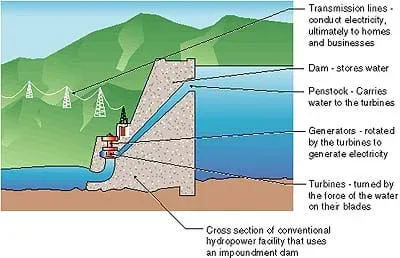 Figure 1. How a hydropower plant works.Copyright US Department of Energy, Energy Efficiency and Renewable Energy http://www1.eere.energy.gov/windandhydro/hydro_plant_types.html
Most hydropower plants rely on a dam that holds back water, creating a large reservoir. Gates on the dam open, and gravity pulls the intake water through the penstock, a pipeline that leads to the turbine(s). Water builds up pressure as it flows through this pipe. The water strikes and turns the large blades of turbines that are attached by shafts to generators above (see Figure 3). As the turbine blades turn, so do a series of magnets inside the generators. Giant magnets rotate past copper coils, producing alternating current (AC). A transformer inside the powerhouse converts the AC to higher-voltage current that is carried on high-tension power lines. The "used" water is carried through pipelines, called tailraces, and re-enters the river downstream.
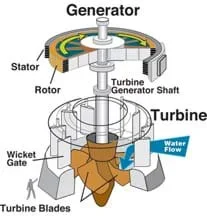 Figure 2: Cutaway view of a water turbine and electrical generator. Note the location of entering water flow to spin the blades, the shaft connecting the turbine to the generator, and how big it is (see the shape of a man at the bottom, for scale)!Copyright US Army Corps of Engineers c/o Wikipedia Commons http://en.wikipedia.org/wiki/File:Water_turbine.jpg
The amount of energy generated by a hydropower project depends on two things: volume of water flow and hydraulic head. The head refers to the vertical distance between the water surface and the turbines. As the head and flow increase, so does the electricity generated. The head depends on the height of the dam and the amount of water in the reservoir.
Some hydropower plants are of a special design called pumped-storage plants because they store energy until it is needed. In our homes, schools and workplaces, we tend to use much more electricity during the day than late at night. To provide for this peak usage time, power can be produced at night and stored for the next day. The plant pumps water up from a lower reservoir into a high reservoir so during peak demand hours water can flow back down through the turbines and generate electricity just like a conventional hydropower plant.
What is the history of hydropower? While the use of hydropower peaked in the mid-twentieth century, humans have been using water to generate power for a long time. More than 2,000 years ago, farmers used waterwheels to grind grains into flour. Waterwheels spin around as a stream of water hits their blades. The gears of the wheel mash the wheat kernels into flour. Students can investigate the transformation of energy in these devices with the Water Power activity by designing and creating their own model.
Most people are familiar with large-scale hydropower (such as the Hoover Dam), but the energy of moving water can be captured on a much smaller scale, called micro-hydropower (see Figure 3). In micro-hydropower applications, small to mid-size generators are placed in rivers and streams to provide electricity for a few buildings or other smaller users.
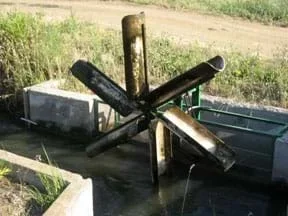 Figure 2. A simple waterwheel in an irrigation ditch uses the movement of flowing water to turn the blades and create electricity to pump water for field irrigation. Positioning a waterwheel (or hydroelectric turbine) to take advantage of the potential energy from a stream of water that falls results in even more energy capture.Copyright 2009 Charles M. Carlson. Used with permission.
Worldwide, hydroelectric power plants produce about 24% of the world's electricity and supply more than one billion people with power. U.S. utilities operate about 2,000 hydropower plants, making hydropower the nation's largest renewable energy source.
Engineers are involved in many aspects of hydropower. Engineers design, build and operate dams and their hydropower units. Engineers also work on improving design and maximizing energy generation. For example, the size and shape of a hydropower turbine, which resembles a propeller blade, helps determine how much energy can be generated. Engineers experiment with different shapes to maximize power generation. They also develop strategies to mitigate the surrounding environmental impacts of constructing and operating hydropower plants.
From where do we get the energy to cook our food, drive our cars, and turn on lights? Think about this for a few minutes, and then I'll ask for your ideas.
(Write student answers on the board in two columns: one for renewable energy sources and one for non-renewable, but do not put headers on the columns yet. After students have exhausted their ideas, ask them what the entries in each column have in common. Answer: One column is types of renewable energy, the other is types of non-renewable energy. Examples of non-renewable energies include: oil, gasoline, diesel, coal and natural gas. Examples of renewable energy include: wind power, solar power, solar thermal [for space and water heating], and hydroelectric.)
What are the benefits of renewable energy? (Answer: Renewable energies do not significantly contribute to global warming and have an inexhaustible supply.)
Where are hydroelectric power plants located? (Answer: At points in rivers, at dams.) Does anyone know how they work? Let's think it through.
Has anyone stood underneath a waterfall? What does it feel like? (Answer: The water pounds down on you with a lot of force.) By the time that water reaches the ground, it has a lot of power. Does water falling from tall waterfalls have more or less power than the water from shorter waterfalls? (Answer: More power.) We can say that the water about to fall from a tall waterfall has more potential energy than the water at the top of a shorter waterfall. When the water falls, or moves through the air, the potential energy decreases as the water gets closer to the ground. The moving water has kinetic energy, or the energy of movement. As the water falls through the air, its kinetic energy grows as its potential energy decreases. So when it finally strikes you at the bottom, all of its potential energy has been turned into kinetic energy. This is in accordance with the idea that energy is never created or destroyed, it just changes form. That's the scientific and engineering way to understand why a waterfall has so much power. Have students solidify their understanding of the change of potential to kinetic energy with the Waterwheel Work: Energy Transformations and Rotational Rates activity by creating their own experimental waterwheels from two-liter plastic bottles.
With this in mind, we can understand how a hydropower plant works. Imagine a dam on a river. A hydropower plant located at the dam takes the (potential) energy of water located high up in a reservoir and captures its energy as it drops to the bottom of the dam. In other words, a hydroelectric power plant is designed to take that power of falling water and use it to create electricity. How is this done?
The water in a reservoir behind a dam is very deep. The water at the bottom of the reservoir feels the weight of all the water that is on top of it — which creates water pressure. The deeper you go in the water, the higher the pressure. Have you ever swam down deep in a swimming pool and felt your ears start to hurt? That is because of the pressure of the water on your eardrums! You are probably only swimming down about six feet in a swimming pool; imagine if you went down 50 or 100 feet. That is a lot of water pressure! The pressurized water is directed through large turbines (shaped like fans, with blades) that spin when the water hits them. When a turbine spins, it turns a shaft in the generator that generates electricity. You know how a house fan requires electricity to spin? These generators work in just the opposite way: when they spin, they create electricity. We'd need to do a unit on electricity and magnetism to understand how this works—but maybe some of you already know!
Today we learned that hydroelectric power plants are common features of dams. What is the type of power that is produced? (Answer: Renewable and clean electrical energy.) We also know how these power plants work. Could anyone explain for the class? (Answer: Water falls from the top of the reservoir onto a turbine at the base of the dam. The power of the falling water spins the turbine, which generates electricity.)
- electricity generation
- The creation of electricity.
- engineer
- A person who applies their understanding of science, mathematics and society to create technology for the benefit of humanity and our world.
- hydropower
- A form of energy (electric power) derived from the conversion of free-falling (and moving) water. Also called hydroelectric power or hydroelectricity.
- kinetic energy
- An object's energy due to its motion.
- mechanical energy
- Energy used to create motion.
- potential energy
- The energy stored in an object based on its position.
- turbine
- A machine that converts the kinetic energy of falling water (or any moving fluid, including steam, gases or air) into mechanical energy by use of a rotating shaft connected to spinning blades.
Pre-Lesson Assessment
Brainstorming: As a class, have students engage in open discussion. Remind them that in brainstorming, no idea or suggestion is "silly." All ideas should be respectfully heard. Take an uncritical position, encourage wild ideas and discourage criticism of ideas. Have them raise their hands to respond. Write their ideas on the board. Ask the students:
- How could engineers use the water stored in a reservoir to create electricity?
Post-Introduction Assessment
Voting: Read aloud true-or-false statements and have students vote by holding thumbs up for true and thumbs down for false. Tally the votes and write the totals on the board. Give the right answer.
- True or False: Hydropower is a renewable source of energy. (Answer: True)
- True or False: The kinetic energy from moving water can be used to make mechanical energy when the water hits a turbine. (Answer: True)
- True or False: Everything else being equal, water that falls from a lower height has more energy than water that falls from a greater height. (Answer: False. The opposite is true.)
Lesson Summary Assessment
Vocabulary: Ask students to write the vocabulary words and definitions on a sheet of paper or in their science journals.
Determine how water pressure and the angle at which water falls affect how water flows using the activities at the Foundation for Water Energy and Education's "Nature of Water Power" website: http://www.fwee.org/TG/curriculum.html
See information and images of the federal dams on the Bonneville Power Administration transmission grid in Oregon at http://www.bpa.gov/corporate/BPANews/Library/images/Dams/
See the attached short video clip (AVI)of a simple water wheel in an irrigation ditch.
Building Big: All About Dams. WGBH Educational Foundation. Accessed December 8, 2007. http://www.pbs.org/wgbh/buildingbig/dam/index.html
Types of Hydropower Plants, Wind and Hydropower Technologies Program. US Department of Energy, Energy Efficiency and Renewable Energy. Accessed July 14, 2009. http://www1.eere.energy.gov/windandhydro/hydro_plant_types.html
Contributors
Sara Born; Kristin Field; Michael Bendewald; Denise W. Carlson
Supporting Program
Integrated Teaching and Learning Program, College of Engineering, University of Colorado Boulder
Acknowledgements
The contents of this digital library curriculum were developed under a grant from the Fund for the Improvement of Postsecondary Education (FIPSE), U.S. Department of Education and National Science Foundation GK-12 grant no. 0338326. However, these contents do not necessarily represent the policies of the Department of Education or National Science Foundation, and you should not assume endorsement by the federal government.
Copyright
2008 by Regents of the University of Colorado.