
Are Dams Forever?
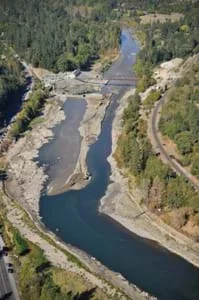 Nearing completion of the removal of the Savage Rapids Dam in Josephine County, OR. Heavy equipment moves piles of soil to direct the Rogue River's flow away from the remaining half of the dam structure, so it can be removed next. October 9, 2009.Copyright 2009 US Bureau of Reclamation http://www.waterwatch.org/programs/freeing-the-rogue-river/photo-gallery-removal-of-savage-rapids-dam
Students learn in this lesson, and through the associated activity, that dams are constructed with specific purposes and unfortunately do not last forever. Similar to other human-made structures, such as roads and bridges, dams require regular maintenance and have a finite lifespan. Many dams built during the 1930-70s, an era of intensive dam construction, have an expected life of 50-100 years. Due to inadequate maintenance and/or for environmental reasons, some of these dams will fail or be removed in the next 50 years. Students can investigate existing projects using the associated activity to see if various structures have stood the test of time while still maintaining their intended purpose The engineers with Splash Engineering have an ethical obligation to remind Thirsty County of the maintenance and lifespan concerns associated with its dam.
Engineers are concerned with the long-term reliability and maintenance of structures, especially dams. While proper initial engineering design of dams is important, safe operation and maintenance is critical to sustaining the benefits of dams and avoiding potential disaster. To prevent failure, engineers inspect these large structures to analyze the condition of their materials, determine maintenance, and sometimes recommend removal. As the US infrastructure of dams ages and as environmental issues become better understood, more dams are being removed so that rivers flow freely.
After this lesson, students should be able to:
- Discuss why dams do not last forever.
- Name some of the forces acting on dams that cause them to deteriorate.
- Name at least one US dam.
- Analyze and interpret data identifying ways Earth's surface is constantly changing through a variety of processes and forces such as plate tectonics, erosion, deposition, solar influences, climate, and human activity
Grade 5
Do you agree with this alignment? - Develop and communicate an evidence based scientific explanation around one or more factors that change Earth's surface
Grade 5
Do you agree with this alignment?
- Structures need to be maintained.
Grades 3-5
Do you agree with this alignment? - STEL-5D Determine factors that influence changes in a society's technological systems or infrastructure.
Grades 3-5
Do you agree with this alignment?
- 3-PS2-1 Plan and conduct an investigation to provide evidence of the effects of balanced and unbalanced forces on the motion of an object.
Grade 3
This resource focuses on the following Three Dimensional Learning aspects of NGSS:
Science & Engineering Practices- Plan and conduct an investigation collaboratively to produce data to serve as the basis for evidence, using fair tests in which variables are controlled and the number of trials considered.Do you agree with this alignment?
- Science investigations use a variety of methods, tools, and techniques.Do you agree with this alignment?
Disciplinary Core Ideas- Each force acts on one particular object and has both strength and a direction. An object at rest typically has multiple forces acting on it, but they add to give zero net force on the object. Forces that do not sum to zero can cause changes in the object's speed or direction of motion. (Boundary: Qualitative and conceptual, but not quantitative addition of forces are used at this level.)Do you agree with this alignment?
- Objects in contact exert forces on each other.Do you agree with this alignment?
Crosscutting Concepts- Cause and effect relationships are routinely identified.Do you agree with this alignment?
Do you agree with this alignment? - Plan and conduct an investigation collaboratively to produce data to serve as the basis for evidence, using fair tests in which variables are controlled and the number of trials considered.
- 5-ESS3-1 Obtain and combine information about ways individual communities use science ideas to protect the Earth's resources and environment.
Grade 5
This resource focuses on the following Three Dimensional Learning aspects of NGSS:
Science & Engineering Practices- Obtain and combine information from books and/or other reliable media to explain phenomena or solutions to a design problem.Do you agree with this alignment?
Disciplinary Core Ideas- Human activities in agriculture, industry, and everyday life have had major effects on the land, vegetation, streams, ocean, air, and even outer space. But individuals and communities are doing things to help protect Earth's resources and environments.Do you agree with this alignment?
Crosscutting Concepts- A system can be described in terms of its components and their interactions.Do you agree with this alignment?
- Science findings are limited to questions that can be answered with empirical evidence.Do you agree with this alignment?
Do you agree with this alignment? - Obtain and combine information from books and/or other reliable media to explain phenomena or solutions to a design problem.
Familiarity with the forces acting on dams, as described in lesson 2, Water and Dams in Today's World, of the Dams unit.
Nearly 800 dams have been removed in the US in the last 100 years. The restored rivers provide better fish and riparian habitat, yield financial savings, improve public safety and revitalize communities. Even so, the number of removed dams is only a small percentage of the ~80,000 dams that still exist in the US. FEMA reports that about one-third of these dams pose either a "high" or "significant" hazard to life and property if failure occurs. The number of dams identified as unsafe is increasing at a faster rate than those being repaired.
Many factors can lead to dam failure or removal. Refer to the Dam Pass or Fail activity to have students research existing projects and their current status. A dam might fail due to "old age" from physical deterioration as evidenced by concrete cracks, failing buttresses and worn-out materials. Removal due to structural material wear is more likely to happen if regular maintenance is not provided, resulting in unsafe dams that are removed to protect public safety. Natural disasters, such as earthquakes and storms, can also damage or destroy dams. The process of sedimentation, a reservoir filling with sands and soils from an incoming river, can reduce reservoir capacity and make dams no longer necessary.
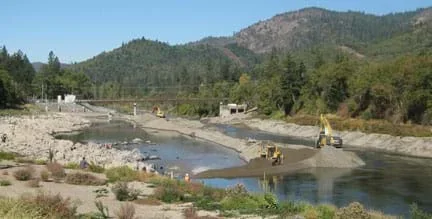 With half of the Savage Rapids Dam already removed, a bulldozer moves soil into the river's path (making a coffer dam) to direct all of the Rogue River flow towards the free-flowing side, so the rest of the concrete dam can be removed, creating clear upstream passage for spawning salmon in Josephine County, Oregon. October 9, 2009.Copyright 2009 Denise W. Carlson, ITL Program, College of Engineering, University of Colorado at Boulder.
In addition, dams are sometimes removed if they cause more harm than good. Many people, including environmentalists, fishermen and Native Americans, argue for the removal of specific dams to restore the natural flow of the river along with its aquatic ecosystem and fish populations. In the Pacific Northwest, dam removal to restore legendary salmon runs, is a contentious political and environmental issue that has resulted in the removal of many dams.
Dam failures are rare, but can cause immense damage and loss of life when they occur. Causes of dam failure include overtopping of a dam (by water spilling over the top of a dam); debris blockage of spillways; settlement of the dam crest; seepage due to eroded piping, animal burrowing and cracks; structural failure of the materials; and inadequate maintenance. Sometimes dam failures occur without much warning, such as from flash floods. Other times, failures and breeches develop over days and weeks, such as the accumulated effect of melting snow upriver or debris blockage. The dam and reservoir size makes a difference in the potential damage, too; some dams hold back immense reservoirs of water; others are relatively small.
Many dams built during the large dam-building era from 1930-70 have a projected lifespan of 50-100 years. After 50 years, the maintenance costs and chances of failure start to rise dramatically. So, due to inadequate maintenance or for environmental reasons, many of these dams will either fail or be removed in the next 50 years. Engineers are in charge of dam safety. They inspect existing dam structures and decide to remove dangerous or unnecessary dams. Due to the catastrophic nature of dam failure, dam safety and inspection is a vital task.
Dam removal is controversial but much has been learned in the last 20 years, including alternatives to damming rivers. Despite the benefits of restoring the natural river flow, dam removal also has consequences, such as the impact of destroying reservoirs, wetlands and recreational resources or impact on hydropower generation or irrigation supply that became established over the years because of the existence of dams. For more information, see the American Rivers website on Dam Removal FAQs: http://www.americanrivers.org/our-work/restoring-rivers/dams/background/faqs.html.
The process of removing a dam (or cleaning up from a failed dam) is unique for each dam, but generally it involves drawing down the reservoir or redirecting the water flow by using heavy earth-moving equipment and sometimes controlled explosives to reroute the water so the dam structural materials can be removed piece at a time, minimizing the downstream impact of releasing more water and sediment.
Do you think dams last forever? (Take a quick poll.) Why do some dams fall apart? Might the dams that we, Splash Engineering, are designing for Thirsty County fall apart? What if you do a really good job designing them, would they still fall apart? Eventually? (Conduct an informal brainstorming session, as described in the Assessment section.)
Can anyone think of any dams they have seen in our community? What about any dams you might have seen while on a trip? (Take suggestions from students. Mention local dams and well-known dams, such as Hoover Dam.) What were they made of? Do you remember if they looked like they were in good condition?
Let's brainstorm why some dams eventually fall apart while others last longer. A key element to understanding the lifespan of a dam is analyzing the forces that act on it. Remember (in Lesson 2) when Splash Engineering talked about the forces that act on their dams? Who can recall what some of those forces were? The main force acting on a dam is the water behind it, but wind and rain also apply forces to dams. Now imagine the impact of wind, sun and water on the materials of a dam over the course of 100 years. Can you think of any of your books, clothes, shoes or toys that started to look worn after only a few years? Imagine what they would look like after 50 or 100 years of being out in the weather, eroding under these forces!
What would happen if a dam just collapsed? (Take suggestions from students about the possible impacts from a powerful flood of water going downstream and the rapid loss of reservoir water upstream.)
Do you know, that to be safe, people inspect the condition of dams (just like they do for skyscrapers, bridges and other buildings) to see if they need any repair work and to schedule regular maintenance to keep them in good condition?
Have you ever heard of a dam being removed? From what we've just talked about, what might be some reasons why dams are removed? (Possible answers: If no longer safe or needed, or if restoring the ecosystem is now more important that the original purpose[s] of the dam.)
(Lead a class discussion. See additional lesson summary questions in the Assessment section.) Who can tell me about a dam they have seen? Or a dam they know about? (Take suggestions from students. This might include local as well as well-known dams from across the globe.) Why would a dam not last forever? (Answer: It might either fail or be removed.) Why might a dam fail? (Take suggestions from students. Possible answers: Physical deterioration of structural materials, breaks because of the forces acting on it, inadequate maintenance and operation.)
What are some of the forces acting on dams that cause them to age? (Possible answers: The force of the great amount of water [in the reservoir, upstream] held back by the dam. Erosion by sun, wind, water, drainage, seepage, and earth settlement. Natural events such as earthquakes, storms, heavy rains and flash flooding.)
Why might a dam be removed? (Possible answers: If it causes more harm than the benefits it provides. To restore a free-flowing river and natural conditions for the river and riparian ecosystems. To prevent loss of life and property damage if an unsafe, poorly-maintained or deteriorating dam structure might fail and cannot be repaired. If it is no longer needed for original purpose [irrigation, power generation, to create a reservoir].)
As the engineers with Splash Engineering, what would you advise Thirsty County to do once their dam is built? (Possible answers: Schedule regular inspections to examine the condition of the dam structure. Make sure to have funding to pay for ongoing maintenance and repairs. Alert the operators of the dam to keep an eye out for possible problems.)
- engineer
- A person who applies her/his understanding of science and mathematics to creating things for the benefit of humanity and our world.
- lifespan
- The length of time something, such as a dam, is expected to last.
- maintenance
- Any work needed to keep an object or a machine functional.
Pre-Lesson Assessment
Brainstorming: As a class, have students engage in open discussion. Remind them that in brainstorming, no idea or suggestion is "silly." All ideas should be respectfully heard. Take an uncritical position, encourage wild ideas and discourage criticism of ideas. Have students raise their hands to respond. Write their ideas on the board. Ask the students:
- Do dams last forever? (Answer: No, dams have a finite lifespan.)
- Why is it that dams don't last forever? (Answer: Eventually they break down.)
- Why do dams break down? (Answer: Natural forces act on objects (whether a dam, a building, or a tree) and eventually causes the object, or structure, to fail. These forces are "unbalanced" forces, because even though the object appears to be still, these forces acting on the object cause it to slowly move or change.)
- Why and how might these forces eventually break a dam? Let's brainstorm as a class to figure it out. (Possible answers: Dams do not last forever because sun, wind, seepage, earth settlement and other natural erosion forces slowly weaken the dam structure. If the strong materials that hold back the water behind dams are not kept in good repair, they become a danger because they might fail; so some dams are removed to prevent their imminent failure. Storms, earthquakes and overspills can cause dams to collapse and fall apart, releasing all the water in the reservoir. Sometimes the reservoirs above dams fill with sediment making a dam no longer necessary. Maybe the dam was poorly/inadequately designed and could not withstand the normal forces acting on it. Sometimes people find out that having a dam across a river causes severe problems for the ecosystem, like blocking the life cycle passage of migratory fish upstream to spawn [reproduce], and so they remove the dam to restore the natural unobstructed river route.)
Investigation: Now that students are thinking about natural forces acting on a structure, take them outside or ask them to look out the window towards other buildings, trees, bushes or a flagpole. Ask them to consider all the unbalanced forces that might be acting on those structures. Examples may include wind, rain, and sun. Explain to students that these unbalanced forces damage the structures, and over time, may break that structure.
Post-Introduction Assessment
Think/Pair/Share: Have students answer the following questions with a partner:
- Why might a dam be removed? (Answer: If the dam is structurally unsound or if it causes more environmental harm than societal good.)
- What might be some consequences of a dam failure? (Possible answers: Loss of life [due to resulting downstream flooding if not enough time for evacuation], loss of or damage to structures, property and recreation [due to flooding, impact to residences, campgrounds, rafting rapids], environmental damage, loss of the purpose of the dam [maybe it was community or irrigation water or hydropower supply].)
Lesson Summary Assessment
Discussion Questions: Ask the students and discuss as a class:
- What are some forces that act on a dam? (Answer: Natural erosion forces, the sun, wind, seepage, earth settlement, storms, earthquakes, overspills)
- Why do some dams fail? (Answer: Poorly designed, inadequate maintenance, erosion over time, exceptional storms, etc.)
- What keeps others from failing? (Answer: Good design and choice of materials suitable to the environment, proper maintenance and operation.)
- Who wants to remove dams? (Answer: People who want to remove unsafe dams that might break; people who want to restore natural ecosystems including environmentalists, conservationists and fishermen; people who want to take boats and watercraft through rivers blocked by dams.)
- Who wants to keep dams? (Answer: People benefiting from the hydropower or irrigation water they supply, people who like to use the resulting reservoir for lake-type recreational activities and have lake-front property.)
Split the class into two teams and stage a debate that might occur in Thirsty County in years to come, in which one side presents all the benefits of keeping the dam and the other presents all the benefits of removing the dam.
Investigate the many dams that have failed in the U.S. What are the consequences? What have we learned? Start by looking at these websites:
- Historic Dam Failures in the US, Association of State Dam Safety Officials, http://www.damsafety.org/news/?p=94bdfdd0-633a-4fa2-bc39-0083c58d14ba
- Examples of Recent Dam Failures and Their Implications, Cracking Dams (Intermediate Level), http://www.simscience.org/cracks/intermediate/failures.html
- List of Dam Failures, Dam Failures, Wikipedia-The Free Encyclopedia, http://en.wikipedia.org/w/index.php?title=Dam_failure&oldid=319455970
Investigate the many dams that have been removed in the U.S. Start by looking at Berkeley's Clearinghouse for Dam Removal Information (CDRI) at http://www.lib.berkeley.edu/WRCA/CDRI/
What are the long-term consequences of dam removal? How do the river, ecosystem and community respond and recover? Start investigating by looking at before/after photos and an article on the "10th Anniversary of the Removal of Edwards Dam: A Historic River Restoration Success," at the American Rivers website at: http://www.americanrivers.org/our-work/restoring-rivers/dams/projects/edwards-anniversary.html. Also see Chris Ladd's article, Dam It All, in the Good.Is Magazine at http://www.good.is/post/dam-it-all/.
Photographs of dam failures and incidents at the Association of State Dam Safety Officials website picture gallery: http://www.damsafety.org/resources/gallery.aspx?catId=51b232a6-ce39-4efd-a57b-30397962a3fa
Building Big: All About Dams. Public Broadcasting System Online. 2000-01. WGBH Educational Foundation, accessed October 14, 2009. http://www.pbs.org/wgbh/
Dam Failure. Last modified June 4, 2009. Federal Emergency Management Agency (FEMA), US Department of Homeland Security. Accessed October 14, 2009. http://www.fema.gov/
Dam Failure. Last updated October 12, 2009. Wikipedia, The Free Encyclopedia, www.wikipedia.org, accessed October 14, 2009.
Dam Removal: Frequently Asked Questions (FAQs). American Rivers. Accessed October 14, 2009. http://www.americanrivers.org/
Dam Safety 101: A National Concern. 2009. Association of State Dam Safety Officials. Accessed October 14, 2009. http://www.damsafety.org/
Edwards Dam and Kennebec Restoration. Natural Resources Council of Maine. Accessed October 14, 2009. http://www.nrcm.org/
Kagen, S. Cooperative Learning. San Juan Capistrano, CA: Kagan Cooperative Learning, 1994. (Source for Think-Pair-Share small group assessment tool.)
Ladd, Chris. Published July 23, 2009. Dam It All. Good.Is Magazine, http://www.good.is/post/dam-it-all/, accessed October 14, 2009. (Article on the state of dams, present and future, in the US, including failures, removals and river recovery.)
Nearly 800 Dams Already Removed across US. Posted November 26, 2008. The Society of Environmental Journalists, Jenkintown, PA. Accessed October 14, 2009. http://www.sej.org/publications/tipsheet/nearly-800-dams-already-removed-across-us
Stanley, Emily H, and Martin W. Doyle. Trading Off: The Ecological Effects of Dam Removal. (2003) Frontiers in Ecology and the Environment: Vol. 1, No. 1, pp. 15-22. Ecological Society of America.
Contributors
Jeff Lyng; Kristin Field; Denali Lander; Denise W. Carlson
Supporting Program
Integrated Teaching and Learning Program and Laboratory, College of Engineering, University of Colorado Boulder
Acknowledgements
The contents of this digital library curriculum were developed under a grant from the Fund for the Improvement of Postsecondary Education (FIPSE), U.S. Department of Education and National Science Foundation GK-12 grant no. 0338326. However, these contents do not necessarily represent the policies of the Department of Education or National Science Foundation, and you should not assume endorsement by the federal government.
Copyright
2008 by Regents of the University of Colorado.