
Sending Astronauts on a Mission to Mars!
 Students explore potential of manned missions to marsCopyright 2004 NASA http://grin.hq.nasa.gov/
Students are immersed in the details for a possible future mission to Mars. They learn about the human safety risks that are evaluated and addressed to minimize danger to astronauts. They examine a specialized launch schedule and the varied backgrounds and professions of the crew. Students find out about the crew's activities and living conditions once on the Martian surface, as well as how to make enough fuel to make it off the Red Planet to return home.
Engineers know that risks are always present in the exploration of space — just as in our daily lives. Are you at risk when you take an escalator, elevator, airplane, bus or amusement park ride? Are you safe when you use your washing machine, blender, drill, furnace or lawn mower? While some level of risk will always exist in our daily activities, safety engineers do their best to minimize risks through smart design and extensive testing transportation, appliances, equipment and products.
After this lesson, students should be able to:
- Explain the varied risks and environments of a planetary mission.
- Recognize the different professions of the crew.
- Describe advantages and disadvantages to planning missions to Mars.
- Explain how future missions to Mars may affect science and society.
- Describe methods and equipment used to explore the solar system and beyond
Grade 8
Do you agree with this alignment?
- Brainstorming is a group problem-solving design process in which each person in the group presents his or her ideas in an open forum.
Grades 6-8
Do you agree with this alignment? - STEL-3G Explain how knowledge gained from other content areas affects the development of technological products and systems.
Grades 6-8
Do you agree with this alignment?
Risk Assessment
Three levels of risks are associated with almost any mission or activity: low, intermediate and high. And, astronauts on planetary missions encounter three environments: active space, in-space, and planetary surface.
The active space environment is a high-risk environment that involves the energetic portions of the mission such as launch, orbital maneuvering, atmospheric entry and landing. The active space environment occurs on both Earth and Mars. The only fatal accidents from US and Russian spacecraft have occurred in the active space environment.
As the name suggests, the in-space environment occurs in space while astronauts are in transit from one planet to another. This environment poses an intermediate risk to astronauts, which comes from radiation exposure, consisting of galactic cosmic rays and solar particle events, and the zero gravity environment, which can harm the human body after prolonged amounts of time.
The planetary surface environment is the lowest-risk environment because Mars itself provides both gravity and protection from radiation. Though the gravity is equal to about 1/3 of the Earth's, it will help recover any zero gravity effects from the in-space environment. The Martian atmosphere and day/night cycle will drastically reduce the solar particle radiation while the planet itself will act as a shield against galactic cosmic rays.
It is important to note that the level of risk of an accident occurring in any environment is hard to quantify, but the probability is lessened by extensive astronaut training and equipment testing. Also, realistically, some level of risk will always be present — no matter how well planned or well executed a mission is. For example, the active space environment is inherent to the mission and cannot be avoided. Finally, with all the levels of risk evaluated, the safest mission with the most productivity occurs by reducing astronauts' time in transit and maximizing their time on Mars.
Launches
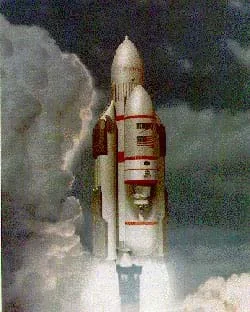 Figure 1. A shuttle is launched into space.Copyright NASA http://nssdc.gsfc.nasa.gov/planetary/mars/image/bigenerg.gif
One plan toward these missions to Mars includes the following: the crewed missions would involve six launches over two years. For example, three launches of cargo would be sent to Mars in a slow-transit trajectory in 2030 to provide safety and help extend the stay of the future crew. The cargo would consist of an Earth return vehicle (ERV), two nuclear power modules, a surface laboratory, a Mars ascent vehicle (MAV), a liquid oxygen/methane propellant production module, two utility trucks, tools, spare parts, a supply of liquid hydrogen, and more! Since the in-space environment does not affect cargo, a slow transit could be used to save money.
Before the next launches could happen in 2032, the previous cargo launches would have to be confirmed successful before a human crew would be sent to Mars. Once that success is affirmed, three more launches would occur. Two of the launches would be similar to the 2030 launches with a backup ERV, a second oxygen/methane propellant module, more liquid oxygen, and more scientific equipment. Finally, the third launch would include astronauts on a fast-transit trajectory.
The crew could consist of 6 or 7 expert individuals trained in several different disciplines, including: mechanical and electrical engineering; general medicine including surgery, psychology and biomedicine; geology, geophysics, paleontology and geochemistry; and biology, botany and ecology. However, every crew member would need to demonstrate skills in management, communications, computer science, and navigation.
On the Surface
During their 500+ day stay, the crew is responsible for trying to answer as many unknown questions about Mars as possible. This includes investigating the existence of life and water on Mars. They would conduct many previously planned experiments while staying in contact with a support team on Earth. The support team helps to evaluate their findings while aiding in instruction for future experiments. Students can use the associated activity Are We Alone? to conduct their own experiment in which they evaluate three soil samples and determine if any of the planet's soil samples contain life.
While on Mars, the crew would most likely spend most of its time in a habitat module and surface laboratory module (see Figure 2). A possible design is for both modules to have the same cylindrical design,7.5 meters in diameter with two sections, both 3 meters high. The modules are powered by the nuclear power modules, which would be placed 1 km away from the habitat module. For long surface explorations, pressurized rovers may be used for up to several weeks at a time. For shorter surface activity, up to 6 to 8 hours, unpressurized rovers could be used and extravehicular activity (EVA) suits would need to be worn.
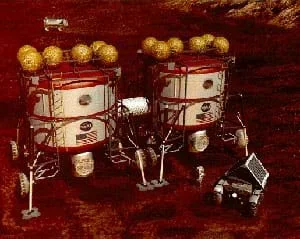 Figure 2. A habitat module joined to a surface laboratory module.Copyright NASA http://nssdc.gsfc.nasa.gov/planetary/mars/image/bighab.gif
Return to Earth
To get back to Earth, methane (CH4) and oxygen (O2) propellant must be made on the surface of Mars. Since the atmosphere of Mars is 95.3% carbon dioxide (CO2), the liquid hydrogen (H2) cargo can be used to produce methane and water (H2O) in the following reaction:
CO2 + 4H2 → CH4 + 2H2O
While the methane is stored for fuel, the H2O is further broken down into hydrogen and oxygen:
2H2O → 2H2 + O2
Now the oxygen is stored for fuel and the hydrogen in recycled back into the first process.
When enough propellant is made, approximately 26 metric tons, the mars ascent vehicle (MAV) could take off from the surface and go into orbit around Mars. While in orbit, the MAV would dock with the ERV, which by now has been orbiting around Mars for around four years. The ERV could be composed of a propulsive stage, transit module, and Earth entry capsule (EEC). To reduce cost and provide familiarity and safety, the transit module could have a design identical to the habitat and laboratory module. During the 180 day return trip, the crew would need to condition themselves for the 1 gravity environment back on Earth. Several days before arrival, the propulsion stage and transit module would be jettisoned and the crew would slightly alter their trajectory and reenter the Earth's atmosphere (much like the Mercury and Apollo missions).
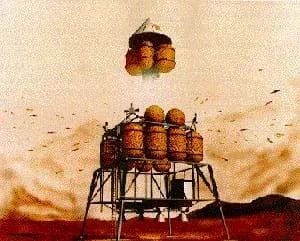 Figure 3.The Mars ascent vehicle launching off the surface of Mars.Copyright NASA http://nssdc.gsfc.nasa.gov/planetary/mars/image/bigascnt.gif
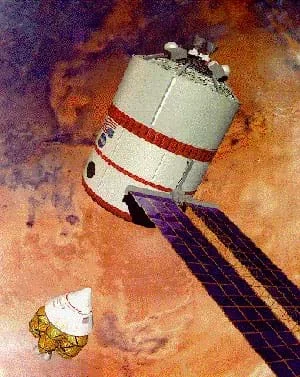 Figure 4. The Mars ascent vehicle as it prepares to dock with the Earth return vehicle.Copyright http://nssdc.gsfc.nasa.gov/planetary/mars/image/bighab.gif
NASA and other space agencies are working diligently to have astronauts go on missions to Mars by the 2030s. Traveling first to the moon allows for easier and more cost effective experimentation with launching larger and heavier spacecraft because the moon has low gravity and no atmosphere.
Risks are always present in the three environments of planetary missions: active space, in-space and planetary surface. The active space environment includes launches and landing; the in-space environment includes time spent in zero gravity; and the planetary surface environment includes any potential hazards on the surface after landing. Since cargo is not affected by the in-space environment, it is sent at a slow rate ahead of time to provide safety for the future crew. These environments are discussed in greater detail in the Lesson Background section.
The crew for future missions to Mars will consist of several people who are trained in a wide range of fields, including mechanical and electrical engineering, medicine, geo-science and bio-science. They will spend their time conducting experiments and helping us learn about the Mars environment. Most of these experiments will be planned before they leave Earth, and the materials will be sent to space ahead of them. The crew will also need to be resourceful; they must be able to make their own methane/oxygen propellant fuel on the surface of Mars in order to return to Earth.
Though it may seem a long time away, it is very likely that there will be a person on Mars in your lifetime! Maybe you could be the first person to walk on Mars! Just remember, if you do decide to go to Mars, it is a perilous two and a half year round-trip journey.
Is there anything risky about humans traveling to other planets? (Listen to student answers.) What are dangerous environments for humans on planetary missions? (Listen to student answers.) That's right, we evaluated the risks involved with the three planetary mission environments: active space, in-space and planetary surface. Which is the highest risk? The active space environment cannot be avoided and has the highest risk, whereas the in-space environment has an intermediate risk and the planetary surface environment has the lowest risk. Since cargo is not affected by the in-space environment, it is sent at a slow rate ahead of time to provide safety for the future crew.
What type of person would you want on your crew if you were going on a space mission? You'll want people from a range of backgrounds, including mechanical and electrical engineering, medicine, geology, and biology, along with skills in management, communications, computer science, and navigation.
Would you be worried about getting back to Earth? What have engineers planned as a way the crew can leave Mars and return to Earth? (Listen to student answers.) That's right, to get back to Earth, the crew must make their own fuel — a methane/oxygen propellant — while on the surface of Mars. How will they do this? They will use the liquid hydrogen cargo to convert the carbon dioxide atmosphere into methane and water. The water is then decomposed into oxygen and hydrogen, which can be reused. Once enough propellant is made, the Mars ascent vehicle (MAV) can launch from the surface into Martian orbit and dock with the orbiting Earth return vehicle (ERV). Are you ready to go?
- active space environment
- High-risk environment that involves energetic portions of the mission (such as launching and landing).
- in-space environment
- Intermediate-risk environment due to radiation and zero gravity.
- planetary surface environment
- Low-risk environment on the surface of Mars that offers protection against the in-space risks.
- erv
- The Earth return vehicle is planned to be sent to Mars ahead of time and orbit around the Red Planet with enough provisions to make it back to Earth.
- mav
- The Mars ascentvehicle will use a methane and oxygen propellant to launch from the surface into an orbit around Mars.
- eec
- The Earth entry capsule is used to reenter the Earth's atmosphere.
Pre-Lesson Assessment
Brainstorming: In small groups, have students engage in open discussion. Remind them that in brainstorming, no idea or suggestion is "silly." All ideas should be respectfully heard. Encourage wild ideas and discourage criticism of ideas. Ask the students:
- What makes a mission to Mars so difficult to accomplish? (As necessary, to get the brainstorm going, suggest one or two of the following considerations: the great distance Mars is from the Earth, the long time required to send an astronaut round-trip, the enormous cost of the mission, the amount of food, air, and supplies needed to survive, and having fuel to return to Earth.)
Post-Introduction Assessment
Question/Answer: Ask students the following questions and have them raise their hands to respond. Write their answers on the board
- Why is reinstating astronauts on moon missions beneficial to preparing to conduct future space exploration? (Answer: To make it easier and more cost effective to experiment with and learn about launching larger and heavier spacecraft.)
- How long would a round trip to Mars take? (Answer: About 2 ½ years.)
Lesson Summary Assessment
Risk Assessment: As a class, assess the risks associated with planetary missions. On the board, list the three environments and short definitions of a planetary mission. Make sure students understand the differences between the three.
- Active Space Environment – High-risk environment that involves energetic portions of the mission (such as launching, landing, atmospheric re-entry).
- In-Space Environment – Intermediate-risk environment due to radiation and zero gravity (such as health affects, etc).
- Planetary Surface Environment – Low-risk environment on the surface of Mars that offers protection against the in-space risks (such as different oxygen levels. protection for radiation, etc).
Next, as a class, brainstorm a list of what risks might be involved in each of the environments. From these lists, students will then come up with an assessment for the risks involved in space flight. Have them rank the risks in order of least harmful (1), to moderately harmful (3), to most harmful (5) for each environment, with 2 and 4 falling between their lower and higher ranking. For example, if there are 5 risks associated with active space environment and they are numbered 1-5, the sum of those risks rankings equals 15. However, if a flight only experiences risk 1 and 3 on their journey, then they have a flight sum score of 4. Their fight risk ratio is 4:15. Depending on their scale, a 4 might be considered a successful mission, while a 9 (for a different flight) might be considered a very unsuccessful mission. Let the students determine the magnitude of their scale. Students should come up with 3-4 flight missions that they name and then evaluate.
Class Debate: Split the class into two groups. Have one group argue for (agree with) the topic and one group argue against (disagree with) the topic. Give the groups a few minutes to come up with their arguments before the class debate or, time permitting, give them a night to research their arguments.
- Topic: Future missions to Mars will change society for the better. (Example arguments: students that are for the topic might discuss engineering and science advances; students against the topic might discuss the incredible financial expense to citizens.)
Numbered Heads: Break the class up into teams of three to five. Have the students on each team pick numbers (or number off) so each member has a different number. Ask the students a question (give them a time frame for solving it, if desired). The members of each team should work together to answer the question. Everyone on the team must know the answer. Call a number at random. Students with that number should raise their hands to give the answer. If not all the students with that number raise their hands, allow the teams to work a little longer. Ask the students:
- What are the three environments encountered in a planetary mission? (Answer: active space, in-space, planetary surface)
- Rank the environments from lowest to highest risk. (Answer: planetary surface, in-space, active space)
- Why is it safer to send cargo to Mars ahead of time? (Answer: So that you can check to make sure everything was received successfully before sending astronauts.)
- What kinds of astronauts will be on the first crew to land on Mars? (Answer: mechanical and electrical engineers, doctors, geo-scientists, bio-scientists)
- How will the propellant be made on the surface of Mars? (Answer: Astronauts will convert the atmosphere into methane and oxygen.)
For a new and exciting detailed plan of a possible mission to Mars, visit the following NASA site: https://www.nasa.gov/sites/default/files/atoms/files/moon-investments-prepare-us-for-mars.pdf
Compare that with previous plan of missions to Mars, at the following NASA site: https://nssdc.gsfc.nasa.gov/planetary/mars/mars_crew.html
Burbank, Sam and Trivedi, Bijal P. "At 'Mars on Earth,' Planning a Manned Mission," National Geographic News, December 9, 2003. http://news.nationalgeographic.com/news/2003/12/1209_031209_tvmarsonearth.html
CNN: Science and Space, "Bush unveils vision for moon and beyond," January 15, 2004. http://www.cnn.com/2004/TECH/space/01/14/bush.space/
Shaw, Malcolm J. "A Crewed Mission to Mars," NASA/Goddard Space Flight Center, November, 18, 2003. http://nssdc.gsfc.nasa.gov/planetary/mars/mars_crew.html
Contributors
Chris Yakacki; Geoffrey Hill; Daria Kotys-Schwartz; Malinda Schaefer Zarske; Janet Yowell
Supporting Program
Integrated Teaching and Learning Program, College of Engineering, University of Colorado Boulder
Acknowledgements
The contents of this digital library curriculum were developed under a grant from the Fund for the Improvement of Postsecondary Education (FIPSE), U.S. Department of Education and National Science Foundation GK-12 grant no. 0338326. However, these contents do not necessarily represent the policies of the Department of Education or National Science Foundation, and you should not assume endorsement by the federal government.
Copyright
2004 by Regents of the University of Colorado.