
Breaking Beams
Students learn about stress and strain by designing and building beams using polymer clay. They compete to find the best beam strength to beam weight ratio, and learn about the trade-offs engineers make when designing a structure.
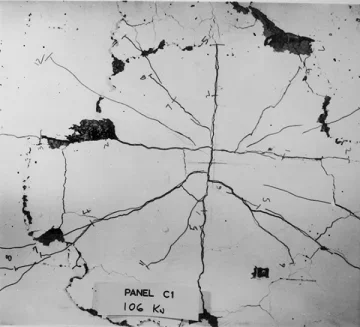 Cracks result when there is excessive stress placed on a beam causing the beam to essentially break.Copyright http://upload.wikimedia.org/wikipedia/en/2/2a/Bridge_deck_-_punching_failure_bottom_cracking.png
Engineers consider the forces of stress and strain in their choice of design and materials. Civil engineers often use a system of beams and columns in their structural design, to keep us safe in our homes and schools. Engineers specify the exact materials from which objects and structures should be made, so that walls support the weight of the roof, airplanes fly safely at high altitude, wheels do not fall off, chairs support the weight of people, bridges support the loads that travel them, shopping carts support groceries, and strollers support children, and so on.
After this activity, students should be able to:
- Recognize various engineered beam designs.
- Identify instances of elastic and plastic deformation.
- Describe the process of how engineers and scientists conduct materials testing to determine the ultimate tensile strength of a beam.
- Perform data collection and analysis (ranking).
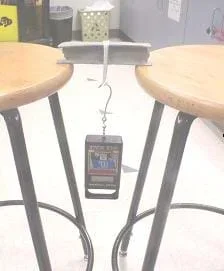 The activity setup to stress test student-designed beams.Copyright Chris Yakacki, Integrated Teaching and Learning Laboratory and Program, University of Colorado at Boulder, 2003.
- 6.1.2.b Fluently add, subtract, multiply, and divide multidigit decimals using standard algorithms for each operation.
Grade 6
Do you agree with this alignment? - 6.1.1 Quantities can be expressed and compared using ratios and rates.
Grade 6
Do you agree with this alignment?
- Predict and evaluate the movement of an object by examining the forces applied to it
Grade 8
Do you agree with this alignment? - Identify the distinguishing characteristics between a chemical and a physical change
Grade 8
Do you agree with this alignment?
- CCSS.Math.Content.7.RP.A.2 Recognize and represent proportional relationships between quantities.
Grade 7
Do you agree with this alignment?
- Buildings generally contain a variety of subsystems.
Grades 6-8
Do you agree with this alignment? - STEL-6D Engage in a research and development process to simulate how inventions and innovations have evolved through systematic tests and refinements.
Grades 6-8
Do you agree with this alignment?
- MS-ETS1-2 Evaluate competing design solutions using a systematic process to determine how well they meet the criteria and constraints of the problem.
Grades 6-8
This resource focuses on the following Three Dimensional Learning aspects of NGSS:
Science & Engineering Practices- Evaluate competing design solutions based on jointly developed and agreed-upon design criteria.Do you agree with this alignment?
Disciplinary Core Ideas- There are systematic processes for evaluating solutions with respect to how well they meet the criteria and constraints of a problem.Do you agree with this alignment?
Do you agree with this alignment? - Evaluate competing design solutions based on jointly developed and agreed-upon design criteria.
Each group needs:
- 2 oz of a polymer clay, available online
- string or rope (to wrap the around the beam several times, about 2 ft.)
- weights to hang on the string (up to 100 pounds for a 7-inch long beam.)
- scale to measure beam weight
Engineers use beams to support the weight of a structure. Beams hold up floors and walls, dams and bridges — in fact, almost every structure you can think of has beams in it. Beams are typically the horizontal support; columns or pillars are usually the vertical support. Since engineers use beams so much, they do a lot of work to figure out what the best kind of beam is for a given job. A solid rectangle support beam is a simple and effective design. However, the weight of a solid beam is tremendous! If we tried to construct buildings and bridges with these beams, their weight would be enormous and a lot of material and money would be wasted unnecessarily. So, engineers have come up with clever designs to reduce beam weight.
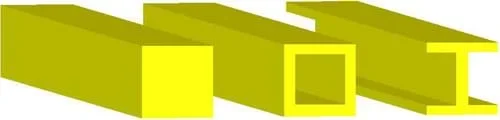 Three types of beams: solid, hollow and I-beam (left to right). The hollow and I-beam can support nearly as much load as the solid beam, but they are much lighter.Copyright Chris Yakacki, Integrated Teaching and Learning Program and Laboratory, University of Colorado at Boulder, 2003.The three types of beam designs shown in the drawing are all the same length, width and height. However, the hollow rectangle beam and the I-beam weigh less than half as much as the solid beam. Even though they weigh less, they can almost hold the same amount of weight as the solid beam! This means they have a much higher beam strength to beam weight ratio (written, beam strength : beam weight), and are more efficient and cost-effective to use in construction projects.
Why do the hollow beam and I-beam perform as well as the solid beam? Due to the principles of stress and strain, the greatest tensile and compressive stresses are realized on the tops and bottoms of beams while the neutral axis (middle of the beam) experiences no stresses. This allows engineers to take away material from the inside of the beam where the stresses are minimal. In this activity, you will design and build your own beam to find a good beam strength : beam weight ratio — you want to build a lightweight beam that can hold a lot of weight. As you make your design, think about the stress and strain on the beam; remember to keep material on the top and bottom surfaces where the stresses are the greatest!
Before the Activity
- Gather materials.
- Divide the 1.75 lbs of clay into 2-oz cubes (1¼ in cube size), resulting in 14 equal cubes.
- For the stress testing, make sure you have a place, such as between two level tables, desks or chairs, to rest the beams and add weights.
- If you want to cure the polymer clay with the students, preheat the oven to 130°C (275°F).
- Make two long, thin lengths of polymer clay for a demonstration. Cure one piece in the oven, but not the other piece.
With the Students
- Ask students to vote with a show of hands on the following question, "Do engineers construct buildings with solid beams or hollow beams?" Tally responses on the board. Tell them they will find out more about what engineers do in this activity.
- Explain the concepts of stress, strain and deformation introduced in this lesson. Use an uncured length of polymer clay to demonstrate plastic deformation by putting it across a gap and showing that it bends, but does not spring back to its original shape, after a weight is added to it and removed. Use the cured length of polymer clay to demonstrate elastic deformation by showing that the polymer clay returns to its original shape after the weight is removed. Challenge the students to design a beam that is very strong, but does not weigh very much.
- Divide the class into groups of two students each.
- Give each team a 2-oz cube of polymer clay with which to make their own beam. Not all 2 ounces must be used. Explain that using less clay may increase their strength : beam weight ratio.
- Have the students design a 7-inch long beam to span a 6-inch gap. Ask the "junior engineer" students to sketch their ideas for various beam designs before constructing the one they predict will have the best strength : beam weight ratio. The beams can be square, rectangular, circular, I-shaped, triangular or any other shape they think will be successful.
- During beam construction, suggest that students use a pencil point to help join any vertical clay slabs to any horizontal clay slabs (perpendicular surfaces) of a beam design, such as the example I-beam in the photograph. This reduces any gaps between the two surfaces, which would weaken the beam.
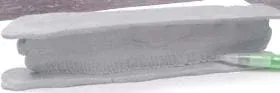 Use a pencil to join clay slab surfaces of a beam.Copyright Chris Yakacki, Integrated Teaching and Learning Program and Laboratory, University of Colorado at Boulder, 2003.
- Follow the directions on the packaging to cure the students' clay beams by baking them in an oven. This can be done at the end of day 1 or overnight, if desired. Typically, curing requires baking at 130°C (275°F) for 15 minutes for every ¼-in thickness. For example, a ½-in thick beam requires 30 minutes to cure.
- To complete the curing process, let the beams cool to room temperature.
- Weigh and record each team's beam design.
- To test the beam strengths, straddle each beam across a six-inch gap (such as between two level tables, desks or chairs).
- Tie several loops of string or rope around the beam, which helps to distribute the weight and provide a place to attach weights.
- Add weight until the beam breaks. Record the maximum amount of weight each beam held (= yield strength).
- Back at their desks, have the students calculate the strength : beam weight ratio, such as 12 oz / 2 oz = 6. Which beams had the highest strength : beam weight ratio? Are they the same three beams that held the most weight? Which beams would be preferred for construction purposes?
- Announce the winning team design as the beam with the highest strength : beam weight ratio. Have the winning team (and runner-up, if time allows) present their design concept to the rest of the class.
Pre-Activity Assessment
Voting: Ask students to vote on the following question with a show of hands. Tally the responses on the board.
- Do engineers construct buildings with solid beams or I- beams? (Answer: I-beams, because their strength : beam weight ratio is higher.)
Activity Embedded Assessment
Sketching: Have students sketch their ideas for various beam designs before constructing one they predict will have the best strength : beam weight ratio.
Calculation / Pairs Check: Have the student groups calculate their beam strength: beam weight ratio for their beam. Have them check their calculations with a neighbor, giving all students time to finish.
Post-Activity Assessment
Presentation: Have the winning team (and runner-up if time allows) present their design to the rest of the class. Ask them to explain why they think their design worked the best.
Informal Discussion: Solicit, integrate and summarize student responses.
- Ask the students to discuss why the beam strength : beam weight ratio is important to engineers.
- Ask the students to think of situations in which the different styles of beams made by the class groups might work better than others. (For example, if a team made a circular beam, it might work better as a vertical column support for holding up a bridge instead of a horizontal load support for cars going across a bridge.)
- Ask the students to come up with different types of materials for beams in different situations. (Example: Would you use concrete to make a beam in a playground toy? Why or why not?)
- The cured clay will be hot when it comes out of the oven.
- Do NOT bake clay in a microwave oven.
- Do NOT bake clay at a temperature higher than recommended on the package.
To avoid beams breaking before loading, make sure there are no cracks or gaps in the clay before curing.
Some brands of polymer clays are hard to manipulate because of their firmness. Firmer clays will also not bend/break as easily after baked. Sculpey and Fimo Soft brands work well.
Polymer clay does not actually completely harden until it has cooled.
If the clay is cured too long it will become brittle and break more easily. Follow the instructions for curing clay on the package of clay.
If unable to obtain large weights (up to 100 pounds for a 7-inch long beam), increase the required length of the beam and gap, which will lower the overall strength of the beams, so lighter weights will work just as effectively.
On their own, have the students research four different styles of beams and model them out of clay. Ask them to:
- Label the forces (stresses) acting on each beam.
- Label purposes for which each beam is commonly used.
- Label from what material the beam is usually made.
- Place their beams in order of beam strength : beam weight ratio. Ask them if this order makes sense in terms of the purpose for which the beam is usually used.
- For upper grades, have the students hypothesize at what point on the beam the most amount of stress and strain occurs. How can they prove this? Ask them to be creative and come up with a way to show where the stress and strain is occurring on the beam. (Note: The most compressive and tensile stress on a beam is on the top and bottom of the beam.)
Sculpey Clay:http://www.sculpey.com/
Contributors
Ben Heavner; Chris Yakacki; Malinda Schaefer Zarske; Denise Carlson
Supporting Program
Integrated Teaching and Learning Program, College of Engineering, University of Colorado Boulder
Acknowledgements
The contents of this digital library curriculum were developed under a grant from the Fund for the Improvement of Postsecondary Education (FIPSE), U.S. Department of Education, and National Science Foundation GK-12 grant no 0338326. However, these contents do not necessarily represent the policies of the Department of Education or National Science Foundation, and you should not assume endorsement by the federal government.
Copyright
2004 by Regents of the University of Colorado