
Team Up!
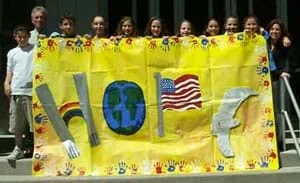 Crestmont Kids Hope Mural. After the 9/11 attack, Crestmont Kids met to discuss their concerns and feelings. Each wrote a letter to a child who was touched by the WTC attack. Then, the group created a mural of "Hope" to share at Comfort Zone Camp where children who lost their loved ones on 9/11 meet as a group.Copyright Image courtesy of Rachel Paulson, children's environmental author, http://www.earthmurals.org and http://www.usakidsauthor.com. Used with permission.
Students explore the physical and psychological effect of stress and tension on human beings. They develop their observing, thinking, writing and teamwork skills by working on a group art project and reporting about it. They learn about the stages of group formation, group dynamics and team member roles that make for effective teams. In the process, they discover how collective action can foster a sense of community support, which can alleviate personal feelings of stress and tension. Note: The literacy activities for the Mechanics unit are based on physical themes that have broad application to our experience in the world — concepts of rhythm, balance, spin, gravity, levity, inertia, momentum, friction, stress and tension.
Engineers often work on teams with people who bring specialized skills and experiences to the problem at hand. Even though working with a variety of people under time constraints can cause stress and tension among team members, it is balanced by the benefits of sharing tasks and the contributions of many talents and points-of-view. Professional engineers are skilled at keeping group dynamics issues constructive and focused towards building a strong, cooperative team that can collaborate to achieve a common goal.
After this activity, students should be able to:
- Apply skills in analysis, synthesis, evaluation and explanation to their writing and speaking.
- Make predictions, draw conclusions and analyze what they read, hear and view
- Learn about the stages of group formation, group dynamics, and team member roles that make for effective engineering teams
- STEL-3D Explain how various relationships can exist between technology and engineering and other content areas.
Grades 3-5
Do you agree with this alignment?
- Paper and pencils
- Access to the Internet
General familiarity with the mechanical concepts of stress and strain.
There is strength in numbers. People working on teams pool their skills to get the job done. Sometimes they discover skills they did not know they have. Engineers often work in teams to develop successful projects. Although artists tend to work alone, they frequently work with teams on large public art projects, such as sculptures or murals. Sometimes they work with engineers and architects.
This activity focuses on building teamwork skills. The type of team project is optional, but it should be creative and have significance. If the students build a tepee, they learn not only about construction principles, but also about Native American culture and paint the tepee with meaningful symbols. If they build a kinetic sculpture, they have fun while learning about movement, balance and beauty. If they construct an arch, they learn about architectural and engineering principles while developing a metaphor for teamwork itself, decorating the arch with designs or symbols. If they paint an Earth Mural (see the References section), they learn principles of design and projection while making a statement about the environment and community.
In the process, students become more aware of how teams work, knowledge they can carry forward through life to the many teams with whom they will work along the way.
Note: Just as Mechanics unit, Lessons 7 and 10 are linked, the literacy activities for the two lesson plans are linked and should be taught in sequence. Mechanics unit, Lessons 7 and 10 discuss the mechanical forces of stress, strain, compression and tension. The associated literacy activities discuss the physical and psychological effect of stress and tension on human beings. The Lesson 7 literacy activity focuses on teamwork and group action as a way of counteracting stress through strength in numbers; Lesson 10 literacy activity focuses on the individual.
The first step is to decide on a project, one large enough in scope to justify a team effort. The teacher can determine the project, or provide options and let the students vote. If the project is very large in scope, more than one class may want to work on it. Some projects may need to be coordinated with an art instructor or a teacher or parent who has construction experience. Cost factors will be a consideration. Building a full-sized tepee or kinetic sculpture is more expensive than a simple garden tepee or a mural, though potentially exciting and highly rewarding in terms of accomplishment and the opportunity to learn construction methods.
Depending on the project scope, the entire class may work as a team, or be divided into several smaller coordinating or competing teams. For a class-sized team, the teacher acts as team leader. If smaller teams are preferred, the teacher can choose and oversee team leaders, or allow the teams to choose leaders who act as liaisons.
Students are introduced to teambuilding concepts in the Observing and Thinking sections. The purpose is to make the students more conscious of the stages of group formation, as well as member roles, so they can anticipate and more easily overcome some of the typical challenges of working on a team. In the Writing section, the students assess the outcome of their project and reflect on their experience working as a team. All phases of the project, including project reporting, are group activities.
Observing
Your class will work as a team to complete a community art construction. Your first task is to decide the type of project that suits your interests and abilities. Here are some suggestions:
- Paint an Earth Mural.
- Build a tepee.
- Build a garden tepee.
- Construct a kinetic sculpture.
- Construct and race a kinetic sculpture.
- Build an arch.
If none of those projects gets you excited, use your imagination and come up with a bright idea of your own. Just keep in mind that you need to build or make something using principles of science, engineering and mathematics (number and measure). Your project should have a creative element as well as significance to the community (your school, city or other community of interest).
For background information, check out the following sources:
- Build an Arch: http://www.bbc.co.uk/history/british/launch_ani_build_arch.shtml and https://technologystudent.com/struct1/arch1.htm
- Build a TeePee: https://www.ehow.com/how_2071258_make-teepee.html and http://www.inquiry.net/outdoor/native/skills/teepee.htm
- Kids Guernica: http://kids-guernica.blogspot.com/
- Ned Kahn Studios: http://nedkahn.com/
To give members of your team a better chance of working well together, you will learn about the basics of group dynamics, such as how groups form and the roles people play on teams. Consider first what defines a team. A team is a group focused on a task or common purpose. A team generally forms for a period of time until it achieves its task and then disbands. A sports team may last through time with ongoing changes to its membership, or it may exist just for the span of time required to play the game.
Team Formation — Educational psychologist Bruce Tuckman observed how groups form. In the 1960s, he developed an influential model of the four stages of group development: Forming, Storming, Norming, Performing. In the 1970s he added a fifth stage, Adjourning. Professor Tuckman said that to be most effective, a group — which, for our purposes, we will refer to as a "team" — needs to go through all the stages:
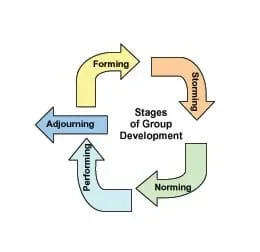 Stages of group development: Forming, storming, norming, performing and adjourning, according to educational psychologist Bruce Tuckman.Copyright Jane Evenson, literacy consultant, Integrated Teaching and Learning Program, College of Engineering, University of Colorado at Boulder, 2003.
- Stage 1: Forming — Team members are uncertain about the scope of their task and their responsibilities. They are dependent on the leader and busy with routines, such as who does what, when to meet, etc. Generally the team members avoid conflict at this stage. The leader directs.
- Stage 2: Storming — Conflicts emerge. Decisions do not come easily. There is a need to clarify roles and responsibilities. The leader coaches and mediates disputes.
- Stage 3: Norming — The scope of the task is now well-defined. Roles and responsibilities are clear. Having had their arguments, team members understand each other better and can appreciate each other's skills. They are more likely to listen to and support each other. The leader participates.
- Stage 4: Performing — Everyone knows and trusts each other enough to work independently. Roles and responsibilities shift easily according to need. Group morale is high and everyone is equally task-oriented and people-oriented. The energy of the group is fully focused on the task at hand. The leader delegates and stands aside.
- Stage 5: Adjourning — Team members feel good about their accomplishment and are glad to have been part of the group. This is a time for recognition so that individuals may consciously move on. Some members may feel a sense of loss as the team disbands.
Team Roles — Three main types of team roles include task roles, functional roles and maintenance roles. One person can play more than one type of role and some roles may need to be played by more than one person (sub-committee):
- Task Roles — These roles are directed toward the task itself. On this project, these roles could include finding volunteers, fundraising, obtaining materials, making calculations, determining a location, design, construction, painting, reporting, etc.
- Functional Roles — These roles help the team achieve its functional goals and can include researching, planning, information seeking, opinion seeking, progress monitoring, clarifying, pushing decisions, acting as spokesperson for the group, troubleshooting, etc.
- Maintenance Roles — These roles help strengthen the team emotionally and can include encouraging, mediating, setting standards, listening, volunteering for other roles as needed.
- Dysfunctional Roles — Unfortunately, team members sometimes take on roles that interfere with the smooth functioning of the group. Be on the watch for dysfunctional roles such as being overly aggressive, blocking or nit-picking, back stabbing, seeking sympathy, disruptive clowning or joking, blaming, taking all the credit, dominating, and manipulating.
Thinking
Team success often depends on whether the members have a common vision for the team. This includes a sense of the task at hand, and also an understanding of how the team itself works. The metaphors we use for teams affect how we view the roles of team members and the style of team leadership. Should the team be an hierarchy with a strong leader, or should it be more of a democracy with shared roles? Should it be like a sports team, a military squad, a community or a family? Those are common metaphors for teams.
If you view a team as a family, how might your expectations for how you will be treated as a team member differ from the way you would be treated if you viewed a team as a military squad? If some members picture their team battling competitors, how might that affect their behavior on the team? Would they be likely to conflict with team members who would prefer to see the team as an open and cooperative community? Many Americans like to think of teams in terms of sports metaphors of winning and losing. Do you think those types of metaphors are appropriate or inappropriate for the project you will be undertaking in this activity? Is your activity competitive? (It is if the team is building a kinetic sculpture to race.)
You might want to think of your team metaphorically in terms of the project. How is your team like an arch (we support each other, the keystone represents our achievement, etc.), a mural (we are a diverse group with many talents [colors] and we harmonize well), a kinetic sculpture (we work well together and move smoothly), a tepee (we are flexible but strong, a number of poles tied together)? Can you think of other metaphors that represent teamwork?
Writing
Write a report of your experiences working as a team. Briefly describe your project and then focus on what you learned about teamwork. Did your team go through Tuckman's stages of group development? Did you have a storming stage? How did you resolve your differences? How did you overcome obstacles? Which type of team metaphor best describes your team: Work team as sports team? Work team as military squad? Work team as community? Work team as family? Overall, did your team work well together? Did you consider your project a success? How did you handle adjourning your team?
- community
- A group of people who live, associate or communicate in the same area, and often share common ties, interests, goals and social rules.
- democracy
- Government by the people; the principles of social equality and respect for the individual within a community.
- facilitate
- To make easy or easier.
- group dynamics
- Understanding the relationships among people in groups and how groups begin, operate and end. (Source: LeadNet Library Database, Michigan State University Extension, http://web2.canr.msu.edu/leadnet/order/glossary.cfm)
- hierarchy
- A body of officials organized into successive ranks or grades with each level subordinate to the one above.
- interaction
- The process of acting on or with each other.
- kinetic
- Of, relating to, or produced by motion.
- mediate
- To settle a dispute between two or more parties; to bring about an agreement, a settlement or a compromise.
- metaphor
- A figure of speech in which a word or phrase that ordinarily designates one thing is used to designate another, thus making an implicit comparison, as in "a sea of troubles" or "All the world's a stage." (Shakespeare)
- mural
- A very large image, such as a painting or enlarged photograph, applied directly to a wall or ceiling.
- objective
- Something worked toward or striven for; a goal.
- teamwork
- Cooperative effort by the members of a group or team to achieve a common goal.
Pre-Activity Assessment
Call-Out Question or Vocabulary Quiz: Use call-out questions and a vocabulary quiz to reinforce basic concepts and vocabulary introduced during the Observing activity.
Activity Embedded Assessment
Call-Out Questions: Use call-out questions during the Thinking discussion to gauge students' understanding of the concepts.
Post-Activity Assessment
Written Report: The students' written report demonstrates their understanding of the concepts.
Discussion Questions: Ask the students, and discuss as a class.
- How are the physical forces of stress and strain similar and dissimilar to the physical and psychological stress and strain experienced by human beings? (Answer: Both are ultimately tests of strength, or how well something [or someone] will hold up under pressure. In the case of physical forces, a test of the strength of materials, structure or engineering design. In the case of people, a test of the strength of endurance, flexibility, teamwork, etc.)
- If an engineer was designing a bridge or the roof of your house, how would an understanding of the concepts of stress and strain apply to her/his work? (Possible answers: S/he would need to take into consideration the expected stresses and strains on the materials and structures [such as wind, rain or snow], and design a solution that is strong enough to be safe for a long period of time.)
- Describe examples of stress and strain in your own life. (Answers: Vary with students' experience.)
- How does good teamwork help alleviate stress and strain? (Possible answers: Strength in numbers [many people to complete a task within restraints as compared to one person doing it all], shared responsibilities, many ideas, many different talents, support of each other.)
- Students working on a construction project need to take the usual safety precautions, including wearing hardhats and goggles, as necessary. Mural painters need smocks, good ventilation and perhaps eye protection.
- A good preliminary discussion on teamwork should mitigate team conflicts.
- Plan on one 50-minute class to introduce concepts, and additional time for the group project.
- Since internet resources in the References list sometimes disappear, for more project examples, search the Internet using search terms such as: mural project, painting mural, kinetic sculpture projects/presentations, kinetic devices, etc.
Teams who are successful with one project may want to try another on their own time.
- The activity can be scaled through choice of project and degree of complexity, which can be adjusted. For example, the simplified version of a tepee or a garden tepee is not as complex as a Plains Indian-style tepee complete with smoke hole. A kinetic sculpture built to race on land and in water is more difficult to build than a standing sculpture. A mural can be small or large depending on the theme and project budget.
Annual Mini Kinetic Sculpture Races. Corvallis da Vinci Days, Oregon State University Extended Campus. Accessed March 8, 2005. (For all ages) http://www.davinci-days.org/
Art for Philadelphia Kids Program. Updated January 1, 2002. The Ogontz Avenue Art Project. http://www.dougweb.com/art.html Accessed May 21, 2004. (Great story about a community art initiative focused on kids)
Buckingham, Linda. Projection Art for Kids: Murals and Painting Projects for Kids of All Ages: Hartley & Marks, 2002. (Resources for mural painting)
Build an Arch. Greater Cincinnati Science Education Center. http://my.choice.net/~gcsec/labelbuildanarch.htm Accessed May 21, 2004.
Build a Medieval Arch Animation. BBC. Accessed May 21, 2004. http://www.bbc.co.uk/history/british/launch_ani_build_arch.shtml
Chapman, Alan. Bruce Tuckman's 1965 Forming Storming Norming Performing Team-Development Model. www.businessballs.com. Accessed May 21, 2004. (Educational psychologist observed how groups form. In the 1960s he developed an influential model of the four stages of group development: Forming, Storming, Norming, Performing. In the 1970s he added a fifth stage, Adjourning.) http://www.businessballs.com/tuckmanformingstormingnormingperforming.htm
A Child's Secret Garden: Grow a Backyard Hideaway. Parenthood.com. Accessed May 21, 2004. (Garden teepee) http://topics-az.parenthood.com/articles.html?article_id=2837
Dictionary.com. Lexico Publishing Group, LLC. Accessed May 15, 2004. (Source of vocabulary definitions, with some adaptation) http://www.dictionary.com
Earth Murals Project. Earth Murals. Accessed May 21, 2004. (The inspiration for this literacy activity. The Earth Murals project is a Global Kids environmental awareness project dedicated to involving children across the globe in the creation of murals that focus on community involvement, as well as taking care of our Earth. The project encourages youth participation in recycling, tree planting, community clean ups, and promotes literacy.)
From Windmills to Whirligigs. Science Museum of Minnesota. Accessed May 21, 2004. (Vollis Simpson's magical kinetic sculpture farm. Not to be missed!) http://www.sci.mus.mn.us/sln/vollis/index/frontvollis.html
Gibson, Cristina B. and Mary E. Zellmer-Bruhn. Metaphors and Meaning: An Intercultural Analysis of the Concept of Teamwork. Administrative Science Quarterly, June 2001. (Background for the Thinking activity) Accessed May 21, 2004. http://web.gsm.uci.edu/~cgibson/Publication%20files/Articles/Metaphors%20and%20Meaning.pdf
Group Dynamics: Basic Nature of Groups and How They Develop. The Management Assistance Program for Nonprofits. (Excellent site. Good overview of the stages of group development and resources for team building. Links to comprehensive material on related topics such as conflict management, group learning, negotiating, etc.) Accessed May 21, 2004. http://www.mapnp.org/library/grp_skll/theory/theory.htm#anchor387149
Hooker, Saralinda. The Art of Construction: Projects and Principles for Beginning Engineers and Architects: Third Edition. Chicago Review Press, 1990. (Award-winning book; good for introducing general principles of construction)
How to Build a Tepee. eHow.com. Accessed May 21, 2004. http://www.ehow.com/how_13450_build-tepee.html
Kid's Guernica, International Children's Peace Mural Exhibition. Panasonic. http://kids-guernica.blogspot.com/ Accessed November 7, 2005.
Kinetic Art. CARTAGE (Central Array of Relayed Transaction for the Advance of General Education). Accessed May 21, 2004. (Background information) http://www.cartage.org.lb/en/themes/Arts/scultpurePlastic/SculptureHistory/European20thCentury/ Constructivistsculpture/KineticArt/KineticArt.htm
Kinetic Sculpture by David C. Roy. Wood that Works. Accessed May 21, 2004. (Website of the brilliant kinetic sculptor, including animations of his works) http://www.woodthatworks.com/index.html
Kinetic Sculpture Racing Links. Updated September 6, 2004. Nifty Links by Ellin Beltz. Accessed November 30, 2004. http://ebeltz.net/niftylinks/ksrlinks.html
LeadNet. Michigan State University Extension. (Resources for community-centered, issue-focused, shared leadership for collective action) Accessed May 21, 2004. http://web2.canr.msu.edu/leadnet/home_page/homepage.htm
Malchiodi, Cathy A. Understanding Children's Drawings. Guilford Press, 1998.
Mobiles / Kinetic Sculpture, Mathew Brand. MIT Media Lab. Accessed May 21, 2004. (Interesting MIT project pitting an "artificial" sculptor [a computer] against a human sculptor) http://xenia.media.mit.edu/~brand/mobiles.html
Murphy, Jo. Mural Creation. Suite University. Accessed May 21, 2004. (Wealth of resources on mural creation) http://www.suite101.com/links.cfm/mural_creation
Ned Kahn Studios. Ned Kahn (artist), Sebastopol, CA. Accessed May 21, 2004. (Remarkably beautiful and mysterious works) http://nedkahn.com/
Paulson, Rachel. Johnny & the Old Oak Tree. Sparta, NJ: Crestmont Publishing, 1995. (Introduces children to lessons on how we have so much trash and landfills and how we can protect our land from being filled with garbage, told through the sweet story and adventure of a boy and his old oak tree. Includes lesson plans and teacher/parent ideas. A wonderful paper-making project using a coffee can and blender takes only minutes. See
Paulson, Rachel. Sir Johnny's Recycling Adventure. Sparta, NJ: Crestmont Publishing, 1999. (Children learn how paper is recycled and turned into new products. Includes practical hands-on recycling demos and ideas for educators. See
Plains Indian Teepee, from the book Wildwood Wisdom, Shelter Publications Online. Shelter Publications, Inc. Accessed July 27, 2004. (Includes a good teepee pattern) http://www.shelterpub.com/_shelter/www_teepee.html
Roman Arch Project. History for Kids. Accessed May 21, 2004. http://www.historyforkids.org/crafts/rome/arch.htm
Ryan, V. The Stone Arch Bridge. TechnologyStudent.com. Accessed May 21, 2004. http://www.technologystudent.com/struct1/arch1.htm
Seligman, Patricia. Painting Murals: Images, Ideas and Techniques. North Light Books, 1988.
Seton, Ernest Thompson. TeePee Plans 10'. Accessed March 8, 2005. http://www.inquiry.net/outdoor/native/skills/teepee.htm
Taufilis, Joanne and Fouad. The Art Miles Mural Project. Accessed September 12, 2006. http://www.the-art-miles-mural-project.org/
Tim Prentice Kinetic Sculpture. Tim Prentice. http://www.timprentice.com/ Accessed May 21, 2004. (Another renowned kinetic sculptor. Large public installations. Click on right for Flash animations of his amazing works. Don't miss his "Museum Talk.")
Contributors
Jane Evenson; Malinda Schaefer Zarske; Denise W. Carlson
Supporting Program
Integrated Teaching and Learning Program, College of Engineering, University of Colorado Boulder
Acknowledgements
The contents of this digital library curriculum were developed under a grant from the Fund for the Improvement of Postsecondary Education (FIPSE), U.S. Department of Education, and National Science Foundation GK-12 grant no 0338326. However, these contents do not necessarily represent the policies of the Department of Education or National Science Foundation, and you should not assume endorsement by the federal government.
Copyright
2004 by Regents of the University of Colorado.