
Strong as the Weakest Link
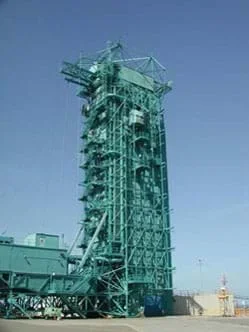 A rocket launching tower — an example of a structure that must withstand immense tension and compression forces.Copyright http://topex-www.jpl.nasa.gov/gallery/spacecraft/gifs/launch-tower-vandenberg.jpg, 2003
To introduce the two types of stress that materials undergo — compression and tension — students examine compressive and tensile forces and learn about bridges and skyscrapers. In the associated activity, they construct their own building structure using marshmallows and spaghetti to see which structure can hold the most weight. In an associated literacy activity, students explore the psychological concepts of stress and stress management, and complete a writing activity.
Engineers consider tension and compression forces when designing a building or structure for our everyday safety, comfort and convenience. Human-made structures include homes, skyscrapers, subways, bridges, tunnels and dams, as well as products such as pens, bungee jumping rope, washing machines, wheelchairs, moon rovers, prosthetic legs or bookshelves, to name a few. Engineers use complex mathematical models to predict the expected loads on these structures and products. They determine suitable material components to support the anticipated forces.
After this lesson, students should be able to:
- Recognize that compression and tension forces are important considerations in building structures.
- Relate that the design of the building will determine the weight the building can withstand.
- Explain how certain materials are good at resisting tensile forces while others are good at resisting compressive forces.
- Realize that buildings fail when engineers do not use designs and materials that are strong enough to resist compressive and tensile forces.
- Predict and evaluate the movement of an object by examining the forces applied to it
Grade 8
Do you agree with this alignment?
- Buildings generally contain a variety of subsystems.
Grades 6-8
Do you agree with this alignment?
- CCC.6.6-8.2 Structures can be designed to serve particular functions by taking into account properties of different materials, and how materials can be shaped and used.
Grades 6-8
Do you agree with this alignment? - DCI.PS2.A.6-8.2 The motion of an object is determined by the sum of the forces acting on it; if the total force on the object is not zero, its motion will change. The greater the mass of the object, the greater the force needed to achieve the same change in motion. For any given object, a larger force causes a larger change in motion.
Grades 6-8
Do you agree with this alignment?
Tension and Compression Forces
Two key types of forces involved in building any structure are tension and compression. Every material has the ability to hold up to a certain amount of tension and a certain amount of compression. A tension force is one that pulls materials apart. A compression force is one that squeezes material together. Some materials are better able to withstand compression, some are better able to resist tension, and others are good to use when both compression and tension are present. For example, if you pull on a strong rope, it can support a large amount of tension. If you push on a rope, it cannot resist compression very well, and just bends. Marshmallows are an example of a material that is easily compressible, but pulls apart under a great amount of tension. From these examples, it is clear that materials may bend or stretch when under a compressive or tensile force. Refer to the associated activity Leaning Tower of Pasta for students to illustrate these forces by building their own structures using spaghetti and marshmallows.
Bending Stress
When two people sit on a seesaw, is the metal bar between the two seats experiencing compressive or tensile stress? This is a trick question! A "bar in bending" experiences both compressive and tensile stresses! To visualize this, grab a paperback book and bend it down (see Figure 1). When you do this, the book materials "want" to return to their normal state of rest, so it feels like the top pages try to pull your fingers together because they are in tension and the bottom pages push your fingers apart because they are in compression. The bending book experiences compressive and tensile stress, just like a seesaw bar that is being bent!
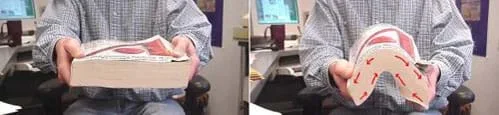 Figure 1. A demonstration using a phone book illustrates tensile and compressive stresses due to bending; the top pages stretch apart (tension) and the bottom pages push together (compression).Copyright Chris Yakacki, ITL Program and Laboratory, University of Colorado at Boulder, 2003.
With the bending book, the greatest tensile and compressive stresses occur on the outer covers; the direction of these forces can be seen with the red arrows in Figure 1. The neutral axis or layer runs along the middle of the book between the red arrows, as if it was the middle page in the book. Amazingly, this axis experiences zero stresses while bending! This has practical applications. For example, if you ever need to drill a hole in a support beam, like the ones along the ceiling in your basement, drill in the center of the beam where there are no stresses (see Figure 2).
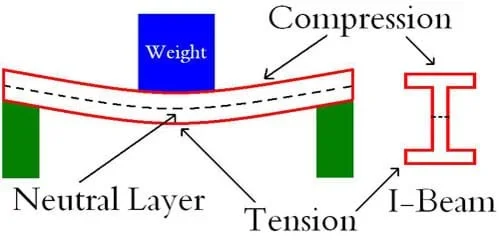 Figure 2. A diagram that shows the effect of a heavy weight placed on a beam. The beam experiences tension and compression. If the weight is too big, the beam will break!Copyright Chris Yakacki, ITL Program and Laboratory, University of Colorado at Boulder, 2004.
The diagram in Figure 2 shows the effect on the beam when a heavy weight is placed on it, causing both tension and compression in the beam. The weight causes compression on the top of the beam as it squeezes together, and causes tensile stress on the bottom side of the beam where it is pulled apart. The beam shortens on the top due to compression, and elongates on the bottom due to tension. With this in mind, what would happen if the beam had an even heavier weight placed on it? In this case, the forces would exert a greater amount of tension and compression on the beam, and if the forces were too great, the material would not be able to handle the stress and it would break in half.
Tension and compression forces are important to keep in mind when designing a building or structure. If we construct a bridge with materials that are not strong enough to hold up to the amount of compression and tension that vehicles cause when they travel across it, the bridge could collapse! All structures must be able to handle the forces that act upon them, or they would not stay up. A great deal of science, design and engineering goes into predicting the kinds of loads a structure might encounter (for example, wind, snow, weight of a bathtub full of water, etc.). For example, houses and bridges built in California must be designed to withstand earthquakes.
Materials and Size
Some materials snap when there is a load on them. These materials – such as ice – are brittle. Would you be able to safely walk across a river when it had just frozen over? Probably not, because the layer of ice is thin and would likely crack. Because ice is brittle, a thin layer would not be able to resist the compression and tension caused by your weight and movement. But what if you crossed the river once the ice had become half a meter thick? At this point, the ice is able to resist the tension and compression, even though it is still brittle. The strength of a structure is a function of both its materials and its size. These concepts of material properties and size are considered when building bridges for vehicles to travel over. For example, suspension bridges, such as the Golden Gate Bridge in San Francisco, use steel wire wrapped together to make it so strong that a diameter of just 1cm is strong enough to hold 8,000 kg of weight (two full grown elephants)!
Skyscrapers and Trees
Why do you think people design and build enormous, tall buildings? Skyscrapers make it possible to fit a lot of businesses on top of a very small area of land. Skyscrapers help economic growth and expansion because the significantly more industries and businesses can fit in each city. But are buildings that are 700-1,100 feet tall dangerous? Does the wind blow dangerously hard against them? Do they weigh a lot? Why don't skyscrapers tumble to the ground with all the force exerted upon them? Skyscrapers are designed to work like trees. Imagine a gigantic tree, like a redwood, that can grow to be more than 350 feet tall. What makes this huge tree stay standing for hundreds of years? It has roots! Tree roots are anchored deep into the ground, spreading out in a fan around the trunk, providing support and a solid foundation. As the wind blows the tree, it bends just like a beam with a weight on it. Like a beam, the tree trunk must also be able to hold up to a great deal of compression and tension.
Skyscrapers can stand up because they are designed with parts like a tree's roots and trunk. In skyscrapers, these parts are called the foundation and the frame. Before a skyscraper is built, a huge excavation takes place deep into the ground where the foundation is laid. For example, the 452 meter (1,483 feet, 88 stories) tall Petronas Towers in Kuala Lumpur, Malaysia, has a foundation that stretches 400 feet deep into the Earth! Steel frames throughout a skyscraper is an important component because steel can handle a great deal of both tension and compression (more than concrete, which is strong in compression, but weak in tension). The taller a building is, the more important it is to think about the forces, such as wind, that might push on it. Tall buildings can be pushed around a lot more by wind than shorter buildings can! Wind can exert a lot of force on a building, so buildings must be built strong enough to resist large forces. The earliest tall buildings were constructed with very thick exterior walls and few windows. Newer designs by engineers place a solid core through the middle of tall buildings to add strength. For example, in the interior core you often find restrooms, elevators and other heavy structures, which serve to add strength to tall buildings. With this design, engineers can use lighter-weight exterior walls and provide many more windows for the occupants.
Engineers use complex mathematical models to predict the loads on all sorts of structures. Understanding tension and compression is fundamental to predict how structures might stand up or fall down because of forces! Students can learn more about how engineers manage such complex tasks with the associated activity Stress, Inc. where they will discover how perception serves to fuel a multi-billion dollar industry dedicated to minimizing risk and relieving stress.
Look around you... what do you see? Structures, structures, everywhere! From the pen in your hand to the building you are in, you are surrounded by structures of all shapes and sizes. What would the world be like without structures? Structures include buildings, homes, bridges, tunnels, and dams — even plants and animals have structure! Engineers, architects and other professionals design the structures that are built for our everyday safety, comfort and convenience.
Over the years, people have built amazing cities and ingenious transportation pathways to travel between cities and continents. For example, the invention of tunnels means we no longer have to go around huge mountains — we can go directly through them! We build bridges to take us from one side of an enormous river to the other. The invention of dams has made it possible to store vast amounts of water to provide a constant supply to our homes, and lessen the chance of flooding.
Teams of architectural, civil and mechanical engineers have made these modern structures possible. Our everyday lives depend on the quality of the structures they design. We take our safety for granted, but what if a bridge crumbled while we were going across it? Or, what if we were on the 30th floor of a skyscraper and it became unsteady and crashed to the ground? What if it was the second story of our home that collapsed? Imagine traveling through a tunnel in a mountain when the roof collapsed? Life would be more risky without carefully designed and built structures.
Have the students discuss various building materials and make predictions on whether they are good materials to use for tension, compression or both. Ask the students to suggest examples of conditions that could cause stress on a structure? (Examples: weight, people, wind, water, earthquakes, snow, cars, etc.) Do different structures need to be designed to resist different kinds of loads? (Answer: Yes.) What are some examples of structures that are specially designed to resist certain kinds of forces? (Answer: Bridges for weight traveling over the structure, skyscrapers for forces applied to the sides of the structure like wind.) Why are engineers important with respect to creating structures? What roles do they play? (Answer: Engineers use complex mathematical models to predict the loads on all sorts of structures. They design structures while considering our day-to-day safety, comfort and convenience. Engineers can be involved in all parts of design, building and maintenance of a structure.)
- tension
- A force that pulls material apart.
- compression
- A force that squeezes material together.
- bending
- A combination of forces that causes one part of a material to be in compression and another part to be in tension.
- neutral axis
- An imaginary plane that runs through the middle of a material under bending, at which zero stress is experienced.
Pre-Lesson Assessment
Discussion Question: Solicit, integrate and summarize student responses.
- What happens to the material a table is made of when you put a book on it? (Answer: It bends a little bit.) What would happen if you put a really heavy weight on the table? (Answer: The table would break.) What happens to the material the road is made of when a car drives over a bridge? (Answer: It bends a little bit, too). What do you think engineers have to consider when they suggest which materials would be best for a certain structure? (Answers: The strength of the materials, the types of forces acting on the structure, etc.)
Post-Introduction Assessment
Voting: Ask a true/false question and have students vote by holding thumbs up for true and thumbs down for false. Count the votes and write the totals on the board. Give the right answer.
- True or False: Tunnels are an example of a structure. (Answer: True. Structures can be built underground as well as above ground.)
- True or False: Plants and animals have structure! (Answer: True. Structures include all buildings, homes, bridges, tunnels, dams, plants and animals.)
- True or False: Dams greatly increase the possibility of flooding. (Answer: False. Dams are structures designed to reduce the possibility of flooding.)
- True or False: Life would be more risky without carefully designed and built structures. (Answer: True. Structures that are not built with careful consideration of stresses and forces applied to them can break and possibly cause injury to people, animals or the environment.)
Lesson Summary Assessment
Team Design / Presentation: Working in teams, have the students select a structure that they have seen before, such as a specific building, tunnel, dam or bridge, and write it down on a piece of paper. Next, have them describe their structure with a sketch, labeling the materials used. Have them explain where tension and compression forces are impacting the structure; drawing arrows may help. Ask them to share some ideas of how their structure could be improved, for example, with respect to its shape or the materials used to build it. Lastly, have the student teams present their ideas to the class.
If the class has not completed the Breaking Beams activity in Mechanics Unit, Lesson 7, conduct it as an excellent extension activity for this compression and tension lesson. If the class has constructed and tested the Sculpey clay beams from that activity, have them discuss how the stress and strain from that activity related to compression and tension stress discussed in this lesson.
Class Design Thinking Challenge: Ask your students to think of things they use in their daily lives that have broken due to compressive and/or tensile stresses. You may receive some that are not applicable, so by the teacher's discretion, choose the best three or four and list them on the board or somewhere the class can see them. Then, challenge the students (in pairs) to think about why those objects couldn't bear the stress and to re-design the object (or design a new object that performs the same function) that will likely not break. Students can use the internet to explore alternative materials and structures.
Have students specifically address the following in a written report:
- What does this object need to be able to do?
- What was it about the original object that made it not strong enough? They may need to interview the person who provided the example.
- Provide a detailed description of your new design.
- How does your new design address the scientific concepts of compression and tension stress?
- Imagine you have built multiple prototypes of this new idea. Explain how you will undergo a scientific test to determine which prototype performs best.
Lead a discussion of the findings and have students turn in their report during the next class period.
Building Big, Wonders of the World, Golden Gate Bridge, February 2004: http://www.pbs.org/wgbh/buildingbig/wonder/structure/golden_gate.html
Macaulay, David. Building Big. Boston, MA: Houghton Mifflin Company, 2000.
Malloy, Betsy. Golden Gate Bridge Facts, California for Visitors. About, Inc., The New York Times Company. Accessed September 12, 2006. http://gocalifornia.about.com/cs/sanfrancisco/a/ggbridge_3.htm
Structures and Bridges, infoplease, February 2004, at: http://www.infoplease.com/ipa/A0001326.html.
- Forces: Stress and Strain
- Stressed and Strained
- Strong as the Weakest Link
Contributors
Chris Yakacki; Ben Heavner; Malinda Schaefer Zarske; Denise Carlson
Supporting Program
Integrated Teaching and Learning Program, College of Engineering, University of Colorado Boulder
Acknowledgements
The contents of this digital library curriculum were developed under a grant from the Fund for the Improvement of Postsecondary Education (FIPSE), U.S. Department of Education and National Science Foundation GK-12 grant no. 0338326. However, these contents do not necessarily represent the policies of the Department of Education or National Science Foundation, and you should not assume endorsement by the federal government.
Copyright
2004 by Regents of the University of Colorado.