
Leaning Tower of Pasta
Using spaghetti and marshmallows, students experiment with different structures to determine which ones are able to handle the greatest amount of load. Their experiments help them to further understand the effects that compression and tension forces have with respect to the strength of structures. Spaghetti cannot hold much tension or compression; therefore, it breaks very easily. Marshmallows handle compression well, but do not hold up to tension.
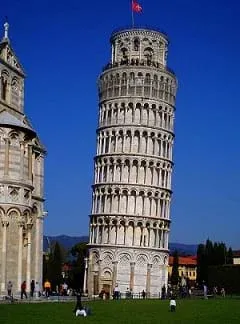 Students investigate compression and tension forces and examine their affect on the strength of structuresCopyright Wikimedia Commons http://upload.wikimedia.org/wikipedia/commons/3/33/A_Classical_View_of_Leaning_Tower_in_Pisa.jpg
Engineers consider tension and compression forces when designing a building or structure, and choosing the materials to build it. All structures must be able to handle the forces that act upon them so they will not fail and injure people, wildlife or the environment. Like all structures, the foundation, frame and joints of a skyscraper must be able to withstand enormous tension and compression forces — from the weight of its own materials, the load of people and equipment it holds and the impact of natural forces such as wind, snow and earthquakes.
After this activity, students should be able to:
- Describe how compression and tension affect the stability of a structure
- Compare their model to others to understand why some models are stronger than others
- Use number sense to correlate the strength of a structure to the amount of weight it holds
- Explain why engineers consider tension and compression forces when designing and choosing the appropriate materials for a building or structure
- 8.3.1.a Construct and interpret scatter plots for bivariate measurement data to investigate patterns of association between two quantities.
Grade 8
Do you agree with this alignment?
- Predict and evaluate the movement of an object by examining the forces applied to it
Grade 8
Do you agree with this alignment?
- CCSS.Math.Content.8.SP.A.1 Construct and interpret scatter plots for bivariate measurement data to investigate patterns of association between two quantities. Describe patterns such as clustering, outliers, positive or negative association, linear association, and nonlinear association.
Grade 8
Do you agree with this alignment?
- Students will develop an understanding of the attributes of design.
Grades K-12
Do you agree with this alignment? - Make two-dimensional and three-dimensional representations of the designed solution.
Grades 6-8
Do you agree with this alignment? - Structures rest on a foundation.
Grades 6-8
Do you agree with this alignment?
- MS-ETS1-1 Define the criteria and constraints of a design problem with sufficient precision to ensure a successful solution, taking into account relevant scientific principles and potential impacts on people and the natural environment that may limit possible solutions.
Grades 6-8
This resource focuses on the following Three Dimensional Learning aspects of NGSS:
Science & Engineering Practices- Define a design problem that can be solved through the development of an object, tool, process or system and includes multiple criteria and constraints, including scientific knowledge that may limit possible solutions.Do you agree with this alignment?
Disciplinary Core Ideas- The more precisely a design task's criteria and constraints can be defined, the more likely it is that the designed solution will be successful. Specification of constraints includes consideration of scientific principles and other relevant knowledge that is likely to limit possible solutions.Do you agree with this alignment?
Crosscutting Concepts- The uses of technologies and any limitations on their use are driven by individual or societal needs, desires, and values; by the findings of scientific research; and by differences in such factors as climate, natural resources, and economic conditions.Do you agree with this alignment?
- All human activity draws on natural resources and has both short and long-term consequences, positive as well as negative, for the health of people and the natural environment.Do you agree with this alignment?
Do you agree with this alignment? - Define a design problem that can be solved through the development of an object, tool, process or system and includes multiple criteria and constraints, including scientific knowledge that may limit possible solutions.
- MS-ETS1-2 Evaluate competing design solutions using a systematic process to determine how well they meet the criteria and constraints of the problem.
Grades 6-8
This resource focuses on the following Three Dimensional Learning aspects of NGSS:
Science & Engineering Practices- Evaluate competing design solutions based on jointly developed and agreed-upon design criteria.Do you agree with this alignment?
Disciplinary Core Ideas- There are systematic processes for evaluating solutions with respect to how well they meet the criteria and constraints of a problem.Do you agree with this alignment?
Do you agree with this alignment? - Evaluate competing design solutions based on jointly developed and agreed-upon design criteria.
Each group needs:
- 20 unbroken pieces of uncooked, long pasta, such as spaghetti, linguine or fettuccine
- 30 small marshmallows
- Measuring tape or ruler
- Weights or small books
Have you ever wondered how really tall buildings stay up? Why do skyscrapers not fall down when wind hits them? Engineers work with architects and scientists to understand what makes materials break, and then use what they learn to design strong structures. Today, you will have the opportunity to figure out how to make a strong structure, too. Sometimes, engineers may be able to find very strong materials, but they cannot use them in a structure because the materials are too expensive. Sometimes, engineers cannot use as much material as they might like due to budget or supply limitations. Just like an engineer, today you will be constrained; you can only use a limited amount of materials. Your job is to design and build a structure that is as tall and strong as possible, using only marshmallows and spaghetti.
As you build, think about what forces will be acting upon your structure. Which parts will be pushed together — that is, which will experience compression — and which parts will be pulled apart — that is, which will be under tension. Is it better to have a piece of spaghetti or a marshmallow under tension? Under compression? How will you design the tallest, strongest structure using limited resources?
Before the Activity
- Copy a Standing Strong Worksheet for each group.
With the Students
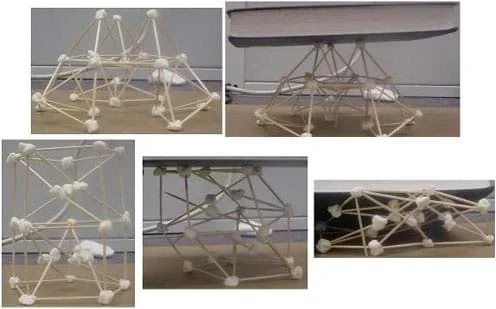 Figure 1. Some structures are strong.... and, some are not.Copyright Ben Heavner, ITL Program and Laboratory, University of Colorado at Boulder, 2004.
- The object of this activity is to build a tower as high AND as strong as you can using only a limited supply of spaghetti (or linguine or fettuccine) and marshmallows. There are no step-by-step instructions for this project, only the constraints of limited resources! Students can do whatever they want with the materials to try to build a structure as tall, stable and strong as possible. The project can be made more difficult by adding more constraints such as fewer materials, a minimum height requirement, or a requirement to support at least a minimum weight for a given time. Let the student teams' imagination, creativity and ingenuity run wild.
- Hold a competition and give points for how tall the structure is as well as how much weight it can hold. A good way to comparatively measure the effectiveness of each structure is by having students take the load the structure can support and divide it by the weight of the structure. The higher this number, the more effective the structure. For example, 30g (maximum weight structure could hold) divided by 10g (weight of structure alone) = 3.
- Before testing the structures (see Figure 1), have students measure and record the height and weight of their structure.
- How much weight does the structure support? Five grams? 10 grams? 20 grams? 30 grams? Have students record their structure's maximum weight held on the worksheet, and calculate the load to weight ratio for comparison purposes.
- As a class, graph the amount of weight each structure held vs. how much each structure weighed as well as the height of the structure. Discuss different trends and use the graph to lead into the other discussion questions.
- After the competition, hold a class discussion:
- Discuss which structure was the tallest and held the most weight. Which structures had the highest ratio of load to structure weight? Which structures held the most weight, regardless of height and the success or failure of the materials used. Spaghetti cannot hold much tension or compression; therefore, it breaks very easily. Marshmallows handle compression well, but do not hold up to tension, and why.
- Discuss the success or failure of the materials used.
- Which geometric shapes seemed the strongest for holding weight — triangles, squares, or circles?
Pre-Activity Assessment
Discussion Question: Solicit, integrate and summarize student responses.
- Have you ever built a tower? What did you use for the material(s)? How strong was it? How did you know it was/was not strong?
Activity Embedded Assessment
Worksheet: Have the students complete the activity worksheet; review their answers to gauge their mastery of the subject.
Pairs Check: After student teams finish their worksheets, have them compare answers with a peer group, giving all students time to finish the worksheet.
Post-Activity Assessment
Class Presentations: Have the student groups take turns presenting the structures to the rest of the class. Ask them to explain where the forces of tension and compression are taking place. Have the class determine which shapes seem to be the strongest for holding up weight.
Toss-a-Question: Using questions 1-7 on the Standing Strong Worksheet, have students work in groups and toss a ball (or wad of paper) back and forth. The student with the ball asks a question and then tosses the ball to someone to answer. If a student does not know the answer, they toss the ball onward until someone gets it. The person who gets the answer correct gets to start the next question. Review the answers at the end and have the students write down the correct answers on their worksheets.
The rigid, long pasta could injure an eye. Although this is an activity with a lot of freedom, students should not horseplay with the spaghetti.
Before students start construction, be sure they understand where you will add weight to their structure to test it. Knowing this should be a consideration in their structure design. For example, it is difficult to add weight to a tall, narrow tower.
Have the students build models using materials other than marshmallows and pasta, such as toothpicks, gumdrops, caramels, Popsicle sticks, etc. Which materials made even better buildings than spaghetti and marshmallows, and why? Have the students discuss these materials in terms of compression and tension.
Give each material a cost and give groups a budget (i.e. spaghetti noodle $0.10 and marshmallows $0.20 with a $10.00 budget). Let groups pick how much of each material they want with the given budget and create a structure.
Have the students design their own experiment to look at the geometry behind different structures. Which shape can hold the most weight — a triangle, square or circle? Challenge the students to explain their answers by creating diagrams showing the compression and tension forces on each shape.
Contributors
Chris Yakacki; Ben Heavner; Malinda Schaefer Zarske; Denise Carlson
Supporting Program
Integrated Teaching and Learning Program, College of Engineering, University of Colorado Boulder
Acknowledgements
The contents of this digital library curriculum were developed under a grant from the Fund for the Improvement of Postsecondary Education (FIPSE), U.S. Department of Education, and National Science Foundation GK-12 grant no 0338326. However, these contents do not necessarily represent the policies of the Department of Education or National Science Foundation, and you should not assume endorsement by the federal government.
Copyright
2004 by Regents of the University of Colorado.