
A New Angle on Photovoltaic Solar Panel Efficiency
Students examine how the orientation of a photovoltaic (PV) panel relative to the sun affects the efficiency of the panel. Using sunshine (or a lamp) and a small PV panel connected to a digital multimeter, students vary the angle of the solar panel, record the resulting current output on a worksheet, and plot their experimental results.
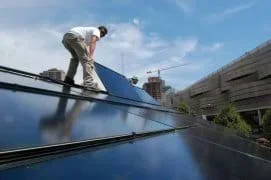 Installing a solar PV array as roof shingles.Copyright 2008 Sean Hauze. Used with permission.
Solar energy generation is becoming one of the most widespread solutions to address energy costs and global climate change. PV panels are used around the world for many applications because they are adaptive to so many buildings, sites and purposes. One of the largest factors in determining a PV panel's efficiency is the angle at which the solar radiation hits its surface. The ideal orientation of a solar panel varies, depending on the season and location on the planet. To design PV arrays with the highest efficiency (energy output) possible, engineers must understand how these factors affect the power output of solar panels.
After this activity, students should be able to:
- Explain how the angle of a PV panel relative to the sun affects the panel's power output.
- Describe some characteristics of a well-designed PV array, including direction and orientation.
- 5.4.2.b Represent real world and mathematical problems by graphing points in the first quadrant of the coordinate plane, and interpret coordinate values of points in the context of the situation.
Grade 5
Do you agree with this alignment? - HS.3.1.b.ii Represent data on two quantitative variables on a scatter plot, and describe how the variables are related.
Grades 9-12
Do you agree with this alignment?
- Use appropriate measurements, equations and graphs to gather, analyze, and interpret data on the quantity of energy in a system or an object
Grades 9-12
Do you agree with this alignment? - Evaluate the energy conversion efficiency of a variety of energy transformations
Grades 9-12
Do you agree with this alignment?
- Energy resources can be renewable or nonrenewable.
Grades 9-12
Do you agree with this alignment? - Power systems must have a source of energy, a process, and loads.
Grades 9-12
Do you agree with this alignment?
- HS-ETS1-2 Design a solution to a complex real-world problem by breaking it down into smaller, more manageable problems that can be solved through engineering.
Grades 9-12
This resource focuses on the following Three Dimensional Learning aspects of NGSS:
Science & Engineering Practices- Design a solution to a complex real-world problem, based on scientific knowledge, student-generated sources of evidence, prioritized criteria, and tradeoff considerations.Do you agree with this alignment?
Disciplinary Core Ideas- Criteria may need to be broken down into simpler ones that can be approached systematically, and decisions about the priority of certain criteria over others (trade-offs) may be needed.Do you agree with this alignment?
Do you agree with this alignment? - Design a solution to a complex real-world problem, based on scientific knowledge, student-generated sources of evidence, prioritized criteria, and tradeoff considerations.
Each group needs:
- mini PV panel ($10-30; available online; do a product search for "small solar panel" or see the Solar Panel Source Information attachment in the Photovoltaic Efficiency unit)
- multimeter ($10; available online; see the Solar Multimeter Source Information attachment in the Photovoltaic Efficiency unit)
- 2 wires with alligator clamps
- sunlight or 100-watt incandescent lamp ($8 from hardware store)
- 2 pieces of cardboard, each about the same size as the panel
- protractor (or use attached Protractor Printout (PDF); print and cut out; two per sheet)
- ruler or string (to help make accurate protractor measurements)
- Student Investigation Guide (PDF), one per team
- Investigation Worksheet (PDF), one per student
Note: The non-expendable items (mini PV panels, multimeters, wires with alligator clamps, lamp and light bulb) are reusable for the entire four-lesson unit, as well as other projects.
For the entire class to share:
- duct tape
Students should:
- Have a basic understanding of electrical circuits, including voltage, current and power.
- Know how to use a protractor to measure angles.
- Be able to record and plot data.
(Have a mini PV panel handy to show students and maneuver as you talk about its orientation.)
Photo means "light," and voltaic means "electric." A photovoltaic (PV) panel is a device that turns light into electrical energy. PV panels have been used on satellites and for power needs in remote areas for years, and are becoming more popular for providing energy to homes and buildings because they are more environmentally-friendly than conventional power solutions. You may have seen a solar panel on a home or know how they work already, but what if I gave you a PV panel to put on your own home and proposed that the person who could create the most energy over the course of the year would win $1,000! What would you do to ensure that your PV panel produced the most energy possible?
PV panels do not all make the same amount of energy when the sun shines on them. Even two identical solar panels might make completely different amounts of energy depending on some very simple differences in how they are installed. Would you like to know the secrets to designing a PV system so that it is as efficient as possible at converting sunlight to energy?
Okay, let's start with one of the most important factors that affects a PV panel's efficiency; this is also one of the easiest factors to control. Let's pretend that I gave you a PV panel for the competition, but because you are so busy with homework and studying, you decide to hire someone else to install the PV panel on your roof. When you come home from school you look up and you see that it is up-side down, so that the light-sensitive material is facing the roof. (Use a mini PV panel to show this orientation, and those that follow.) Do you think this set-up will win the competition of making the most energy possible? No! Okay, so that's an obvious error, but what if it was installed flat against your roof so that it had the same slope as the roof? Is that the best way to install it? Would it be better for it to lie horizontally and point straight up into the sky? Or, should it stand up on its edge, vertically? What is the best angle to install the PV panel so that you can generate the most energy possible over the course of the year? Engineers who design photovoltaic systems for buildings and other spaces must consider all of these questions when creating their designs.
While there is no contest or prize money for installing the world's most efficient solar panel, maximizing the energy output of each installed panel saves its owner the maximum amount of money over the lifetime of the PV panels (PV panels are costly). Let's do some experiments to see how the angle at which sunlight hits a PV panel affects its current output, which is directly related to its overall power output and efficiency.
Background
If you have a lamp with wattage other than 100 watts (100W), test to see how much current it creates in the panel. Or, use the sun and perform the experiment outside. Depending on the PV panel, you may need to change your multimeter setting to 10 amperes (10A) because the sun is stronger than a 100W lamp. This may also require that you move the positive (red) pin of the multimeter probes to the 10A connection for the experiment set-up (see Figure 1).
It is very important that during the experiment, the equipment set-up stays in the same location so that the measurements of current at different angles are not skewed. As necessary, use tape to secure everything in place.
Before the Activity
- Gather and organize materials.
- Test all PV panels and multimeters to make sure they are functioning correctly.
- Make copies of the Investigation Worksheet (PDF), one per student.
- Make copies of the Student Investigation Guide (PDF), one per team.
- Divide the class into groups of three students each.
With the Students — Experimental Set-up
- Take all materials outside, or if inside, secure the lamp to a desk or shelf.
- To support the solar panel during the experiments, tape two pieces of cardboard that are roughly the size of the panel to opposite sides of the solar panel to create an adjustable support triangle, as shown in the experimental set-up in Figure 1.
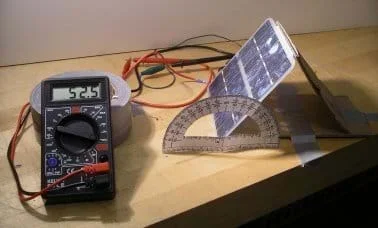 Figure 1: Solar angles experimental set-up.Copyright William Surles, ITL Program, College of Engineering, University of Colorado at Boulder
 - Connect the negative and positive pins on the multimeter to the corresponding wires on the PV panel (the red pin should be connected to the red wire).
- Turn the multimeter to the direct current amps (DCA) setting for 200m. Place the panel one to two feet from the lamp. (Tips: The reading on the multimeter should be positive; if it is not, the wires are backwards. If you see only a "1" on the screen, the panel is producing more current than the multimeter can read at that setting. In this case, back the panel away from the lamp a little or move the multimeter dial to a higher current setting.)
- Point the PV panel directly at the light/sun and tape its triangle base down to prevent movement during the experiment. (The panel angle remains adjustable using the other cardboard piece.) Also be sure the lamp is secured.
- Measure the zenith angle, θz, of the sun and record it on the worksheet. Do this by placing the protractor at the front edge of the panel. Use a ruler or string pointed at the light source to help increase your accuracy in reading the angle of the light source. (Optional: Place the light source so the zenith angle is equal to the latitude of your location.)
With the Students — Experiment 1: Vary the Collector Slope Beta, β
- Lay the panel completely flat. Measure the current and record it in the first spot on the worksheet (0º).
- Make sure that the protractor is centered at the front edge of the PV panel. (If the angle is measured with the protractor in an incorrect position, it skews the data.)
- Vary the slope of the PV collector in 10º increments and record the resulting current measurements on the worksheet. (Note: If you notice a higher current reading at an angle other than the zenith angle, it may be due to the reflectance of your table surface. Take this into account when answering worksheet questions.)
With the Students — Experiment 2: Vary the Azimuth Angle of the Panel, γ
- Set the panel to the optimal slope from Experiment 1 and secure the cardboard support triangle so the panel remains at this angle.
- Remove the tape from the base. Rotate the base slightly until the current is at its maximum. Record this as the 0º reading.
- Tape the protractor to the table at the front edge of the panel so that the center of the protractor lines up with the center of the panel. Rotate the base of the panel by 10º increments to the left or right, keeping the center of the panel at the center of the protractor. Record the resulting current measurements on the worksheet. (Be sure to rotate the panel about its center and not to slide it forward or backwards during the experiment.)
With the Students — Create a Plot and Interpret the Experiment Results
- Plot the data on the graphs provided on the worksheet.
- Answer the questions on the worksheet to demonstrate your understanding of the data.
With the Students — Activity Closure
- Lead a class discussion to review the experiment results and investigating questions.
- Assign students to complete the post-activity assessment (as described in the Assessment section), creating and presenting designs for small PV systems for their school using their observations to defend their choices for angle and orientation of the panels.
- array
- A group of solar panels connected to each other.
- efficiency
- The ratio of the useful energy delivered by a dynamic system to the energy supplied to it.
- solar radiation
- Energy emitted from the sun, including visible light, heat, UV rays, etc.
- zenith angle
- The angle between the line pointing to the sun and the vertical.
Pre-Activity Assessment
Class Discussion: Solicit, integrate and summarize student responses.
Let's think about how you would place a photovoltaic (PV) panel on a roof to get the maximum amount of energy output from it. Should the PV panel be installed flat against your roof so that it has the same slope as the roof, or would it be better for it to lie horizontally and point straight up into the sky? Or should it stand up on its edge, vertically? Would it matter if you installed it on a north-facing roof or south-facing roof? What is the best angle and orientation to install the PV panel so that you can make the most energy possible over the course of the year at your specific location? (General answers: More solar energy is available around noon because the sunlight is more direct [traveling through less atmosphere], thus it is best to face the panels due south. The best tilt angle depends on the location. Generally it is optimal to place the panel at the same angle as the latitude of the location, for example in Boulder CO, this would be 40º. But, depending on the climate, and when more sunlight is available, it may be a good idea to tilt the panel a little more or less to optimize the energy potential in the summer [25º] or winter [55º]. Basically, you need to know where the sun is throughout the year and when the most sunlight is available.)
Activity Embedded Assessment
Experimental Set-up and Worksheet: As teams follow the procedure described on the Student Investigation Guide (PDF), walk around and review each group's experimental set-up. Make sure that they are taking measurements and recording data correctly on the Investigation Worksheet (PDF).
Post-Activity Assessment
Worksheet Wrap-Up: Have students complete the graphs and investigating questions on their worksheets. As necessary, help them transfer their data to the plots and validate the data accuracy. Review and discuss the results and answers with the entire class. Review individual worksheets to gauge students' mastery of the subject.
Design It! Have students draw simple PV system designs for their school. Require the designs to be labeled with parts and angles. Have teams present their designs to the class with an engineering explanation of how they chose the angles and orientations of their systems.
- The PV panels are fragile so be careful when handling them. You may want to tape over the wire connections to be sure they are not pulled out of the back.
- 100W incandescent lamps can become extremely hot! Use caution when handling them.
If you are outside, you may need to use the 10A setting on the multimeter.
Make sure that the wire connections are tight. If you do not get a reading on the multimeter, look for a bad connection or loose alligator clamp.
Make sure that the conductive pieces, especially the ends of the wires or leads of both the PV panel and the multimeter, are not touching any other conductive materials, such as a metal table.
The panels do not work well under fluorescent lights due to their reduced light spectrum. When setting up the circuit, use direct sunlight or an incandescent lamp to test the circuit and panel.
Writing Practice: Have students draw PV system designs for another building or space, such as their homes or a community center. Require the designs to be labeled with parts and angles. Have students write about their PV systems as if they were part of an engineering company presenting a design to a client. Have them describe the building setting, how they chose the angle and orientation of the system, and the benefits of installing a PV system in that space.
- For lower grades, conduct this activity as a class demonstration.
- For lower grades, instead of using multimeters, connect the PV panels to small buzzers that change volume with different current values. Have students rotate the panel to different angles and observe the effect via the sound output. This way, rather than collecting data, students hear the varying volume of the buzzer in response to the changing solar panel angle to the light source. Buzzers are inexpensive ($4) and can be found at electronics and hardware stores such as RadioShack, or online at http://scientificsonline.com/.
- For upper grades, have students construct more durable and precise measurement equipment as a class project. Have them adjust the lamp angle (or panel height) to simulate the sun's angle during different hours of the day. Allow them to calculate the total amount of energy created during one day using a PV panel at different angles and the equation: power = current * voltage. Note: this requires students to also measure the voltage of the panel at each angle.
Contributors
William Surles; Jack Baum; Stephen Johnson; Abby Watrous; Eszter Horanyi; Malinda Schaefer Zarske
Supporting Program
Integrated Teaching and Learning Program, College of Engineering and Applied Science, University of Colorado Boulder
Acknowledgements
The contents of these digital library curricula were developed by the Integrated Teaching and Learning Program under National Science Foundation GK-12 grant no. 0338326. However, these contents do not necessarily represent the policies of the National Science Foundation, and you should not assume endorsement by the federal government.
Copyright
2009 by Regents of the University of Colorado.