
Concentrated Solar Power
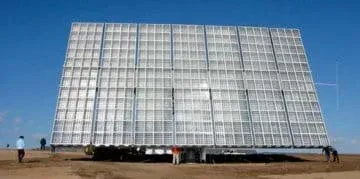 Figure 1. A solar concentrator with lenses.Copyright Solar Energy Development Program EIT, US Department of Energy http://solareis.anl.gov/guide/solar/pv/index.cfm
Students learn how the total solar irradiance hitting a photovoltaic (PV) panel can be increased through the use of a concentrating device, such as a reflector or lens. This is the final lesson in the Photovoltaic Efficiency unit and is intended to accompany a fun design project (see the associated Concentrating on the Sun with PVs activity) to wrap up the unit. However, it can be completed independently of the other unit lessons and activities.
Engineers create concentrated photovoltaic (CPV) systems that use lenses or reflectors to concentrate light onto PV panels to increase the amount of power each individual panel can produce, and reduce the number of panels needed to produce a certain amount of power. Because solar panels are significantly more expensive than reflectors, this is a cost-effective way to generate clean, renewable energy with a smaller number of panels and a lower cost, which allows solar energy to be used in more applications. CPV systems produce clean, renewable energy that benefits our environment and health.
After this lesson, students should be able to:
- Explain how solar concentrators improve the efficiency of solar PV panels.
- Explain how a simple planar reflector can increase the output of a photovoltaic panel.
- Explain why engineers want to maximize the power output of each individual PV panel.
- HS.1.2.a Reason quantitatively and use units to solve problems.
Grades 9-12
Do you agree with this alignment? - HS.1.2.a.i Use units as a way to understand problems and to guide the solution of multi-step problems.
Grades 9-12
Do you agree with this alignment?
- Use appropriate measurements, equations and graphs to gather, analyze, and interpret data on the quantity of energy in a system or an object
Grades 9-12
Do you agree with this alignment? - Evaluate the energy conversion efficiency of a variety of energy transformations
Grades 9-12
Do you agree with this alignment?
- Energy resources can be renewable or nonrenewable.
Grades 9-12
Do you agree with this alignment? - STEL-1R Develop a plan that incorporates knowledge from science, mathematics, and other disciplines to design or improve a technological product or system.
Grades 9-12
Do you agree with this alignment? - STEL-7DD Apply a broad range of making skills to their design process.
Grades 9-12
Do you agree with this alignment?
- HS-ESS3-4 Evaluate or refine a technological solution that reduces impacts of human activities on natural systems.
Grades 9-12
This resource focuses on the following Three Dimensional Learning aspects of NGSS:
Science & Engineering Practices- Design or refine a solution to a complex real-world problem, based on scientific knowledge, student-generated sources of evidence, prioritized criteria, and tradeoff considerations.Do you agree with this alignment?
Disciplinary Core Ideas- Scientists and engineers can make major contributions by developing technologies that produce less pollution and waste and that preclude ecosystem degradation.Do you agree with this alignment?
- When evaluating solutions it is important to take into account a range of constraints including cost, safety, reliability and aesthetics and to consider social, cultural and environmental impacts.Do you agree with this alignment?
Crosscutting Concepts- Engineers continuously modify these technological systems by applying scientific knowledge and engineering design practices to increase benefits while decreasing costs and risks.Do you agree with this alignment?
- Feedback (negative or positive) can stabilize or destabilize a system.Do you agree with this alignment?
Do you agree with this alignment? - Design or refine a solution to a complex real-world problem, based on scientific knowledge, student-generated sources of evidence, prioritized criteria, and tradeoff considerations.
- HS-PS3-3 Design, build, and refine a device that works within given constraints to convert one form of energy into another form of energy.
Grades 9-12
This resource focuses on the following Three Dimensional Learning aspects of NGSS:
Science & Engineering Practices- Design, evaluate, and/or refine a solution to a complex real-world problem, based on scientific knowledge, student-generated sources of evidence, prioritized criteria, and tradeoff considerations.Do you agree with this alignment?
Disciplinary Core Ideas- Criteria and constraints also include satisfying any requirements set by society, such as taking issues of risk mitigation into account, and they should be quantified to the extent possible and stated in such a way that one can tell if a given design meets them.Do you agree with this alignment?
- At the macroscopic scale, energy manifests itself in multiple ways, such as in motion, sound, light, and thermal energy.Do you agree with this alignment?
- Although energy cannot be destroyed, it can be converted to less useful forms—for example, to thermal energy in the surrounding environment.Do you agree with this alignment?
Crosscutting Concepts- Energy cannot be created or destroyed—it only moves between one place and another place, between objects and/or fields, or between systems.Do you agree with this alignment?
- Modern civilization depends on major technological systems. Engineers continuously modify these technological systems by applying scientific knowledge and engineering design practices to increase benefits while decreasing costs and risks.Do you agree with this alignment?
Do you agree with this alignment? - Design, evaluate, and/or refine a solution to a complex real-world problem, based on scientific knowledge, student-generated sources of evidence, prioritized criteria, and tradeoff considerations.
All the different types of concentrated PV systems (or CPV systems) work by directing additional light onto PV panels to increase their power output. Irradiance is power per unit area of solar radiation on a surface (that is, W/m2). Engineers measure total irradiance on a PV panel as the sum of both direct and reflected irradiance over the surface of the panel.
Some CPV systems focus on concentrating solar irradiance equal to only "a few suns," while others can concentrate irradiance equal to hundreds or even thousands of suns. With this high level of concentration, adequate cooling systems become important and complex tracking systems are required to optimize the system at all times, which adds to a system's cost. Concentrating the sun onto a very efficient solar cell is a great way to maximize the efficiency of a solar power system.
Figure 1 shows a CPV solar system that uses lenses to concentrate the sun onto solar cells behind it. Other systems use mirrors or curved metal reflectors to concentrate sunlight onto a panel. One of the most basic types of CPV systems involves a simple planar reflector placed next to the solar panel. The associated activity focuses on this type of CPV system because it is easy to build and test and conveys the fundamental solar concentration concepts.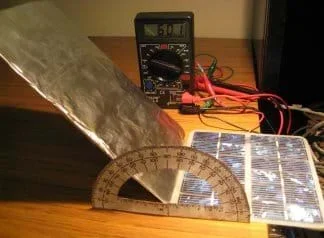 Figure 2. Example simple experimental set-up to measure the energy gain from using a simple planar reflector next to a solar panel.Copyright 2008 Abigail Watrous, ITL Program, College of Engineering. University of Colorado at Boulder
Figure 2 shows a simple CPV system in which a planar reflector is placed next to a solar panel to reflect additional irradiance onto the surface of the solar panel. This is a simple construction using cardboard and foil that serves as an educational device to test different design aspects of a solar reflector.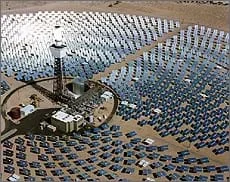 Figure 3. Example solar tower power plant that uses mirrors to concentrate solar power, in Daggett, CA.Copyright Sandia National Laboratories / PIX 00036 http://www1.eere.energy.gov/solar/printable_versions/csp_basics.html
The size of the reflector in relation to the collector and the angle between the collector and reflector are important factors that affect the efficiency of the system. If the panel is pointing directly at the light source, then the best angle to place the reflector is not 45º, but between 60º and 80º, depending on the reflector size. The goal of any reflector is to bounce all the light from the sun unto the panel, so the best angle varies, depending on the relationship between the size of the reflector and panel and the angle of the sun. Most systems that use reflection or concentration also track the sun so that the angle of the sun can be controlled to optimize the amount of light reflecting onto the panel. Typically this requires an external system that moves the panels and concentrator, but engineers are constantly creating new inventions, such as a solar panel that has small lenses that move within the panel so no external system is needed (see ZettaSun reference and prototype video).
Concentrated solar energy is becoming increasingly common for solar power plants. It is used to maximize the efficiency and minimize cost when using highly-efficient (and expensive) solar PV cells (see NREL reference), yet it is also used in other types of solar power plants besides PV. Figure 3 shows a solar tower surrounded by thousands of heliostats (mirrors that track the sun). In this solar power plant, a liquid is sent though the top of the tower, heated by the concentrated sun rays, and used to boil water to run a steam-powered turbine.
We have learned about ways to increase the efficiency of photovoltaic panels. Who can describe a factor that affects the efficiency of a PV panel? (Look for these answers from the students: 1. angle: a panel is the most efficient when it points directly at the sun; as it turns away, it is less efficient; 2. circuit resistance: a maximum power point exists for a specific condition [light level, temperature and orientation] of the panel and this can be found by changing the resistance in the circuit until the maximum power is achieved; 3. temperature: PV panels are more efficient when cold; they become less efficient as they heat up.)
Yes, that's right, the angle, circuit resistance and temperature all affect the efficiency of PV panels. But there is one more important factor and you won't believe you didn't think of it — it is simply the amount of solar radiation that a panel receives! Even if you have just the right angle, resistance and temperature, if the panel is blocked by something, say the shade of a tree or a cloud, it will not be as efficient as it would be in direct sunlight. Knowing this, and wanting to increase the efficiency of PV panels, how might we increase the amount of solar radiation a panel receives? (Take suggestions from the students.).
By using reflectors and concentrators, we can greatly increase the efficiency of a PV panel because they increase the amount of solar radiation that hits the panel, which makes it as if the panel is "seeing" multiple suns and thus increases the power output of the panel. Students can practice optimizing the power output of a PV panel while designing their own system in the Concentrating on the Sun with Photovoltaic Solar Panels activity.
While the ground reflects some solar radiation back onto the panel, the amount of reflectance is small, especially as most panels are pointing towards the sky; reflection from the ground does not have a significant effect on the power output of a panel. But by placing a more reflective surface at a specific angle to the panel, or a lens over the panel, a significant amount of additional light can be directed onto the panel. Concentrated PV systems (or CPV systems) are beneficial because they can reduce the cost of generating a certain amount of power and can be built to any size needed (see ObservatoryNANO reference).
Many engineers are working to improve the efficiency of solar power by using concentrated photovoltaic systems. These systems use lenses or reflectors to concentrate light onto PV panels to accomplish two key benefits. Can you describe them to me? (Answer: The lenses or reflectors concentrate light onto PV panels to: 1. increase the amount of power each individual panel can produce and 2. reduce the number of panels needed to produce a certain amount of power.)
These concentrated PV systems are used to create large-scale solar power plants as well as small rooftop solar arrays. Because solar panels are significantly more expensive than reflectors, this is a cost-effective way to generate clean, renewable energy using a smaller number of panels, which enables solar energy to be more affordable so it can be used in more applications.
- concentrated photovoltaic (cpv) system
- A system designed to concentrate sunlight onto a PV panel or series of panels in order to increase their power output.
- heliostat
- A device that tracks the sun's position in the sky.
- heliostat
- Power per unit area of solar energy hitting a surface.
- planar reflector
- A reflective panel used to reflect sunlight in order to increase the power output of a photovoltaic panel.
Pre-Lesson Assessment
Discussion Questions: Ask a few questions to get students to think about the upcoming lesson. After soliciting answers, explain that these questions will be answered during the lesson.
- Have you ever used a mirror or magnifying glass to make a bright spot on the ground? How did it work?
- Would a PV panel generate more power if more suns were shining on it?
Post-Introduction Assessment
Reading & Class Discussion: Have students read the attached Fundamentals Article (PDF), which contains content to cover in this lesson and associated activity. As they read, have each record on a sheet of paper 10 facts that they did not know before. Engage the class in a discussion of what they have read. Ask each student or student group to record on the board one new understanding that they learned from the reading.
Lesson Summary Assessment
Vocabulary Check: Ask students to write down their definitions of the four vocabulary words. Discuss their answers together as a class to ensure comprehension of subject matter content.
Work with students to find a local photovoltaic manufacturer, installer or research center. Invite an engineer from a photovoltaic design, research or installation company to visit the class and talk about their company, work or research experiences.
Have students research the installation and creative applications of photovoltaic systems in impoverished countries around the world. Start with the information available from TuffStuff Solar Panels (see "TuffStuff Photos captions) at http://www.toughstuffonline.com/
To learn about a solar panel design that has small lenses that move within the panel, show students a 1:19 minute Zettasun animation video on their prototype technology solar panel.
Best Research-Cell Efficiencies. Last revised November 7, 2007. ObservatoryNANO. Accessed March 3, 2010. (see reference in Introduction/Motivation section) http://www.observatorynano.eu/project/filesystem/images/2en.p04.jpg
Concentrating Photovoltaic Technology. Last updated July 25, 2008. Concentrating Solar Power Research, National Renewable Energy Laboratory (NREL). Accessed March 3, 2010. (see reference in Background section) http://www.nrel.gov/csp/concentrating_pv.html
Concentrating Solar Power Basics. Last updated September 16, 2008. Solar Energy Technologies Program, Energy Efficiency and Renewable Energy (EERE), US Department of Energy. Accessed March 3, 2010. http://www1.eere.energy.gov/solar/csp_program.html
"Interview with Sunrgi's founding partner Dr KRS Murthy." Published November 5, 2008. CPV Today (news, events and business intelligence for the CPV industry), FC Business Intelligence Limited, UK. Accessed March 3, 2010.
Rooftop solar panel prototype videos. Zettasun, Inc. Accessed July 13, 2010. (see reference in Background section) http://www.zettasun.com/zettasun/videos.html
Solar Photovoltaic Technologies. Solar Energy Guide, Utility-Scale Solar Energy. Solar Energy Development Programmatic EIS Information Center. Accessed March 3, 2010. http://solareis.anl.gov/guide/solar/pv/index.cfm
Contributors
William Surles; Abigail Watrous; Jack Baum; Stephen Johnson
Supporting Program
Integrated Teaching and Learning Program, College of Engineering and Applied Science, University of Colorado Boulder
Acknowledgements
The contents of these digital library curricula were developed by the Integrated Teaching and Learning Program under National Science Foundation GK-12 grant no. 0338326. However, these contents do not necessarily represent the policies of the National Science Foundation, and you should not assume endorsement by the federal government.
Copyright
2009 by Regents of the University of Colorado.