
Photovoltaics & Temperature: Ice, Ice, PV!
Students examine how the power output of a photovoltaic (PV) solar panel is affected by temperature changes. Using a 100-watt lamp and a small PV panel connected to a digital multimeter, teams vary the temperature of the panel and record the resulting voltage output. They plot the panel's power output and calculate the panel's temperature coefficient.
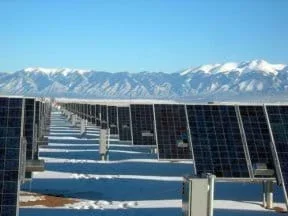 A solar power plant in the snow near Alamosa, CO.Copyright NREL http://www.nrel.gov/data/pix/Jpegs/15550.jpg
Photovoltaic power generation is becoming a cost-efficient method of electricity generation throughout the world. Many parameters affect the power output of a PV panel. To predict the power output of a PV system in different geographical locations and climates, engineers must understand how a PV panel responds to exposure in a range of different temperatures. Engineers have designed a variety of methods to effectively control the temperature of a solar panel to increase its efficiency, yet it often requires unique solutions for the many different environments and applications in which solar power is generated.
After this activity, students should be able to:
- Describe the effects of temperature on the efficiency of a PV system.
- Explain the temperature coefficient and how it is calculated.
- Explain the importance of understanding how PV panels react to different weather conditions when designing a solar power plant for a specific location.
- HS.2.4.c.i Solve linear equations and inequalities in one variable, including equations with coefficients represented by letters.
Grades 9-12
Do you agree with this alignment? - 8.3.1.a Construct and interpret scatter plots for bivariate measurement data to investigate patterns of association between two quantities.
Grade 8
Do you agree with this alignment?
- Use appropriate measurements, equations and graphs to gather, analyze, and interpret data on the quantity of energy in a system or an object
Grades 9-12
Do you agree with this alignment? - Evaluate the energy conversion efficiency of a variety of energy transformations
Grades 9-12
Do you agree with this alignment?
- CCSS.Math.Content.HSA-CED.A.4 Rearrange formulas to highlight a quantity of interest, using the same reasoning as in solving equations.
Grades 9-12
Do you agree with this alignment? - CCSS.Math.Content.HSF-LE.B.5 Interpret the parameters in a linear or exponential function in terms of a context.
Grades 9-12
Do you agree with this alignment?
- Energy resources can be renewable or nonrenewable.
Grades 9-12
Do you agree with this alignment? - Power systems must have a source of energy, a process, and loads.
Grades 9-12
Do you agree with this alignment?
- HS-ESS3-4 Evaluate or refine a technological solution that reduces impacts of human activities on natural systems.
Grades 9-12
This resource focuses on the following Three Dimensional Learning aspects of NGSS:
Science & Engineering Practices- Design or refine a solution to a complex real-world problem, based on scientific knowledge, student-generated sources of evidence, prioritized criteria, and tradeoff considerations.Do you agree with this alignment?
Disciplinary Core Ideas- Scientists and engineers can make major contributions by developing technologies that produce less pollution and waste and that preclude ecosystem degradation.Do you agree with this alignment?
- When evaluating solutions it is important to take into account a range of constraints including cost, safety, reliability and aesthetics and to consider social, cultural and environmental impacts.Do you agree with this alignment?
Crosscutting Concepts- Engineers continuously modify these technological systems by applying scientific knowledge and engineering design practices to increase benefits while decreasing costs and risks.Do you agree with this alignment?
- Feedback (negative or positive) can stabilize or destabilize a system.Do you agree with this alignment?
Do you agree with this alignment? - Design or refine a solution to a complex real-world problem, based on scientific knowledge, student-generated sources of evidence, prioritized criteria, and tradeoff considerations.
Each group needs:
- mini PV panel ($10-30; available online; do a product search for "small solar panel" or see the Solar Panel Source Information attachment in the Photovoltaic Efficiency unit)
- multimeter ($10; available online; see the Solar Multimeter Source Information attachment in the Photovoltaic Efficiency unit)
- 2 wires with alligator clips
- clamp or desk lamp with 100-watt incandescent bulb (~$8; best for each group to have their own, but teams can share if necessary)
- stop watch
- calculator
- Student Investigation Guide (PDF), one per group
- Investigation Worksheet (PDF), one per person
Note: The non-expendable items (mini PV panels, multimeters, wires with alligator clamps, lamp and light bulb) are reusable for the entire four-lesson unit, as well as other projects.
For the entire class to share:
- a bucket of ice water, large enough to submerge three-quarters of the PV panel
- a bucket of ice water, large enough to submerge three-quarters of the PV panel
- towel or paper towels
- (optional) thermometer, to measure the room temperature
A basic understanding of an electrical circuit, including voltage, current, power and resistance.
When designing a solar PV power plant, engineers determine the expected power output of the entire plant. To do this, they must take into account all the factors that affect the efficiency of the PV panels and electrical equipment over the life of the power plant. Let's explore some of those factors.
If engineers installed the exact same power plant in Las Vegas, NV, and Fargo, ND, do you think it would produce the exact same amount of power over the course of a year? (Answer: No) Would it produce more or less power and what are some of the factors that would influence the power generation of the PV plants?
Well, for starters the collector slopes would be different for each latitude. If not set correctly, the panels would lose efficiency because they would not be facing the optimal direction. Another factor is the weather. The weather in Fargo is extremely different than the weather in Las Vegas. Las Vegas is in a hot and sunny, desert climate while Fargo is covered in snow many months of the year. It is obvious that snowy and cloudy days result in the PV panels producing less power, but what about a sunny day in Fargo vs. a sunny day in Las Vegas? How do you think the ambient temperature (surrounding environmental temperature) of the air would affect the efficiency of the solar panels?
The temperature of a PV cell is directly influenced by both the ambient temperature and amount of solar radiation hitting the panel. The same PV panels installed in Fargo will be colder then the panels in Las Vegas, but is this a good or bad thing? Let's do an experiment to find out!
Before the Activity
- Gather materials and make copies of the Student Investigation Guide (PDF)(one per group) and Investigation Worksheet (PDF) (one per student).
- Practice setting up the experiment. Tip: It is best to set up the experiment far from a window to prevent errors due to additional incoming sunlight.
- Place a bucket of ice water at the front of the room.
- Measure and write the room temperature on the board.
- Write on the board the equations found in the associated lesson and on the worksheet.
- (optional) Write the symbols for AC (~) and DC (—) on the board and explain what they mean. (This information can be found in the multimeter manual or online.)
- Divide the class into groups of two or three students each.
- Show an example set-up of what will be done in the activity (see Figure 1).
With the Students
- Give each group an investigation guide and each student a worksheet.
- Direct students to gather each item on their materials list (in the guide).
- Have students set up the 100-watt lamp in a stable position at a desk or lab station. (It is critical that the lamp does not move during the experiment.) Position the lamp about 1 foot (31 cm) from the flat surface where the PV panel will be placed.
- Mark the exact placement of the top corner of the PV panel throughout the experiment. To do this, have students place two pieces of tape at a 90° angle from each other at a location where the PV panel will be positioned directly under the lamp.
- Have students assemble the experimental set-up following instructions on the guide (see Figure 1).
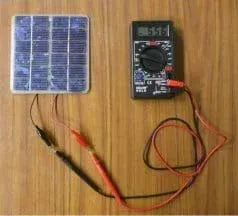 Figure 1. For the experimental set-up, attach the two multimeter leads to the two PV panel leads.Copyright 2009 William Surles, ITL Program, College of Engineering, University of Colorado at Boulder
 - Turn the multimeter to measure volts.
- Designate one person in each group to be the recorder for the first experiment.
- Have each group place its panel under the lamp, its corner lined up with the tape marks.
- Record and calculate the Ambient Conditions on page 1 of the worksheet:
- Measure and record the room temperature.
- Turn the lamp on, set the multimeter to read milliamps and record the current. (Make sure the leads are plugged into the correct sockets.)
- Switch the multimeter to voltage and have one team member read and record the voltage. (Make sure the multimeter is turned to the voltage setting; the leads may need to be switched, depending on the multimeter used.)
- Calculate the power by multiplying I x V, being sure to convert from milliamps to amps before using Equation 1.
- Remove the PV panel from under the lamp, being careful not to touch the lamp.
- Detach the leads from the panel and have one student bring it to the bucket of ice water. Make sure students leave the multimeter at their desks to avoid contact between electrical parts and water.
- Submerge the PV panel about three-quarters of the way into the bucket of ice water for one minute. Tips: Do not hold the panel by the wires. Do not hold the panel by the wires. Do not let the wires get wet! Hold the panel by its edges and not by its leads, because the leads will pull out!
- While the students are cooling the panels, ask them to predict what might happen to the voltage and current of the panels at a lower temperature, based on the equations on the board (and on the worksheet). Record their predictions on the board.
- After 1 minute in the ice water, have students remove the panel and quickly dry it with a towel. Return to the desk and quickly attach the leads of the (now cooler) PV panel to the multimeter.
- When the leads are in place and the multimeter is set to measure voltage (the 20V DCV setting), have students place the panel back under the lamp in the same position as before. Immediately record the voltage. Since a direct temperature measurement cannot be made of the panel, assume the first voltage value to be taken at 0°C.
- At 30-second intervals, record the voltage (power will be calculated later). Continue to do this for 15 minutes or until the voltage stops significantly changing. The voltage should increase as the panel warms up, with the rate being dependent on the light used and the ambient temperature.
- Calculate the power output of the panel at each of the time intervals. Graph power output vs. time.
- Have students complete the questions on their worksheets.
- Conclude with an informal discussion covering worksheet predictions and questions, as described in the Assessment section.
- ambient
- Surrounding environmental conditions.
- open circuit voltage
- Voltage available from a power source in an open circuit.
- photovoltaic cell
- A cell of silicone that produces a current when exposed to light.
- photovoltaic thermal (pvt)
- A system of pipes that run a fluid behind the PV panels to simultaneously cool the panels and heat the fluid.
- short circuit current
- Current drawn from a power source if no load is present in the circuit.
Pre-Activity Assessment
Prediction: Before beginning the activity, ask the students to predict:
- If engineers installed the exact same power plant that exists in Las Vegas, NV, in Fargo, ND, would it produce more or less power over a year? Record predictions on the board.
Class Discussion: Discuss as a class the engineering challenges to design a PV power plant. (Possible factors to consider: Optimal panel angle placement [unique at every latitude], climate and weather conditions [sunny days, cloud cover, snow cover, length of days, ambient temperature, etc.], PV panel material composition, etc.)
Activity Embedded Assessment
Worksheet: Have students record measurements and follow along with the activity on their Investigation Worksheets (PDF). After they have finished their worksheets, have them compare answers with their peers. Walk around the class as the students are conducting the investigations and be sure that they are recording correct values and using all equipment correctly. A quick comparison to other groups and the data in the Investigate Worksheet Answers (PDF) shows whether they understand the procedure and are collecting good data.
Post-Activity Assessment
Prediction Analysis: Have students compare their initial predictions with their test results, as recorded on the worksheets. Ask them to explain why their predictions were correct or incorrect.
Informal Discussion: Solicit, integrate and summarize student responses.
- (Question from worksheet) Explain what the temperature coefficient means and how it can be used to predict the power output of the panel at any temperature? (Answer: The temperature coefficient tells us how much the voltage changes for a 1º change in panel temperature. Knowing this, we can calculate the voltage output of the panel at any temperature.)
- What would an engineer need to consider when designing an array of solar panels in your area? (Answer: Weather conditions such as cloud cover, length of days, and temperature; shading from trees or nearby buildings; the amount of energy used by the building, school or home, and when it will be used.)
- Engineers can design ways to improve the efficiency of solar panels that must operate in non-optimal temperature conditions, including cooling systems that use outside air, fans and pumps. How might this affect the cost of the solar panel? (Answers should consider increased costs for complex technologies or fewer costs for more passive approaches that require no added power. See Lesson Background for Teachers in the associated lesson.)
- Be aware that 100-watt lamps get hot!
- If using a thermometer, give a brief safety talk; thermometers are very delicate and if broken, can be dangerously sharp.
- Keep ice water away from all electrical equipment.
The wire connections are very important. Make sure the connections are tight throughout. If you do not get a reading on the multimeter, look for a bad connection or alligator clamp somewhere in the circuit.
Be sure that the conductive pieces, especially the ends of the leads of both the PV panel and the multimeter, are not touching any other conductive materials, such as a metal table.
Be sure you understand how to use the multimeters, take measurements in the correct setting, and convert the units as necessary (for example, 78.9 mA read from the multimeter equals .0789 A).
Design for Cooling Panels: Have students conceptually design creative ways to keep the solar panels in a power plant cool. Choose a hot location, such as a Nevada desert, and ask students to consider the real weather conditions for this site in their design. Have students draw their designs on paper or computer, and arrange for them to present and/or discuss their designs with the class.
- For lower grades, set up a demonstration of the activity, asking students to guess the voltage before and after placing the panel in ice water. Or, place a panel under the lamp for a few minutes and have them guess what the voltage will be after it heats up.
- For upper grades, have students look up the temperature coefficients of different PV panels on manufacturer specification sheets. Also have them look up the range of temperature coefficients for different types of PV materials and draw a graph comparing the different materials.
Contributors
William Surles; Jack Baum; Abby Watrous; Stephen Johnson; Eszter Horanyi; Malinda Schaefer Zarske
Supporting Program
Integrated Teaching and Learning Program, College of Engineering and Applied Science, University of Colorado Boulder
Acknowledgements
The contents of these digital library curricula were developed by the Integrated Teaching and Learning Program under National Science Foundation GK-12 grant no. 0338326. However, these contents do not necessarily represent the policies of the National Science Foundation, and you should not assume endorsement by the federal government.
Copyright
2009 by Regents of the University of Colorado.