
Solar Angles and Tracking Systems
Students learn about the daily and annual cycles of solar angles used in power calculations to maximize photovoltaic power generation. They gain an overview of solar tracking systems that improve PV panel efficiency by following the sun through the sky.
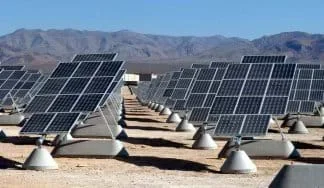 Figure 1. The solar power array at Nellis Air Force Base (NV) uses tracking devices to keep the solar panels pointed toward the sun. Tilted toward the south, each set of solar panels rotates around a central bar to track the sun from east to west.Copyright Nellis Air Force Base, US Department of Energy http://apps1.eere.energy.gov/news/news_detail.cfm/news_id=11486
With PV solar power becoming popular in many different applications, more engineers are needed who understand how to maximize a PV panel's power output so they can design PV arrays that create as much clean energy as possible from this technology. The optimal design of a PV array depends on the location and position of the panels, so engineers must understand the basics of solar angles to design the most-efficient systems.
After this lesson, students should be able to:
- Describe how the sun moves in the sky throughout the day and during the course of a year.
- Explain the efficiency advantages of solar tracking systems.
- HS.2.4.c.i Solve linear equations and inequalities in one variable, including equations with coefficients represented by letters.
Grades 9-12
Do you agree with this alignment? - HS.4.2 Concepts of similarity are foundational to geometry and its applications.
Grades 9-12
Do you agree with this alignment?
- Use appropriate measurements, equations and graphs to gather, analyze, and interpret data on the quantity of energy in a system or an object
Grades 9-12
Do you agree with this alignment? - Evaluate the energy conversion efficiency of a variety of energy transformations
Grades 9-12
Do you agree with this alignment?
- Energy resources can be renewable or nonrenewable.
Grades 9-12
Do you agree with this alignment? - Power systems must have a source of energy, a process, and loads.
Grades 9-12
Do you agree with this alignment?
- HS-ESS3-4 Evaluate or refine a technological solution that reduces impacts of human activities on natural systems.
Grades 9-12
This resource focuses on the following Three Dimensional Learning aspects of NGSS:
Science & Engineering Practices- Design or refine a solution to a complex real-world problem, based on scientific knowledge, student-generated sources of evidence, prioritized criteria, and tradeoff considerations.Do you agree with this alignment?
Disciplinary Core Ideas- Scientists and engineers can make major contributions by developing technologies that produce less pollution and waste and that preclude ecosystem degradation.Do you agree with this alignment?
- When evaluating solutions it is important to take into account a range of constraints including cost, safety, reliability and aesthetics and to consider social, cultural and environmental impacts.Do you agree with this alignment?
Crosscutting Concepts- Engineers continuously modify these technological systems by applying scientific knowledge and engineering design practices to increase benefits while decreasing costs and risks.Do you agree with this alignment?
- Feedback (negative or positive) can stabilize or destabilize a system.Do you agree with this alignment?
Do you agree with this alignment? - Design or refine a solution to a complex real-world problem, based on scientific knowledge, student-generated sources of evidence, prioritized criteria, and tradeoff considerations.
Using Solar Angles to Predict the Sun's Location
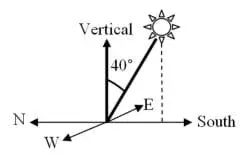 Figure 2: The angle of the position of the sun in Boulder, CO, on the equinox. The latitude in Boulder is 40°.Copyright ITL Program, College of Engineering, University of Colorado at Boulder
On one day every year, called the equinox, the sun is positioned directly above our planet's equator. On this day, the angle between a line that points to the sun and a line that points straight up (vertical) exactly matches the latitude of the place you are standing. If you live on the equator, then in the very middle of the day (solar noon) the sun will be directly above you, or at 0º from the vertical. If you live in Boulder, CO, which is in the northern hemisphere at the latitude of 40º, then on the equinox the sun will be 40º to the south from the vertical (see Figure 2). The sun's position on the equinox is the average location of the sun throughout the year and is a great reference to use when designing a solar system for a specific location.
But keep in mind, the sun is always moving. In the summer, the sun appears higher in the sky, which increases the duration of sunlight seen in a day, and in the winter it appears lower, which decreases the length of sunlight in a day. The sun is highest in the sky on the summer solstice. To be more exact, it is 23.45º higher than on the equinox, or at 40 - 23.45 = 16.55º to the south of vertical.
The winter solstice is the day when the sun appears lowest in the sky. On this day, the sun is 23.45º lower than on the equinox, or at 40 + 23.45 = 63.45º to the south of vertical in Boulder. So, if you live in the northern hemisphere at latitude higher than 23.45º, then the sun will never shine from the north at solar noon. In general, people with homes located in the northern hemisphere – especially those above latitudes of 23.45º – should not place solar panels (or gardens) on the north sides of their homes.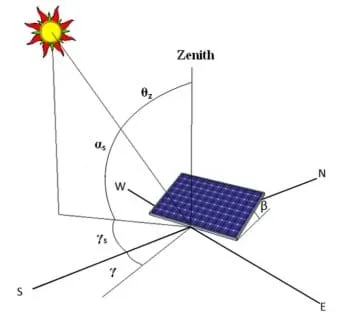 Figure 3: Solar angles used in power calculations for PV panels.Copyright William Surles, ITL Program, College of Engineering, University of Colorado at Boulder
Summary of Solar Angles
Below is an overview of the angles involved in calculating the amount of solar radiation that a PV panel receives at any given time (also see Figure 3). The angle at which the sun hits a PV panel is the basis for understanding how to design the most efficient PV array for a specific location. This is one of the first topics presented in solar engineering textbooks.
Zenith Angle, Θz: This is the angle between the line that points to the sun and the vertical — basically, this is just where the sun is in the sky. At sunrise and sunset this angle is 90º.
Solar Altitude Angle, αs: This is the angle between the line that points to the sun and the horizontal. It is the complement of the zenith angle. At sunrise and sunset this angle is 0º.
Solar Azimuth Angle, γs: This is the angle between the line that points to the sun and south. Angles to the east are negative. Angles to the west are positive. This angle is 0º at solar noon. It is probably close to -90º at sunrise and 90º at sunset, depending on the season. This angle is only measured in the horizontal plane; in other words, it neglects the height of the sun.
Angle of Incidence, θ: This is the angle between the line that points to the sun and the angle that points straight out of a PV panel (this is also called the line that is normal to the surface of the panel). This is the most important angle. Solar panels are the most efficient when pointing at the sun, so engineers want to minimize this angle at all times. To know this angle, you must know all of the angles listed and described next.
Hour Angle, ω: This is based on the sun's angular displacement, east or west, of the local meridian (the line the local time zone is based on). The earth rotates 15º per hour so at 11am, the hour angle is -15º and at 1pm it is 15º.
Surface Azimuth Angle, γ: This is the angle between the line that points straight out of a PV panel and south. It is only measured in the horizontal plane. Again, east is negative and west is positive. If a panel pointed directly south, this angle would be 0º.
Collector Slope, β: This is the angle between the plane of the solar collector and the horizontal. If a panel is lying flat, then it is 0º. As you tip it up, this angle increases. It does not matter which direction the panel faces.
Declination, δ: This is the angle between the line that points to the sun from the equator and the line that points straight out from the equator (at solar noon). North is positive and south is negative. This angle varies from 23.45 to -23.45 throughout the year, which is related to why we have seasons.
Latitude, φ: This is the angle between a line that points from the center of the Earth to a location on the Earth's surface and a line that points from the center of the Earth to the equator. This can be easily found on a map.
Solar Tracking Systems
Now let's talk about how to apply all of this information. Figure 1 shows a small portion of North America's largest solar PV power plant (as of 2010). The 14-megawatt power plant is located at Nellis Air Force Base in Nevada and is expected to provide more than 30 million kilowatt-hours of electricity each year. A typical compact fluorescent lamp (CFL) uses 15 watts, so when the sun is shining, this plant could power almost a million CFLs. At this site, 72,000 PV panels are placed across 140 acres of land. This power plant has more than just PV panels. Look at Figure 1 to see if you notice anything else that might affect the efficiency of the panels.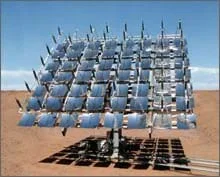 Figure 4. One of the most efficient PV panels in the world — this dual-axis PV tracking system uses small mirrors to focus sunlight on high-efficient cells. It supplies electricity to the Arizona Public Service grid.Copyright NREL http://www.nrel.gov/pv/high_performance_pv.html
It might not be obvious at first, but look closely at the bases supporting the panels. They are designed to move! SunPower Corporation, a German company that specializes in PV power systems, designed this PV power plant with an east-west single-axis tracking system. That means that the panels rotate from east to west throughout the day to follow the sun and optimize panel efficiency. Because of this tracking system, these panels produce 30% more power than they would if they were fixed facing south.
Further panel efficiency can be obtained by tracking the sun not only along a single axis, but on two perpendicular axes. Figure 4 shows one of the most efficient PV panels in the world (more than 40% conversion efficiency) created by Spectrolab. These PV panels are extremely expensive so this module uses very small panels and less expensive mirrors to reflect sunlight from a larger area onto the small PV panel. The process of concentrating the sunlight for photovoltaic power production is explained in more detail in the Concentrated Solar Panel lesson. For this high-tech system, it is important to track the sun's location exactly throughout the day to provide the maximum amount of sunlight for the module at all times. To do that, this module has a double-axis tracking system that moves from east to west and an adjustable collector slope, β, to follow the height of the sun in the sky throughout the year.
Reduction of Pollution
So why are solar panels called a "clean" source of energy? (Elicit answers from students – they should be able to name the following reasons.) That's right! Solar panels don't create pollution when they generate electricity, and their energy source – the sun – is renewable, meaning that it will never run out of energy (at least not for billions of years). This method of producing electricity is environmentally-friendly. But other, more common methods of producing electricity use fossil fuels such as coal and natural gas, energy sources that are non-renewable and create pollution when burned.
Now let's see how much pollution the Nellis Air Force Base's solar power plant can save from being emitted when it's compared to a power plant that uses coal (coal plants generate almost half of the electricity used in the U.S.). When coal is burned to produce electricity, pollution in the form of carbon dioxide, nitrogen oxides, sulfur dioxide, and mercury compounds are created. Let's just consider carbon dioxide – for every 1,000 kilowatt-hours of electricity produced, a coal-fired power plant creates about 2,250 pounds of carbon dioxide. So, how many pounds of carbon dioxide does the Nellis Air Force Base's solar power plant save from being emitted? (Allow time for students to perform this calculation: the NAFB's plant generates 30,000,000 kWh; 30,000,000 x 2,250 lbs CO2 / 1,000 kWh = 67,500,000 pounds of CO2 saved each year!). This unbelievable amount of pollution weighs the same as about 22,500 cars!
(In advance, make copies of the attached Fundamentals Article (PDF), which contains basic photovoltaic efficiency information and facts that are used throughout this unit [including this lesson], one per student or one per small group.)
Where is the sun in the sky? From our perspective on Earth, the sun is always changing its position in the sky. It is pretty obvious that every day the sun moves from the east to the west between sunrise and sunset, but did you know that it also moves from north to south throughout the course of the year? If you were to measure the position of the sun every day at solar noon (or the time of day when the sun is the highest in the sky) it would be at a different angle every day. The exact location of the sun in the sky depends on where you live, the day of the year, and, of course, the time of day. This effects the design decisions engineers make when they are installing photovoltaic (PV) panels.
What are photovoltaic (PV) panels? "Photo" means light and "voltaic" means voltage. Thus, a photovoltaic panel is a device that turns light into electric potential. Commonly, these devices are referred to simply as "solar panels" because the light source in many applications is the sun. Yet the term "solar panel" can also refer to other devices that capture the sun's heat but do not produce electricity. Photovoltaic panels use layers of special materials to create a voltage and current when sunlight is absorbed.
It is important for engineers to know where the sun will be throughout the year so they can install PV panels at the ideal angle to absorb the maximum amount of sunlight during the course of a year. To improve the efficiency of PV panels, engineers also design creative ways so more sunlight hits the surface of the panel. Can you think of ways to improve the efficiency of PV panels that relates to the angle of the sun? (Have students brainstorm ideas as a class.) Let's do some reading to find out more.
(Have the students read the Fundamentals Article, and record 10 important facts, then conduct the post-introduction assessment described in the Assessment section.) Following the lesson, students can conduct the associated activity A New Angle on Photovoltaic Solar Panel Efficiency to explore the effect of changing the angle of a small PV panel on its electrical current output.
The energy output of a photovoltaic (PV) panel changes based on the angle between the PV panel and the sun. The angle at which the sun hits a PV panel determines its efficiency and is what engineers use in the design of an efficient PV array for a specific location.
Solar tracking systems designed by engineers help optimize the amount of sunlight that hits a photovoltaic panel over time (day, month, year). One example is SunPower Corporation — a German company that creates photovoltaic power systems — that designed a PV power plant with an east-west single-axis tracking system. That means that the panels rotate from east to west throughout the day to follow the sun and optimize panel efficiency. Because of this tracking system, these panels produce 30% more power than they would if they were fixed facing south.
Whether a panel is fixed in one direction or integrated with a single- or double-axis tracking system, it is important to know the location of the sun throughout the year and the effect that the angle of sunlight hitting the panel has on its overall efficiency.
- current
- The flow of electricity (electrons) through a wire.
- efficiency
- The ratio of the useful energy delivered by a dynamic system to the energy supplied to it.
- equinox
- The days when the sun is directly above the equator. This happens twice a year.
- latitude
- The angle above or below the equator. The north pole is at 90º N and the south pole is at 90º S.
- local meridian
- The closest longitude of 15º increments. If you live in Boulder, CO, at a longitude of 105.25º W, then your local meridian is 105º W (this is the closest number divisible by 15º).
- longitude
- The angle of your location on the earth measured around the equator, west from the prime meridian (0º).
- photovoltaic cell
- A device that converts the energy of light into electric energy. Also called a PV cell or a solar cell (when the sun is the light source). Cells may be combined in a panel, or array of panels to generate more energy as part of a PV system.
- solar noon
- The time of day when the sun is highest in the sky. This is not always the same as 12 o'clock, because of daylight savings time and time zones. If the sunrise was exactly at 8am and sun set exactly at 8pm, then solar noon would be the same as 12 noon.
- voltage
- Electric potential. A difference in charge between two points in a circuit.
Pre-Lesson Assessment
Discussion Questions: Ask a few discussion questions to get students to think about the upcoming lesson. After soliciting answers, explain that these questions will be answered during the lesson.
- What is the best direction for a PV panel to face?
- What do you know about how these PV panels work?
Post-Introduction Assessment
Brainstorming: As a class, have students engage in open discussion. Remind them that in brainstorming, no idea or suggestion is "silly." All ideas should be respectfully heard. Encourage wild ideas and discourage criticism of ideas. Have students raise their hands to respond. Write answers on the board. Ask the students:
- Can you think of a way to improve the efficiency of a PV panel that relates to the angle of the sun?
Class Discussion: Have students read the Fundamentals Article (PDF), which contains basic facts that are used throughout this unit (including this lesson). As they read, have students each write 10 facts from the article on a sheet of paper. Engage the class in a discussion of what they have read. Ask each student or student group to record on the board one fact about PV panels that they have learned from the reading.
Lesson Summary Assessment
Writing/Reflection: Have students think about solar panels and panel tracking systems, and compose a journal entry on their thoughts. How would they explain the importance of designing a solar panel to track the sun to someone who did not know a lot about solar panels? Have them list and describe any of the solar angles that were discussed in class.
Assume your school leaders are thinking about installing solar panels on the roof of your school. It's estimated that the system will generate 120,000 kilowatt-hours of electricity each year. How many pounds of carbon dioxide per year will this system save from being emitted when compared to a power plant that burns coal? (Answer: 120,000 kWh x 2,250 lbs / 1,000 kWh = 270,000 pounds of CO2 per year)
Human Solar Tracker Activity: Have every student in the class hold up a book. Tell them that the front of the classroom is south. Give them the time of the year, and hour of the day, and ask them to position their books as though they are solar panels seeking to receive the maximum amount of sunlight. Guide them through each aspect of the sun's positions and help them think through the solar angles.
Long-Term Classroom Tracking: To make more tangible the annual cycle of the sun's angle, designate an area in the classroom or school that receives direct sunlight at which to have students make a daily mark to record how far sunlight reaches into the classroom at solar noon. Do this for a month or longer. For the daily mark, place of piece of (removable) masking tape on the floor, wall or tabletop, and write the date on the tape.
Interactive Seasons: Have students explore this interactive astronomy website to see the how the angle of the sun changes throughout the year. Students can view what would happen if our planet had a different tilt angle. See: http://highered.mcgraw-hill.com/sites/007299181x/student_view0/chapter2/seasons_interactive.html
High-Performance Photovoltaics. Last updated July 25, 2008. Photovoltaic Research, National Renewable Energy Laboratory (NREL). Accessed February 4, 2010. http://www.nrel.gov/pv/high_performance_pv.html
Solar Energies Technology Program. Last updated January 18, 2010. Energy Efficiency & Renewable Energy, US Department of Energy. Accessed February 4, 2010. http://www1.eere.energy.gov/solar/
Photovoltaic cell. The American Heritage® Dictionary of the English Language, Fourth Edition. Houghton Mifflin Company, 2004, via Dictionary.com. Accessed February 11, 2010. http://dictionary.reference.com/browse/photovoltaic+cell
Contributors
William Surles; Abby Watrous; Eszter Horanyi; Malinda Schaefer Zarske
Supporting Program
Integrated Teaching and Learning Program, College of Engineering and Applied Science, University of Colorado Boulder
Copyright
2009 by Regents of the University of Colorado.