
No Valve in Vain
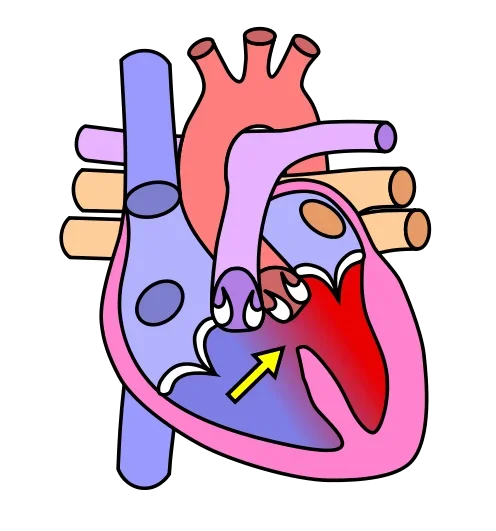 Students design for the heart.Copyright Wikimedia Commons http://commons.wikimedia.org/wiki/File:Heart_vsd.svg
Acting as biomedical engineers, students design, build, test and redesign prototype heart valves using materials such as waterproof tape, plastic tubing, flexible plastic and foam sheets, clay, wire and pipe cleaners. They test them with flowing water, representing blood moving through the heart. As students creatively practice engineering problem solving, they demonstrate their understanding of how one-way heart valves work.
Biomedical engineers work with physicians to design and test replacement human body parts that extend human lives in situations of disease or damage. Researchers apply their understanding of physics, mechanics, materials and mathematics as well as their understanding of how the body and its interdependent systems function to prototype and test prosthetic devices for body parts. Designing long-lasting and dependable heart valves is a grave challenge that requires great creativity and perseverance.
After this activity, students should be able to:
- Explain how heart valves work.
- Describe a prosthetic valve and how it works.
- Explain how engineering contributes to solving problems in the body.
- Describe the steps of the engineering design process.
- Explain the steps they took to design, construct and test prototype prosthetic valves.
- Explain how the heart valves they created work and the logic of their designs.
- Students will develop an understanding of the attributes of design.
Grades K-12
Do you agree with this alignment? - Students will develop an understanding of engineering design.
Grades K-12
Do you agree with this alignment? - There is no perfect design.
Grades 6-8
Do you agree with this alignment? - Requirements for design are made up of criteria and constraints.
Grades 6-8
Do you agree with this alignment? - Design involves a set of steps, which can be performed in different sequences and repeated as needed.
Grades 6-8
Do you agree with this alignment? - Brainstorming is a group problem-solving design process in which each person in the group presents his or her ideas in an open forum.
Grades 6-8
Do you agree with this alignment? - Modeling, testing, evaluating, and modifying are used to transform ideas into practical solutions.
Grades 6-8
Do you agree with this alignment? - STEL-4N Analyze examples of technologies that have changed the way people think, interact, and communicate.
Grades 6-8
Do you agree with this alignment? - STEL-4Q Critue whether existing and proposed technologies use resources sustainably.
Grades 9-12
Do you agree with this alignment? - STEL-7J Evaluate designs based on criteria, constraints, and standards.
Grades 3-5
Do you agree with this alignment? - STEL-7R Refine design solutions to address criteria and constraints.
Grades 6-8
Do you agree with this alignment? - STEL-7S Create solutions to problems by identifying and applying human factors in design.
Grades 6-8
Do you agree with this alignment?
- MS-ETS1-1 Define the criteria and constraints of a design problem with sufficient precision to ensure a successful solution, taking into account relevant scientific principles and potential impacts on people and the natural environment that may limit possible solutions.
Grades 6-8
This resource focuses on the following Three Dimensional Learning aspects of NGSS:
Science & Engineering Practices- Define a design problem that can be solved through the development of an object, tool, process or system and includes multiple criteria and constraints, including scientific knowledge that may limit possible solutions.Do you agree with this alignment?
Disciplinary Core Ideas- The more precisely a design task's criteria and constraints can be defined, the more likely it is that the designed solution will be successful. Specification of constraints includes consideration of scientific principles and other relevant knowledge that is likely to limit possible solutions.Do you agree with this alignment?
Crosscutting Concepts- The uses of technologies and any limitations on their use are driven by individual or societal needs, desires, and values; by the findings of scientific research; and by differences in such factors as climate, natural resources, and economic conditions.Do you agree with this alignment?
- All human activity draws on natural resources and has both short and long-term consequences, positive as well as negative, for the health of people and the natural environment.Do you agree with this alignment?
Do you agree with this alignment? - Define a design problem that can be solved through the development of an object, tool, process or system and includes multiple criteria and constraints, including scientific knowledge that may limit possible solutions.
- MS-ETS1-2 Evaluate competing design solutions using a systematic process to determine how well they meet the criteria and constraints of the problem.
Grades 6-8
This resource focuses on the following Three Dimensional Learning aspects of NGSS:
Science & Engineering Practices- Evaluate competing design solutions based on jointly developed and agreed-upon design criteria.Do you agree with this alignment?
Disciplinary Core Ideas- There are systematic processes for evaluating solutions with respect to how well they meet the criteria and constraints of a problem.Do you agree with this alignment?
Do you agree with this alignment? - Evaluate competing design solutions based on jointly developed and agreed-upon design criteria.
- MS-ETS1-4 Develop a model to generate data for iterative testing and modification of a proposed object, tool, or process such that an optimal design can be achieved.
Grades 6-8
This resource focuses on the following Three Dimensional Learning aspects of NGSS:
Science & Engineering Practices- Develop a model to generate data to test ideas about designed systems, including those representing inputs and outputs.Do you agree with this alignment?
Disciplinary Core Ideas- Models of all kinds are important for testing solutions.Do you agree with this alignment?
- The iterative process of testing the most promising solutions and modifying what is proposed on the basis of the test results leads to greater refinement and ultimately to an optimal solution.Do you agree with this alignment?
Do you agree with this alignment? - Develop a model to generate data to test ideas about designed systems, including those representing inputs and outputs.
- 5.L.1 Understand how structures and systems of organisms (to include the human body) perform functions necessary for life.
Grade 5
Do you agree with this alignment? - 7.L.1 Understand the processes, structures and functions of living organisms that enable them to survive, reproduce and carry out the basic functions of life.
Grade 7
Do you agree with this alignment?
- scissors
- waterproof tape (such as duct tape, electrical tape, etc.)
- flexible plastic tubing (2-in diameter and 4-in length per student)
- flexible plastic sheets (flexible binder type of material, 12 in x 12 in piece per student)
- foam sheets (1/4-in thick, 12 in x 12 in piece per student)
- modeling clay
- wire
- pipe cleaners
- beakers or measuring cups, for pouring the water
- buckets (or sinnk), for catching water
- paper towels, sponges or cloths, for wiping up spills
- Heart Valves Handout (PDF), one per student
- example prosthetic heart valves (try to obtain from local hospital or biomedical department of a university; alternatively, find images, schematics and/or animations of artificial heart valves, such as the photographs shown below, or via Internet search of "artificial heart valve" or "prosthetic heart valve")
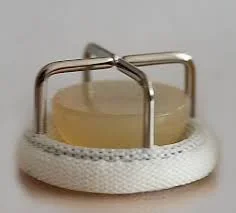 Copyright Stif Komar 2006, CC BY-SA 3.0.
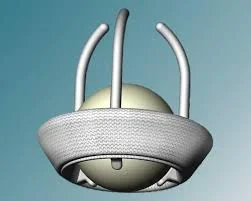 Copyright Stif Komar 2014, CC BY-SA 3.0.
(Be ready to show students some real examples of prosthetic valves. If not available, find photographs, diagrams and/or animations to show them instead.)
What are we looking at? (Listen to student responses.). These are artificial heart valves, or prosthetic heart valves. How are they used? How do they each work? (Give students a chance to examine and discuss.)
If you were biomedical engineers challenged to design artificial heart valves, what would be your design requirements? What do heart valves need to be able to do? (Write down student ideas on the classroom board.) Would your design requirements be different for the different heart valves? Would the requirements be different if you were creating a valve for a 200-lb man? for a 130-lb woman? for a child or a baby?
What are the differences between the various valve designs? Which ones do you think work best? Which might be most effective to replace a person's damaged or injured heart valve? (Make a list on the board of the various features and the pros/cons for each design.)
Decide on one of the designs as being the best one. Now let's take a few minutes to brainstorm about ways to improve on the best design.
- Pass around real prosthetic valves (or pictures of the same) for students to examine, and explain how they work. Present the Introduction/Motivation section.
- Give students the Heart Valves Handout (PDF) to add supplementary visual and written information for students to look at during and after the lesson and activity.
- Show students examples of valves constructed from materials they will be provided.
- Divide the class into engineering teams of two students each. Have the teams talk through the engineering design process and the steps that they will experience today.
- Have each team start the third step of the engineering design process: Imagine Possible Solutions. Encourage creative ideas in this brainstorming session.
- After the teams have come up with several possible ideas, they will move into the fourth step of the EDP: Plan by Selecting a Promising Solution. Have teams review all of their ideas and select the most promising one.
- Creating a Prototype is the fifth step in the engineering design process: Give each group materials and time to experiment with designing one-way valves that permit water to flow through one way, but not the other way.
- After the teams have completed prototypes, remind them that they are in the sixth step in the engineering design process: test and evaluate the prototype. Test the team prototype valves by timing how long it takes equal amounts of water to flow through in each direction.
- Remind teams that engineers constantly work to redesign and improve their designs, which leads them into the seventh step in the engineering design process: improve and redesign as needed. Give teams a certain amount of time to redesign and improve the functioning their valves.
- capillary
- The smallest blood vessels. They distribute oxygenated blood from arteries to the tissues of the body and feed deoxygenated blood from the tissues back into the veins
- vein
- A blood vessel that carries blood low in oxygen content from the body back to the heart.
- artery
- A vessel that carries blood high in oxygen away from the heart to the body.
- prosthetic
- Referring to a prosthesis, an artificial substitute or replacement of a body part.
- valve
- A mechanical device by which the flow of liquid (such as blood) may be started, stopped or regulated by a movable part that opens, shuts or partially obstructs one or more ports or passageways.
- vascular
- Relating to the blood vessels of the body, which as a group, are referred to as the vascular system; of, relating to, constituting, or affecting a tube or a system of tubes for the conveyance of a body fluid
- biocompatibility
- The condition of being compatible with living tissue or a living system without being toxic or injurious and not causing immunological rejection.
- hemophiliac
- A person whose blood has an impaired ability to clot and consequently has difficulty controlling bleeding even after minor injuries.
- anti-coagulant
- A drug used to prevent the formation of blood clots.
- immunosuppressive
- A drug designed to suppress immune response that might otherwise result in attacking a foreign implant.
- epithelial
- Relating to the epithelium, the outside layer of cells that covers all the free, open surfaces of the body including the skin and mucous membranes that communicate with the outside of the body; a membranous cellular tissue that covers a free surface or lines a tube or cavity of an animal body and serves especially to enclose and protect the other parts of the body, to produce secretions and excretions, and to function in assimilation
Concluding Discussion: Conclude with a class discussion to compare the testing results of the student-designed prototype heart valves. Which worked the best? Why? Why did others not work as well? What further improvements would you make?
Oral Quiz: At activity end, administer a short oral quiz by asking the questions in the Heart Valves Handout (PDF), which pertain to the lesson content material. Ask them to define the vocabulary words. Have students raise their hands to answer the questions:
- What is a valve?
- What is a one-way valve?
- Where have you seen valves in the world around you?
- Where do valves appear in the human body?
- What do heart valves do and how do they work?
- What happens if these valves do not function as they should?
- What solutions have engineers devised to help with this problem?
- What steps of the engineering design process did we follow today? (imagine, plan, create, test, improve)
- Warn students to be careful with the scissors, especially when cutting plastics.
- Beware of any spills that might result from pouring water; have students dry them up right away to keep anyone from slipping.
If students seem to be having trouble coming up with designs, hold one-on-one discussions with teams about what options they think they have and how best to start building their prototype valves.
If valves do not work perfectly as one-way valves when tested, do not let students become discouraged. These are prototypes made with limited materials in a limited time period by "novice" engineers (limited knowledge and experience). From this experience students can begin to see how much engineering work goes into making high-quality, dependable devices.
Feel free to modify the supplied materials, especially if students have trouble envisioning designs with the suggested materials or if they request specific materials.
Give students more time to create their designs if they seem to be taking a long time to brainstorm and construct their valves.
Have students practice taking their pulses and blood pressures to explore further how fluid dynamics works in the body's blood vascular system.
Have students look around their homes for fluids that are different densities or viscosities, and experiment how they flow differently in tubes.
- For more of a challenge, ask students to construct valves using materials of their own choosing and give them more time to do it. Hold a contest to determine which team's prototype valve is the most effective (that is, no water gets through in one direction, and water flows completely unobstructed in the other direction). Technically, it is not possible to obtain COMPLETELY unobstructed flow, but as in the real-world, unreachable engineering objectives can serve as useful motivational goals.
- Vary the number of students in each group between 1-3 students. Working individually may be more challenging and/or rewarding as each student finishes with his/her own prototyope, while groups of 2-3 are more realistic and promote teamwork and collaboration, as well as aiding students who might struggle on their own.
Surgical Associates of Texas, P.A. Accessed May 13, 2004. http://www.texheartsurgeons.com
Contributors
Emily McDowell; Alice Hammer
Supporting Program
Techtronics Program, Pratt School of Engineering, Duke University
Acknowledgements
This content was developed by the MUSIC (Math Understanding through Science Integrated with Curriculum) Program in the Pratt School of Engineering at Duke University under National Science Foundation GK-12 grant no. DGE 0338262. However, these contents do not necessarily represent the policies of the NSF, and you should not assume endorsement by the federal government.
Copyright
2013 by Regents of the University of Colorado; original © 2004 Duke University