
Put Your Heart into Engineering
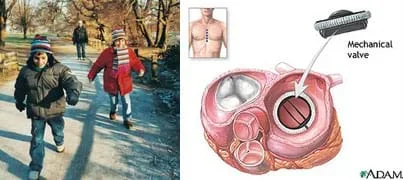 Our hearts are at the hub of a powerful cardiovascular system. Artificial heart valves are creative biomedical inventions that extend people's lives.Copyright (left) Medline Plus, National Institutes of Health; (right) Adam, National Library of Medicine via NSF http://www.nlm.nih.gov/medlineplus/magazine/issues/winter09/articles/winter09pg6.html http://www.nsf.gov/discoveries/disc_images.jsp?cntn_id=103066&org=NSF
Students learn all about the body's essential mighty organ, the heart, as well as the powerful blood vascular system. This includes information on the many different sizes and pervasiveness of capillaries, veins and arteries, and how they affect blood flow through the system. Then students focus on heart valves, how they work and what might cause them to fail, coming to realize the value of prosthetic heart valves, a life-saving biomedical invention. Students are asked to evaluate the different options for heart valve replacements based on performance criteria, and provide an summary of their advantages and disadvantages.
Artificial heart valves are one example of biomedical inventions that aid human health and extend human lives. Only through understanding human anatomy and biological functions have engineers been able to determine the design requirements to create successful prosthetic valves. To design artificial heart valves, engineers of many specialties (biomedical, mechanical, biochemical) must understand what is required of a device before they design and test numerous prototypes. Engineers design these life-extending devices for people whose hearts are faulty or damaged due to illness, injury or birth defect.
After this lesson, students should be able to:
- Identify the difference between capillaries, veins and arteries.
- Explain how human heart valves work.
- Describe a prosthetic valve and how it works.
- Explain how engineering contributes to solving problems in the body.
- Brainstorming is a group problem-solving design process in which each person in the group presents his or her ideas in an open forum.
Grades 6-8
Do you agree with this alignment? - Advances and innovations in medical technologies are used to improve healthcare.
Grades 6-8
Do you agree with this alignment? - STEL-2N Illustrate how systems thinking involves considering relationships between every part, as well as how the system interacts with the environment in which it is used.
Grades 6-8
Do you agree with this alignment? - STEL-3F Apply a product, system, or process developed for one setting to another setting.
Grades 6-8
Do you agree with this alignment? - STEL-3G Explain how knowledge gained from other content areas affects the development of technological products and systems.
Grades 6-8
Do you agree with this alignment?
- MS-ETS1-2 Evaluate competing design solutions using a systematic process to determine how well they meet the criteria and constraints of the problem.
Grades 6-8
This resource focuses on the following Three Dimensional Learning aspects of NGSS:
Science & Engineering Practices- Evaluate competing design solutions based on jointly developed and agreed-upon design criteria.Do you agree with this alignment?
Disciplinary Core Ideas- There are systematic processes for evaluating solutions with respect to how well they meet the criteria and constraints of a problem.Do you agree with this alignment?
Do you agree with this alignment? - Evaluate competing design solutions based on jointly developed and agreed-upon design criteria.
- 5.L.1 Understand how structures and systems of organisms (to include the human body) perform functions necessary for life.
Grade 5
Do you agree with this alignment? - 7.L.1 Understand the processes, structures and functions of living organisms that enable them to survive, reproduce and carry out the basic functions of life.
Grade 7
Do you agree with this alignment? - 7.L.1.4 Summarize the general functions of the major systems of the human body (digestion, respiration, reproduction, circulation, and excretion) and ways that these systems interact with each other to sustain life.
Grade 7
Do you agree with this alignment?
Arteries, Capillaries and Veins, Oh My!
Arteries, veins and capillaries have one main thing in common: they are all blood vessels. In a general sense, a vessel is a hollow instrument for carrying something. A blood vessel, therefore, is a hollow instrument for carrying blood.
Fun Facts:
- If you strung together all the blood vessels of an average child, the total length would be more than 60,000 miles long.
- Doing the same for an average adult's blood vessels would be more than 100,000 miles long (more than four times around the equator).
Arteries
Arteries are the biggest blood vessels in the body. They serve the purpose of pumping the blood directly from the heart to the main dorsal artery. This artery then branches into smaller arteries that help supply each region of the body with freshly oxygenated blood. Arteries are tough on the outside and smooth on the inside. Since they carry blood at relatively high pressures, they must be durable to be able to withstand pressure. Three layers of tissue make up an artery: the outer protective layer of tissue, the muscular middle, and the inner layer of epithelial (skin-like) cells. The muscular middle is elastic and very strong so that it can help the heart pump the blood through contraction and relaxation. The inside wall is smooth so that blood can flow more easily with no obstacles. The arteries deliver oxygen-rich blood to the capillaries.
Capillaries
In contrast to arteries, capillaries are very thin and fragile. They are only one epithelial cell thick in order to effectively aid in the exchange of oxygen and carbon dioxide between the blood being carried and the body's oxygen-starved tissue. The red blood cells release fresh oxygen to the surrounding tissue, and the tissue releases its carbon dioxide waste into the red blood cells. The capillaries then deliver this waste-rich blood to the veins for transport back to the heart and eventually other organs for disposal.
Veins
Veins resemble arteries in make-up, but are much thinner and weaker because they do not have to carry the blood at such high pressure. Veins have the same three layers, but the layers are thinner, containing less tissue. Also, the middle muscle layer is not as strong as that of arteries. Waste-rich blood flows from the capillaries into the veins. The veins carry the waste-rich blood back to the heart and lungs. Valves inside the veins help make sure that no contaminated blood flows backwards to contaminate the oxygen-rich blood coming from the heart. These one-way valves act like gates to ensure that blood can only flow in one direction. These valves are also necessary to help blood flow against the force of gravity to travel up your legs, torso and arms.
Heart Valves
If a computer/projector is available, show students the animated image at: https://www.smm.org/heart/heart/pumping.htm. It provides an excellent depiction of the movement of blood through the heart.
What Are Heart Valves?
Heart valves are similar to little doors in your heart that control how much blood gets in and when it comes and goes. The heart contains four of these "doors," and they all only open one way. These are called one-way valves. The purpose of one-way valves is to make sure the blood only flows in one direction, which ensures that oxygen-rich blood is continuously being delivered to the body, while carbon dioxide is continuously being taken out of the body's blood.
How Do Heart Valves Work?
The heart is divided into four chambers. The two upper chambers are called atria (or atrium when referring to one) and the two lower chambers are called ventricles. Blood is moved from one chamber to the next when the heart contracts. With each contraction, the valves also open to allow the blood to flow into the next chamber. The valves then shut as the heart expands to prevent blood flow backwards. This allows blood to be moved out of the heart and throughout the body. The waste-rich blood from the body enters the right atrium first. Once this chamber fills with blood, the atrium contracts, forcing the blood down through the tricuspid valve into right ventricle. Next, the ventricle contracts, pushing the blood to the lungs through the pulmonary valve to receive oxygen. The oxygen-rich blood returns to the left atrium of the heart and then travels to the left ventricle through the mitral valve. From the left ventricle, the blood travels through the aortic valve to the large blood vessel called the aorta. The aorta then distributes blood to the rest of the body.
What Can Go Wrong with a Heart Valve?
Valve disease can occur when a valve stops functioning properly. A valve might not close all the way, which allows leakage of blood backwards. Alternatively, a valve may not open all the way, keeping blood from flowing as well as it might otherwise. Both of these problems cause the heart to work much harder to carry the same amount of blood through the body.
Fun Facts
- Your heart is about the size of your fist.
- An average adult body contains about five quarts of blood.
- Your heart circulates your blood supply about 1,000 times each day.
Prosthetic Heart Valves
The two main types of prosthetic valves are mechanical and bioprosthetic. Refer to the associated activity No Valve in Vain for students to demonstrate their understanding of how one-way valves function as they practice creative engineering problem solving.
Mechanical Heart Valves
Since first designed in 1952, mechanical heart valves have gone through many design evolutions. Over the years, improvements helped to reduce blood clots in the heart and create more central flow through the valve. Three main different designs are the caged ball valve, the tilting-disc valve, and the bileaflet, which is the valve that is primarily used today.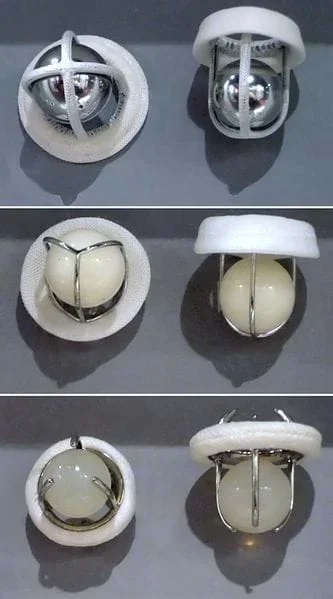 Figure 1. Three design variations for caged ball artificial heart valves.Copyright 2008 Mirko Junge http://en.wikipedia.org/wiki/File:Prosthetic_Cardiac_Ball_Valves.jpg
Caged Ball Design
The caged ball valve design uses a metal ball held in place by a welded metal cage (see Figure 1). When the blood flows one way, it pushes the ball into the cage, which allows blood to flow around the ball and through the valve. However, when the blood flows the other way, it pushes the ball over the valve opening and prevents blood from flowing backwards. The main problem with this design is that the ball prevents blood flow from going centrally through the valve opening like it would in a natural valve. When blood flows non-centrally, it causes the heart to work harder to compensate for the momentum lost when the blood has to change direction to flow around the ball. This type of blood flow also tends to cause more damage to red blood cells due to collisions with the ball. When red blood cells are damaged, they release blood-clotting ingredients, requiring patients to take lifelong prescriptions of anti-coagulants. Taking anti-coagulants minimizes the chance of heart attacks, but makes patients vulnerable to any type of trauma that might cause internal or external bleeding, because the their blood is unable to clot well-enough to stop rapid blood loss.
Tilting-Disc Design
The tilting-disc valve consists of a polymer disc held in place by two welded struts on either side of the disc. The struts are attached in such a way so that the disc only rotates open when the blood is flowing forward. As soon as the blood starts to flow backwards, the disc rotates closed. This design vastly improved on the caged ball design because it permits improved central flow by opening at a 60° angle. Yet, it still closed at a rate of 70 times per minute and thus prevented blood backflow. The tilting-disc also allowed decreased mechanical damage to the red blood cells. Thus, blood clotting and infection became less of a problem with this design than with the caged ball design. The design flaw of the tilting-disc, however, is that the outlet struts of the disc would fracture due to fatigue from the repeated slamming of the disc, causing valve failure.
Bileaflet Design
The bileaflet valve consists of two semicircular discs attached near the center of the valve with hinges. These discs swing open to be parallel to the flow of blood and create a rectangular tunnel to help centralize the flow of blood when the blood is flowing forward. When the blood flows backwards, the discs come together to cover the circular valve opening. The leaflets are very strong, exhibiting excellent biocompatibility in that they do not damage tissue or red blood cells and do not cause clotting or infection. However, the two semicircular discs do not close completely and still allow some leakage when the blood flows backwards. Backflow is one of the main reasons doctors have switched to using prosthetic valves because mechanical valves can be less than ideal.
Materials
Currently, the most commonly used materials for mechanical valves are:
- stainless steel alloys
- molybdenum alloys
- pyrolitic carbon (for valve housings and leaflets)
- silicone
- polyester (for sewing rings that are attached to the valve and are used to sew the valve into the heart)
Pros and Cons of Mechanical Heart Valves
Mechanical heart valves are good long-term solution because they are durable and typically last a patient's lifetime, which generally eliminates the need for a second valve surgery. However, they cause an increased risk of blood clotting and thus force patients to take anti-coagulant medications for the rest of their lives, essentially creating blood clotting risks for them.
Bioprosthetic Heart Valves
Bioprosthetic heart valves are also known as prosthetic tissue valves. The design of bioprosthetic valves is much more similar to that of natural heart valves, giving them many advantages over mechanical valves. Bioprosthetic valves do not require patients to take anti-coagulants for life. Additionally, these valves result in better hemodynamics (blood movement), do not cause damage to blood cells, and do not experience many of the structural problems found in mechanical heart valves. Bioprosthetic valves are of two types: human tissue valves, and animal tissue valves.
Human Tissue Valves
The two types of human tissue valves are homografts and autografts. Homografts are human heart valves transplanted from other people. Autografts are valves transplanted from one position to another, within the same person.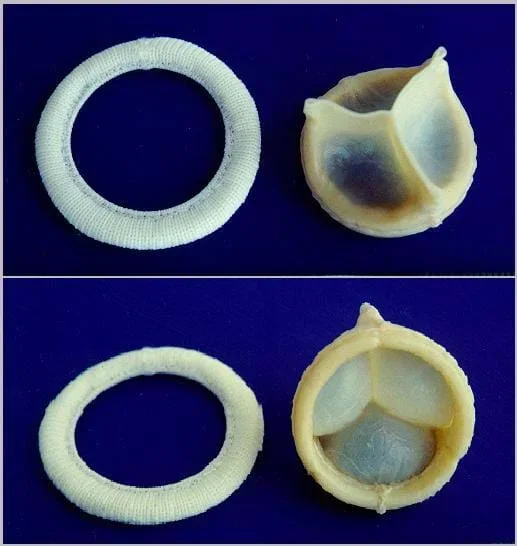 An example biological artificial heart valve.Copyright 2008 Robertolyra, Wikipedia http://en.wikipedia.org/wiki/File:BiologicalValves.JPG
Homografts
Homografts are valves transplanted from deceased people to recipients. The recipients generally do not problems with the body rejecting the valve and, thus do not require immunosuppressive therapy (medicines to prevent the body from rejecting a transplanted organ). Once a homograft is donated, it is frozen in liquid nitrogen to preserve it until it is needed for implantation. In cases in which the valve implant dimensions are a good match and closely resemble the patient's valve size, homografts resulte in good blood flow characteristics and durability.
Autografts
Most commonly, autografts consist of a patient's pulmonary valve being transplanted to the aortic position to replace a diseased aortic valve. A homograft pulmonary valve is then used to replace the patient's original pulmonary valve. This is called the Ross Procedure, and the advantage is that the patients receive living valves to replace the aortic valves. Both the long term survival rate and the fact that there is minimal risk for complications for patients with aortic valve disease make the Ross Procedure a more viable option than any other type of valve replacement.
Animal Tissue Valves
Animal tissue valves are also referred to as xenografts or heterografts. These valves are usually acquired from animals during commercial meat processing. The leaflet valve tissue of the animals is inspected, and the highest quality leaflet tissues are then preserved. The two most commonly used animal tissues are porcine tissue (pig) and bovine pericardial tissue (cow).
The most common cause of failure of the bioprosthetic valve is tissue stiffening due to calcium build-up. Calcium build-up causes restricted blood flow and can also tear valve leaflets. Due to gradual wear, bioprosthetic valves usually need to be replaced after 10-15 years.
Engineering currently plays a huge role in the design of artificial valves. Specifically, the future of bioprosthetic valves lies with tissue engineering. The ideal valve would be composed of a patient's own tissues and sculpted to the ideal shape and dimensions for the patient. With rapid advances in engineering and technology, this idea may not be too far off.
 One-way valves permit and control the flow of liquids in one direction.Copyright City of Woodstock, IL http://www.woodstockil.gov/index.asp?Type=B_BASIC&SEC=%7B6E85995F-8259-4D03-87A1-3E970F666303%7D
What is a valve? (Define what a valve is and, specifically, how a one-way valve works.) One-way valves allow flow in only one direction and prevent fluid from flowing back where it came from, should there be a force that would cause backflow (such as gravity).
What might be examples where this idea of "flowing one way" is beneficial? (Listen to student ideas.) Examples might be preventing drainage water from flowing back into drinking water, or when donating blood to keep the blood from flowing back into the vein, or speaking valves for people on ventilators.)
What other things in our everyday lives might act as one-way valves? (Possible answers: One-way doors, the oxygen regulator on a scuba mask, plumbing valves that regulate water flow at faucets. Give students time to brainstorm ideas to sharpen their understanding of what a one-way valve is and what it does.)
- The definition of blood vessels is hollow instruments that carry blood throughout the body.
- The differences between capillaries, arteries and veins in terms of size, make-up and function. Capillaries are the smallest and most fragile and serve as the vessel for gas exchange between tissue and blood cells. Arteries carry oxygen rich blood into the body and are the largest and strongest vessels. Veins carry oxygen-weak blood back to the heart and lungs.
- Heart valves help control the timing and direction of blood flow through the heart.
- Heart valves can fail either by not closing properly and allowing backflow of blood, or by not opening completely and thus restricting the flow of too much blood.
- Prosthetic heart valves are engineered devices that are desgined to replace faulty heart valves in people.
- There are many different kinds of artificial heart valves.
- Mechanical heart valves include the caged ball design, tilting-disc design and the bileaflet design.
- Bioprosthetic heart valves include both human and animal tissue valves.
- For human tissue valves, you can have either a homograft from a deceased donor, or an autograft in which a valve is taken from one position in the patient themselves and relocated to another position.
- For animal tissue valves, the most common animals used are pig and cow valves.
- Mechanical prosthetic valves are durable and can last for a patient's lifetime, thus they are good for people who do not want to have replacement valve surgery again.
- Bioprosthetic valves tend to have better blood flow characteristics and do not require a patient to take anticoagulants for long periods of time. However they last only 10 -15 years.
- biocompatibility
- The condition of being compatible with living tissue or a living system without being toxic or injurious and not causing immunological rejection.
- hemophiliac
- A person whose blood has an impaired ability to clot and consequently has difficulty controlling bleeding even after minor injuries.
- anti-coagulant
- A drug used to prevent the formation of blood clots.
- immunosuppressive
- A drug designed to suppress immune response that might otherwise result in attacking a foreign implant.
- epithelial
- Relating to the epithelium, the outside layer of cells that covers all the free, open surfaces of the body including the skin and mucous membranes that communicate with the outside of the body; a membranous cellular tissue that covers a free surface or lines a tube or cavity of an animal body and serves especially to enclose and protect the other parts of the body, to produce secretions and excretions, and to function in assimilation
- capillary
- The smallest blood vessel. Collectively, they distribute oxygenated blood from arteries to the tissues of the body and feed deoxygenated blood from the tissues back into the veins
- vein
- A blood vessel that carries blood low in oxygen content from the body back to the heart.
- artery
- A vessel that carries blood high in oxygen away from the heart to the body.
- prosthetic
- Referring to a prosthesis, an artificial substitute or replacement of a body part.
- valve
- A mechanical device by which the flow of liquid (such as blood) may be started, stopped or regulated by a movable part that opens, shuts or partially obstructs one or more ports or passageways.
- vascular
- Relating to the blood vessels of the body, which as a group, are referred to as the vascular system; of, relating to, constituting, or affecting a tube or a system of tubes for the conveyance of a body fluid
- blood vessel
- A tube through which the blood circulates throughout the body.
Evaluate to make sure that students are able to:
- Accurately predict whether fluid would flow faster in veins, capillaries or arteries.
- Explain the difference between capillaries, veins and arteries in terms of size and function.
- Explain what heart valves do and how they work.
- Describe different one-way valves and what purposes they serve.
- List different types of prosthetic heart valves and discuss their pros and cons.
- Design their own heart valves for experimentation.
- Understand the advantages and disadvantages of the different valve replacement options based on performance criteria. (Students can complete the attached Replacement Valve Evaluation Table (PDF).)
What are some solutions for faulty heart valves that might be engineered in the future?
What other failures of the body have engineering inventions made it possible to repair?
Look around your home and find at least three things that might act as one-way valves.
Research different types of prosthetics, their material components, and how they work. .
Extension Activities from the Science Museum of Minnesota
- Valves and Pumps: A Demonstration Students see how valves and pumps work in concert to move blood through the circulatory system.
- The Heart as a Pump Students explore the working of the heart by making comparisons with the actions of a pump.
- Go With the Flow Students name and locate the major areas and structures of the heart and trace the pathway of the blood through the heart, lungs and body.
Useful Links
The following websites offer interactive activities and attritional information on heart valves:
- https://www.smm.org/heart//heart/top.html
- http://www.stayinginshape.com/4trover/libv/h10.shtml
- http://sln.fi.edu/biosci/vessels/vessels.html
American Heart Association. Accessed May 5, 2004. http://www.americanheart.org
Science Museum of Minnesota. Accessed May 5, 2004. https://www.smm.org/heart//heart/top.html
- Surgical Device Engineering
- Medical Instrumentation
- Put Your Heart into Engineering
Contributors
Emily McDowell; Alice Hammer
Supporting Program
Techtronics Program, Pratt School of Engineering, Duke University
Acknowledgements
This content was developed by the MUSIC (Math Understanding through Science Integrated with Curriculum) Program in the Pratt School of Engineering at Duke University under National Science Foundation GK-12 grant no. DGE 0338262. However, these contents do not necessarily represent the policies of the NSF, and you should not assume endorsement by the federal government.
Copyright
2013 by Regents of the University of Colorado; original © 2004 Duke University