
Medical Instrumentation
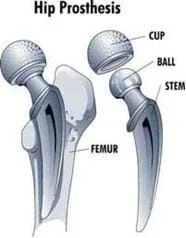 Figure 1. An artificial hip implant.Copyright A black and white drawing shows a hip prosthesis components: cup, ball, stem, and where the stem is inserted into the femur.
Students learn about the sorts of devices designed by biomedical engineers and the many other engineering specialties that are required in their design of medical diagnostics, therapeutic aids, surgical devices and procedures, and replacement parts. They discuss the special considerations that must be made when dealing with the human body, such as being minimally invasive, biocompatible, keeping sterile, lightweight, corrosion resistant, long lasting and electrically safe. They also explore how "form fits function." Students gain an appreciation for the amazing devices that improve our quality of life. This lesson serves as a starting point for students to begin to ponder how the medical devices in their everyday lives work.
Biomedical engineers design all sorts of medical equipment and systems, including EGCs, pacemakers, defibrillators, prosthetics, implants, vascular graphs, x-rays, MRIs, medicine delivery systems, replacement valves and laparoscopic surgery. Biomedical products require the expertise of electrical, mechanical computer science and chemical engineers, working with physicians. This lesson and associated activity look at the special design challenges engineers face when designing surgical instruments and other biomedical devices used with living human bodies.
After this lesson, students should be able to:
- Make hypotheses about the function instruments from their shapes and material properties.
- State some of the considerations that must be taken into account by biomedical engineers when working with the human body, which might not be factors in other engineering disciplines.
- Hypothesize why a certain material was chosen for a specific medical instrument.
- Advances and innovations in medical technologies are used to improve healthcare.
Grades 6-8
Do you agree with this alignment? - STEL-1J Develop innovative products and systems that solve problems and extend capabilities based on individual or collective needs and wants.
Grades 6-8
Do you agree with this alignment? - STEL-1M Apply creative problem-solving strategies to the improvement of existing devices or processes or the development of new approaches.
Grades 6-8
Do you agree with this alignment? - STEL-3G Explain how knowledge gained from other content areas affects the development of technological products and systems.
Grades 6-8
Do you agree with this alignment?
- MS-ETS1-2 Evaluate competing design solutions using a systematic process to determine how well they meet the criteria and constraints of the problem.
Grades 6-8
This resource focuses on the following Three Dimensional Learning aspects of NGSS:
Science & Engineering Practices- Evaluate competing design solutions based on jointly developed and agreed-upon design criteria.Do you agree with this alignment?
Disciplinary Core Ideas- There are systematic processes for evaluating solutions with respect to how well they meet the criteria and constraints of a problem.Do you agree with this alignment?
Do you agree with this alignment? - Evaluate competing design solutions based on jointly developed and agreed-upon design criteria.
- 7.P.2.4 Explain how simple machines such as inclined planes, pulleys, levers and wheel and axels are used to create mechanical advantage and increase efficiency.
Grade 7
Do you agree with this alignment?
1. Interdisciplinary
An incredibly wide range of biomedical devices influence our lives and the lives of those around us. The design of biomedical instruments and devices involves concepts from every other discipline of engineering.
Electrical Engineering - Electrical engineering concepts provide a basis for a multitude of devices. They are helpful in biomedical engineering (BME) because they provide a means for studying biological signals. The body has its own electrical system that is used for communication through neurons, as well as in muscle contraction. An ECG, or electrocardiogram, is used to monitor the electrical signals generated by the beating of the heart. An ECG can be used to determine whether the heart signal is normal, and if it is not normal whether or not there is any health danger. An EEG, or electroencephalogram, is a similar device that displays the electrical signals generated by the brain. Both ECG and EEG are primarily diagnostic tools, but many therapeutic devices are also electrical in nature. Devices such as pacemakers and defibrillators rely heavily on electrical engineering. A pacemaker provides a pulse of electrical current to stimulate the heart to beat regularly. A defibrillator applies a much larger current to jumpstart the heart when it has stopped beating altogether. Students may be familiar with some of these devices through their families or the media (TV shows, news, movies).
Mechanical Engineering - Many other devices and instruments are mechanical in nature, and require biomedical engineers to have a fundamental understanding of the forces acting on objects in different situations. Many surgical instruments are purely mechanical, and so are most prosthetics and many implants. A prosthetic leg must be engineered to perform in all types of situations ( walking, running, sitting), and still be aesthetically acceptable. Artificial joints can totally replace entire knees and hips. A hip implant is a made of a ball and socket, just like natural hips. A knee replacement is very different due to the very different range of motion of the knee; it moves in only one plane. Other mechanical devices that have changed the lives of many people are artificial heart valves and catheter delivery systems.
Computer Science - With many biomedical devices, precision is key. Instead of manual operation, many devices are automated with the use of computer programs. That way, even those with shaky hands can perform delicate tasks. Computers are also of extreme importance in the design process. When a new device is designed, it is first tested in computer models before it is used on animals or people. Computer programs are also used in conjunction with electrical devices to interpret the electrical signals that are received. For example, a computer can be used to determine whether the output of an ECG is irregular, and if so, determine what kind of problem exists.
Imaging - Advances in imaging systems have allowed us to learn a great deal about human physiology, and have helped us find solutions to many medical problems. The most common imaging technique is the well-known x-ray. Another option is computerized tomography, or CT. A CT image is created by taking many two dimensional x-rays and building them into a three-dimensional image. A third well-known imaging modality is magnetic resonance imaging, or MRI. MRI uses a magnetic field and a radio signal to create images of the body's interior. Its advantage is that unlike x-ray and CT, it does not involve any harmful ionizing radiation.
Chemical Engineering - Chemical engineering concepts are also crucial to biomedical engineering because it is very important to determine how devices and implants might interact chemically with bodies. We must be sure that a specific material is not harmful or toxic before placing it inside an animal or human. Chemical engineering is also important in the field of drug delivery. Engineers are capable of creating polymers (a group of materials that includes plastics and rubbers) that can be used to carry drugs. These materials can be implanted in the body to release a drug at a predictable rate.
2. Special Considerations
Biomedical engineers must make many special considerations in their designs that civil or mechanical engineers may not have to worry about.
Minimally Invasive - A biomedical engineer strives to make any procedure minimally invasive. This means that a procedure has the smallest incision possible to still meet the required goal. The biomedical engineer aims to design instruments that maximize patient comfort and reduce the chance of infection.
Biocompatibility - Any materials used must not cause any adverse biological reactions. If materials are not biocompatible, the body rejects them, causing inflammation and swelling.
Lightweight - If a material is being used for an implant or prosthetic, it must be relatively light weight. A prosthetic limb made of concrete, no matter how well designed, would never be practical.
Corrosion Resistant - Much of the body is made of water, thus, any implanted materials must be able to stay in this wet environment without oxidizing or rusting. Corrosion would cause inflammation, which is likely to reduce the performance of the device and be uncomfortable for the patient.
Little Debris - Certain implants and prosthetics need to move within the body. An engineer must make sure that no materials rub against each other that might create particles of debris. Debris, like corrosion, causes unnecessary inflammation. For instance, a knee replacement moves inside the body at the knee joint. It is important that no debris is created from the rubbing of the upper and lower joint surfaces.
Long Lifetime - Engineers strive to design products that last as long as makes sense. For example, a pacemaker would be of little use if the batteries needed to be changed every month.
Electrical Safety - When a patient is connected to electrical biomedical devices, it is important that s/he is not connected directly to a power line. It is important that circuitry includes safety devices so that dangerous levels of electrical current do not flow through the body under any circumstances.
Bioethics - Biomedical engineers always test their designs, first by computer modeling, then with animals and finally with human test volunteers. Engineer must always be respectful and conscientious of the lives that they affect, considering every possible problem before risking the lives of others.
3. Form Fits Function
Since most medical instruments are designed for a specific purpose, it is important that their forms fit the intended functions. Examples:
Vascular Grafts - Vascular grafts are devices that can be used to replace vascular tissue, such as major arteries and veins.These are flexible, stretchy tubes composed of a synthetic cloth material called Dacron, or a plastic-type material called polytetraflouroethylene (PTFE), otherwise known as Teflon. These grafts can be sewn to the end or side of another artery or vein to bypass a damaged or blocked vessel. (Interesting fact: Teflon is the same material that is often used as the non-stick coating on frying pans. The purpose is exactly the same. We do not want blood to stick to vascular grafts, otherwise it clots the blood, causing a dangerous condition called thrombosis. Thus, all vascular devices are designed to reduce the risk of thrombosis.)
Laparoscopy - Laparoscopic surgery is a type of minimally invasive surgery. A small incision is made in the abdomen, and the entire abdominal cavity is inflated with carbon dioxide. Two or three other holes, or ports, are made, and surgery is performed using specialized tools that are inserted through these ports. The instruments used in these kinds of procedures are very narrow so that they can fit through the ports. They are also fairly long so that the handle of the instrument can be outside of the body, while the other end is inside of the body. The ends of these instruments are specially designed for a multitude of uses. They can cut, grasp, clamp and staple, just to name a few uses. How does a surgeon see what s/he is doing? A special camera called a laparoscope is also inserted through one of the ports. It has a light source and lens on the end that in the body. Fiber optics in the scope act as light pipes to send light into the body and carry the image out to a television screen. Like the other laparoscopic instruments, the laparoscope is long and thin in order to fit its function.
Hip Replacement - A healthy natural hip is composed of a ball and socket joint that allows for motion in many directions. A hip implant looks very similar (see Figure 1). It is composed of a titanium post with a ball on the end. The post is inserted into the femur. The top portion of the implant is called the acetabular cup. It is a cup shaped piece of metal, usually cobalt chromium, that fits over the ball. This cup is implanted into the acetabulum, which is a part of the pelvis. Both titanium and cobalt chromium are extremely strong, light weight, corrosion resistant and biocompatible. The inside of the cup is lined with smooth plastic so that the ball can easily swivel inside without creating any debris particles. One interesting fact about these types of implants is that the metal parts are often covered in tiny bumps or ridges. The bumps allow for bone to grow into the spaces, so that the implant is held tightly by normal bone tissue.
Begin with a class discussion: What does the word "biomedical" mean? What types of devices might engineers design for doctors, nurses or surgeons? Do you think that biomedical engineers must think about different potential problems than civil engineers?
What other disciplines of engineering might influence biomedical engineering? What biomedical devices might involve electrical, mechanical or computer engineering?
Show the class a collection of assorted medical devices, preferably objects that students will not be able to immediately identify. Ask students to examine the devices and try to deduce their functions by looking at their shapes and compositions. Following the lesson, conduct the associated activity Surgical Resident for a Day where students act as if they are surgical residents by using a training set up that a medical doctor-in-training might use to practice laparoscopic surgery.
- x-ray imaging
- An imaging technique that uses invisible electromagnetic radiation to create images of the inside of the body.
- computerized (computed) tomography (ct)
- An imaging technique that creates a three-dimensional image from many two-dimensional a-ray images.
- corrosion
- When a metal deteriorates by chemical reaction, often in response to moisture. For iron, this is known as rusting.
- minimally invasive
- Surgery in which surgeons perform procedures without making major incisions that can lead to long recovery times.
- biocompatibility
- When a material is suitable for use inside the body. There is little chance for adverse reactions to occur.
- laparoscopy
- A form of minimally invasive surgery that in which surgeons perform procedures without making major incisions that can lead to long recovery times.
- vascular graft
- A tubular prosthetic that helps maintain correct blood flow by replacing or bypassing a damaged artery or vein.
- fiber optics
- Thin tubes, usually made of glass or plastic, which transmit light from one location to another.
- In groups or pairs, ask students to think of a biomedical device (real or imagined). Then have them draw multiple views of the device and present it to the class, stating how the form of the device fits its function, as well as what materials it might be made of.
- Ask students to list several special considerations that biomedical engineers must make when designing medical devices.
- Ask students to describe ways in which other disciplines of engineering are incorporated into the designs created by biomedical engineers. For instance, present a biomedical engineering device to the class and ask students to explain which other engineering disciplines were likely involved in the development of the device and why.
Have a speaker visit the classroom to talk about his/her own personal experiences using a biomedical device. This might be a person using a prosthetic limb or a pacemaker.
Ask students to keep journals of all of the biomedical devices that they come in contact with for two weeks.
A mind-controlled robotic arm is an example of a biomedical engineering feat that incorporates multidisciplinary knowledge from various fields of engineering. Watch a video about this at http://www.guardian.co.uk/science/video/2012/may/16/mind-controlled-robotic-arm-video
Contributors
Emily McDowell
Supporting Program
Techtronics Program, Pratt School of Engineering, Duke University
Acknowledgements
This content was developed by the MUSIC (Math Understanding through Science Integrated with Curriculum) Program in the Pratt School of Engineering at Duke University under National Science Foundation GK-12 grant no. DGE 0338262. However, these contents do not necessarily represent the policies of the NSF, and you should not assume endorsement by the federal government.
Copyright
2013 by Regents of the University of Colorado; original © 2004 Duke University