
Biomimetic Digging Design: Treasure Exploration
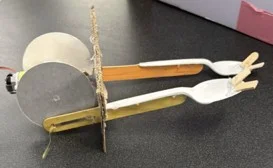 Example of a student-built biomimetic motorized digging tool.Copyright Tufts University Center for Engineering Education and Outreach and TERC
In this hands-on biomimicry design challenge, students investigate how animals dig and apply what they learn to design and build a motorized digging device. Students conduct structure/function analyses of moles, pocket gophers, pangolins, and naked mole rats to identify structures, properties, and actions that support digging. They also explore simple motors, batteries, and circuits, and consider how a motor’s spinning motion can be converted into different types of movement. Using their biological research and motor explorations, student teams plan and construct a biomimetic digging device using small motors, batteries, and craft materials, then test their prototypes by digging through a simulated material such as shredded paper to locate or retrieve “treasure.”
Mechanical engineers design machines and systems that use force and motion to accomplish specific tasks, often looking to nature for inspiration when developing new solutions. Through biomimicry, engineers can study how biological structures and movements perform particular functions and translate those strategies into mechanical designs. For example, the structures and movements animals use to dig can inspire the design of digging mechanisms powered by motors. Motors convert electrical energy into rotational motion, and mechanical engineers design ways to transfer and transform that motion to perform useful tasks.
After this activity, students should be able to:
- Apply the concept of structure and function to analyze how organisms dig.
- Build a circuit with a motor and batteries.
- Use simple motors, craft materials, and tools to construct a physical prototype with moving parts.
- Implement a biomimetic design process.
- Investigate the strengths and weaknesses of different nature-inspired design ideas.
- CCSS.Math.Content.6.G.A Solve real-world and mathematical problems involving area, surface area, and volume.
Grade 6
Do you agree with this alignment? - CCSS.Math.Content.7.G.B Solve real-life and mathematical problems involving angle measure, area, surface area, and volume.
Grade 7
Do you agree with this alignment?
- STEL-1J Develop innovative products and systems that solve problems and extend capabilities based on individual or collective needs and wants.
Grades 6-8
Do you agree with this alignment? - STEL-7U Evaluate the strengths and weaknesses of different design solutions.
Grades 6-8
Do you agree with this alignment?
- CCC.6.6-8.4 Complex and microscopic structures and systems can be visualized, modeled, and used to describe how their function depends on the relationships among its parts, therefore complex natural structures/systems can be analyzed to determine how they function.
Grades 6-8
Do you agree with this alignment? - MS-ETS1-2 Evaluate competing design solutions using a systematic process to determine how well they meet the criteria and constraints of the problem.
Grades 6-8
This resource focuses on the following Three Dimensional Learning aspects of NGSS:
Science & Engineering Practices- Evaluate competing design solutions based on jointly developed and agreed-upon design criteria.Do you agree with this alignment?
Disciplinary Core Ideas- There are systematic processes for evaluating solutions with respect to how well they meet the criteria and constraints of a problem.Do you agree with this alignment?
Do you agree with this alignment? - Evaluate competing design solutions based on jointly developed and agreed-upon design criteria.
- MS-ETS1-3 Analyze data from tests to determine similarities and differences among several design solutions to identify the best characteristics of each that can be combined into a new solution to better meet the criteria for success.
Grades 6-8
This resource focuses on the following Three Dimensional Learning aspects of NGSS:
Science & Engineering Practices- Analyze and interpret data to determine similarities and differences in findings.Do you agree with this alignment?
Disciplinary Core Ideas- There are systematic processes for evaluating solutions with respect to how well they meet the criteria and constraints of a problem.Do you agree with this alignment?
- Sometimes parts of different solutions can be combined to create a solution that is better than any of its predecessors.Do you agree with this alignment?
- Although one design may not perform the best across all tests, identifying the characteristics of the design that performed the best in each test can provide useful information for the redesign process—that is, some of the characteristics may be incorporated into the new design.Do you agree with this alignment?
Do you agree with this alignment? - Analyze and interpret data to determine similarities and differences in findings.
- MS-ETS1-4 Develop a model to generate data for iterative testing and modification of a proposed object, tool, or process such that an optimal design can be achieved.
Grades 6-8
This resource focuses on the following Three Dimensional Learning aspects of NGSS:
Science & Engineering Practices- Develop a model to generate data to test ideas about designed systems, including those representing inputs and outputs.Do you agree with this alignment?
Disciplinary Core Ideas- Models of all kinds are important for testing solutions.Do you agree with this alignment?
- The iterative process of testing the most promising solutions and modifying what is proposed on the basis of the test results leads to greater refinement and ultimately to an optimal solution.Do you agree with this alignment?
Do you agree with this alignment? - Develop a model to generate data to test ideas about designed systems, including those representing inputs and outputs.
Each group needs:
- 1 internet-enabled laptop or computer
- access to the Padlet site with animal inspirations: https://padlet.com/TuftsCEEO/digging-370winala6hbvhm2
- Biomimetic Digging Device Design Challenge Brief (PDF)(1 per group)
- Structure/Function Analysis Worksheet (PDF) (1 per student)
- Design Planning Worksheet (PDF) (1 per student)
- Progress Report (PDF) (1 per student)
- Revisiting Structure/Function Analysis Worksheet (PDF) (1 per student)
- Updated Design Worksheet (PDF) (1 per student)
- Final Reflection Worksheet (PDF) (1 per student)
- 1 DC hobby gearmotor (3-6 volts), such as this one from Adafruit: https://www.adafruit.com/product/3777
- 1 AA battery pack with positive and negative wire leads and sized to hold 1, 2, or 4 AA batteries: https://www.adafruit.com/product/3858
- 2 alligator-clip wires, like these from Adafruit: https://www.adafruit.com/product/1592
- 2 AA batteries
- access to guides and tutorials for operating motors and connecting motors to craft materials:
For the entire class to share:
- bin of shredded paper for testing digging device prototypes
- assorted building materials and tools; see list below
Non-exhaustive list of possible building materials and tools:
- cardstock, index cards, or file folders
- cardboard
- paper clips
- binder clips
- craft sticks
- pipe cleaners
- wire
- rubber bands
- zip ties
- paper cups
- string
- hole puncher
- scissors
- hot glue gun
- glue sticks
- tape
- Biomimetic Digging Device Design Challenge Brief (pdf)
- Structure/Function Analysis Worksheet (docx)
- Structure/Function Analysis Worksheet (pdf)
- Structure/Function Analysis Worksheet Answer Key (docx)
- Structure/Function Analysis Worksheet Answer Key (pdf)
- Design Planning Worksheet (docx)
- Design Planning Worksheet (pdf)
- Progress Report (docx)
- Progress Report (pdf)
- Revisiting Structure/Function Analysis Worksheet (docx)
- Revisiting Structure/Function Analysis Worksheet (pdf)
- Updated Design Sketch Worksheet (docx)
- Updated Design Sketch Worksheet (pdf)
- Final Reflection Worksheet (docx)
- Final Reflection Worksheet (pdf)
Students should be:
- Familiar with biomimicry as a design approach. See Activity 1 Introduction to Biomimicry: Airborne Transport Design for an introduction to biomimicry.
- Familiar with the steps of the engineering design process.
Have you ever seen someone walking along a beach with a metal detector? What do you think they are looking for? (Pause for student responses.) A metal detector might help someone figure out where something is buried, but once they find it, there is another problem: How do they get to it?
Imagine there is treasure buried under the sand. You need to design a device that can dig through the sand to reach it. What would your device need to be able to do? What kinds of movements might help it dig? (Pause for student responses.)
Engineers have designed many different machines that dig, but they are not the only ones that are good at digging. Nature is full of expert diggers. Think about a mole, for example. A mole doesn't use a shovel, so how does it move through soil? What parts of its body might help it dig? (Pause for student responses.)
In this challenge, we're going to use biomimicry, an engineering approach that looks to nature for ideas about how to solve problems. We will investigate four animals that are especially good at digging: moles, pocket gophers, naked mole rats, and pangolins. These animals don't all dig in the same way. They use different body structures and different types of movement to move through soil.
We'll research these animals using a process called structure/function analysis. A structure is a part of an organism, such as a claw, paw, tooth, or limb. A function is what that structure helps the organism do. We'll look closely at the animals' body parts, the properties of those parts, and the actions they perform. As you investigate, you'll be thinking like an engineer: What makes this structure effective at digging, and could that same idea be used in a machine?
Then you'll use what you discover to design your own biomimetic digging device. Your device won't just be something you push through the material with your hands—it will have moving parts powered by a small motor and batteries. A motor converts electrical energy into spinning motion. One of your engineering challenges will be figuring out how to use that spinning motion to create a useful digging movement. Could you make something scratch, scoop, pull, or move back and forth? Could you reproduce one of the movements you observed in an animal?
Over the next several days, you'll work as engineers to investigate, imagine, plan, create, test, and improve your designs. Your first idea probably won't be your final idea—and that's part of engineering. Testing will help you discover what works, what doesn't, and what you can change to make your device better.
Your goal is to use what you learn from nature, along with motors and everyday building materials, to create a device that can successfully dig through our model sand and search for buried treasure.
So before we start investigating our expert diggers, think about this question: What might an animal be able to teach an engineer about how to dig?
Background
Biomimicry
Biomimicry is a design approach in which engineers look to organisms and natural systems for strategies that can inspire solutions to human problems. Rather than simply copying what an organism looks like, biomimetic design focuses on understanding how organisms accomplish particular tasks and translating those biological strategies into engineered solutions. In this activity, biomimicry provides a way to investigate how animals use specialized body structures and movements to dig and apply those strategies to the design of a mechanical digging device.
Structure/Function Analysis
Structure/function analysis is a way to examine how the physical structures of an organism contribute to a particular function. The analysis identifies important parts, or structures; their properties, such as shape, size, angle, or orientation; and their actions, such as scratching, rotating, chiseling, or pulling. In this activity, four digging strategies are investigated: scratch digging in pocket gophers, humeral-rotation digging in moles, chisel-tooth digging in naked mole rats, and hook-and-pull digging in pangolins. Examining the relationships among these animals’ structures, properties, and actions can help reveal how they accomplish the function of digging and provide inspiration for mechanical digging mechanisms.
Digging Adaptations
Animals have evolved different structures and movements for moving through soil and other materials. This activity focuses on four digging strategies: scratch digging in pocket gophers, humeral-rotation digging in moles, chisel-tooth digging in naked mole rats, and hook-and-pull digging in pangolins. Pocket gophers primarily use their strong forelimbs and claws to scratch and move soil. Moles use broad forelimbs that rotate and sweep soil away from the body. Naked mole rats can use their large front teeth to loosen and remove soil, while pangolins use strong forelimbs and curved claws to break apart and pull material. These examples demonstrate that the same overall function of digging can be accomplished through different combinations of structures, properties, and actions.
Motors and Mechanical Motion
A motor converts electrical energy into mechanical motion. The small DC motors used in this activity produce rotary, or spinning, motion at the motor shaft. Connecting a motor to a battery in a complete circuit causes the shaft to rotate; reversing the electrical connections reverses the direction of rotation. One of the central mechanical engineering challenges in the activity is determining how to use this rotary motion to produce a useful digging action. Students might use attached arms, linkages, cams, or other simple mechanisms to produce sweeping, scratching, pulling, or back-and-forth movements. You do not need to prescribe a particular mechanism; experimentation with ways to transfer and transform the motor's motion is an important part of the design process.
Before the Activity
- Make copies of worksheets
- Biomimetic Digging Device Design Challenge Brief (PDF)(1 per group)
- Structure/Function Analysis Worksheet (PDF) (1 per student)
- Design Planning Worksheet (PDF) (1 per student)
- Progress Report (PDF) (1 per student)
- Revisiting Structure/Function Analysis Worksheet (PDF) (1 per student)
- Updated Design Worksheet (PDF) (1 per student)
- Final Reflection Worksheet (PDF) (1 per student)
- Make sure students can access the curated Padlet site of photos, videos, and text about digging animals: https://padlet.com/TuftsCEEO/digging-370winala6hbvhm2.
- To prepare to guide students in investigating these animal inspirations (curated on the Padlet site), review the provided sample answers on the Structure/Function Analysis Worksheet Answer Key (PDF).
- Gather building materials for students.
- Optional: Assign a designated table for materials display, exploration, and pick-up.
- Optional: If preferred, you can instead keep the materials stowed and allocate them according to students’ design plans with lists of materials.
- Test the motors, battery packs, batteries, and alligator-clip wires before the activity to make sure they are functioning properly.
- Set up a designated testing area. For example, set up the station with:
- A clear or opaque plastic storage bin, approximately 18–24 inches long, 12–18 inches wide, and 6–10 inches deep.
- 4–6 inches of loosely packed shredded paper to represent sand or soil.
- Several small objects to represent “treasure,” such as pom-poms, plastic blocks, large beads, or other lightweight classroom objects.
- A ruler, meterstick, or measuring tape so students can measure the testing environment during Day 3.
- A designated starting line or starting area where each digging device must begin its test.
During the Activity
Day 1: Pre-Assessment, Ask, and Research (60 minutes)
Pre-Assessment Brainstorm
- Ask students to brainstorm animals they already know that dig. Record their ideas where the class can see them.
- After students share their ideas, ask them to consider how each animal digs. Encourage students to identify the body parts the animals use and the movements they make while digging.
- Guide a brief class discussion comparing the animals students identified. Ask questions such as:
- What body parts do these animals use to dig?
- How do those body parts move during digging?
- What similarities do you notice among the different animals?
- What differences do you notice in how the animals dig?
- Do you think some of these animals are better suited for digging than others? Why?
- Explain that students will investigate several digging animals more closely to understand how their body structures and movements help them dig. They will then use what they learn as inspiration for designing their own digging devices.
(Optional) Review Biomimicry
- If students did not complete Activity 1 (Introduction to Biomimicry and Airborne Transport Design), or have not otherwise been introduced to biomimicry, take a few minutes to familiarize them with the approach. Show the video “The World is Poorly Designed. But Copying Nature Helps.” (6:49 minutes) to explain biomimicry and illustrate what it looks like when engineers use it to design solutions.
Introduce Design Challenge
- Divide the class into groups of two to three students.
- Distribute one Biomimetic Digging Device Design Challenge Brief (PDF) to each group or display Image 1 for students to view. (See Image 1.)
- Explain that students will use biomimicry to design and build a digging device inspired by the structures and functions of digging animals.
- Review the design criteria with the students:
- Device must dig through shredded paper (standing in for sand).
- Device must stay connected as one device during and after the dig.
- Device must be able to dig for treasure multiple times.
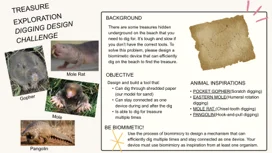 Biomimetic digging design challenge brief.Copyright Tufts University Center for Engineering Education and Outreach and TERC
Introduce the Biological Inspirations
- Use the images and resources on the provided Padlet to briefly introduce students to the four inspirational organisms and their digging strategies: scratch diggers (pocket gophers), humeral-rotation diggers (moles), chisel-tooth diggers (naked mole rats), and hook-and-pull diggers (pangolins).
Review Structure/Function Analysis
- Review the process of structure/function analysis. Explain that scientists can study how biological structures contribute to particular functions by identifying:
- Parts: The physical structures of the organism (nouns).
- Properties: The characteristics of those structures (adjectives).
- Actions: What those structures do (verbs).
- Optional: Model a structure/function analysis of one of the organisms as a class. Refer to Activity 1 (Introduction to Biomimicry and Airborne Transport Design) of this unit for a sample anchor chart demonstrating the structure/function analysis process.
Conduct Structure/Function Analysis
- Assign each group one of the four digging organisms to investigate more closely.
- Distribute one Structure/Function Analysis Worksheet (PDF) to each student.
- Have each group use the Padlet resources to analyze the parts, properties, and actions of their assigned organism. (Sample answers are included in the Structure/Function Analysis Worksheet Answer Key (PDF).)
- As groups study their assigned animals, circulate the room and support their work. Encourage students to incorporate mathematical thinking into their analyses by considering measurements, angles, ratios, proportions, and scale. Ask questions such as: At what angle do the animal’s paw and arm meet? How might this relationship help the animal perform the function of digging?
Share Findings
- Bring the class together to discuss the results of their structure/function analyses.
- As students share their observations, it can be helpful to make a three-column chart (see example in Activity 1: Introduction to Biomimicry and Airborne Transport Design) for each of the four organisms, listing the parts, properties, and actions that support digging.
- Optional: After students have researched the different animals on the Padlet, have students use their arms and hands to mimic the digging motions of each organism. Ask students to compare the motions and consider how these different types of movement might be reproduced in a mechanical digging device.
Day 2: Research: Explore Motors (60 minutes)
Simple Hands-On Exploration
- Introduce a motor simply as a device that uses internal magnets to convert electricity into spinning motion.
- Pass out 1 motor, 2 alligator-clip wires, 1 AA battery pack, and AA batteries to each group.
- Challenge students to figure out how to get the motor running: with the batteries. Encourage students to talk through the process with one another and allow them to try troubleshooting by themselves before jumping in to help.
- If some students quickly get their motors to run, challenge them to figure out how to get the motor moving in the opposite direction.
Quick-Build Task
- Challenge students to securely attach a cardboard or craft-stick arm to the motor shaft and add a flag (made of paper or other craft material) to the end of the arm. The goal is for the flag to rotate around as the motor spins.
- Support students’ explorations with this set of photos and tutorials that show how to attach materials to motor axles: Motor Attachment Tips (PPTX).
- If there is time, instruct students to use the DIY Switches (PPTX) photo tutorial to create a DIY switch for their motor so they can control when the flag is spinning and which direction it is spinning.
Summarize Motors
- After students have had concrete experiences getting a motor to spin, formalize their learning by discussing these key terms and concepts:
- How are motors used in tools and machines?
- Motors create motion from electrical energy. The spinning motion of a motor axle can be used to make other parts of a tool or machine move.
- What is challenging about designing a tool or machine with a motor?
- The challenge with motors is that their axles go round and round, but many tools and machines need to have straight-line or back-and-forth motion. When designing with motors, engineers have to figure out how the spinning motion of an axle can be converted to motion in a straight line or back and forth.
- What is an electric circuit?
- An electric circuit is a complete path through which electric current can flow. In this activity, the circuit includes a battery, wires, and a motor. A switch can be added to control the flow of current.
- What does a battery do?
- A battery stores and provides power to an electronic device such as a motor.
- What does a switch do?
- A switch can turn on or off the flow of current and a load (e.g., light bulb, fan, etc.).
Ask students to think back to the digging motions they observed on Day 1. How might they use the spinning motion of a motor to reproduce one of those digging actions?
Day 3: Imagine, Plan, Create, and Test (60 minutes)
- Re-display Image 1 and remind students of the criteria for the digging-device design challenge.
- Have students measure the length, width, and depth of the testing site and then use their measurements to calculate its area and volume. Have them consider these dimensions when making decisions about the scale and shape of their digging tools.
- Provide students with access to the photo-based tips for sturdy construction with motors:
- Have students brainstorm and plan their design for treasure exploration digging tools in their Design Planning Worksheet (PDF).
- Remind students to create a labeled sketch that:
- Labels each component/part in their design.
- Labels what material they are using in specific places.
- Helps them visualize the working of the digging tool.
- Helps them explain how they utilized biomimicry in their design.
- Encourage students to use their Structure/Function Analysis Worksheet (PDF) as they develop their designs.
- As students brainstorm and plan, circulate to ask them about their animal inspiration(s) and how their designed tool will be similar to and different from the animal(s).
Build Initial Prototype
- Have students gather the materials identified in their Design Planning Worksheet (PDF) and begin constructing their digging-device prototypes.
- Encourage students to refer to their design sketches as they build while recognizing that they may need to make adjustments as they encounter construction challenges.
- Remind students to use the Motor Mounting Tips (PPTX), Motor Attachment Tips (PPTX), and Tips for Translating Motor Motion (PPTX) resources as needed.
- As students build, circulate and ask them to explain how particular structures or movements in their prototypes were inspired by their digging animals.
Test Initial Prototype
- Once students have a functional prototype, have them test it at the testing site against the design criteria.
- Encourage groups to begin testing their prototypes as soon as they become functional. Have students observe what happens during each test and make small adjustments as needed. Groups that do not complete an initial test during Day 3 should do so at the beginning of Day 4.
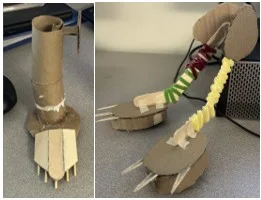 Examples of student-built mole-inspired digging tools.Copyright Tufts University Center for Engineering Education and Outreach and TERC
Day 4: Analyze, Improve, and Iterate (60 minutes)
Analyze, Document Progress, and Gather Feedback
- Distribute the Progress Report (PDF).
- In the first 5 minutes, have students use their observations and test results to document the performance of their prototypes and identify features that worked well and features that could be improved.
- Pair each group with another group.
- Have students share their prototypes and test results with each other and compare the strengths and weaknesses of their different nature-inspired design approaches.
- Encourage students to give and receive constructive feedback about how their designs might be improved.
- Have students add relevant peer feedback to their Progress Report (PDF).
Redesign, Test, and Iterate
- Have students use their test results, Progress Report (PDF), and peer feedback to identify changes they want to make to their prototypes.
- Encourage students to revisit their Structure/Function Analysis Worksheet (PDF) for additional inspiration. Ask them to consider whether they could better incorporate a useful structure, property, or action from their digging animal into their designs.
- Have students update their design sketches before gathering additional materials or rebuilding their prototypes.
- Have students modify their prototypes and test them again against the design criteria.
- Encourage students to continue the design-test-improve cycle as time allows, using evidence from each test to inform their next design modification.
- Optional: Distribute the Revisiting Structure/Function Analysis Worksheet (PDF) and Updated Design Worksheet (PDF) to provide additional structure for the redesign and iteration process.
Example of a student-built biomimetic motorized digging tool.Copyright Tufts University Center for Engineering Education and Outreach and TERCDay 5: Present and Reflect (60 minutes)
Share Out Prototypes
- Have students share their updated prototypes with the class.
- As students present, have them:
- Identify which organism(s) they took inspiration from.
- Identify what worked and what didn’t.
- Break down the structure/function behind their design.
- Have students describe what worked well, what did not work as expected, and how they modified their designs based on testing.
- Facilitate a class discussion about the relationship between the biological structures students observed and the engineered structures they created.
Reflection
- Distribute one Final Reflection Worksheet (PDF) to each student.
- Have students complete the Final Reflection Worksheet (PDF) to reflect on their use of biomimicry, the performance of their designs, and the changes they made during the engineering design process.
- biomimicry (noun)
- A practice that learns from and mimics the strategies used by living organisms to solve challenges comparable to the ones we face as individuals and societies.
- mechanism (noun)
- A system of parts that work together to do something.
- dig (verb)
- To break up, turn over, or remove earth, sand, etc., as with a shovel, spade, bulldozer, or claw; to make one’s way or work by removing or turning over material.
- electric circuit (noun)
- A closed loop that allows electric current to flow.
- battery (noun)
- A device that stores chemical energy and converts it into electrical energy that can power a circuit.
- switch (noun)
- A device that turns on/off the flow of current.
- motor (noun)
- A device that uses a wire coil and magnets to convert electrical energy into the spinning of a shaft.
Pre-Activity Assessment
Brainstorming: Have students come up with different digging animals that they already know prior to the activity. After students have shared their ideas, ask students how those animals are able to dig. Are there any differences among the different animals they can think of? Is there an animal they believe is better at digging than the other examples of animals people have shared?
Activity Embedded (Formative) Assessment
Design Check-Ins: As students plan, build, test, and improve their prototypes, circulate among the groups and ask questions to assess students’ understanding of structure and function and their application of biomimicry. Ask questions such as: What animal inspired your design? What parts of your design interact with the material you are trying to dig? How is that part of your design similar to a structure found in your animal inspiration? How does the movement of your device mimic the animal’s digging motion?
Worksheets and Design Documentation: Throughout the activity, review students’ Structure/Function Analysis Worksheet (PDF), Design Planning Worksheet (PDF), Progress Report (PDF), Revisiting Structure/Function Analysis Worksheet (PDF), Updated Design Worksheet (PDF) and Final Reflection Worksheet (PDF) to assess their understanding of structure and function, application of biomimicry, design decisions, and use of evidence to improve their designs.
Post-Activity (Summative) Assessment
Final Design Share-Out: Have groups present their final prototypes to the class. Ask students to identify the organism or organisms that inspired their designs, explain how specific biological structures, properties, or actions influenced their design choices, and describe how testing and iteration led to changes in their prototypes.
Final Reflection: Review students’ Final Reflection Worksheet (PDF) to assess their understanding of biomimicry, structure and function, the performance of their designs, and how they used evidence from testing and feedback to improve their engineering solutions.
- When using hot glue guns, remind students not to touch the heated tip or hot glue. Monitor students during use and unplug hot glue guns when they are not actively being used. Place hot glue guns in a secure location where they cannot fall or be accidentally touched.
- Monitor students when they are cutting cardboard or other materials. Review proper use of scissors and other cutting tools, and make sure students always cut away from their bodies. If box cutters or other sharp cutting tools are used, provide close adult supervision.
Motors
- If students don’t think their motors are working, first check if the wires have been attached properly. If that doesn’t work, have students check whether they’ve put in the batteries at the correct positions.
- Make sure that students aren’t expecting the motor to move too heavy of a load.
Possible Modifications if Needed:
- For classrooms with limited access to motors and battery packs, prepare one or more reusable bases with the motors, batteries, and electrical connections already installed. Instead of constructing the entire motorized system, have students design and build digging mechanisms that can be attached to the prepared base and use the motor’s rotation to create a digging motion.
- For students who have difficulty cutting cardboard or other construction materials, provide pre-cut pieces in a variety of sizes and shapes. You may also assist students with cutting as needed while allowing students to make the other construction and design decisions themselves.
https://padlet.com/TuftsCEEO/digging-370winala6hbvhm2
Contributors
William Church, Debra Bernstein, Mike Cassidy, Kristen Wendell, Geling (Jazz) Xu, Tyrine Pangan, Ethan Danahy, Pragyee Shrestha
Supporting Program
Tufts University Center for Engineering Education and Outreach (CEEO) in Medford, Massachusetts; Technical Education Research Centers (TERC) in Cambridge, Massachusetts., This material is based on work supported by the National Science Foundation (NSF) under Grant No. 2300433. Any opinions, findings, conclusions, or recommendations expressed in this material are those of the author(s) and do not necessarily reflect the views of the National Science Foundation.
Acknowledgements
This material is based on work supported by the National Science Foundation (NSF) under Grant No. 2300433. Any opinions, findings, conclusions, or recommendations expressed in this material are those of the author(s) and do not necessarily reflect the views of the National Science Foundation.
Copyright
2026 by Regents of the University of Colorado; original © 2025 Tufts University Center for Engineering Education and Outreach