
Biomimetic Grasping Design: Fruit Harvesting Devices
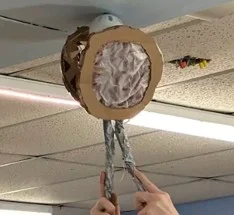 Example of a student-built fruit harvester prototype, grasping a ball attached to the ceiling.Copyright Tufts University Center for Engineering Education and Outreach and TERC
Students explore biomimicry by taking inspiration from plants and animals to design and build a fruit harvesting tool. Students begin by conducting a structure/function analysis of three organisms that are well adapted for grasping and capturing objects: birds of prey, Venus flytraps, and trap-jaw ants. After investigating the parts, properties, and actions that contribute to these organisms’ grasping abilities, students apply what they learned to design a hand-operated device that can grasp and harvest a model fruit without damaging it. Using craft materials to build their prototypes and wiffle balls or ping-pong balls to represent fruit, students build, test, evaluate, and revise their designs. Throughout the iterative design process, students revisit their biological inspirations and use evidence from testing and peer feedback to improve their fruit harvesting tools.
Harvesting fruit is an important agricultural process that helps move food from farms to consumers. Because many fruits are delicate, harvesting them efficiently while minimizing bruising or other damage can present an engineering challenge. Agricultural engineers and engineering technologists help address challenges like these by designing, testing, and improving machinery and tools used for planting, growing, harvesting, and processing crops. When developing harvesting technologies, engineers must consider factors such as the size and shape of the fruit, the force needed to grasp and remove it, the speed and efficiency of the harvesting process, and the potential for damage. Biomimicry offers one approach to solving these challenges. By studying how plants and animals grasp, capture, and hold objects, engineers can identify biological structures and functions that may inspire new approaches to designing effective harvesting tools.
After this activity, students should be able to:
- Apply the concept of structure and function to analyze how organisms grasp.
- Implement a biomimetic design process.
- Use craft materials and tools to construct a physical prototype with moving parts.
- Investigate the strengths and weaknesses of different nature-inspired design ideas.
- STEL-1J Develop innovative products and systems that solve problems and extend capabilities based on individual or collective needs and wants.
Grades 6-8
Do you agree with this alignment? - STEL-7U Evaluate the strengths and weaknesses of different design solutions.
Grades 6-8
Do you agree with this alignment?
- CCC.6.6-8.4 Complex and microscopic structures and systems can be visualized, modeled, and used to describe how their function depends on the relationships among its parts, therefore complex natural structures/systems can be analyzed to determine how they function.
Grades 6-8
Do you agree with this alignment? - MS-ETS1-1 Define the criteria and constraints of a design problem with sufficient precision to ensure a successful solution, taking into account relevant scientific principles and potential impacts on people and the natural environment that may limit possible solutions.
Grades 6-8
This resource focuses on the following Three Dimensional Learning aspects of NGSS:
Science & Engineering Practices- Define a design problem that can be solved through the development of an object, tool, process or system and includes multiple criteria and constraints, including scientific knowledge that may limit possible solutions.Do you agree with this alignment?
Disciplinary Core Ideas- The more precisely a design task's criteria and constraints can be defined, the more likely it is that the designed solution will be successful. Specification of constraints includes consideration of scientific principles and other relevant knowledge that is likely to limit possible solutions.Do you agree with this alignment?
Crosscutting Concepts- The uses of technologies and any limitations on their use are driven by individual or societal needs, desires, and values; by the findings of scientific research; and by differences in such factors as climate, natural resources, and economic conditions.Do you agree with this alignment?
- All human activity draws on natural resources and has both short and long-term consequences, positive as well as negative, for the health of people and the natural environment.Do you agree with this alignment?
Do you agree with this alignment? - Define a design problem that can be solved through the development of an object, tool, process or system and includes multiple criteria and constraints, including scientific knowledge that may limit possible solutions.
- MS-ETS1-3 Analyze data from tests to determine similarities and differences among several design solutions to identify the best characteristics of each that can be combined into a new solution to better meet the criteria for success.
Grades 6-8
This resource focuses on the following Three Dimensional Learning aspects of NGSS:
Science & Engineering Practices- Analyze and interpret data to determine similarities and differences in findings.Do you agree with this alignment?
Disciplinary Core Ideas- There are systematic processes for evaluating solutions with respect to how well they meet the criteria and constraints of a problem.Do you agree with this alignment?
- Sometimes parts of different solutions can be combined to create a solution that is better than any of its predecessors.Do you agree with this alignment?
- Although one design may not perform the best across all tests, identifying the characteristics of the design that performed the best in each test can provide useful information for the redesign process—that is, some of the characteristics may be incorporated into the new design.Do you agree with this alignment?
Do you agree with this alignment? - Analyze and interpret data to determine similarities and differences in findings.
Each group needs:
- 1 internet-enabled laptop or computer
- access to the Padlet site with plant and animal inspirations: https://padlet.com/TuftsCEEO/grasping-8aqcinra3exqb8tm
- Biomimetic Fruit Harvester Design Challenge Brief (PDF) (1 per group)
- Structure/Function Analysis Worksheet (PDF) (1 per student)
- Design Planning Worksheet (PDF) (1 per student)
- Progress Report (PDF)(1 per student)
- Revisiting Structure/Function Analysis Worksheet (PDF) (1 per student)
- Updated Design Worksheet (PDF) (1 per student)
- Final Reflection Worksheet (PDF)(1 per student)
For the entire class to share:
- variety of balls to use as model fruit (e.g., wiffle ball, ping pong ball)
- assorted building materials and tools; see list below
Non-exhaustive list of possible building materials and tools:
- scissors
- hole puncher
- glue guns and glue sticks
- tape
- cardboard
- cardstock, file folders, or index cards
- rubber bands
- string
- zip ties
- paper clips
- binder clips
- pipe cleaners
- wire
- craft sticks
- paper cups
- Biomimetic Fruit Harvester Design Challenge Brief
- Structure/Function Analysis Worksheet (docx)
- Structure/Function Analysis Worksheet (pdf)
- Structure/Function Analysis Worksheet Answer Key (docx)
- Structure/Function Analysis Worksheet Answer Key (pdf)
- Design Planning Worksheet (docx)
- Design Planning Worksheet (pdf)
- Progress Report (docx)
- Progress Report (pdf)
- Revisiting Structure/Function Analysis Worksheet (docx)
- Revisiting Structure/Function Analysis Worksheet (pdf)
- Updated Design Worksheet (docx)
- Updated Design Worksheet (pdf)
- Final Reflection Worksheet (docx)
- Final Reflection Worksheet (pdf)
Students should be:
- Familiar with biomimicry as a design approach. See Activity 1 Introduction to Biomimicry: Airborne Transport Design for an introduction to biomimicry.
- Familiar with the steps of the engineering design process.
Have you ever tried to pick a piece of fruit from a tall tree or seen people or machines harvesting fruit? How do people get the fruit off the tree? What might make harvesting fruit difficult? (Pause to hear student ideas.)
Farmers need to harvest large amounts of fruit and get that fruit from the tree to us without damaging it. That can be challenging. Some fruits grow high in trees or in places that are difficult to reach. Workers may need ladders or other equipment to reach them, and even then, some fruit may be difficult to access. Fruits can also be delicate. A harvesting tool needs to grasp a piece of fruit firmly enough to remove it from the plant but gently enough that it does not crush, puncture, or bruise it. Engineers who design agricultural tools and equipment have to think about challenges like these.
So, your engineering challenge is to design a hand-operated tool that could help a farmer safely harvest fruit that is difficult to reach. We obviously don’t have fruit trees growing in our classroom, so we’re going to model the problem. We’ll use lightweight balls, such as wiffle balls and ping-pong balls, to represent fruit and place them in locations such as the ceiling or wall. Your tool will need to reach the model fruit, grasp it, and remove it without damaging it.
But before you start designing, we’re going to look to nature for ideas. We’ll use a design approach called biomimicry. Biomimicry involves studying how living things accomplish tasks or solve problems and using what we learn as inspiration for human designs. Nature has many examples of organisms that are very good at grasping, capturing, and holding things.
We’re going to investigate three of those organisms: birds of prey, Venus flytraps, and trap-jaw ants. Each uses different structures and actions to capture or hold the food it needs to survive. Birds of prey use their feet and talons, Venus flytraps use specialized leaves, and trap-jaw ants use their mandibles. Instead of just seeing what these organisms look like, we’re going to investigate how their structures help them perform the function of grasping or capturing.
To do this, we’ll conduct a structure/function analysis. We’ll break each organism down into important parts, examine the properties or characteristics of those parts, and identify the actions those parts perform. For example, we might notice that a structure is curved or flexible, that it wraps around an object, or that two parts close toward each other. Understanding these details can give us ideas that we can translate into an engineering design.
Then it will be your turn to become biomimicry engineers. You’ll use what you learn from one or more of these organisms to brainstorm and sketch a fruit harvesting tool. You’ll use craft materials to build a prototype, test how well it grasps and removes the model fruit, and collect evidence about what works and what doesn’t. You’ll also get feedback from other students and return to your biological inspirations to look for ideas that might help solve problems with your first design.
Finally, you’ll use what you learned to redesign and improve your prototype and test it again. At the end of the challenge, we’ll compare our designs and think about how studying nature influenced the solutions we created. Remember, biomimicry doesn’t mean you have to make something that looks exactly like a bird’s foot, a Venus flytrap, or an ant’s jaws. The goal is to understand how nature accomplishes the task of grasping and use those ideas to develop your own engineering solution.
Background
Biomimicry and Engineering Design
Biomimicry is a design approach in which engineers and designers study biological systems to gain inspiration for solving human problems. Rather than simply copying what an organism looks like, biomimicry focuses on understanding how and why biological structures, properties, and processes function and considering how those strategies might be translated into engineered solutions. For example, an engineer interested in designing a device that can securely grasp delicate objects might investigate how different organisms capture, grip, hold, or release objects without relying on human-like hands.
Structure and Function
An important concept underlying biomimicry is the relationship between structure and function. In biology, a structure is a physical feature or part of an organism, while a function describes what that structure enables the organism to do. The properties of a structure—such as its shape, size, flexibility, texture, stiffness, or arrangement—often contribute to how effectively it performs its function.
In this activity, students use a structure/function analysis that examines an organism in terms of its parts, properties, and actions. Parts are physical structures, properties describe characteristics of those structures, and actions describe what the structures do. For example, students might observe that a grasping structure is curved (property), closes around an object (action), and helps the organism hold onto something (function). Breaking biological systems into these components helps students move beyond simply copying an organism’s appearance and toward identifying biological strategies that could inform an engineering design.
Biological Strategies for Grasping
The three biological inspirations in this activity—birds of prey, Venus flytraps, and trap-jaw ants—use very different structures and mechanisms to capture or grasp objects. These differences provide students with multiple strategies that can inspire their designs.
Birds of prey use their feet and talons to capture and securely hold prey. Their toes can wrap around an object, while curved, pointed talons help maintain a secure grip. This system can inspire engineering ideas involving multiple grasping points, curved structures, wrapping motions, or surfaces that increase grip.
Venus flytraps use modified leaves to capture insects. When triggered, the two lobes of the leaf rapidly close around the prey. Structures along the edges help contain the captured organism while the trap closes more completely. This mechanism can inspire designs that surround an object from two sides, use hinged or flexible components, or close around an object.
Trap-jaw ants use specialized mandibles that can open widely and snap shut extremely rapidly. Their grasping mechanism demonstrates how opposing structures and rapid closing actions can be used to capture or manipulate objects. Students might translate this strategy into designs involving jaws, pincers, hinges, levers, or opposing gripping surfaces.
Engineering Fruit Harvesting Tools
Harvesting fruit presents an engineering challenge because a tool must apply enough force to securely grasp and remove a piece of fruit while avoiding excessive force that could bruise, puncture, crush, or otherwise damage it. The size, shape, surface texture, and position of the fruit can also affect how easily it can be grasped. Engineers designing harvesting equipment therefore consider not only whether a device can grasp an object, but also where forces are applied, how those forces are distributed, how securely the object is held, and how easily it can be released.
During this activity, wiffle balls or ping-pong balls serve as simplified models of fruit. Students' prototypes do not reproduce all the complexities of real agricultural harvesting, but the challenge allows them to explore fundamental engineering considerations involved in grasping and manipulating delicate objects. Through testing and iteration, students can evaluate how characteristics such as the shape, flexibility, texture, arrangement, and movement of their grasping structures affect the performance of their devices.
Before the Activity
- Print copies of worksheets.
- Biomimetic Fruit Harvester Design Challenge Brief (PDF) (1 per group)
- Structure/Function Analysis Worksheet (PDF) (1 per student)
- Design Planning Worksheet (PDF) (1 per student)
- Progress Report (PDF) (1 per student)
- Revisiting Structure/Function Analysis Worksheet (PDF) (1 per student)
- Updated Design Worksheet (PDF) (1 per student)
- Final Reflection Worksheet (PDF)(1 per student)
- Make sure students can access the curated Padlet site of photos, videos, and text about grasping animals and plants: https://padlet.com/TuftsCEEO/grasping-8aqcinra3exqb8tm
- To prepare to guide students in investigating the plant and animal inspirations curated on the Padlet site, review the provided sample answers on the Structure/Function Analysis Worksheet Answer Key (PDF).
- Gather building materials for students.
- Optional: Assign a designated table for materials display, exploration, and pick-up.
- Optional: If preferred, you can instead keep the materials stowed and allocate them according to students’ design plans with lists of materials.
During the Activity
Day 1: Pre-Assessment, Ask, and Research (60 minutes)
Pre-Assessment Brainstorm
- Ask students to share what they know about how people harvest fruit.
- Discuss different methods they may have seen or experienced, such as picking fruit by hand or using tools or machinery.
- Ask students to identify challenges associated with harvesting fruit, particularly when fruit is difficult to reach or can be easily bruised or damaged.
- Encourage students to consider what a successful fruit harvesting tool would need to be able to do.
(Optional) Review Biomimicry
- If students did not complete Activity 1 (Introduction to Biomimicry: Airborne Transport Design), or have not otherwise been introduced to biomimicry, you’ll want to take a few minutes to familiarize them with the approach. Show the video “The World is Poorly Designed. But Copying Nature Helps.” (6:49 minutes) to explain biomimicry and illustrate what it looks like when engineers use it to design solutions.
Introduce Design Challenge
- Divide the class into groups of two or three students.
- Distribute one Biomimetic Fruit Harvester Design Challenge Brief (PDF) to each group or display Image 1 for students to view. (See Image 1.)
- Explain that students will use biomimicry to design a mechanism capable of grasping and removing difficult-to-reach fruit.
- Review the design criteria with the students:
- Design a tool that can grasp a lightweight ball, which represents a piece of fruit, and remove it from the ceiling or wall.
- The device must use biomimicry as inspiration from at least one organism.
- The tool must be hand-operated.
- The “fruit” should not be damaged when grasped.
- Optional: The tool must be able to harvest a specified number of “fruits” within a specified amount of time.
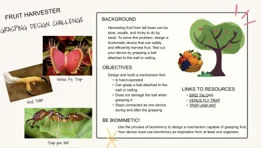 Biomimetic fruit harvester design challenge brief.Copyright Tufts University Center for Engineering Education and Outreach and TERC
Introduce the Biological Inspirations
- Use the images and resources on the provided Padlet to briefly introduce students to the three biological inspirations for the fruit harvesting challenge: birds of prey, Venus flytraps, and trap-jaw ants.
Conduct Structure/Function Analysis
- Introduce or review the process of structure/function analysis. Explain that scientists can study how biological structures contribute to particular functions by identifying:
- Parts: The physical structures of the organism (nouns).
- Properties: The characteristics of those structures (adjectives).
- Actions: What those structures do (verbs).
- Optional: Model a structure/function analysis of one of the organisms as a class. Refer to Activity 1 of this unit for a sample anchor chart demonstrating the structure/function analysis process.
- Assign each group one biological inspiration: bird talons, Venus flytraps, or trap-jaw ants.
- Distribute one Structure/Function Analysis Worksheet (PDF) to each student.
- Have each group use the Padlet resources to analyze the parts, properties, and actions of their assigned organism. (Sample answers are included in the Structure/Function Analysis Worksheet Answer Key (PDF).)
- As groups study their assigned animals, circulate the room and support their work.
- Bring the class together to discuss the results of their structure/function analyses.
- As students share their observations, create a three-column chart for each organism listing the parts, properties, and actions that contribute to grasping or capturing.
Day 2: Imagine, Plan, and Create (60 minutes)
Brainstorm and Sketch
- Re-display Image 1 and review the design challenge criteria and constraints for the fruit harvester design challenge.
- Distribute one Design Planning Worksheet (PDF) to each student.
- Introduce the materials and tools available for building the fruit harvesting prototypes.
- Allow students time to examine and handle the materials before planning and designing their initial prototypes.
- Have each group select the type of ball they will use to represent a piece fruit, such as a wiffle ball or ping-pong ball.
- Have groups determine where their “fruit” will be positioned for harvesting, such as on a wall, ceiling, table, or floor. Ensure that each group clearly understands the conditions under which its prototype will be tested.
- Instruct groups to brainstorm and then plan out their design ideas for their fruit harvesting tool on their Design Planning Worksheet (PDF).
- Remind students to create a labeled sketch that:
- Shows the major components or parts of the harvesting tool.
- Identifies the materials that will be used for each component.
- Shows how the tool will grasp and remove the “fruit.”
- Identifies the structures, properties, or actions inspired by their biological organism(s).
- Encourage students to use their Structure/Function Analysis Worksheets (PDF) as they develop their designs rather than simply copying the overall appearance of an organism.
- Ask them to consider which biological structures, properties, and actions could help their device perform the desired function.
- As students brainstorm and plan, circulate among the groups and ask them to explain their biological inspiration and how their proposed design is similar to and different from the biological system. Prompt students with questions such as:
- Which structure or action from your organism inspired this part of your design?
- What property of that biological structure are you trying to imitate?
- How will that feature help your tool grasp the fruit?
- How is your design different from the biological structure?
Build the Initial Prototype
- Have students build initial prototypes using the available materials.
- Circulate as students build, asking questions that encourage them to connect their design decisions to the structures and functions observed in their biological inspirations. Consider asking:
- Which organism or organisms inspired your design?
- Which features of the organism did you incorporate into your prototype?
- How does this part of your design help with grasping fruit?
- How does this feature relate to the structure and function you observed in your biological inspiration?
Day 3: Test and Analyze (60 minutes)
Conduct Initial Testing
- Have each group conduct an initial formal test of its prototype.
- Have students observe and record how their devices perform.
- Ensure that all groups have completed at least one test during the class period.
Analyze, Document Progress, and Gather Feedback
- Distribute one Progress Report (PDF) to each student.
- In the first 5 minutes, have students use their observations and test results to document the performance of their prototypes and identify features that worked well and features that could be improved.
- Pair each group with another group.
- Have students share their prototypes and test results with each other and compare the strengths and weaknesses of their different nature-inspired design approaches.
- Encourage students to give and receive constructive feedback about how their designs might be improved.
- Have students add relevant peer feedback to their Progress Report (PDF).
Revisit Structure/Function Analysis
- Distribute one Revisiting Structure/Function Analysis Worksheet (PDF) to each student.
- Have students return to the biological inspirations they investigated on Day 1 and reconsider their structures, properties, and actions in light of what they learned from their initial prototype testing.
- Encourage students to identify biological features that could help address problems observed during testing. Prompt students to consider questions such as:
- Is there a biological structure or property that your initial design did not incorporate?
- How does your prototype behave differently from the organism it was inspired by?
- Could another biological inspiration provide a useful feature for your redesign?
- How could you better imitate a biological structure, property, or action in your improved design?
- Have students complete the Revisiting Structure/Function Analysis Worksheet (PDF) to document how their developing understanding of the biological system can inform their redesign.
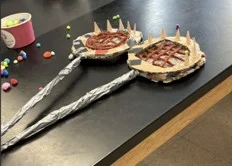 The inner surfaces of a student-built fruit harvester prototype.Copyright Tufts University Center for Engineering Education and Outreach and TERC
Day 4: Redesign, Build, and Test (60 minutes)
Plan the Redesign
- Distribute one Updated Design Worksheet (PDF) to each student.
- Have students use evidence from their initial tests, peer feedback, and revisited structure/function analyses to identify changes they want to make to their prototypes.
- Have students document their planned changes on the Updated Design Worksheet (PDF), including which features they will change and why they expect those changes to improve performance.
Build the Redesign
- Have students modify their fruit harvesting tools according to their redesign plans.
- Circulate as students work and encourage them to explain how their modifications are based on testing evidence, peer feedback, and the structures and functions of their biological inspirations.
Conduct Final Testing
- Have groups conduct final tests of their redesigned prototypes using the same testing procedures used for their initial tests.
- Have students compare the performance of their initial and redesigned prototypes and determine whether their modifications improved performance.
Example of a student-built fruit harvester prototype, grasping a ball attached to the ceiling.Copyright Tufts University Center for Engineering Education and Outreach and TERCDay 5: Present and Reflect (60 minutes)
Share Out Prototypes
- Have students share their final fruit harvesting tools with the class.
- As students present, have them identify the organism or organisms that inspired their designs and explain how specific structures, properties, and actions from those organism(s) influenced their design choices.
- Have students describe what worked well, what did not work as expected, and how they modified their designs based on testing.
- Facilitate a class discussion about the relationship between the biological structures students observed and the engineered structures they created.
Reflection
- Distribute one Final Reflection Worksheet (PDF) to each student.
- Have students complete the Final Reflection Worksheet (PDF)to reflect on their use of biomimicry, the performance of their designs, and the changes they made during the engineering design process.
- grasp (verb)
- To seize and hold firmly.
- harvest (noun)
- The process or period of gathering in crops.
- mechanism (noun)
- A system of parts that work together to do something.
- biomimicry (noun)
- A practice that learns from and mimics the strategies used by living organisms to solve challenges comparable to the ones we face as individuals and societies.
Pre-Activity Assessment
Brainstorming: Ask students to share what they know about how people harvest fruit and identify challenges associated with harvesting fruit, particularly when fruit is difficult to reach or easily damaged. Encourage students to consider what a successful fruit harvesting tool would need to be able to do. Use student responses to assess their prior understanding of the problem and engineering design considerations.
Activity Embedded (Formative) Assessment
Structure/Function Analysis: Students work in groups to complete the Structure/Function Analysis Worksheets (PDF). Review students’ Structure/Function Analysis Worksheets (PDF) to assess their ability to identify the parts, properties, and actions of their assigned biological inspiration and explain how these features contribute to grasping or capturing.
Design Planning: Review students’ Design Planning Worksheet (PDF) and observe group discussions to assess how well students translate biological structures, properties, and actions into features of their fruit harvesting designs.
Post-Activity (Summative) Assessment
Final Design Share-Out: Have groups present their final fruit harvesting tools to the class. Ask students to identify the organism or organisms that inspired their designs, explain how specific biological structures, properties, or actions influenced their design choices, and describe how testing and iteration led to changes in their prototypes.
Final Reflection: Review students’ Final Reflection Worksheet (PDF) to assess their understanding of biomimicry, structure and function, the performance of their designs, and how they used evidence from testing and feedback to improve their engineering solutions.
- When using hot glue guns, remind students not to touch the heated tip or hot glue. Monitor students during use and unplug hot glue guns when they are not actively being used. Place hot glue guns in a secure location where they cannot fall or be accidentally touched.
- Monitor students when they are cutting cardboard or other materials. Review proper use of scissors and other cutting tools, and make sure students always cut away from their bodies. If box cutters or other sharp cutting tools are used, provide close adult supervision.
- For students who are newer to building three-dimensional structures with craft materials, provide additional building time or extend the activity by one day.
- For students who have difficulty cutting cardboard or other materials, provide pre-cut materials in a variety of shapes and sizes or have an adult assist with cutting.
“What Is Agricultural Engineering Technology? | SFA.” SFA, 2024, www.sfasu.edu/academics/colleges/forestry-agriculture/academics/agriculture/academics/agricultural-engineering/what-is-agricultural-engineering.
YouTube Video: “Seed Dispersal” by Next Generation Science (July 5, 2023)
Contributors
William Church, Debra Bernstein, Mike Cassidy, Kristen Wendell, Geling (Jazz) Xu, Tyrine Pangan, Ethan Danahy, Pragyee Shrestha
Supporting Program
Tufts University Center for Engineering Education and Outreach (CEEO) in Medford, Massachusetts; Technical Education Research Centers (TERC) in Cambridge, Massachusetts.
Acknowledgements
This material is based upon work supported by the National Science Foundation (NSF) under Grant No. 2300433. Any opinions, findings, conclusions, or recommendations expressed in this material are those of the author(s) and do not necessarily reflect the views of the National Science Foundation.
Copyright
2026 by Regents of the University of Colorado; original © 2025 Tufts University Center for Engineering Education and Outreach