
Biomimetic Engineering Design: Making Things That Move
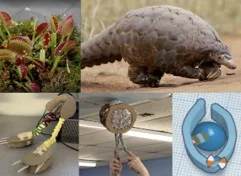 Biomimetic Engineering Design: Making Things that MoveCopyright “Waiting Venus Fly Traps” by Beatrice Murch (blmurch) is licensed under CC BY-SA 2.0. To view a copy of this license, visit https://creativecommons.org/licenses/by-sa/2.0/?ref=openverse Flickr Link: https://flic.kr/p/23QTAh “Giant ground pangolin” by Oregon State University is licensed under CC BY-SA 2.0. To view a copy of this license, visit https://creativecommons.org/licenses/by-sa/2.0/?ref=openverse Flickr Link: https://flic.kr/p/MwEsuc
This hands-on unit engages students in a biomimetic engineering design process as they investigate how plants and animals accomplish different types of motion and use those biological strategies to inspire engineered devices. Across four design challenges, students analyze biological structures and functions, translate their observations into design ideas, create and test prototypes, gather evidence and peer feedback, and iteratively improve their solutions.
Engineers are often tasked with developing multiple feasible solutions to real-world problems while working within defined criteria and constraints. Biomimicry offers engineers a way to generate diverse design ideas by investigating how organisms and natural systems successfully accomplish similar functions. By analyzing the relationships between biological structures and their functions, engineers can identify strategies from nature that may be translated into engineered solutions. Throughout this unit, students engage in similar engineering practices as they define design problems, analyze the structures and functions of biological systems, work within material and design constraints, and translate biological strategies into prototypes. Like engineers, students test their designs, evaluate evidence about what works and what could be improved, and iteratively redesign their solutions to better meet the criteria for success.
- Activity 1: Introduction to Biomimicry: Airborne Transport Design (with Craft Materials)
- Day 1: Pre-Assessment, Biomimicry, and Structure/Function Analysis
- Day 2: Imagine, Plan, Create, and Test
- Day 3: Analyze, Improve, and Iterate
- Day 4: Present and Reflect
Time Required: Four 60-minute sessions
- Activity 2: Biomimetic Grasping Design: Fruit Harvesting Devices (with Craft Materials)
- Day 1: Pre-Assessment, Ask, and Research
- Day 2: Imagine, Plan, and Create
- Day 3: Test, Analyze, and Revisit Biology
- Day 4: Redesign, Build, and Test
- Day 5: Present and Reflect
Time required: Five 60-minute sessions
- Activity 3: Biomimetic Digging Design: Treasure Exploration (with Motors And Batteries)
- Day 1: Pre-Assessment, Ask, and Research
- Day 2: Explore Motors and Mechanical Motion
- Day 3: Imagine, Plan, and Create
- Day 4: Test, Analyze, and Improve
- Day 5: Complete, Present, and Reflect
Time required: Five 60-minute sessions
- Activity 4: Biomimetic Flinging Design: T-Shirt Launchers (with Tinkercad)
- Day 1: Pre-Assessment, Ask, and Research
- Day 2: Explore Tinkercad
- Day 3: Explore Sim Lab and Mechanical Motion
- Day 4: Imagine, Plan, and Create
- Day 5: Create, Test, and Redesign
- Day 6: Present and Reflect
Time required: Six 60-minute sessions
- Biomimetic Engineering Design: Making Things That Move
Contributors
William Church, Debra Bernstein, Mike Cassidy, Kristen Wendell, Geling (Jazz) Xu, Tyrine Pangan, Ethan Danahy, Pragyee Shrestha
Supporting Program
Tufts University Center for Engineering Education and Outreach (CEEO) in Medford, Massachusetts; Technical Education Research Centers (TERC) in Cambridge, Massachusetts.
Acknowledgements
This material is based upon work supported by the National Science Foundation (NSF) under Grant No. 2300433. Any opinions, findings, conclusions, or recommendations expressed in this material are those of the author(s) and do not necessarily reflect the views of the National Science Foundation.
Copyright
2026 by Regents of the University of Colorado; original © 2025 Technical Education Research Centers