
Commanding a Robot Using Sound
Legacy Curriculum
Hey there! This curriculum is no longer being curated or supported. It may contain materials that are no longer available or outdated information. Please use this document for reference.
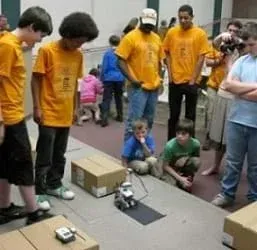 Can robots hear?Copyright GK-12 Program, Computational Neurobiology Center, College of Engineering, University of Missouri
Students continue their exploration of the human senses and their engineering counterparts, focusing on the auditory sense. Working in small groups, students design, create and run programs to control the motion of LEGO® TaskBots. By doing this, they increase their understanding of the use and function of sound sensors, gain experience writing robot programs, and reinforce their understanding of the sensory process.
**Note: This activity uses the retired LEGO NXT robot which is no longer available for purchase.
Biological engineers and neuroscientists perceive the human body as a functioning, controlled system, similar to a robot. Research is showing that mathematical principles similar to those used in robotics are extremely useful or even necessary for a complete understanding of the human body. This activity compares the human senses with similar electronic robot sensors. Researchers study how pressure sensors in the human fingers and multiple fingers work, so that they can design efficient robotic hands. Researchers also study how the human eye works to help engineers design cameras with higher performance and speed.
After this activity, students should be able to:
- Explain how the five human senses work using anatomy terminology.
- Compare the human senses to the electronic sensors in a robot.
- Program a LEGO robot with sensors to follow sound commands.
- Describe at a fundamental level how sensors are integrated into robots via logic and computer programming.
- STEL-3G Explain how knowledge gained from other content areas affects the development of technological products and systems.
Grades 6-8
Do you agree with this alignment?
- Describe how new technologies have helped scientists make better observations and measurements for investigations (e.g., telescopes, electronic balances, electronic microscopes, x-ray technology, computers, ultrasounds, computer probes such as thermometers)
Grade 5
Do you agree with this alignment? - Explain the interactions between the nervous and muscular systems when an organism responds to a stimulus
Grade 8
Do you agree with this alignment? - Make qualitative observations using the five senses
Grade 6
Do you agree with this alignment?
- MS-ETS1-2 Evaluate competing design solutions using a systematic process to determine how well they meet the criteria and constraints of the problem.
Grades 6-8
This resource focuses on the following Three Dimensional Learning aspects of NGSS:
Science & Engineering Practices- Evaluate competing design solutions based on jointly developed and agreed-upon design criteria.Do you agree with this alignment?
Disciplinary Core Ideas- There are systematic processes for evaluating solutions with respect to how well they meet the criteria and constraints of a problem.Do you agree with this alignment?
Do you agree with this alignment? - Evaluate competing design solutions based on jointly developed and agreed-upon design criteria.
- MS-ETS1-4 Develop a model to generate data for iterative testing and modification of a proposed object, tool, or process such that an optimal design can be achieved.
Grades 6-8
This resource focuses on the following Three Dimensional Learning aspects of NGSS:
Science & Engineering Practices- Develop a model to generate data to test ideas about designed systems, including those representing inputs and outputs.Do you agree with this alignment?
Disciplinary Core Ideas- Models of all kinds are important for testing solutions.Do you agree with this alignment?
- The iterative process of testing the most promising solutions and modifying what is proposed on the basis of the test results leads to greater refinement and ultimately to an optimal solution.Do you agree with this alignment?
Do you agree with this alignment? - Develop a model to generate data to test ideas about designed systems, including those representing inputs and outputs.
Each group needs:
- LEGO MINDSTORMS NXT robot, such as the NXT Base Set
- LEGO MINDSTORMS Education NXT Software 2.1
- computer, loaded with NXT 2.1 software
- Students should know the five senses of the human body and understand their function.
- Familiarity with robots and the tasks they perform. For example, robots are used to paint cars on an assembly line.
- We suggest students complete the previous unit in the series, Humans Are Like Robots, and the previous two lessons and activity in this unit prior to starting this activity.
In our previous lesson, we learned all about the human senses and sensors, as well as how the sensors work. How many primary senses do humans have? (Answer: Five) Who can tell me an example of a sensor for each of these five human senses? (Answer: Vision = eyes, auditory/hearing= eyes, smell = nose, taste = tongue, touch = skin.) These sensors are so important for how we function every moment of every day.
These senses also influence engineering designs, such as the design of robots. Engineers mimic human sensors in robots, so that the robots can sense and "understand" their surroundings.
Today, we are going to focus on the sense of sound, also known as the auditory sense. The robots sensor for sound is simply called a sound sensor. During this activity, you will gain more experience programming the robot, this time to respond to sound!
Background
The activity objective is for students to appreciate that a robot can recognize a sound be programmed to follow instructions based on that sound.
Students are challenged to design, create and run a LEGO TaskBot program using its sound sensor. The TaskBot must respond to the sound of a hand clap; on the first clap the TaskBot, while moving forward, the robot should turn to the right and then continue moving forward. On the second clap, the TaskBot should turn to the left and continue to move forward.
Before the Activity
- Gather materials. If you have conducted the previous activity in this unit, you should already have the required LEGO robot materials.
- Work with interested students to put together the TaskBots (takes about 45 minutes per bot) using the base sets (https://shop.education.lego.com/legoed/education/NXT/NXT+Base+Set+and+Software+Pk/5003404&isSimpleSearch=false), as described in the LEGO TaskBot Building Instructions (PDF), which is also available at https://www.teachengineering.org/collection/umo_/activities/umo_robots_act/how_to_build_a_lego_taskbot.pdf.
- Make copies of the LEGO Instructions to Attach Sensors to NXT Robots (PDF), one per group.
- To be able to assist students in attaching the sound sensor to the TaskBots, familiarize yourself with those instructions.
- Familiarize yourself with the entire solution program design provided in the Command by Sound Programming Solution (PDF).
With the Students
- Divide the class into groups of two to three students each.
- Provide each group with a computer, a LEGO TaskBot (already put together prior to class) and the parts and instructions needed to attach sound sensors onto the robots.
- Have students work in their groups to attach the sound sensors to the robots using the instructions.
- The programming objective is to have a robot recognize a sound and follow the "obey" instructions.
- Explain the activity challenge by stating the program requirements:
- The program should cause the robot to move forward until its sound sensor detects a hand clap sound. Once this occurs, the robot is to turn to the right, and continue on its way until it hears a second clap, at which time it should turn left and continue on its way.
- First, have students work up the solution in "logic" form, that is, write down the process, step-by-step, on paper, before beginning the NXT brick programming. Refer to the detailed solution program to guide students if they have difficulties.
- Then have groups demonstrate their programmed robots for the rest of the class. Evaluate their success using the rubric provided in the Assessment section.
- At activity end, lead a class discussion during which students share their activity experiences, especially where they encountered any difficulties. Ask the questions provided in the Assessment section.
- auditory
- Related to hearing.
- peripheral
- Surrounding.
- sensor
- A device that converts one type of signal to another. For instance, a tachometer displays the speed a car is traveling.
- sound sensor
- A sensor that detects vibrations cause by sound waves and sends this information to the robot's computer.
Pre-Activity Assessment
Sensory Review: As a class, review all the human senses, and have students create a list of the human sensors for each of the five senses. Then ask student to create a list of robot sensors, and compare each of the robot sensors to a human sensor. Have students share their responses with the class.
Embedded Activity Assessment
Programming Challenge: Expect students to be able to come up with the logic for the program, assemble the program (as shown in the Command by Sound Programming Solution (PDF)), and successfully demonstrate that it meets the challenge requirements. Use the following rubric to assess their achievements (maximum 40 points):
- The sound sensor was correctly assembled on the robot, following instructions. (5 points)
- The computer program made the robot move forward. (15 points)
- The sound sensor worked as planned, that is, it made the robot turn right, and then continue until it heard the second sound, when it turned left. (20 points)
Post-Activity Assessment
Closing Discussion: As a class, have students share their activity experiences, especially where they encountered difficulties. Also ask the students:
- What did you learn about programming?
- What are the "stimulus-sensor-coordinator-effector-response" components of this process?
- What are other examples of similarities between the human senses and robotic sensors?
- What do you want to learn about the sensors beyond this activity?
Conclude by emphasizing to the students that robots use sensors to make decisions about movement and actions, similar to what humans do to control muscles and bodily functions. Engineers are always trying to improve sensors so they function more like the senses in our bodies. Engineers have designed robotic sensors that measure temperature, pressure, etc., similar to what we sense through temperature and pressure sensors in our skin. Engineers often get creative ideas for the design of sensors and robots from studying in great detail the functioning of the human body and brain.
If the robot does not turn when it hears a clap, as expected, make sure the sensors/motors are connected to the correct ports, and read back through the instructions to make sure all the command properties are set correctly.
- As necessary, provide more explanatory material for any of the topics using the using the websites listed in the Additional Multimedia Support section.
NXT robots and sensors: http://mindstorms.lego.com/en-us/whatisnxt/default.aspx
Women's and Children's Health Network, Kid's Health's How Your Ears Work web page: http://www.cyh.com/HealthTopics/HealthTopicDetailsKids.aspx?p=335&np=152&id=1463
Contributors
Sachin Nair; Kalyani Upendram; Satish Nair
Supporting Program
GK-12 Program, Computational Neurobiology Center, College of Engineering, University of Missouri
Acknowledgements
This curriculum was developed under National Science Foundation GK-12 grant no. DGE 0440524. However, these contents do not necessarily represent the policies of the National Science Foundation, and you should not assume endorsement by the federal government.
Copyright
2013 by Regents of the University of Colorado; original © 2012 Curators of the University of Missouri