
Pupillary Response & Test Your Reaction Time
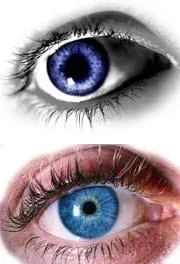 What can we learn and apply to the design of robots from the human body's many reflexes and reactions?Copyright 2004 Microsoft Corporation, One Microsoft Way, Redmond, WA 98052-6399 USA. All rights reserved.
Students observe and test their reflexes, including the (involuntary) pupillary response and (voluntary) reaction times using their dominant and non-dominant hands, as a way to further explore how reflexes occur in humans. They gain insights into how our bodies react to stimuli, and how some reactions and body movements are controlled automatically, without conscious thought. Using information from the associated lesson about how robots react to situations, including the stimulus-to-response framework, students see how engineers use human reflexes as examples for controls for robots.
Biological engineers and neuroscientists perceive human bodies as functioning, controlled systems, not unlike robots. Research is increasingly revealing that mathematical principles similar to those used in robotics are extremely useful or even necessary for a complete understanding of the human body. As an example of how engineers get ideas from human reflexes, painting robots are designed to take input from vision sensors in order to continuously move the robot sprayer tip so it is always positioned at the right distance from the car body as it paints.
After this activity, students should be able to:
- List typical human reaction times.
- Explain how the "stimulus-sensor-coordinator-effector-response" loop works in humans and in robots.
- CCSS.Math.Content.6.SP.B.5 Summarize numerical data sets in relation to their context, such as by:
Grade 6
Do you agree with this alignment? - CCSS.Math.Content.6.SP.B.5a Reporting the number of observations.
Grade 6
Do you agree with this alignment? - CCSS.Math.Content.6.SP.B.5b Describing the nature of the attribute under investigation, including how it was measured and its units of measurement.
Grade 6
Do you agree with this alignment?
- STEL-3G Explain how knowledge gained from other content areas affects the development of technological products and systems.
Grades 6-8
Do you agree with this alignment?
- Identify receivers of visible light energy (e.g., eye, photocell)
Grade 6
Do you agree with this alignment? - Make qualitative observations using the five senses
Grade 6
Do you agree with this alignment?
- MS-LS1-8 Gather and synthesize information that sensory receptors respond to stimuli by sending messages to the brain for immediate behavior or storage as memories.
Grades 6-8
This resource focuses on the following Three Dimensional Learning aspects of NGSS:
Science & Engineering Practices- Gather, read, and synthesize information from multiple appropriate sources and assess the credibility, accuracy, and possible bias of each publication and methods used, and describe how they are supported or not supported by evidence.Do you agree with this alignment?
Disciplinary Core Ideas- Each sense receptor responds to different inputs (electromagnetic, mechanical, chemical), transmitting them as signals that travel along nerve cells to the brain. The signals are then processed in the brain, resulting in immediate behaviors or memories.Do you agree with this alignment?
Crosscutting Concepts- Cause and effect relationships may be used to predict phenomena in natural systems.Do you agree with this alignment?
Do you agree with this alignment? - Gather, read, and synthesize information from multiple appropriate sources and assess the credibility, accuracy, and possible bias of each publication and methods used, and describe how they are supported or not supported by evidence.
Each group needs:
- meter-length ruler, wooden or plastic
- pencil, one per student
- Response & Reaction Worksheet (PDF), one per student
To share with the entire class:
- computer and projector to show the Response & Reaction Presentation (PPT) to the class
Although not required, we suggest students complete the previous unit in the series, Humans Are Like Robots and the previous lessons and activities of this unit, prior to starting this activity.
A reflex is an involuntary and nearly instantaneous movement made by the body in response to a stimulus. In some instances, the body reacts to a stimulus without having to send a signal to the brain. Local nerves process the information from the stimulus and react to it automatically. Reflexes are an automatic defense mechanism from the body.
Can you think of instances in which it would be important for the body to react swiftly in order to protect the body so that it makes sense that it reacts without sending a message to the brain first? (See what scenarios students suggest. Possible answers: Pulling back your hands or limbs quickly from touching something hot, sharp or unknown, to protect the body; changing pupil size as you move from daylight into a tunnel or shady area and back into full sunshine, all the while generating continual vision, making the pupil smaller and/or blinking when objects like balls, branches, dust or other people come too close to the eyes, to protect the eyes.)
What are some human reflexes that you know about or have heard about? (Possible answers, many of them mentioned in the associated lesson: knee jerk reflex [patellar reflex], blinking [corneal reflex], blushing, hands touching hot objects, acoustic reflex, rooting reflex, shivering, vestibule-ocular reflex, sneezing, ankle jerk, biceps reflex, coughing, gag reflex, accommodation reflex [coordinated eye lens shape and pupil size adjustments when looking at a distant object after a near object], and pupillary light reflex.)
Let's do some experimenting to test our own reflexes and reactions.
Before the Activity
- Gather materials and make copies of the worksheets.
- Be ready to show the class the Response & Reaction Presentation (PPT) PowerPoint file.
Background
With information provided on the eight presentation slides, oversee students as they conduct two short exercises (10 minutes + 25 minutes) on the pupillary light reflex response and hand reaction times. Have students work in pairs, using the worksheet to guide their testing and data collection.
With the Students
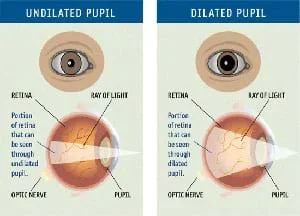 Dilated vs. undilated human eye pupils.Copyright National Eye Institute, National Institutes of Health http://www.nei.nih.gov/healthyeyes/eyeexam.asp
- Divide the class into groups of two students each. Hand out the worksheets.
- Allow 10 minutes for student pairs to conduct exercise 1, observing their pupillary light reflex responses (slide 2). Instructions (also on the slide and worksheet):
- Perform this exercise with a partner.
- Dim the room lights. After a few minutes, look at the eyes of your partner and note the pupil sizes (the black center spots in the middle of the eyes).
- Turn on the room lights. Check the pupil sizes again. The pupils should now be smaller.
- This is the pupillary light reflex response. This reflex "automatically" keeps out excessive light that may damage the eyes, and thus protects your eyes for you!
- Allow 25 minutes for student pairs to conduct exercise 2, testing reaction times (slides 2-6). Explain the exercise and review the instructions so they are clear to students: In your groups, you will perform four variations of a reaction test. As you collect data, fill in the worksheet data table. Then switch roles and repeat the tests and data collection. As necessary, demonstrate for students the ruler drop-n-catch set-up. Then let the student pairs proceed to conduct their own tests and collect data. Instructions (also on the slides and worksheet):
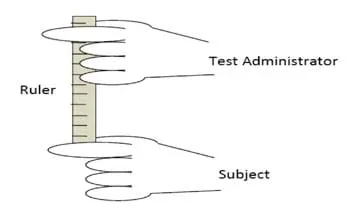 How to hold the ruler.Copyright Computational Neurobiology Center, College of Engineering, University of Missouri
- For Test A: Hold a meter-long ruler near the end with the highest number and let it hang down. Have your partner put his/her dominant hand at the bottom of the ruler, not touching it, and be ready to grab the ruler when it drops. Tell your partner that you will drop the ruler sometime in the next five seconds with no countdown warning and that s/he is to try to catch the ruler as fast as s/he can after you drop it. Be consistent in where hands are placed at the start of each trial. Record in the data table the point on the ruler (centimeters or inches) at which your partner catches it. Repeat this test with the same subject for a total of three times. Vary the time of dropping within the five-second "drop-zone" so the subject cannot guess when you will drop the ruler.
- For Test B: Conduct the same test with the addition of a countdown warning. Tell your partner that you will drop the ruler at the count of three and say: 1... 2... 3 and drop it when you say 3. Record in the data table the point on the ruler where the partner caught it for this trial. Repeat this test with a countdown with the same subject for a total of three times.
- For Test C: Conduct the test with no countdown warning and your partner's eyes closed. Tell your partner that you will drop the ruler any time within a five-second "drop-zone." Record the data.
- For Test D: Conduct the test with a countdown warning, eyes closed, with the subject using his/her non-dominant hand. Tell your partner that you will drop the ruler at the count of three and say: 1... 2... 3 and drop it when you say 3. Record the data.
- Have students share and discuss their exercise 2 findings as a class. Then either have students answer the six worksheet results and analysis questions (slide 7) in writing or lead a class discussion using the questions as prompts.
- Conclude by administering the three-question Post-Lesson Quiz (slide 8, and attachment to associated lesson). As a class, summarize and highlight the key concepts:
- A reflex is an involuntary and nearly instantaneous body movement in response to a stimulus that is largely done for self-defense and self-preservation purposes.
- Response time is the sum of reaction time and movement time.
- Human reflexes and robot actions can be described using the "stimulus-sensor-coordinator-effector-movement" framework, which is very useful to understand both human and engineering systems.
- reflex
- An involuntary and nearly instantaneous body movement in response to a stimulus, largely for self-defense and self-preservation.
- response time
- The sum of reaction time and movement time.
Pupillary Response: After the pupillary response exercise, have students discuss their findings in groups, particularly if any differences were observed.
Test Reaction Times: After testing their reaction times, have students share and discuss as a class their findings. Then either have students answer the six Response & Reaction Worksheet (PDF) results and analysis questions in writing to be turned in for grading or lead a class discussion using the questions as prompts. Consider student answers and/or discussion contributions to gauge their comprehension.
Wrap-Up Quiz: Wrap up the lesson/activity set by administering the three-question post-lesson quiz, provided on slide 8 and as the Human & Robot Reflexes Post-Lesson Quiz attachment to the associated lesson. Answers are provided in the slide 8 notes, and as an attachment in the associated lesson.
- For more advanced students, provide additional explanatory material as found at the websites listed in the References section.
Dowshen, Steven. What Are Reflexes? Last updated September 2010. Kids Health from Nemours. Accessed April 16, 2013. http://kidshealth.org/kid/talk/qa/reflexes.html
List of reflexes (alphabetical). Last updated November 3, 2012. In Wikipedia, The Free Encyclopedia. Accessed April 16, 2013. http://en.wikipedia.org/w/index.php?title=List_of_reflexes_(alphabetical)&oldid=521175984
Mental chronometry. Last updated March 2, 2013. In Wikipedia, The Free Encyclopedia. Accessed April 16, 2013. http://en.wikipedia.org/w/index.php?title=Mental_chronometry&oldid=541675578
Your Sense of Touch. The Senses, Oracle ThinkQuest. Accessed April 16, 2013. http://library.thinkquest.org/3750/touch/touch.html
Contributors
Marianne Catanho; Sachin Nair; Charlie Franklin; Satish Nair
Supporting Program
GK-12 Program, Computational Neurobiology Center, College of Engineering, University of Missouri
Acknowledgements
This curriculum was developed under National Science Foundation GK-12 grant no. DGE 0440524. However, these contents do not necessarily represent the policies of the National Science Foundation, and you should not assume endorsement by the federal government.
Copyright
2013 by Regents of the University of Colorado; original © 2012 Curators of the University of Missouri