
Hearing: How Do Our Ears Work?
Legacy Curriculum
Hey there! This curriculum is no longer being curated or supported. It may contain materials that are no longer available or outdated information. Please use this document for reference.
 From whispers to jarring bullhorns, both ears and robot sound sensors, inform us of sound intensity.Copyright 2004 Microsoft Corporation, One Microsoft Way, Redmond, WA 98052-6399 USA. All rights reserved.
Students learn about the anatomy of the ear and how the ears work as a sound sensor. Ear anatomy parts and structures are explained in detail, as well as how sound is transmitted mechanically and then electrically through them to the brain. Students use LEGO® robots with sound sensors to measure sound intensities, learning how the brick (computer) converts the intensity of sound measured by the sensor input into a number that transmits to a screen. They build on their experiences from the previous activities and establish a rich understanding of the sound sensor and its relationship to the TaskBot's computer.
**Note: This activity uses the retired LEGO NXT robot which is no longer available for purchase.
Biological engineers and neuroscientists perceive the human body as a functioning, controlled system, similar to a robot. Research is showing that mathematical principles similar to those used in robotics are extremely useful or even necessary for a complete understanding of the human body. In this activity, students further explore how our sound sensors, the ears, work, and how they convert sound into signals that are transmitted to the brain. Engineers use such findings to design improved speakers and sound systems for music and entertainment systems and venues.
After this activity, students should be able to:
- Explain how our ears convert sound into signals that are sent to the brain.
- Explain how a robot sound sensor functions.
- Explain how sound intensity changes by changing the distance to the source of the sound.
- CCSS.Math.Content.8.EE.B.5 Graph proportional relationships, interpreting the unit rate as the slope of the graph. Compare two different proportional relationships represented in different ways.
Grade 8
Do you agree with this alignment? - CCSS.Math.Content.8.SP.A.1 Construct and interpret scatter plots for bivariate measurement data to investigate patterns of association between two quantities. Describe patterns such as clustering, outliers, positive or negative association, linear association, and nonlinear association.
Grade 8
Do you agree with this alignment?
- STEL-3G Explain how knowledge gained from other content areas affects the development of technological products and systems.
Grades 6-8
Do you agree with this alignment?
- Describe how new technologies have helped scientists make better observations and measurements for investigations (e.g., telescopes, electronic balances, electronic microscopes, x-ray technology, computers, ultrasounds, computer probes such as thermometers)
Grade 5
Do you agree with this alignment? - Explain the interactions between the nervous and muscular systems when an organism responds to a stimulus
Grade 8
Do you agree with this alignment? - Make qualitative observations using the five senses
Grade 6
Do you agree with this alignment?
- MS-LS1-8 Gather and synthesize information that sensory receptors respond to stimuli by sending messages to the brain for immediate behavior or storage as memories.
Grades 6-8
This resource focuses on the following Three Dimensional Learning aspects of NGSS:
Science & Engineering Practices- Gather, read, and synthesize information from multiple appropriate sources and assess the credibility, accuracy, and possible bias of each publication and methods used, and describe how they are supported or not supported by evidence.Do you agree with this alignment?
Disciplinary Core Ideas- Each sense receptor responds to different inputs (electromagnetic, mechanical, chemical), transmitting them as signals that travel along nerve cells to the brain. The signals are then processed in the brain, resulting in immediate behaviors or memories.Do you agree with this alignment?
Crosscutting Concepts- Cause and effect relationships may be used to predict phenomena in natural systems.Do you agree with this alignment?
Do you agree with this alignment? - Gather, read, and synthesize information from multiple appropriate sources and assess the credibility, accuracy, and possible bias of each publication and methods used, and describe how they are supported or not supported by evidence.
Each group needs:
- LEGO MINDSTORMS NXT Intelligent Brick
- LEGO MINDSTORMS Sound Sensor
- whistle
- How Do Our Ears Work? Pre-Activity Quiz (PDF), one per student
- Sound Intensity Worksheet (PDF), one per student
- The Marvelous Ear Post-Activity Quiz (PDF), one per student
To share with the entire class:
- computer and projector to show the The Marvelous Ear Presentation (PPTX), a PowerPoint file
- vacuum cleaner (and other sound-making items that can be measured for sound levels)
- The Marvelous Ear Presentation (pptx)
- The Marvelous Ear Presentation (pdf)
- How Do Our Ears Work? Pre-Activity Quiz (docx)
- How Do Our Ears Work? Pre-Activity Quiz (pdf)
- How Do Our Ears Work? Pre-Activity Quiz Answers (docx)
- How Do Our Ears Work? Pre-Activity Quiz Answers (pdf)
- Sound Intensity Worksheet (docx)
- Sound Intensity Worksheet (pdf)
- The Marvelous Ear Post-Activity Quiz (docx)
- The Marvelous Ear Post-Activity Quiz (pdf)
- The Marvelous Ear Post-Activity Quiz Answers (docx)
- The Marvelous Ear Post-Activity Quiz Answers (pdf)
- We suggest students complete the previous unit in the series, Humans Are Like Robots, and the previous two lessons and two activities in this unit prior to starting this activity.
- Students should have a strong understanding of the five senses of the human body.
- Students should be experienced using a LEGO MINDSTORMS NXT robot and creating programs for its computer, the LEGO MINDSTORMS NXT Intelligent Brick.
(Be ready to show students The Marvelous Ear Presentation (PPTX) [a PowerPoint file]. First, administer the three-question Pre-Activity Quiz (PDF), either by handing out paper copies or showing slide 2.)
Why is our sense of hearing so important to us? (Listen to student ideas.) Our sense of hearing is one of our most important senses. It enables us to experience and interact with the world in many different ways. We can experience entertainment through music, singing, movies and theater. Hearing gives us the ability to gather information through spoken language and oral communication. It enables us to have social relationships with friends and family. Our auditory system also helps to keep us safe by alerting us to possible threats in the world around us.
One aspect of our sense of hearing is sound intensity. What do we mean by intensity? That's right—loudness. Can your ears determine sound intensity? Can a robot sensor determine sound intensity? Let's learn more and then do some experimenting.
(Continue on to present students with the content in the PowerPoint file, using the guidance and suggestions provided in the Procedure section.)
Teacher Notes
- Present to students the ear anatomy content information and detailed concept explanations provided in the PowerPoint file using the guidance and suggestions provided below.
- The worksheet and pre/post quizzes (and answers) are embedded in the presentation and available as separate attachments, leaving it to the teacher to decide how to administer them.
- Students use LEGO robots and their sound sensors to investigate sound intensity. Using a sound command helps students understand the relationship between different noise levels created and the different sound intensities detected.
Before the Activity
- Gather materials. If you have conducted the previous activities in this unit, you should already have the necessary LEGO robots and software.
- Make copies of the quizzes and worksheet.
- Make sure the NXT robot batteries are fully charged.
- Be ready to show the PowerPoint slide presentation to the class.
With the Students
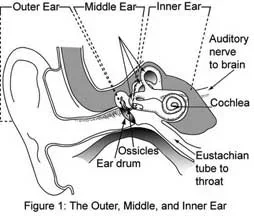 Human ears are a marvelous system of bones, structures and processes.Copyright NASA via Wikimedia Commons http://commons.wikimedia.org/wiki/File:Outer,_middle_and_inner_ear.jpg
- Administer the pre-activity quiz, which is also provided as slide 2 for showing to students. Slide 3 shows the quiz answers to aid in a class discussion after students have completed their quizzes.
- Mention to students the activity objectives (slide 4): to investigate how hearing works (ear anatomy and process), learn about the differences in detecting sound intensities (loudness), and make sound commands with the LEGO robots and their sound sensors to see the relationship between different noise levels created and the different sound intensities detected.
- What is hearing and how does it work? Provide a short introduction to hearing, starting with the Introduction/Motivation section, and then the information on slide 5. Our ears are remarkable organs and they are unique among the senses because they operate mechanically and electrically.
- In detail, explain how the human auditory system works, including the functions of the outer ear (slide 6), middle ear (slide 7), the inner ear, particularly the cochlea (slides 8-9).
- Review and summarize the hearing process (slides 10-11) using the larger-scale diagrams provided.
- Move on to introduce the important concept of sound intensity or "loudness," and how it is measured (slide 12) in decibels. Give a range of example sound intensities, from a ticking watch at 20 dBs to a jet engine at 130 dBs.
- Show students a two-minute animation that illustrates how we hear; it summarizes and reiterates the concepts just presented to students; see the website link provided in slide 13 (also listed in the Additional Multimedia Support section). As the animation plays, read aloud the text in the bubble graphic.
- Introduce the hands-on activity, in which the LEGO robots with the sound sensors are used to determine the intensities of various sounds. Allow 15 minutes for the activity portion.
- Divide the class into student pairs and hand out the computers, robots, sensors and worksheets.
- Walk students through the set-up procedure (slide 14) with the LEGO sensor and brick.
- Attach the sound sensor to any one of ports 1-4 of the NXT brick.
- Press the orange button to turn ON the NXT brick.
- Use the right and left move buttons to scroll over to VIEW.
- Select Sound Sensor dBA and indicate the port that the sound sensor is connected to.
- Look for a box and a % indicated within of the loudness of the sound that the NXT sound sensor is hearing —on a scale of 0 to 100. Now you are ready to begin the experiment.
- Provide an overview of the robot experimentation and review the worksheet (slide 15).
- Measure each sound with the sound sensor approximately 6 inches away from the source of sound, then approximately 12 inches away.
- Use a ruler to measure each distance.
- Take note of what happens to the sensor reading when the distance to the sound changes.
- Use table on the worksheet to record your data on the loudness of the various tested sounds, and include some of your own choices for sound-making sources in the blank cells.
- As a class, lead a discussion in which students share their data, results and conclusions. Expect students to discover that as the distance from the source of a sound increases, the intensity of the sound decreases. Students come to this conclusion by comparing their sound measurement data at a distance of 6 inches to their sound measurement data at a distance of 12 inches. Also ask them the questions provided in the Assessment section.
- Conclude by administering the three-question post-activity quiz (slide 16, with answers on slide 17).
- auditory
- Related to hearing.
- human senses
- The primary modes by which we sense the world: vision, hearing, smell, taste, touch.
- intensity
- The strength or level. For sound, intensity is measured in decibels (dBs) with louder sounds having higher dB values.
Pre-Activity Quiz: Administer the How Do Our Ears Work? Pre-Activity Quiz (PDF) (also shown on slide 2, with answers on slide 3) to judge how much students know about the topic prior to the activity.
Concluding Discussion: As a class, have students share their data, results and conclusions from the sound intensity LEGO robot experimentation. Also ask the students:
- What did you learn during the activity?
- What are some parallels between the robot sound sensor system and the human ear/brain system?
- What occurs to you that you might now want to learn about the sound sensor beyond this activity?
- How might engineers use sound sensors in devices and products that help people?
Post-Activity Quiz: Administer The Marvelous Ear Post-Activity Quiz (PDF) (also provided on slide 16, with answers on slide 17). The questions are similar to those in the pre-activity quiz, so answers can be used to assess student progress in gaining an understanding of the content material.
- For more advanced students, provide additional explanatory material for any of the topics from the websites in the References section.
Chudler, Eric H. The Ear, Neuroscience for Kids. University of Washington. Accessed June 15, 2011. http://faculty.washington.edu/chudler/bigear.html
Ears: How Your Ears Work. Kids' Health, Child and Youth Health, Women's and Children's Health Network, Government of South Africa. Accessed June 15, 2011. http://www.cyh.com/HealthTopics/HealthTopicDetailsKids.aspx?p=335&np=152&id=1463
How Hearing Works. MED-El International, UK (a hearing implant company). Accessed June 15, 2011. (Includes an excellent three-minute narrated video animation of how hearing works) http://www.medel.com/us/how-hearing-works/
Kurtus, Ron. Hearing Direction and Distance. Last revised August 22, 2002. Ron Kurtis' School for Champions. Accessed November 19, 2009. http://www.school-for-champions.com/senses/hearing_direction.htm
Contributors
Marianne Catanho; Sachin Nair; Charlie Franklin; Satish Nair
Supporting Program
GK-12 Program, Computational Neurobiology Center, College of Engineering, University of Missouri
Acknowledgements
This curriculum was developed under National Science Foundation GK-12 grant no. DGE 0440524. However, these contents do not necessarily represent the policies of the National Science Foundation, and you should not assume endorsement by the federal government.
Copyright
2013 by Regents of the University of Colorado; original © 2012 Curators of the University of Missouri