
Brain is a Computer
Legacy Curriculum
Hey there! This curriculum is no longer being curated or supported. It may contain materials that are no longer available or outdated information. Please use this document for reference.
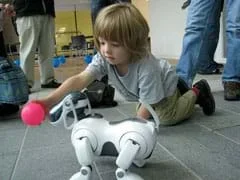 AIBO is a dog-like artificial intelligence robotic pet made by Sony.Copyright 2008 Stuart Caie, Wikimedia Commons http://commons.wikimedia.org/wiki/File:AIBO_ERS-7_following_pink_ball_held_by_child.jpg
Students learn about the similarities between the human brain and its engineering counterpart, the computer. Since students work with computers routinely, this comparison strengthens their understanding of both how the brain works and how it parallels that of a computer. Students are also introduced to the "stimulus-sensor-coordinator-effector-response" framework through the associated activity to reinforce their understanding of human and robot interactions.
Biological engineers and neuroscientists perceive the human body as a functioning, controlled system, similar to a robot. Research shows that electrical, mechanical and biological engineers may apply mathematical principles similar to those used in human brains and systems as they continue to devise better robots, computers and sensors. In this lesson, students compare the functionalities of human brains and robot computers, noting the similarities and differences. Engineers are learning how pressure sensors in the human fingers help you pick up a glass without breaking it, and use that information to design better touch sensors for robots. Engineers also examine how the human eye works so that they can design cameras with higher performance and speed.
After this lesson, students should be able to:
- Explain how the human brain is similar to a computer by providing at least one example.
- Describe how the motor cortex of the brain helps us with movement such as walking, and related that to how a robot computer helps a robot move forward.
- Explain how human senses and the brain interact to accomplish a task, and relate that to how an electronic sensor interacts with a robot to accomplish a task.
- STEL-3G Explain how knowledge gained from other content areas affects the development of technological products and systems.
Grades 6-8
Do you agree with this alignment?
- Describe how new technologies have helped scientists make better observations and measurements for investigations (e.g., telescopes, electronic balances, electronic microscopes, x-ray technology, computers, ultrasounds, computer probes such as thermometers)
Grade 5
Do you agree with this alignment? - Explain the interactions between the nervous and muscular systems when an organism responds to a stimulus
Grade 8
Do you agree with this alignment? - Make qualitative observations using the five senses
Grade 6
Do you agree with this alignment?
- MS-LS1-8 Gather and synthesize information that sensory receptors respond to stimuli by sending messages to the brain for immediate behavior or storage as memories.
Grades 6-8
This resource focuses on the following Three Dimensional Learning aspects of NGSS:
Science & Engineering Practices- Gather, read, and synthesize information from multiple appropriate sources and assess the credibility, accuracy, and possible bias of each publication and methods used, and describe how they are supported or not supported by evidence.Do you agree with this alignment?
Disciplinary Core Ideas- Each sense receptor responds to different inputs (electromagnetic, mechanical, chemical), transmitting them as signals that travel along nerve cells to the brain. The signals are then processed in the brain, resulting in immediate behaviors or memories.Do you agree with this alignment?
Crosscutting Concepts- Cause and effect relationships may be used to predict phenomena in natural systems.Do you agree with this alignment?
Do you agree with this alignment? - Gather, read, and synthesize information from multiple appropriate sources and assess the credibility, accuracy, and possible bias of each publication and methods used, and describe how they are supported or not supported by evidence.
- Brain is a Computer Presentation (EV3 version) (pptx)
- Brain is a Computer Presentation (EV3 version) (pdf)
- Brain is a Computer Presentation (NXT version) (pptx)
- Brain is a Computer Presentation (NXT version) (pdf)
- LEGO TaskBot Building Instructions (EV3) (pdf)
- LEGO TaskBot Building Instructions (NXT) (pdf)
- Brain is a Computer Pre-Lesson Quiz (docx)
- Brain is a Computer Pre-Lesson Quiz (pdf)
- Brain is a Computer Pre-Lesson Quiz Answers (docx)
- Brain is a Computer Pre-Lesson Quiz Answers (pdf)
- Brain is a Computer Worksheet (docx)
- Brain is a Computer Worksheet (pdf)
- Brain is a Computer Worksheet Answers (docx)
- Brain is a Computer Worksheet Answers (pdf)
- Brain is a Computer Post-Lesson Quiz (docx)
- Brain is a Computer Post-Lesson Quiz (pdf)
- Brain is a Computer Post-Lesson Quiz Answers (docx)
- Brain is a Computer Post-Lesson Quiz Answers (pdf)
- We suggest students complete the previous unit in the series, Humans Are Like Robots, prior to starting this lesson.
- An understanding that the human body has five senses and a brain that gets information from the senses and interprets it.
- Ability to operate a personal computer and a LEGO® MINDSTORMS® EV3 robot.
- Familiarity with graphical programming on the LEGO MINDSTORMS EV3 TaskBot.
Teacher Notes
- Before the lesson, work with interested students to put together the EV3 TaskBots that will be used for the associated activity (takes about 45 minutes per bot) using LEGO MINDSTORMS EV3 robot, such as EV3 Core Set (5003400) at https://education.lego.com/en-us/products/lego-mindstorms-education-ev3-core-set/5003400#lego-mindstorms-education-ev3. Note: This activity can also be conducted with the older LEGO MINDSTORMS NXT set. You’ll need a computer loaded with the NXT 2.1 software.
- Review the online materials listed in the Additional Multimedia Support section.
- Make copies of the Pre-Lesson Quiz (PDF), Post-Lesson Quiz (PDF) and the Brain is a Computer Worksheet (PDF).
- This lesson explores the similarities between the human brain and computers. Teach this lesson by delivering the content information and detailed explanations provided in the Brain is a Computer Presentation (PPTX) (a PowerPoint file) to students using the guidance and suggestions provided below. To begin, some parts of the human brain are presented, followed by what a brain does and how, and then its functioning is compared with that of computers.
- At lesson end, conducting the associated activity strengthens students' understanding of the parallels between our brain moving our fingers when touching a hot object and a LEGO robot computer deciding to move back quickly when its touch sensor is activated by bumping into a wall.
Day 1 PowerPoint Outline Information (slides 1-15)
- In today's lesson, we will explore the similarities between the human brain and computers (slide 1).
- Administer the Pre-Lesson Quiz, which is also provided as slide 3 for showing to students. Slide 4 shows the quiz answers to aid in a class discussion after students have completed their quizzes.
- As a quick review, provide an overview of the LEGO robot and its parts (slide 5), and then compare the LEGO EV3 robot with a human (slide 6).
- Using slides 7-10, introduce what the human brain does and how. To link it back to the robot, ask students: What is the equivalent of the nervous system in the robot? (Answer: A set of wires carrying signals from the sensors to the computer and from the computer to the motors.)
- Before moving to slide 11, ask students: How does your brain help you move your arms when needed? Write student responses on the board, but do not provide them any help. Using the movement of the arm as an example movement, provide relevant details of the human brain using slides 11-14 (and in more detail on Day 2). This narrow focus on arm movement helps provide students with a basic understanding of how the brain works, without them getting lost in brain anatomy. After this explanation, repeat the question and discuss it as a class.
- Point out the two hemispheres of the brain (slide 12), noting that the color in the brain drawings is only to distinguish between the lobes; the human brain actually appears gray in color. The human brain serves as our "computer." Next, compare the brain sizes in different animals, and then look at what the different parts are called.
- Before talking about the various lobes, give some perspective about the size of the human brain by comparing it with those of a wild pig and a dolphin (slide 13). The adult human brain weighs on average about 3 lbs. (1.5 kg).
- Talk about the four lobes of the human brain: frontal, parietal, temporal, occipital. The brain has gyri, which are ridges, and sulci, which are depressions. Major sulci divide the brain into the four lobes (slide 14).
- End Day 1 by handing out the worksheets, which ask students to sketch the shape of a human brain, and highlight the four lobes. The worksheet questions are also provided on slide 15.
Day 2 PowerPoint Outline Information (slides 17-40)
- Verify that students remember the various functions brains perform. Ask them to brainstorm some of the functions of the brain, as they did on Day 1. Then remind them that our brains perform LOTS and LOTS of functions, and that in this lesson, we are studying only MOVEMENT.
- For movement to occur, a person must want to do it. This "wanting" occurs in the prefrontal cortex, which is a part of the frontal lobe. Briefly review the many higher-level functions performed by the prefrontal cortex (slide 17). Neuroscientists are still trying to figure out how our brains do this; we do not know much about it today!
- Focusing on MOVEMENT only, some movements are conscious (the ones we plan) and others are unconscious (reflex actions). We will focus only on the conscious ones, which start with the prefrontal cortex (slides 17-18).
- To emphasize that our brains have a complex way of controlling movement, guide students to perform the movement activity described on slide 20.
- Next, look at some details of how the brain coordinates movement (slides 21-29). Slide 21 lists the brain areas involved in coordinating movement: motor association cortex, primary motor cortex, basal ganglia and cerebellum. Consider the simple human action of waving goodbye (slide 22). This action is performed by several steps starting with the thought and desire to wave. After that, you wave in a coordinated way and then finally stop when done waving. The thought and desire to wave comes from the prefrontal cortex, which conveys the information to the primary motor cortex (slide 23). The primary motor cortex then initiates the action.
- An important concept involved in this process is the motor/sensory homunculus, which is a pictorial representation of the anatomical divisions of the parts of the human cortex directly responsible for the movement and exchange of sense and motor information (namely touch: sensitivity, cold, heat, pain, etc.) with the rest of the body. For instance, to which part of the brain is the touch sensors on my finger connected/wired? From an engineering point-of-view, this is an important question because it helps us understand the "wiring" from the senses to the brain. Go to the websites provided on slide 24 to show the mapping. Move your mouse around to see which regions of the body map to the motor areas of the brain (slides 24-25). Also show students the primary motor cortex area (slide 25).
- Information about how the primary motor cortex performs this movement is provided in brief form on slides 26-29. The primary motor cortex initiates movement, that is, it starts the action (slide 26). The motor cortex association area coordinates the complex movement of waving with the primary motor cortex starting the movement (as mentioned before). The motor cortex association area coordinates the motion of the many muscles used as you wave. The act of waving involves the use of several muscles!
- What happens in Parkinson's disease? One of the areas responsible for motion, the basal ganglia, is damaged, and so the person has difficulty starting the movement to wave goodbye, although he or she wants to wave (slide 27).
- Another region of the brain that is important for coordinating smooth movement of the hand during a wave is the cerebellum (slide 28). The cerebellum makes sure that the hand does not go too far to either side, which would look awkward! When people drink alcohol, their cerebellums cannot function properly and they are unable to coordinate the movements of their fingers to their own noses! They cannot walk in straight lines either. That is why police check a person's ability to perform such motions to determine whether that person's movement coordination is impaired from too much alcohol (slide 29).
- In summary, the main brain areas responsible for all our conscious movements are the prefrontal cortex, motor association cortex, primary motor cortex, basal ganglia and cerebellum. Now that students know this information and before going to slide 30, ask them: "How is the brain similar to a computer?" Write their ideas on the board. Then use slide 30 to explain the commonalities between brains and computers.
- Provide an overview of what a computer is (slide 31) and what it does, with a brief comparison to the brain (slide 32).
- Slide 33 is somewhat technical; students just need to know about the parts in computers and brains that perform similar functions. One-by-one, read aloud the five questions on slide 33 and have students answer them. This provides the student a chance to check their understanding of the similarities between brains and computers. Then move on to slide 34 for the answers. For example, a computer's power supply is like the body's heart, providing energy to the computer and brain, respectively. The computer's wiring system is similar to the nervous system (including spinal cord) in the human body—both carry signals to and from their respective "computers." Human senses are the "devices" that provide input to the brain, similar to how a computer's keyboard, drives (floppy, flash, CD, DVD), networking cards, fingerprint and retinal scans provide it with input. The computer case is like the human skull, protecting the inside components from damage. For this lesson, no need to mention the other computer parts.
- To further strengthen student understanding about brain/computer similarities, show slide 35 and ask students: You jerk your hand back when you touch a hot object. What makes your hand muscles move? How might that be programmed using the robot? What would we need to do to mimic the hand moving back? Write student ideas on the classroom board. Slides 36-40 provide the answers and detailed explanations; explain each, step-by-step.
- As time and technology permit, show a YouTube video (1:08 min) at the URL provided on slide 37 for details of touch sensors on the skin. Human skin contains millions of highly sensitive nerve endings that are able to detect several different types of stimulation, such as pressure, temperature, and pain. When these specialized receptors are stimulated, they send signals through the nervous system to the brain, which interprets them and decides on responses, all happening very quickly.
- Summarize Day 2 topics by emphasizing the similarities between human brains and computers.
Day 3 PowerPoint Outline Information (slides 41-49)
- Since the concepts relating human brains to computers can be somewhat difficult for students to grasp, use slides 42-45 to start Day 3 with a review.
- Use slide 46 to introduce the important framework of "stimulus-sensor-coordinator-effector-response." Moving our hands away from hot objects can be understood using the framework. Ask students to write down some other actions they perform using this framework, clearly noting the various components involved.
- Administer the Post-Lesson Quiz, which is also provided as slide 47 for showing to students. Slide 48 shows the quiz answers to aid in class discussion after students have completed their quizzes. Slide 49 provides a list of vocabulary words and definitions.
You may know how a computer controls a robot, but have you wondered what controls movements of your body and thoughts? Your brain is like a computer that controls lots of your body functions, such as walking and talking.
Today we are going to learn how the human brain is similar to a computer. Then we'll do the fun and hands-on That's Hot! Robot Brain Programming activity in which you will program a LEGO EV3 robot with a touch sensor to "move back quickly"—a reflex action—when the touch sensor "bumps" into something in front of the robot.
Review the simple comparison between human brains and robot computers (as it relates to movement only). Emphasize that our brains are much more complex than computers. Even with all our amazing research discoveries, we do not really understand the brain's functioning. Some engineers focus their research on finding ways to help people who do not have functioning muscles, including amputees, by designing prosthetic devices (replacement body parts) that can receive, send and act on signals sent through the human nervous system and brain.
- computer
- A human-created electronic device that processes data, performs mathematical and logical calculations, displays graphics, and helps you connect to the internet.
- emotions
- Feelings. For instance, feelings of joy, happiness, sadness or fear.
- homunculus
- A drawing of the human body that shows where various regions of the body (finger, nose, etc.) are connected in the brain. For example, this identifies which parts of the human cortex are directly responsible for the movement and exchange of sensory and motor information (such as touch: sensitivity, cold, heat, pain, etc.) with the rest of the body.
- gyri
- Ridges in the texture of the brain.
- robot
- A mechanical device that sometimes resembles a human and is capable of performing a variety of often complex human tasks on command or by being programmed in advance.
- sensor
- A device that converts one type of signal to another. For instance, a tachometer that displays the speed a car is traveling.
- stimulus
- Something that causes a response.
- sulci
- Depressions in the texture of the brain. Major sulci divide the brain into the four lobes.
Pre-Lesson Assessment
Pre-Quiz: Administer the three-question Pre-Lesson Quiz (PDF) (also shown as slide 3 in the PowerPoint file) to help students begin thinking about how their brains help move their arms and legs, and how a robot computer helps move a robot using touch sensors. If time at the end of Day 1, revisit the quiz questions to gauge student comprehension of the new material presented.
Post-Lesson Assessment
Post-Quiz: Administer the three-question Post-Lesson Quiz (PDF) (also shown as slide 47) with questions similar to those in the pre-lesson quiz. Review students' answers to gauge their progress.
Information on parts of the brain at Bryn Mawr College's Serendip Studio's page titled, "Brain Structures and their Functions" at https://serendipstudio.org/bb/kinser/Structure1.html
EV3 robots and sensors: https://www.lego.com/cdn/cs/set/assets/bltbef4d6ce0f40363c/LMSUser_Guide_LEGO_MINDSTORMS_EV3_11_Tablet_ENUS.pdf
Information on how humans feel using skin at MedIndia's web page titled, "The Skin" at https://www.medindia.net/know_ur_body/anatomy-of-skin.asp
Lesson Scaling:
- For lower grades, edit and remove some slides, as makes sense for your students. For example, remove the following slides for grades 4 and 5: 11, 12, 14, 15; 32-24; 44-45.
- As necessary, provide additional explanatory material for any of the topics using the websites listed in the Additional Multimedia Support section.
Contributors
Sachin Nair; Charlie Franklin; Satish Nair
Supporting Program
GK-12 Program, Computational Neurobiology Center, College of Engineering, University of Missouri
Acknowledgements
This curriculum was developed under National Science Foundation GK-12 grant number DGE 0440524. However, these contents do not necessarily represent the policies of the National Science Foundation, and you should not assume endorsement by the federal government.
Copyright
2013 by Regents of the University of Colorado; original © 2012 Curators of the University of Missouri