
Energy on a Roller Coaster
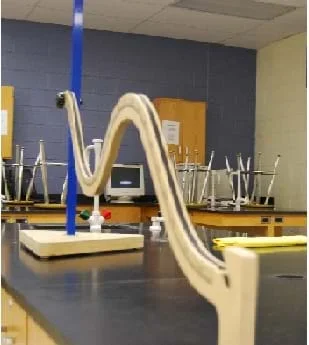 Roller coaster for a physics lab.Copyright 2006 Vanderbilt University
Students learn about the conservation of energy and the impact of friction as they use a roller coaster track to collect position data and then calculate velocity and energy data. After the lab, students relate the conversion of potential and kinetic energy to the conversion of energy used in a hybrid car.
Engineers design new and more creative roller coasters all the time. In this activity, students act as engineers to measure the amount of the different types of energy. An engineering team designing a rollercoaster would need to make sure the cars never runs too fast (velocity) and relate that to how high the drops are using conversion of energy.
After this activity, students should be able to:
- Apply their background knowledge to begin solving the challenge.
- Relate kinetic energy with gravitational potential energy.
- Hypothesize about experimental "error."
- CCSS.Math.Content.HSA-REI.B.3 Solve linear equations and inequalities in one variable, including equations with coefficients represented by letters.
Grades 9-12
Do you agree with this alignment? - CCSS.Math.Content.HSA-REI.B.4b Solve quadratic equations by inspection (e.g., for x² = 49), taking square roots, completing the square, the quadratic formula and factoring, as appropriate to the initial form of the equation. Recognize when the quadratic formula gives complex solutions and write them as a ± bi for real numbers a and b.
Grades 9-12
Do you agree with this alignment? - CCSS.Math.Content.HSF-IF.B.4 For a function that models a relationship between two quantities, interpret key features of graphs and tables in terms of the quantities, and sketch graphs showing key features given a verbal description of the relationship.
Grades 9-12
Do you agree with this alignment? - CCSS.Math.Content.HSS-ID.B.6 Represent data on two quantitative variables on a scatter plot, and describe how the variables are related.
Grades 9-12
Do you agree with this alignment?
- Use computers and calculators to access, retrieve, organize, process, maintain, interpret, and evaluate data and information in order to communicate.
Grades 9-12
Do you agree with this alignment? - Energy cannot be created nor destroyed; however, it can be converted from one form to another.
Grades 9-12
Do you agree with this alignment? - STEL-8N Use various approaches to communicate processes and procedures for using, maintaining, and assessing technological products and systems.
Grades 9-12
Do you agree with this alignment?
- Physical Science
Grades K-12
Do you agree with this alignment? - Science and Technology
Grades K-12
Do you agree with this alignment?
- HS-PS3-1 Create a computational model to calculate the change in the energy of one component in a system when the change in energy of the other component(s) and energy flows in and out of the system are known.
Grades 9-12
This resource focuses on the following Three Dimensional Learning aspects of NGSS:
Science & Engineering Practices- Create a computational model or simulation of a phenomenon, designed device, process, or system.Do you agree with this alignment?
Disciplinary Core Ideas- Energy is a quantitative property of a system that depends on the motion and interactions of matter and radiation within that system. That there is a single quantity called energy is due to the fact that a system's total energy is conserved, even as, within the system, energy is continually transferred from one object to another and between its various possible forms.Do you agree with this alignment?
- Conservation of energy means that the total change of energy in any system is always equal to the total energy transferred into or out of the system.Do you agree with this alignment?
- Energy cannot be created or destroyed, but it can be transported from one place to another and transferred between systems.Do you agree with this alignment?
- Mathematical expressions, which quantify how the stored energy in a system depends on its configuration (e.g. relative positions of charged particles, compression of a spring) and how kinetic energy depends on mass and speed, allow the concept of conservation of energy to be used to predict and describe system behavior.Do you agree with this alignment?
- The availability of energy limits what can occur in any system.Do you agree with this alignment?
Crosscutting Concepts- Science assumes the universe is a vast single system in which basic laws are consistent.Do you agree with this alignment?
- Models can be used to predict the behavior of a system, but these predictions have limited precision and reliability due to the assumptions and approximations inherent in models.Do you agree with this alignment?
Do you agree with this alignment? - Create a computational model or simulation of a phenomenon, designed device, process, or system.
- HS-PS3-2 Develop and use models to illustrate that energy at the macroscopic scale can be accounted for as either motions of particles or energy stored in fields.
Grades 9-12
This resource focuses on the following Three Dimensional Learning aspects of NGSS:
Science & Engineering Practices- Develop and use a model based on evidence to illustrate the relationships between systems or between components of a system.Do you agree with this alignment?
Disciplinary Core Ideas- Energy is a quantitative property of a system that depends on the motion and interactions of matter and radiation within that system. That there is a single quantity called energy is due to the fact that a system's total energy is conserved, even as, within the system, energy is continually transferred from one object to another and between its various possible forms.Do you agree with this alignment?
- At the macroscopic scale, energy manifests itself in multiple ways, such as in motion, sound, light, and thermal energy.Do you agree with this alignment?
- These relationships are better understood at the microscopic scale, at which all of the different manifestations of energy can be modeled as a combination of energy associated with the motion of particles and energy associated with the configuration (relative position of the particles). In some cases the relative position energy can be thought of as stored in fields (which mediate interactions between particles). This last concept includes radiation, a phenomenon in which energy stored in fields moves across space.Do you agree with this alignment?
Crosscutting Concepts- Energy cannot be created or destroyed—it only moves between one place and another place, between objects and/or fields, or between systems.Do you agree with this alignment?
Do you agree with this alignment? - Develop and use a model based on evidence to illustrate the relationships between systems or between components of a system.
- CCSS.Math.Content.HSA-REI.B.3 Solve linear equations and inequalities in one variable, including equations with coefficients represented by letters.
Grades 9-12
Do you agree with this alignment? - CCSS.Math.Content.HSA-REI.B.4b Solve quadratic equations by inspection (e.g., for x² = 49), taking square roots, completing the square, the quadratic formula and factoring, as appropriate to the initial form of the equation. Recognize when the quadratic formula gives complex solutions and write them as a ± bi for real numbers a and b.
Grades 9-12
Do you agree with this alignment? - CCSS.Math.Content.HSF-IF.B.4 For a function that models a relationship between two quantities, interpret key features of graphs and tables in terms of the quantities, and sketch graphs showing key features given a verbal description of the relationship.
Grades 9-12
Do you agree with this alignment? - CCSS.Math.Content.HSS-ID.B.6 Represent data on two quantitative variables on a scatter plot, and describe how the variables are related.
Grades 9-12
Do you agree with this alignment?
- 3204.2.1 Differentiate among the various forms of energy.
Grades 9-12
Do you agree with this alignment? - 3204.2.7 Diagram and evaluate pathways of energy transfer to demonstrate the law of conservation of energy.
Grades 9-12
Do you agree with this alignment? - 3237.1.13 Analyze the characteristics of energy, and conservation of energy including friction, and gravitational potential energy.
Grades 9-12
Do you agree with this alignment?
Each group needs:
- Varnier or Pasco photo gate and appropriate software
- marble (of known mass)
- marble roller coaster track (similar to one pictured)
- access to computer and Excel spreadsheet software application
Each student needs:
- Roller Coaster Worksheet
- calculator
Students must have a basic working knowledge of dry lab operations and measurements.
Yesterday you worked in a virtual lab, but in today's activity we will apply what we learned in the virtual laboratory to a hands-on activity. Think of different portions of the virtual lab that will apply to a real-world situation. Always be thinking about conversion of energy and how we can apply what we learn in this activity to our challenge question about hybrid cars.
Background
This activity introduces students to the concept of conservation of energy and the relationship of friction to this interaction.
Before the Activity
- Make copies of the Roller Coaster Worksheet.
- Set up marble tracks with photo gates.
With the Students
- Assign lab groups of 2-3 people per lab group if possible.
- Roll the marble, with the photogate at the prescribed location.
- Record the time for the marble to pass the photogate into Table 1.
- At each position on the rollercoaster, use the meterstick to measure the height from the lab bench in meters. Record these values in Table 2.
- Calculate the potential energies and kinetic energies and record into Table 2.
- Calculate the total energies and record into Table 2.
- In Excel®, make a graph with Distance along the track (m) on the x-axis and Energy (J) on the y-axis. Put both energy curves on the same plot. This plot must be printed out and stapled to your lab sheet.
Pre-Activity Assessment
Estimations: Have students apply the law of conservation of energy to estimate the velocity of the marble at two different points along the roller coaster (middle and end). Assume the marble's energy exists only as potential and/or kinetic energy (i.e., neglect friction). After the activity, compare these two estimates with the measured values to answer the investigating questions. (Hint: Students will need to measure the height of the marble at the start of the rollercoaster, the middle of the rollercoaster and the end to use in their estimation calculations.)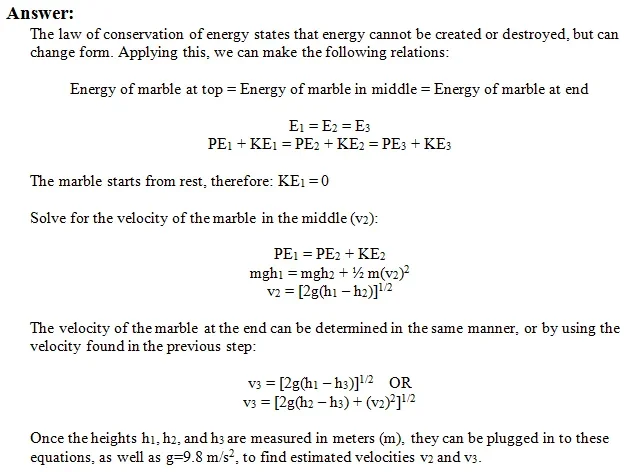 Copyright 2013 Todd France, University of Colorado Boulder
Activity-Embedded Assessment
Participation: Observe students during the activity and assess each student based on his or her contributions during the lab.
Post-Activity Assessment
Results and Conclusions: Ask students to compare their answers to the Pre-Activity Assessment (estimations) to the results they found by answering the investigating questions on the Roller Coaster Worksheet (PDF). Ideally, the velocities they estimated should be slightly greater than the measured values to account for energy lost to friction. If the estimated values are smaller than the measured values, this likely means that the marble was initially pushed or that there is measurement error. After discussing this comparison and reason for error, collect the worksheet. Assess students based on their graph produced in Excel®, as well as the completeness of their worksheet, as well as its accuracy.
- For lower grades, provide more time for group discussions and have them graph by hand.
- For upper grades, have students determine what other forms of energy friction diverted energy into.
Contributors
Joel Daniel (Center for Compact and Efficient Fluid Power, University of Minnesota); Megan Johnston
Supporting Program
VU Bioengineering RET Program, School of Engineering, Vanderbilt University
Acknowledgements
The contents of this digital library curriculum were developed under National Science Foundation RET grant nos. 0338092 and 0742871. However, these contents do not necessarily represent the policies of the NSF, and you should not assume endorsement by the federal government.
Copyright
2013 by Regents of the University of Colorado; original © 2006 Vanderbilt University