
How a Hybrid Works
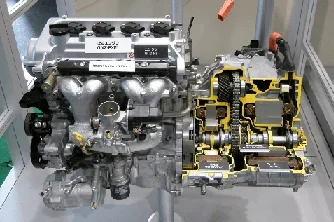 An example hybrid engine.Copyright 2008 Hatsukari715, Wikimedia Commons http://commons.wikimedia.org/wiki/File:Toyota_1NZ-FXE_Engine_01.JPG
Students investigate different forms of hybrid engines as well as briefly conclude a look at the different forms of potential energy, which concludes the Research and Revise step of the legacy cycle. Students are introduced to basic circuit schematics and apply their understanding of the difference between series and parallel circuits to current research on hybrid cars.
Some engineers apply their understanding of circuits to research on hybrid car technology. As an alternative to the cost and carbon emissions of gasoline engines, hybrid car technology is an intensive area of research for electrical, mechanical, chemical and computer engineers. Circuit schematics are an important communication tool for all types of engineers.
After this lesson, students should be able to:
- Explain how differing forms of potential energy are translated into kinetic energy.
- Explain the difference between parallel and series hybrid engines.
- Power systems must have a source of energy, a process, and loads.
Grades 9-12
Do you agree with this alignment? - STEL-4R Assess a technology that minimizes resource use and resulting waste to achieve a goal.
Grades 9-12
Do you agree with this alignment?
- Science and Technology
Grades K-12
Do you agree with this alignment? - Science in Personal and Social Perspectives
Grades K-12
Do you agree with this alignment?
Students should already have a working understanding of the principle of conservation of energy, as well as kinetic and potential energy. It is also helpful if they understand the difference between parallel and series circuits.
Display schematics for both parallel and series hydraulic hybrids, which are easily found on the Internet. At this point, the main intent is to inform students of the difference between parallel (most common in market) and series (usually more efficient) systems.
Series and Parallel Circuits: To explain the difference between series and parallel, us an analogy to water running through pipes, using Figure 1 to explain.
In Figure 1, the top image shows pipes in parallel while the bottom image shows pipes in series. Each blue circle represents a point where flow can be measured. Ask students the volume of water to pass through each of the check points. Explain that the total volume of water passes through each of the check points in the series pipes, but in the parallel pipes, only one-third the volume passes through each check point.
Then ask students how much pressure would be required to work each pump. Explain then that more pressure would be required to pump the series pipes as each check point offers resistance and all the water must go through three check points. In the parallel pipes, the water must only go through one of the three check points and therefore a lower amount of overall pressure would be required.
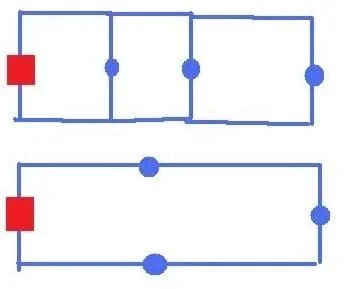 Figure 1. Series and parallel pipes.Copyright 2006 Joel Daniel, Vanderbilt University
If students are familiar with current, voltage and electrical resistance consider explaining that the pressure is analogous to voltage, and volume of flow is analogous to current and the resistance of the check points is analogous to resistors.
Describe the differing types of hybrid engines in use today. Since you have the schematic displayed, start off with a hydraulic hybrid most commonly in use in larger trucks and using a gas spring. Ask students to explain what might be meant by a gas spring. Then move on to the gas electric hybrid, and how that works. A Toyota Prius is one of the first extremely popular vehicles of this type and thus schematics are easy to obtain. Then, a diesel-electric with a train engine, followed by a nuclear-electric with a submarine.
Now that we have learned a about different types of energy and how they are converted and conserved, let's revisit the video clip we watched at the beginning of this unit. (Show the hybrid engine video clip: https://www.youtube.com/watch?v=m2qvGJwTuBo)
What did you learn from watching it a second time that you did not learn before, or you did not understand before?
(Continue with the lecture material as described in the Lesson Background section). Following the lesson, refer to the hands-on associated activity Energy Storage Derby and Proposal to have students design energy storage devices for small model cars and go public with a brochure about their designs.
- parallel
- A mechanism in which both systems are used to power the drive train simultaneously.
- series
- A mechanism in which one of the systems is used only to provide power for the other.
- regenerative braking
- A system that converts forward kinetic energy into potential energy during braking, to be re-converted into kinetic energy during acceleration.
Informal Assessment via Questions: 1) During the lesson, ask questions to verify that students are following along and understanding the key concepts. 2) While discussing the different varieties of hybrids (such as gas-electric, diesel-electric, nuclear-electric, etc.), ask students to identify whether each type is parallel or series in its design.
Contributors
Joel Daniel (Center for Compact and Efficient Fluid Power, University of Minnesota); Megan Johnston
Supporting Program
VU Bioengineering RET Program, School of Engineering, Vanderbilt University
Acknowledgements
The contents of this digital library curriculum were developed under National Science Foundation RET grant nos. 0338092 and 0742871. However, these contents do not necessarily represent the policies of the NSF, and you should not assume endorsement by the federal government.
Copyright
2013 by Regents of the University of Colorado; original © 2006 Vanderbilt University