
Hybrid Vehicle Design Challenge
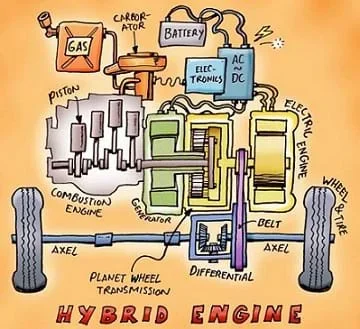 Hybrid engine schematic.Copyright 2004 Welleman at nl.wikipedia, Wikimedia Commons http://commons.wikimedia.org/wiki/File:Hybrid_engine.jpg
The design uses a contextually based "Challenge" followed by a sequence of instruction in which students first offer initial predictions ("Generate Ideas") and then gather information from multiple sources ("Multiple Perspectives"). This is followed by "Research and Revise" as students integrate and extend their knowledge through a variety of learning activities. The cycle concludes with formative ("Test Your Mettle") and summative ("Go Public") assessments that lead the student towards answering the Challenge question. See the unit overview section for the progression of the legacy cycle through the unit. Research and ideas behind this way of learning may be found in How People Learn, (Bransford, Brown & Cocking, National Academy Press, 2000). View the entire text at https://www.nap.edu/catalog/9853/how-people-learn-brain-mind-experience-and-school-expanded-edition.
The legacy cycle is similar to the engineering design process in that they both involve identifying a societal need, combining science and math to develop solutions, and using the research conclusions to design a clear conceived solution to the original challenge. Though both the engineering design process and legacy cycle depend on a correct and accurate solution, each focuses particularly on how the solution is devised and presented. See an overview of the engineering design process at https://en.wikipedia.org/wiki/Engineering_design_process.
In Lesson 1, students are presented with a Challenge Question: "The rising price of gasoline has many effects on the US economy and the environment. You have been contracted by an engineering firm to help design a physical energy storage system for a new hybrid vehicle for Nissan. How would you go about solving this problem? What information would you consider to be important to know? You make a small prototype of your idea and make a sales pitch to Nissan at the end of the unit."
Students begin by Generating Ideas in a journal, answering questions such as, "How does the internal combustion engine currently work?" and "How do current hybrids work?" and "What other forms of energy are available?"
Lesson 2 moves into the Research and Revise phase to focus on the conservation of energy solely between gravitational potential energy and kinetic energy. Students start out with a virtual laboratory, and then move into the notes and working of problems as a group. A few questions are given as homework. A dry lab that focuses on the kinetic and potential energies on a roller coaster concludes the lesson in the Test Your Mettle phase of the legacy cycle.
In Lesson 3, as part of the Research and Revise step students investigate potential energy held within springs. Class begins with a video of either spring shoes or bungee jumping. Students then move on into notes and problems as a group. A few questions are given as homework. The Test Your Mettle section concludes the lesson and includes a dry lab that involves pogo sticks that to solidify the concepts of spring potential energy, kinetic energy, and gravitational energy, as well as conservation of energy.
In Lesson 4, students conclude the Research and Revise step of the legacy cycle, as they investigate different forms of hybrid engines as well as take a brief look at the different forms of potential energy.
In Activity 4 (Energy Storage Derby and Proposal), students finish the legacy cycle with the Go Public phase. A design problem is given to the students to design and construct a small-scale vehicle to participate in a derby. To be considered for a complete project, vehicles must complete a 10-meter run in the hallway. Submissions are ranked on performance in three areas: 1) vehicle weight, 2) unloaded time, and 3) time with a 250 g load. Students then make sales pitches for their ideas and prototypes to be considered in Nissan's next design.
Alternative energy sources, particularly within the realm of transportation, are a hot topic in the scientific and engineering communities. Achieving a design for a safe and efficient method of capturing the energy given off by a vehicle and transferring it into kinetic energy is of utmost importance. Throughout this unit, students apply the classroom-presented scientific concepts of energy conservation to the real-world problem of designing and implementing a system for energy transformation in vehicles.
- CCSS.Math.Content.HSA-REI.B.3 Solve linear equations and inequalities in one variable, including equations with coefficients represented by letters.
Grades 9-12
Do you agree with this alignment?
- HS-PS3-1 Create a computational model to calculate the change in the energy of one component in a system when the change in energy of the other component(s) and energy flows in and out of the system are known.
Grades 9-12
This resource focuses on the following Three Dimensional Learning aspects of NGSS:
Science & Engineering Practices- Create a computational model or simulation of a phenomenon, designed device, process, or system.Do you agree with this alignment?
Disciplinary Core Ideas- Energy is a quantitative property of a system that depends on the motion and interactions of matter and radiation within that system. That there is a single quantity called energy is due to the fact that a system's total energy is conserved, even as, within the system, energy is continually transferred from one object to another and between its various possible forms.Do you agree with this alignment?
- Conservation of energy means that the total change of energy in any system is always equal to the total energy transferred into or out of the system.Do you agree with this alignment?
- Energy cannot be created or destroyed, but it can be transported from one place to another and transferred between systems.Do you agree with this alignment?
- Mathematical expressions, which quantify how the stored energy in a system depends on its configuration (e.g. relative positions of charged particles, compression of a spring) and how kinetic energy depends on mass and speed, allow the concept of conservation of energy to be used to predict and describe system behavior.Do you agree with this alignment?
- The availability of energy limits what can occur in any system.Do you agree with this alignment?
Crosscutting Concepts- Science assumes the universe is a vast single system in which basic laws are consistent.Do you agree with this alignment?
- Models can be used to predict the behavior of a system, but these predictions have limited precision and reliability due to the assumptions and approximations inherent in models.Do you agree with this alignment?
Do you agree with this alignment? - Create a computational model or simulation of a phenomenon, designed device, process, or system.
- HS-PS3-2 Develop and use models to illustrate that energy at the macroscopic scale can be accounted for as either motions of particles or energy stored in fields.
Grades 9-12
This resource focuses on the following Three Dimensional Learning aspects of NGSS:
Science & Engineering Practices- Develop and use a model based on evidence to illustrate the relationships between systems or between components of a system.Do you agree with this alignment?
Disciplinary Core Ideas- Energy is a quantitative property of a system that depends on the motion and interactions of matter and radiation within that system. That there is a single quantity called energy is due to the fact that a system's total energy is conserved, even as, within the system, energy is continually transferred from one object to another and between its various possible forms.Do you agree with this alignment?
- At the macroscopic scale, energy manifests itself in multiple ways, such as in motion, sound, light, and thermal energy.Do you agree with this alignment?
- These relationships are better understood at the microscopic scale, at which all of the different manifestations of energy can be modeled as a combination of energy associated with the motion of particles and energy associated with the configuration (relative position of the particles). In some cases the relative position energy can be thought of as stored in fields (which mediate interactions between particles). This last concept includes radiation, a phenomenon in which energy stored in fields moves across space.Do you agree with this alignment?
Crosscutting Concepts- Energy cannot be created or destroyed—it only moves between one place and another place, between objects and/or fields, or between systems.Do you agree with this alignment?
Do you agree with this alignment? - Develop and use a model based on evidence to illustrate the relationships between systems or between components of a system.
- Day 1: Engineering Brainstorming lesson
- Day 2-5: Conservation of Energy: Pushing It Off a Cliff lesson
- Day 6: Energy Skate Park activity
- Day 7: Energy on a Roller Coaster activity
- Day 8: Elastic Potential Energy of Springs—It’s Tiggerific! lesson
- Day 9: Energy and the Pogo Stick activity
- Day 10: How a Hybrid Works lesson
- Day 11-13: Energy Storage Derby and Proposal activity
Contributors
Joel Daniel (Center for Compact and Efficient Fluid Power, University of Minnesota); Megan Johnston
Supporting Program
VU Bioengineering RET Program, School of Engineering, Vanderbilt University
Acknowledgements
The contents of this digital library curriculum were developed under National Science Foundation RET grant nos. 0338092 and 0742871. However, these contents do not necessarily represent the policies of the NSF, and you should not assume endorsement by the federal government.
Copyright
2013 by Regents of the University of Colorado; original © 2006 Vanderbilt University