
Elastic Potential Energy of Springs—It’s Tiggerific!
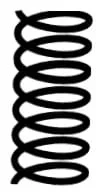 Potential energy can be stored in springs.Copyright 2004 Microsoft Corporation, One Microsoft Way, Redmond, WA 98052-6399 USA. All rights reserved.
Who doesn't love bouncing?! Students investigate potential energy held within springs (elastic potential energy) as part of the Research and Revise step. Class begins with a video of spring shoes or bungee jumping. Then students move on into notes and problems as a group. A few questions are given as homework. The Test Your Mettle section concludes. The lesson includes a dry lab that involves pogo sticks to solidify the concepts of spring potential energy, kinetic energy and gravitational energy, as well as conservation of energy.
The conversion of kinetic and gravitational potential energy to elastic potential energy is important for many engineers. Biomedical engineers must know about the elasticity of blood vessels. Mechanical and civil engineers must know the elasticity of materials and how much movement that elasticity can create.
After this lesson, students should be able to:
- Apply the law of conservation of energy to the use of springs to physics problems in one dimension.
- Explain why mechanical energy is not always conserved with a spring.
- Energy cannot be created nor destroyed; however, it can be converted from one form to another.
Grades 9-12
Do you agree with this alignment?
- HS-PS3-2 Develop and use models to illustrate that energy at the macroscopic scale can be accounted for as either motions of particles or energy stored in fields.
Grades 9-12
This resource focuses on the following Three Dimensional Learning aspects of NGSS:
Science & Engineering Practices- Develop and use a model based on evidence to illustrate the relationships between systems or between components of a system.Do you agree with this alignment?
Disciplinary Core Ideas- Energy is a quantitative property of a system that depends on the motion and interactions of matter and radiation within that system. That there is a single quantity called energy is due to the fact that a system's total energy is conserved, even as, within the system, energy is continually transferred from one object to another and between its various possible forms.Do you agree with this alignment?
- At the macroscopic scale, energy manifests itself in multiple ways, such as in motion, sound, light, and thermal energy.Do you agree with this alignment?
Crosscutting Concepts- Energy cannot be created or destroyed—it only moves between one place and another place, between objects and/or fields, or between systems.Do you agree with this alignment?
Do you agree with this alignment? - Develop and use a model based on evidence to illustrate the relationships between systems or between components of a system.
- 3231.1.18 Analyze the characteristics of energy, conservation of energy including friction, and gravitational potential energy [Gravitational Potential Energy: Ep=mgΔh].
Grades 9-12
Do you agree with this alignment?
Students must be beginning to understand conservation of mechanical energy. Since this lesson focuses on elastic potential energy, they should have already covered Hooke's law and be able to recognize Hooke's spring constant.
Concept Information
After students have grasped the concept of conservation of energy between KE and GPE, introduce the concept of elastic potential energy. In the basic physics course, only Hookien materials should be considered. Therefore, the equation for elastic potential energy can be expressed as:
EPE = ½ kx2 (1)
Here, k is the Hooke's spring constant and x is the amount of displacement from the free length by compression or elongation. However, students should also be made aware of that is happening at the molecular level within a spring, and that friction is present, and therefore conversion of energy into non-mechanical forms of energy is also present.
Again we will be making the assumption of a closed system. Therefore, the law of conservation of energy is:
E1 = E2 (2)
Here, we assume that the only forms of energy that can be dealt with are kinetic, gravitational potential energies, and elastic potential energy.
KE1 + GPE1 + EPE1 = KE2 + GPE2 + EPE2 (3)
Expanding,
½ mv1 2 + mgh1 + ½ kx1 2 = ½ mv2 2 + mgh2 + ½ kx2 2 (4)
To start out, problems should be solely EPE at one point and GPE at the other. A problem made up on the spur of the moment dealing with an ejection seat in a James Bond car always gets the students interested and involved. This also requires careful placement of your ground level. So (4) can reduce to:
½ kx1 2 = mgh2 (5)
Only after a few problems, should the case in which we have to include other terms to have (4) be true should be attempted. Just before the activity "Energy and the Pogo Stick" should the concept of adding other forms of energy is discussed and the law of Conservation of Energy always be expressed as in (1).
Lecture Information
Eventually, the conclusion that energy is stored within springs should be reached. Ask students what helps determine the amount of energy held within the springs (elastic potential energy, EPE). If possible, have several springs of varying stiffness to pass out around the room so that the students can come up with answers kinesthetically. Immediately, they will talk about the stiffness of the spring. Help remind them what constant was used to measure stiffness, the spring constant (k). Then write "EPE a k" on the board. Another possibility would be how far the spring is compressed or elongated. Ask if it is a linear relationship. Students should fairly quickly be able to determine that it is not, so you should be able to just tell them that it is actually a linear relationship with the square of compression or elongation. Therefore, "EPE a kx2" can replace the aforementioned expression. Then you can include the constant ½ and replace "a" with "=" for "EPE = ½ kx2."
Students then need to immediately see an application. "Making up" a problem is quite effective. Finding the required spring constant for use in James Bond's car or a fighter jet is often a good choice. Here the amount of room available for compression and the required height of ejection can be estimated, while using an average mass of a man, leaving only the spring constant to calculate. A few more problems from the text are then attempted with the class.
The lesson finishes the next day with the associated activity, Energy and the Pogo Stick, by having students model their understanding with pogo sticks!
Now that we know more about gravitational potential energy and kinetic energy, let's introduce another type of potential energy called elastic potential energy. Let's watch this video clip first.
(Play the 2-minute You Tube video of people doing tricks on spring shoes; see details in the Additional Multiimedia Support section.)
So, how were the people able to get that much height to be able to perform those tricks? Can you name all the types of energy involved? (Answers: Kinetic, gravitational and elastic potential energy.)
(Continue with the lecture information provided in the Background section.)
- elastic potential energy
- Stored energy held within any elastic material, due to the compression or elongation of the material.
- tigger
- A fictional stuffed animal tiger character in A.A. Milne’s Winnie the Pooh book series. He is known for his distinctive orange and black stripes, large eyes, long chin, springy tail, and love of bouncing.
Informal Assessment: While doing problems with the class, make sure to only do the first problem. Then solve another with help from the class. Then have all additional problems solved solely by the students with individual help from the teacher and other students who have had their work checked by the teacher.
Formal Assessment: Review students' lab reports from the virtual lab and dry lab. Require them to be in a format that the teacher is comfortable with, but that also allows for the checking of the understanding of the concepts by the student.
Concluding Group Quiz: Ask the class: "How could you determine the spring constant of a ball point pen by only using a metric ruler? All forms of friction can be neglected." Expect students to be able to apply the law of conservation of energy between GPE and EPE, using the ruler to measure the amount of displacement from the free length and the height reached by the pen.
Powershoes video clip (2:15 minutes) https://www.youtube.com/watch?v=TcHhf6vNoq4
Contributors
Joel Daniel (Center for Compact and Efficient Fluid Power, University of Minnesota); Megan Johnston
Supporting Program
VU Bioengineering RET Program, School of Engineering, Vanderbilt University
Acknowledgements
The contents of this digital library curriculum were developed under National Science Foundation RET grant nos. 0338092 and 0742871. However, these contents do not necessarily represent the policies of the NSF, and you should not assume endorsement by the federal government.
Copyright
2013 by Regents of the University of Colorado; original © 2006 Vanderbilt University