
What Makes Our Bones Strong?
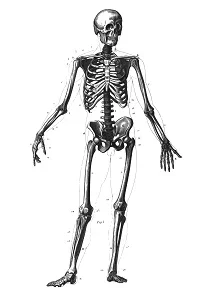 What makes our bones strong?Copyright Wikimedia Commons http://commons.wikimedia.org/wiki/File:Skeleton_diagram.svg
Through this activity, students determine what keeps our bones strong. Soaking chicken bones in vinegar removes the calcium, causing them to become soft and rubbery. Students see the connection to aging bones that become depleted of calcium faster than it can be restored. Then they determine what complications can arise from this condition.
Biomedical and mechanical engineers study bones because of their fascinating structural material. Engineers perform many mechanical tests, such as strength and torque tests, and they have found that bone has the ability to adapt to a changing load environment over time and can also recover from failure. One emerging fields of study in biomedical engineering is bone tissue engineering. By applying engineering and biological concepts, substitute materials are being created to perform the functions of human bones.
After this activity, students should be able to:
- Determine what inorganic salts are stored in bone.
- Describe what happens to bone as people age, and the complications that may ariset.
- Technological problems must be researched before they can be solved.
Grades 9-12
Do you agree with this alignment? - STEL-1Q Conduct research to inform intentional inventions and innovations that address specific needs and wants.
Grades 9-12
Do you agree with this alignment?
- 3251.2.4 Distinguish between the different types of bones.
Grades 9-12
Do you agree with this alignment? - 3251.2.5 Describe the physiological mechanisms involved in bone development, growth, and repair.
Grades 9-12
Do you agree with this alignment?
Each group needs:
- boiled chicken bone, cooked or un-cooked
- vinegar
- beaker
- wax pencil
- rubber band
- plastic wrap
- What Makes Our Bones Strong? Worksheet (PDF), one per student
- Lab Report Grading Rubric (PDF)
General knowledge about the functions of the skeletal system.
Today we will start an activity to determine what keeps our bones strong. Mechanical and biomedical engineers work together in labs to design materials that perform the same as human bones. To determine what material needs to be used, often strength and torque tests are performed.
You will work in groups of two to complete this activity, which also focuses on bone strength. Your group will determine what material keeps our bones strong. At the conclusion of the activity, your group will also determine what problems can arise when our bones lose their strength. Remember to keep in mind the challenge question we talked about at the beginning of our study.
Students investigate what materials are in bones that give them strength. The purpose of the experimental design is to test the strength of bones. The structure of bone is an important topic of study in the mechanical and biomedical engineering communities. This is especially pertinent when studying the causes, prevention and treatment of osteoporosis.
Background
To complete this experiment, students must work together. During the experiment, monitor each group to ensure they are following the safety procedures and ask students questions about how they are performing their experiments, what results they are finding, and how these results relate to helping them answer the engineering challenge question.
For more background information about the skeletal system, refer to the notes given in the associated lesson.
Before the Activity
Make copies of the What Makes Our Bones Strong? Worksheet (PDF), one per student and the Lab Report Grading Rubric (PDF), one per group.
Procedure (also on the worksheet)
- Use the wax pencil to label the beaker with your group members' names.
- Label the experiment start date and time on the beaker.
- Observe the chicken bone (length, width, shape, mass, color, rigidity, etc.). Write down and date your observations.
- Make a chart with the written observations about what your group thinks makes bones strong.
- Place the chicken bone in the beaker.
- Cover the bone with vinegar.
- Cover the beaker with plastic and secure it with a rubber band.
- Let the bones sit four days in the liquid solution.
- During this time, write all observations on a chart.
- As a conclusion, compare and contrast your observations of the bone condition from before and after the experiment.
Prepare a lab report and class presentation. Make sure to do the following:
- Write the experiment purpose.
- Write a hypothesis.
- Make a prediction.
- Run the experiment.
- Create a chart and your record data and observations.
- Analyze and state your results.
- Draw conclusions.
- Write additional questions that you would like to explore.
- Class presentation of experiments, results and conclusions.
- Lab write-up of experiment.
After the lab, make sure students wash their hands with soap. Even though you have boiled the bones and they should be safe, washing just ensures that any bacteria is washed away.
Contributors
Morgan Evans
Supporting Program
VU Bioengineering RET Program, School of Engineering, Vanderbilt University
Acknowledgements
The contents of this digital library curriculum were developed under National Science Foundation RET grant nos. 0338092 and 0742871. However, these contents do not necessarily represent the policies of the NSF, and you should not assume endorsement by the federal government.
Copyright
2013 by Regents of the University of Colorado; original © 2010 Vanderbilt University