
Skeletal System
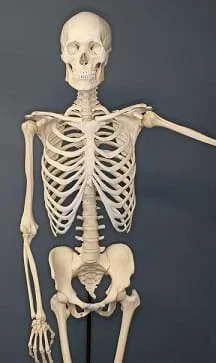 Students examine the human skeletal systemCopyright Wikipedia https://en.wikipedia.org/wiki/Human_skeleton#/media/File:Human-Skeleton.jpg
This "legacy cycle" unit is structured with a contextually-based Grand Challenge followed by a sequence of instruction in which students first offer initial predictions (Generate Ideas) and then gather information from multiple sources (Multiple Perspectives). This is followed by Research and Revise as students integrate and extend their knowledge through a variety of learning activities. The cycle concludes with formative (Test Your Mettle) and summative (Go Public) assessments that lead students towards answering the Challenge Question. See the Unit Schedule section for the progression of the legacy cycle through the unit. Research and ideas behind this way of learning may be found in How People Learn (Bransford, Brown & Cocking, National Academy Press, 2000); see the entire text at https://www.nap.edu/read/9853/chapter/1
The "legacy cycle" is similar to the engineering design process in that they both involve identifying existing societal needs, combining science and math to develop solutions, and using the research conclusions to design clear, conceived solutions to the original challenges. Though the engineering design process and the legacy cycle depend on correct and accurate solutions, each focuses particularly on how the solution is devised and presented. See an overview of the engineering design process at https://www.teachengineering.org/populartopics/designprocess.
In lesson 1, Fix the Hip Challenge, students are asked to answer the following Grand Challenge:: When you get home from school, your mother grabs you, and you race to the hospital. Your grandmother fell and was rushed to the emergency room. The doctor tells your family your grandmother has a fractured hip and she is referring her to an orthopedic specialist. The orthopedic doctor decides to perform a DEXA scan. The results show her BMD is -3.3. What would be a probable diagnosis to her condition? What are some possible causes of her condition? Should her daughter and granddaughter be worried about this condition, and if so, what measures could they take to prevent this from happening to them?
Students begin Generating Ideas in the activity, "What is Going on with Grandma?" by answering questions such as, "What are your initial ideas on how the question can be answered?" and "What background knowledge is needed?" and completing the questions worksheet. The students then enter the Multiple Perspectives phase of the legacy cycle by watching two YouTube video clips about osteoporosis.
In lesson 2, Skeletal System Overview, students enter the Research and Revise phase of the legacy cycle focusing on an overview of the skeletal system. A copy of "Skeletal System Notes" is provided for this lesson, and the lesson conclude with a set of review questions as a part of the Test Your Mettle stage of the cycle. The students then participate in the "What Makes our Bones Strong?" lab activity. The next activity, "Osteoporosis Brochure," begins the Go Public phase of the legacy cycle. In groups of two, students research information about osteoporosis. In pairs, they create informative brochures presenting findings on osteoporosis and the role biomedical engineers play in helping diagnose this disease. They need to keep in mind the questions asked in the Challenge Question.
Biomedical engineers and researchers develop procedures to test bone strength. Bone density testing is the most common way to test bone mineral density (BMD), which is believed to have some correlation to bone strength. New development in nuclear magnetic resonance (NMR) is enabling researchers to use magnetic imaging to view bone. By using mechanical three-point bend testing and NMR images, researchers hope to make a direct correlation to the force required to cause mechanical failure and the image produced by the NMR. Researchers want to be able to use this method in the future to diagnose osteoporosis.
- 3251.2.4 Distinguish between the different types of bones.
Grades 9-12
Do you agree with this alignment? - 3251.2.5 Describe the physiological mechanisms involved in bone development, growth, and repair.
Grades 9-12
Do you agree with this alignment? - CLE 3204.Inq.1 Recognize that science is a progressive endeavor that reevaluates and extends what is already accepted.
Grades 9-12
Do you agree with this alignment? - CLE 3295.T/E.1 Explore the impact of technology on social, political, and economic systems.
Grades 9-12
Do you agree with this alignment?
Day 1
- Introduce the Challenge Question and distribute the "Bone Module Worksheet."
- Have students independently work in their journals to answer the Generate Ideas questions. If possible, have journal responses submitted electronically so that all entries can easily be pulled into one document.
- As a class, review all journal entries.
- On the board, record the needed knowledge areas that students identified. Also record any specific ideas that were generated.
- Watch the Multiple Perspective video.
Day 2 and Day 3
- Initial setup for "What Makes our Bones Strong?" activity.
- Teacher presents overview of bones.
- Give each student a student notes sheet. The student version contains blanks to be filled in.
- Give review questions to each student to be completed for homework.
Day 4
- Completion of the What Makes our Bones Strong? activity.
Day 5
- Students begin working on the Go Public phase: "Osteoporosis Brochure" activity.
Day 6
- Students continue working on their brochures and present to the class.
Contributors
Morgan R. Evans
Supporting Program
VU Bioengineering RET Program, School of Engineering, Vanderbilt University
Acknowledgements
The contents of this digital library curriculum were developed under National Science Foundation RET grant nos. 0338092 and 0742871. However, these contents do not necessarily represent the policies of the NSF, and you should not assume endorsement by the federal government.
Copyright
2013 by Regents of the University of Colorado; original © 2010 Vanderbilt University