
The Grand Challenge: Fix the Hip Challenge
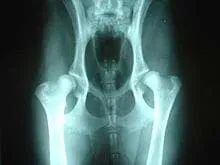 Students are presented with a hip challengeCopyright https://simple.wikipedia.org/wiki/Hip_dysplasia
This lesson introduces the Bone Module Grand Challenge question. Students individually write their initial responses to the question. Then they brainstorm ideas with another student. Then the ideas are shared with the class and recorded. It is important for students to gather information to decide whether or not this condition is hereditary. Next, students watch two videos about osteoporosis. Grand Challenge Question: When you get home from school, your mother grabs you, and you rush to the hospital. Your grandmother fell and was rushed to the emergency room. The doctor tells your family your grandmother has a fractured hip, and he is referring her to an orthopedic specialist. The orthopedic doctor decides to perform a DEXA scan. The result showed her bone mineral density (BMD) was -3.3. What would be a probable diagnosis to her condition? What are some possible causes of her condition? Should her family be worried that this condition is hereditary, and if so, what are possible prevented measures they could take to prevent this from happening to them? What statistical method did you use to determine if the condition is hereditary?
Biomedical engineers and researchers are in the process of developing new procedures to test bone strength. Bone density testing is the most common way to test BMD (bone mineral density), which is believed to have some correlation to bone strength. New development in NMR (nuclear magnetic resonance) is allowing researchers to use magnetic imaging to view bone. By using mechanical 3-point bend testing and NMR images, researchers are hoping to make a direct correlation to the force required to cause mechanical failure and the image produce by the NMR. Researchers want to be able to use this method in the future to diagnose osteoporosis.
After this lesson, students should be able to:
- Explain the challenge problem.
- List what information might be needed to answer the problem.
- Understand, using statistics, whether or not the condition is hereditary.
- Group together similar areas of knowledge needed to answer the challenge.
- Identify the design problem to solve and decide whether or not to address it.
Grades 9-12
Do you agree with this alignment? - STEL-7Y Optimize a design by addressing desired qualities within criteria and constraints.
Grades 9-12
Do you agree with this alignment?
- HS-LS3-3 Apply concepts of statistics and probability to explain the variation and distribution of expressed traits in a population.
Grades 9-12
This resource focuses on the following Three Dimensional Learning aspects of NGSS:
Science & Engineering Practices- Apply concepts of statistics and probability (including determining function fits to data, slope, intercept, and correlation coefficient for linear fits) to scientific and engineering questions and problems, using digital tools when feasible.Do you agree with this alignment?
Disciplinary Core Ideas- Environmental factors also affect expression of traits, and hence affect the probability of occurrences of traits in a population. Thus the variation and distribution of traits observed depends on both genetic and environmental factors.Do you agree with this alignment?
Crosscutting Concepts- Algebraic thinking is used to examine scientific data and predict the effect of a change in one variable on another (e.g., linear growth vs. exponential growth).Do you agree with this alignment?
- Technological advances have influenced the progress of science and science has influenced advances in technology.Do you agree with this alignment?
- Science and engineering are influenced by society and society is influenced by science and engineering.Do you agree with this alignment?
Do you agree with this alignment? - Apply concepts of statistics and probability (including determining function fits to data, slope, intercept, and correlation coefficient for linear fits) to scientific and engineering questions and problems, using digital tools when feasible.
- 3251.2.4 Distinguish between the different types of bones.
Grades 9-12
Do you agree with this alignment? - 3251.2.5 Describe the physiological mechanisms involved in bone development, growth, and repair.
Grades 9-12
Do you agree with this alignment?
This lesson covers the Challenge, Generates Ideas, and Multiple Perspectives phases of the legacy cycle. After being introduced to the challenge question, students should begin to brainstorm ideas and organize the information they deem necessary to solve the challenge. This constitutes the Generate Ideas phase of the cycle.
After the students generate ideas about the challenge question, introduce the students to the input of a professional. This will help guide their learning, also known as the Multiple Perspectives phase. The following links provide the professional input of Dr. Brian P. Kessler and a glance inside the human body to see the effects of osteoporosis.
https://www.youtube.com/watch?v=xxmkMMoJ_Mg
https://www.youtube.com/watch?v=5uAXX5GvGrI
This first part of the legacy cycle allows students to deeply engage with a problem and become motivated to learn information. The Generate Ideas section lets them identify prior knowledge so they feel that they have a starting place for the problem. Students get to hear everyone's ideas so they understand different perspectives of the problem. This is also a time for teachers to identify misconceptions. The Multiple Perspectives aspect of this lesson gives students more clues to the challenge problem and allow them to see why this information is useful.
When you get home from school, your mother grabs you, and you rush to the hospital. Your grandmother fell and was rushed to the emergency room. The doctor tells your family your grandmother has a fractured hip, and he is referring her to an orthopedic specialist. The orthopedic doctor decides to perform a DEXA scan. The result showed her BMD was -3.3. What would be a probable diagnosis to her condition? What are some possible causes of her condition? Should her family be worried that this condition is hereditary, and if so, what are possible prevented measures they could take to prevent this from happening to them? What statistical method did you use to determine if this condition is hereditary?
Over the next week or so, we will work together to solve this challenge. We will solve this challenge in a different way, but it will be exciting and fun. Engineers are presented with challenges each and every day and it is their responsibility to generate ideas and gather the information necessary to find solution. Specifically, biomedical engineers would examine problems involving the human body to find solutions. We will begin by generating ideas about what we already know, and what we need to know. We will watch a couple of videos about a common bone disease to give us more insight into what challenge question is asking us. We will spend time learning general information about our skeletal system and what makes bones strong. Following the lesson, students can follow the Generating Ideas & Questions: What Is Going on with Grandma? activity to practice researching a challenge question. Finally, you and another student will create an informative brochure providing important information about osteoporosis. This brochure will also reflect your understanding of what biomedical engineers do to help diagnose and prevent this disease.
- biomedical engineering
- The application of engineering principles and techniques to the medical field. It combines the design and problem solving skills of engineering with medical and biological sciences to help improve patient health care and the quality of life of individuals.
- bmd
- Acronym for bone mineral density. Mineral content in a given volume of bone, used as a measure of bony health and in the diagnosis of osteoporosis.
- dexa scan
- A device that measures bone mineral density. DEXA = dual-energy x-ray absorptiometry.
- osteoporosis
- A disorder in which the bones become increasingly porous, brittle and subject to fracture, owing to a loss of calcium and other mineral components.
Post-Lesson Assessment: Ask students to write anwers in their journals to the following questions.
- What do you know about osteoporosis?
- Does anyone in your family have osteoporosis? If so, what medical care do they require and can this affect whether or not you will get osteoporosis?
- Do you feel the statistical method you used is sufficient enough to determine if the condition will get passed down?
- What other information do you need to attain to answer the challenge question and complete your informative brochure?
Videos about osteoporosis for Multiple Perspectives.
Random House Unabridged Dictionary, Random House. Accessed January 5, 2010. http://www.dictionary.com
Illumistream Health, Illumistream's Channel. Accessed January 5, 2010. http://www.youtube.com/user/illumistream
- Skeletal System
- The Grand Challenge: Fix the Hip Challenge
- Skeletal System Overview
Contributors
Morgan Evans
Supporting Program
VU Bioengineering RET Program, School of Engineering, Vanderbilt University
Acknowledgements
The contents of this digital library curriculum were developed under National Science Foundation RET grant nos. 0338092 and 0742871. However, these contents do not necessarily represent the policies of the NSF, and you should not assume endorsement by the federal government.
Copyright
2013 by Regents of the University of Colorado; original © 2010 Vanderbilt University