
Skeletal System Overview
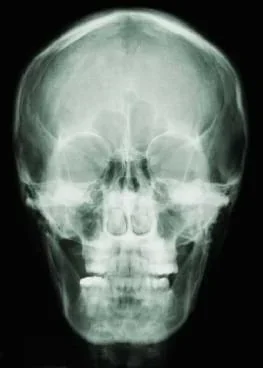 X-ray of a human skull.Copyright 2004 Microsoft Corporation, One Microsoft Way, Redmond, WA 98052-6399 USA. All rights reserved.
Students learn about bone structure, bone development and growth, and bone functions. Later, they apply this understanding to answer the Challenge Question presented in the "Fix the Hip" lesson and use what they have learned to create informative brochures about osteoporosis and biomedical engineering contributions to this field.
Biomedical and mechanical engineers study bones because of their amazing structural material. Many mechanical tests can be performed by engineers such as strength or torque tests. Bone has the ability to adapt to a changing load environment over time, and can also recover from failure. One emerging field of study in biomedical engineering is bone tissue engineering. By applying concepts from both biology and engineering, possible substitutes are being created that perform the same functions of human bones. Later, students demonstrate how engineers would present their findings by creating brochures about osteoporosis. This is an important skill because engineers must be able to relay their findings to audiences of people with different backgrounds so that they understand what is going on. Osteoporosis is a condition that causes bones to become brittle and, thus, weak. Biomedical engineers are working on ways to prevent bone fractures from occurring due to the onset of this condition. In addition, DEXA scans are performed to screen for osteoporosis. Biomedical engineers use the information from the scans (i.e., bone density) to determine where the onset of osteoporosis has occurred.
After this lesson, students should be able to:
- List the active tissues in a bone.
- Describe the macroscopic and microscopic structure of a long bone, and list the functions of these parts.
- Distinguish between intramembranous and endochondral bones, and explain how such bones develop and grow.
- Discuss the major functions of bones.
After the associated activities "What Makes our Bones Strong?" and "Osteoporosis Brochure," students should be able to:
- Organize content in order to produce an informative brochure to increase awareness of osteoporosis including treatment, prevention, and new technologies.
- Medical technologies include prevention and rehabilitation, vaccines and pharmaceuticals, medical and surgical procedures, genetic engineering, and the systems within which health is protected and maintained.
Grades 9-12
Do you agree with this alignment? - STEL-3H Analyze how technology transfer occurs when a user applies an existing innovation developed for one function to a different purpose.
Grades 9-12
Do you agree with this alignment?
- 3251.2.4 Distinguish between the different types of bones.
Grades 9-12
Do you agree with this alignment? - 3251.2.5 Describe the physiological mechanisms involved in bone development, growth, and repair.
Grades 9-12
Do you agree with this alignment?
Students need to know the basic vocabulary terms associated with the skeletal system.
This lesson starts the Research and Revise and the Test Your Mettle steps of the Legacy Cycle. Students receive additional information that enables them to revise their original ideas. In addition, students participate in the What Makes our Bones Strong? associated activity, which helps them explore the infoarmation presented about bones thus far. The following outline of notes aligns with the attached Skeletal Systems Notes sheet for students:
Introduction
- Bones contain a variety of very living tissue.
- Each is composed to several types of tissues and thus is an organ.
- Bone functions include: points of attachment, protection and support, blood cell production and mineral storage.
Bone Structure
- Bones differ in size and shape, yet are similar in several ways.
Bone Classification: Bones are classified according to shape.
- Long bones: forearm, thigh.
- Short bones: wrists, ankles.
- Flat bones: ribs, scapulae, some skull bones.
- Irregular bones: vertebrae, many facial bones.
- Sesamoid (round) bones: patella.
Bone Structure
Parts of Long Bone
- Epiphyses = end of long bone.
- Articular cartilages = cover epiphyses.
- Diaphysis = bone shaft.
- Compact bone = walls of diaphysis.
- Spongy bone = fills ends of epiphyses.
- Medullary cavity = hollow inside of diaphysis; lined w/endosteum & filled w/marrow.
Bone Development and Growth
Intramembranous Bones
- Flat bones of the skull.
- Osteoblasts deposit bony tissue around themselves.
- Spongy bone forms in all directions w/in the connective tissue.
- When completely enclosed in bony deposits, they are called osteocytes.
- Cells that lie outside the developing bone make the periosteum.
- Osteocytes in the inside of the periosteum form a layer of compact bone over the newly formed spongy bone.
- Ossification= bone formation.
Endochondral Bone
- Most bones fall into this category.
- Begin as masses of hyaline cartilage shaped like future bony structures and are replaced by bone.
- Cartilage is broken down in the diaphysis.
- Cartilage tissue is invaded by blood vessels.
- Osteoblasts that first form spongy bone at the primary ossification center in the diaphysis.
- Osteoblasts under the periosteum lay down compact bone outside the spongy bone.
- Secondary ossification centers appear later in the epiphyses.
- A medullary cavity forms in the region of the diaphysis due the osteoclasts.
Homeostasis of Bone Tissue
- Osteoclasts tear down and osteoblasts build bone throughout the lifespan w/ the processes of resorption and deposition.
- There is an average of 3%-5% of bone calcium exchange annually.
Factors affecting bone development, growth, and repair.
- Nutrition, hormonal secretions, and physical exercise.
Bone Function
- Bones shape, support, and protect body structures.
- They also aid in body movements, house tissues that produce blood cells, and store various inorganic salts.
- Bones give shape to the head, thorax, and limbs.
- Bones, such as the pelvis and lower limbs, provide support for the body.
- Bones of the skull protect the brain, ears, and eyes.
- Bones can act as levers - a lever has 4 components: A rigid bar, a pivot or fulcrum, an object that is moved against resistance, and a force that supplies energy.
Blood Cell Formation: Two kinds of marrow occupy the medullary cavity of bone.
- Red marrow= functions in the formation of red blood cells, white blood cells, and platelets. Red marrow is found in the spongy bone of the skull, ribs, sternum, clavicles, vertebrae, & pelvis.
- Yellow marrow= occupies the cavities of most bones and stores fat.
Storage of Inorganic Salts
- Inorganic bone matrix stores inorganic mineral salts as calcium phosphate (important for metabolic process).
- Ca in bone is a reservoir for body Ca; when levels are low, osteoclasts release Ca from bone.
- When Ca levels are high, Ca is stored in bone.
- Bone also stores magnesium, sodium, potassium, and carbonate ions.
- Bones can also accumulate harmful elements, such as lead, radium, & strontium.
Because bones are able to adapt to a changing load environment over time and can recover from failure, one emerging field of study in biomedical engineering is bone tissue engineering. By applying concepts from both biology and engineering, possible substitutes are being created that perform the same functions of human bones. Over the next couple of days, we are going to learn about bone structure, development and growth, and functions. After learning these objectives, you should have the basic knowledge needed to answer the challenge question. Later, we will start on the Go Public step of the Legacy Cycle: creating the Osteoporosis Brochure with the associated activity Go Public: Osteoporosis Brochure . You and your partner will make an informative brochure answering the Challenge Question. I will give you a rubric that will describe all the expectations I have for this project. You will have class time to work on your brochure; however, what you do not finish in class will need to be finished on your own time.
- Assign students to complete the attached questions as homework. Review their answers to gauge their comprehension.
- Have student pairs make presentations to the class of their experimental results and conclusions. Use the rubric to grade students on their presentations; and assign a participation grade.
Shier, David, Butler Jackie, and Lewis Ricki. Hole's Essentials of Human Anatomy and Physiology. New York, NY: McGraw-Hill, 2009.
Contributors
Morgan Evans
Supporting Program
VU Bioengineering RET Program, School of Engineering, Vanderbilt University
Acknowledgements
The contents of this digital library curriculum were developed under National Science Foundation RET grant nos. 0338092 and 0742871. However, these contents do not necessarily represent the policies of the NSF, and you should not assume endorsement by the federal government.
Copyright
2013 by Regents of the University of Colorado; original © 2010 Vanderbilt University