
Bridges
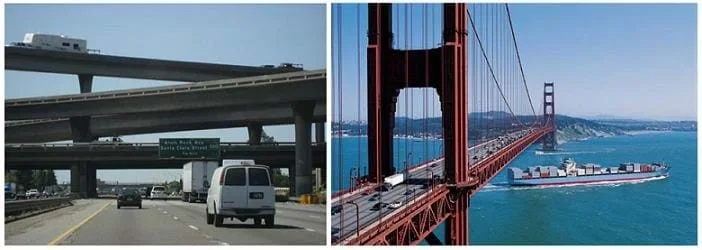 Bridges, an engineering marvel, connect people to resources, places and other peopleCopyright (left) 2007 Denise W. Carlson. Used with permission. (right) 2004 Microsoft Corporation, One Microsoft Way, Redmond, WA 98052-6399 USA. All rights reserved.
Overview of topics, by lesson: 1) bridge types, tension and compression forces; 2) design, loads, piers/columns and girders/beams; 3) geology, foundations, bearing pressure and settlement; 4) strength of materials; and 5) economics, estimates, costs.
Engineers are involved in many aspects of weather forecasting and weather-appropriate design. They analyze information about weather when designing instruments such as barometers, thermometers and anemometers—technologies that are essential for accurate weather predictions so that we can make informed decisions about how we interact with our world. Also, computer science engineers develop software to integrate these complex weather information technologies for meteorologists to use to make such predictions and inform the public. Engineers develop websites (and software) to present predicted and historical weather information in the most informative and pleasing way for people to understand. Civil engineers utilize weather data when designing bridges, houses and other structures, to ensure that those designs are appropriate for the climate of their locations. Environmental engineers analyze weather measurements to determine the placement and effectiveness of renewable energy technologies, such as wind farms and solar arrays. Engineers also serve an important role in designing products that enable people to more comfortably adjust to the weather (for example, waterproof jackets, heated driveways and sunscreen, and many other weather-resistant goods).
- Identify and calculate the direction and magnitude of forces that act on an object, and explain the results in the object's change of motion
Grade 8
Do you agree with this alignment? - Predict and evaluate the movement of an object by examining the forces applied to it
Grade 8
Do you agree with this alignment?
- CCSS.Math.Content.6.NS.B.3 Fluently add, subtract, multiply, and divide multi-digit decimals using the standard algorithm for each operation.
Grade 6
Do you agree with this alignment? - CCSS.Math.Content.7.G.B.6 Solve real-world and mathematical problems involving area, volume and surface area of two- and three-dimensional objects composed of triangles, quadrilaterals, polygons, cubes, and right prisms.
Grade 7
Do you agree with this alignment?
- MS-ETS1-2 Evaluate competing design solutions using a systematic process to determine how well they meet the criteria and constraints of the problem.
Grades 6-8
This resource focuses on the following Three Dimensional Learning aspects of NGSS:
Science & Engineering Practices- Evaluate competing design solutions based on jointly developed and agreed-upon design criteria.Do you agree with this alignment?
Disciplinary Core Ideas- There are systematic processes for evaluating solutions with respect to how well they meet the criteria and constraints of a problem.Do you agree with this alignment?
Do you agree with this alignment? - Evaluate competing design solutions based on jointly developed and agreed-upon design criteria.
- Day 1: Bridging the Gaps lesson
- Day 2: Bridge Types: Tensile & Compressive Forces activity
- Day 3: Straw Bridges activity
- Day 4: Designing Bridges lesson
- Day 5: Load It Up! activity
- Day 6: A Good Foundation lesson
- Day 7: Shallow & Deep Foundations activity
- Day 8: Strength of Materials lesson
- Day 9: Breaking the Mold activity
- Day 10: Show Me the Money lesson
- Day 11: Cost Comparisons activity
For an amazing bridge image and a story about an incredible US bridge project, see the July 4, 2009 Daily Mail story, "The Wider View: Taking Shape, the New Bridge at the Hoover Dam," on the 2010 Hoover Dam bypass bridge (called the "Colorado River Bridge") at http://www.dailymail.co.uk/news/article-1197544/THE-WIDER-VIEW-Taking-shape-new-bridge-Hoover-Dam.html
For an interesting time lapse of construction photos of the 10-year creation process of the 2010 Hoover Dam bypass bridge, see https://www.youtube.com/watch?v=fu4_gY5TFOY
Supporting Program
Integrated Teaching and Learning Program, College of Engineering, University of Colorado Boulder
Acknowledgements
This digital library content was developed by the Integrated Teaching and Learning Program in the College of Engineering and Applied Science under National Science Foundation grant no. 0338326. However, these contents do not necessarily represent the policies of the National Science Foundation and you should not assume endorsement by the federal government.
Copyright
2006 by Regents of the University of Colorado