
Bridging the Gaps
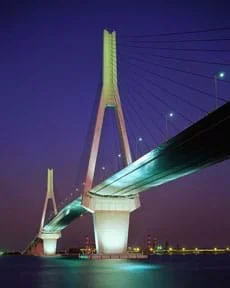 Figure 1. Tsurimi Tsubasa Bridge in Japan.Copyright 2004 Microsoft Corporation, One Microsoft Way, Redmond, WA 98052-6399 USA. All rights reserved.
Students are presented with a brief history of bridges as they learn about the three main bridge types: beam, arch and suspension. They are introduced to two natural forces — tension and compression — common to all bridges and structures. Throughout history, and today, bridges are important for connecting people to resources, places and other people. Using the associated activities to prototype their own structures, students become more aware of the variety and value of bridges around us in our everyday lives.
Bridges are fascinating feats of engineering. Throughout history, humans have creatively designed everything from rope and plank bridges to the Golden Gate Bridge. Today, primarily civil and structural engineers are responsible for the design of bridges of which we have more than 500,000 in the U.S. that are longer than 100 feet (30 meters). Since bridges must be safe under all anticipated load and weather conditions, in designing today's modern bridges, engineers take into consideration tension and compression forces. They also creatively strive to meet people's needs within budget and material constraints.
After this lesson, students should be able to:
- Discuss several different bridge designs.
- Describe some of the social, economic and cultural impacts of bridges.
- List various considerations of engineers when designing bridges.
- Predict and evaluate the movement of an object by examining the forces applied to it
Grade 8
Do you agree with this alignment?
- The selection of designs for structures is based on factors such as building laws and codes, style, convenience, cost, climate, and function.
Grades 6-8
Do you agree with this alignment?
- DCI.PS2.A.6-8.2 The motion of an object is determined by the sum of the forces acting on it; if the total force on the object is not zero, its motion will change. The greater the mass of the object, the greater the force needed to achieve the same change in motion. For any given object, a larger force causes a larger change in motion.
Grades 6-8
Do you agree with this alignment? - DCI.PS2.A.6-8.3 All positions of objects and the directions of forces and motions must be described in an arbitrarily chosen reference frame and arbitrarily chosen units of size. In order to share information with other people, these choices must also be shared.
Grades 6-8
Do you agree with this alignment?
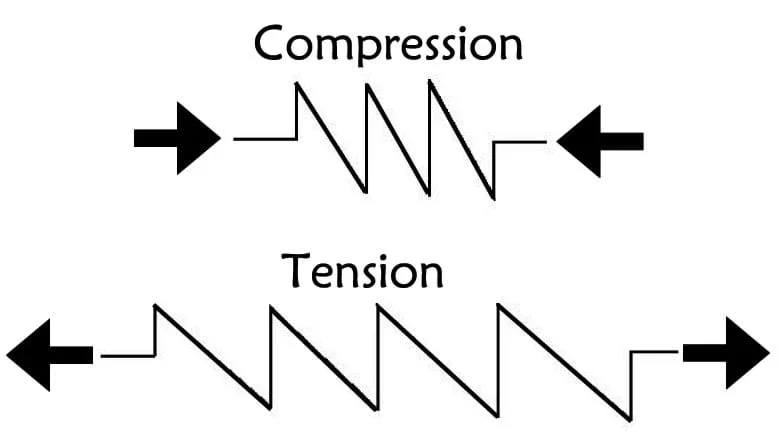 Figure 5. Tension and compression forces acting on a spring.Copyright ITL Program, University of Colorado at Boulder.
Three main types of bridges are beam (or truss), arch and suspension bridges. Refer to the Bridge Types: Tensile & Compressive Forces activity to have students design and prototype their own bridges while learning about the involved acting forces. Usually, the obstacle to be overcome — another roadway, a river, a valley, a canyon, railroad tracks — is the main factor in determining which bridge type is best to use. The obstacles that require bridges are many and varied. One unusual bridge might be a catwalk high above and across a theater stage, to provide access for lighting and props. Besides how these bridges look, the main difference in the three types of bridges is the distances each type can safely span. Typical span lengths are: beam = up to 200 feet (61 m), arch = 130-500 feet (40-152 m), and suspension = 2,000-7,000 feet (610-2,134 m). The primary reason for the differences in span lengths is how each bridge type handles tension and compression forces.
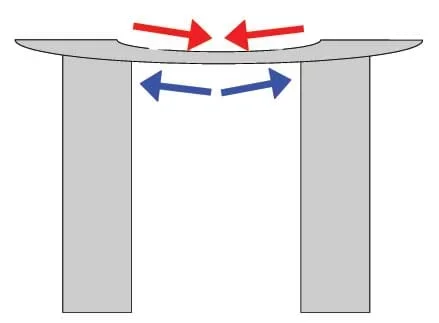 Figure 6. Tensile and compressive forces acting on a beam bridge; in a typical beam bridge tensile forces are negligible. Compressive forces are indicated by red arrows and tensile forces are indicated by blue arrows.Copyright ITL Program, University of Colorado at Boulder.
At any given time, two main forces act upon a bridge: compression and tension. Compression is a force that acts to compress or shorten the thing it is acting on. Tension is a force that acts to expand or lengthen the thing it is acting on. As an example, think of a spring (see Figure 5). If we push both ends of the spring towards each other we are compressing the spring. Thus, a force of compression is acting to shorten the spring. If we pull both ends of the spring away from each other we are stretching the spring. Thus, a force of tension is acting to lengthen the spring.
Compressive and tensile forces are present in all bridges, and it is the job of engineers to design bridges capable of withstanding these forces without buckling or snapping. Buckling occurs when compressive forces overcome an object's ability to handle compression, and snapping occurs when the tensile forces overcome an object's ability to handle tension. The best way to deal with these forces is to either dissipate them or transfer them. To dissipate force is to spread it out over a greater area, so that no one spot has to bear the brunt of the concentrated force. To transfer force is to move it from an area of weakness to an area of strength, an area designed to handle the force. An arch bridge is a good example of dissipation, while a suspension bridge is a good example of transference. Figures 6 and 7 illustrate tension and compression forces acting on three bridge types.
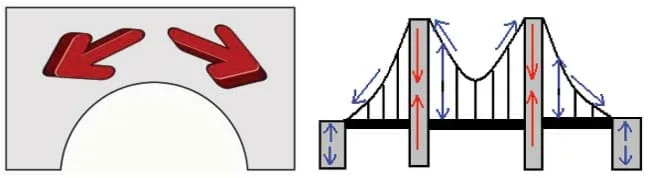 Figure 7. Tension and compression forces acting on an arch bridge (left) and suspension bridge (right). Compressive forces are indicated by red arrows and tensile forces are indicated by blue arrows.Copyright ITL Program, University of Colorado at Boulder.
Beam (or Truss) Bridge
A beam bridge is typically a simple structure made of horizontal, rigid beams. The beam ends rest on piers or columns. The weight of the beams (and any other load) is supported by the piers or columns. Compression force acts on the top portion of the beam and bridge deck, shortening these two elements. Tension force acts on the bottom portion of the beam, stretching this element. Figure 8 shows examples of beam bridges. Students will design their own bridge using common materials in the Straw Bridges activity
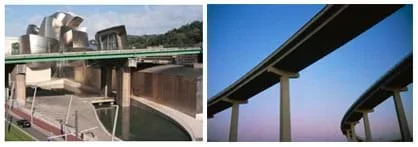 Figure 8. Example beam bridge construction. Left: Bilbao, Spain. Right: A modern highway bridge.Copyright (left) 2005 Charles M. Carlson. Used with permission. (right) Copyright © 2004 Microsoft Corporation, One Microsoft Way, Redmond, WA 98052-6399 USA. All rights reserved.
Many beam bridges are constructed of steel, concrete, and (in some cases) wood. The beam size directly influences the maximum span capability of the beam. A very large solid beam must be strong enough to support itself (it is very heavy) plus any other load on the beam. Therefore, as the span gets longer the beam must be able to support more "self-weight."
Beam bridges come in a variety of different styles. For example, a beam bridge might be made of solid beams of steel, concrete, wood or other rigid material. Or, beams might be made with a hollow-center (reducing their weight). Beam bridges can also be composed of a truss system, which is a combination of triangular units that use fewer materials and are simple to build. A truss is a structural form based on the geometric rigidity of the triangle and composed of straight members. Many truss systems originated in the mid-1800s and are still in use today. One example is a truss designed in 1840 — the Howe Truss — that combined diagonal and vertical members to create impressive strength over long spans; which contributed to its overwhelming popularity as a railroad bridge.
Arch Bridge
An arch bridge is easily recognized with its defining characteristic of a semicircular structure. Not as easily recognized but extremely important are the abutments at each end of the semicircular arch. Figure 9 shows examples of arch bridges.
The weight of the bridge and any additional load is dissipated by the abutments of the arch through the semicircular design. The force of compression is pushed outward along the curve of the arch and into the abutments (see Figure 7). The tensile forces are small in most arches and usually negligible. However, when the degree of curvature or the semicircular arch gets larger, the force of tension becomes larger and must be considered in the design. Similar to the beam bridge, increasing size of the arch bridge may eventually overtake the natural strength of the arch.
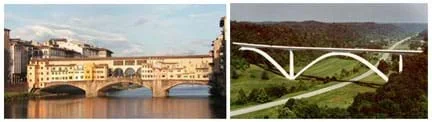 Figure 9. Example arch bridge construction. Left: Florence, Italy. Right: Natchez Trace Parkway, TN.Copyright (left) 2005 Charles M. Carlson. Used with permission. (right) U.S. Department of Transportation, http://www.efl.fhwa.dot.gov/projects/projphoto.htm.
Arch bridges have little variability in the overall design, however most arch bridges do vary cosmetically. Some examples include the Roman, Baroque and Renaissance arches. Romans built arch bridges for transportation and aqueducts; many are still standing and are structurally sound. These bridges and aqueducts are excellent examples of the natural effectiveness of the arch shape as a bridge structure.
Suspension Bridge
A suspension bridge is easily recognized by its defining characteristic of a bridge deck suspended from cables (or ropes or chains). See Figures 1 and 10 for examples of suspension bridges.
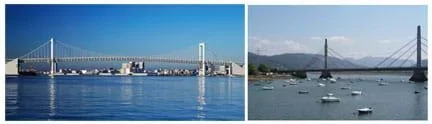 Figure 10. Example suspension bridge construction. (left) A suspension bridge in Tokyo, Japan. (right) A cable-stayed bridge in Spain.Copyright (left) 2004 Microsoft Corporation, One Microsoft Way, Redmond, WA 98052-6399 USA. All rights reserved. (right) 2006 Charles M. Carlson. Used with permission.
Conventional suspension bridges are recognized by the elongated M shape. In these bridges, parallel sets of large cables are suspended between at least two towers (with smaller cables hung vertically from the large cable) and anchor into the earth at their end points. The smaller cables support the roadway. The weight of the bridge deck and any additional load push down on the bridge deck and create a force of tension in the cables. The cables then transfer their force to the towers. The force induced in the towers is compressive; the towers dissipate this force to the earth.
A second type of suspension bridge is a cable-stayed bridge, recognized by its A shape(s). In cable-stayed suspension bridges, the small cables are attached directly to the tower, and they splay out in rows "like the strings of a harp."
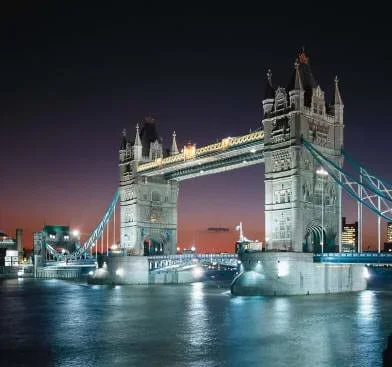 Figure 2. The Tower Bridge in London is three types of bridges in one. The shore-to-tower spans are suspension bridges, the pedestrian walkways are truss (beam) bridges, and the center span is movable to allow tall ships to pass.Copyright 2004 Microsoft Corporation, One Microsoft Way, Redmond, WA 98052-6399 USA. All rights reserved.
Have you ever placed a board or log over a stream so you can get across without getting wet? Have you ever noticed when traveling in a vehicle how many bridges you cross to get to where you are going? Have you noticed the different types of bridges? What do they look like? Bridges are part of our everyday lives; they usually go unnoticed and are taken for granted. Most bridges do not receive any kind of recognition. Often, they are only thought of as being part of the roadway, when in fact they contribute heavily to commerce, urban development and social life. Bridges also impact cultural and environmental development. Some bridges even serve as national landmarks, symbols of their respective cities. Just as the Eiffel Tower in Paris, draws worldwide interest and testifies to engineering excellence, many bridges leave a similar impression and maintain a magnificent presence. For example, the Golden Gate Bridge in San Francisco, the Tower Bridge in London (see Figure 2), or the Brooklyn Bridge in New York City. These bridges, when built, caught the attention of the entire nation and the world. Not only do they make possible transport between places for commercial and social purposes, but they bring people together, serving as significant attractions, generating tourism and pride in one's city. Such bridges become symbols of their cities and are certainly unique.
 Figure 3. A swinging cable and wooden plank bridge in a New Zealand rain forest.Copyright 2005 Denise W. Carlson. Used with permission.
However, when you think about it, all bridges are unique. All bridges pass over a different roadway, river, bay, valley, canyon or railroad tracks. All of these obstacles are different and therefore the bridges that cross them must be designed for those particular obstacles. In addition, a variety of geologic and environmental factors must be considered during the design process. This includes anchoring the foundation, minimizing weathering from local climate conditions and minimizing environmental impacts during and after construction, which includes sediment and airborne particle control.
It is also important to consider why bridges have been constructed or used in the past. Some of the earliest bridges were no more than fallen (or cut) trees or logs. They were positioned to cross over small rivers and ravines, so people could access other communities or resources for commerce, trade or social visits. We call these natural bridges. While natural bridges are inexpensive and effective for human travel, they are almost impossible for moving heavy loads.
Later bridges were made of rope with wooden boards. These bridges made it possible for more people to cross, and transport materials, carts and wagons. However, heavy loads were restricted from these bridges due to the relative weakness of early rope. How would wind or rain affect these rope bridges? High winds might cause the bridge to sway and heavy rains could wash out the soil supporting the bridge, or even the bridge itself. Stone arch bridges, primarily built during the Roman Empire, are some of the strongest and most durable bridges. Even today, many are still standing and being used in many parts of Europe, Asia and the Middle East.
In addition, other alternative bridge designs have been constructed, such as wire bridges for crossing ravines, canyons and gorges (see Figure 3). In Nepal for example, some communities constructed suspended wire bridges that span canyons and other extreme land features. In some cases, these bridges resemble gondolas, and in other cases they are simple zip lines used for passenger and material transport. Today, the use of steel, concrete and cables lends greater material strength and enables the construction of even larger bridges capable of supporting many automobiles, passengers as well as the weight of the bridge itself. Currently the state of Colorado has more than 8,000 bridges and the U.S. has more than 500,000 bridges that are more than 100 feet (30 m) long! Civil and structural engineers are responsible for the design of bridges. They work in teams to determine the bridge type, design and materials; analyze site conditions, geologic and environmental factors; and establish detailed design plans and budget/funding schedules
Indeed, bridges are more than materials, designs and budgeting. Engineers must not forget the customers — the people and the community that use the bridge. Who might benefit from using a bridge and why? (Possible answers: Themselves, their families, businesses — for commerce, social gatherings, visiting family and friends, transportation to other areas, travel, etc.) Some people want a bridge for the access it provides to resources, for expansion, for trade or industry, for the purpose of being connected to another community, city or region (see Figure 4).
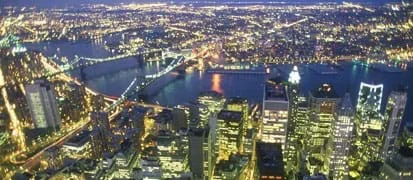 Figure 4. The many bridges in New York City make transportation possible for a huge populationCopyright Microsoft Corporation, One Microsoft Way, Redmond, WA 98052-6399 USA. All rights reserved.
What would it be like if we didn't have any bridges? Would we be able to get our favorite video games or shop at our favorite stores or visit our friends? Do you think we could effectively function as a society without bridges? People living during the 1850s were faced with this same situation when heading west to explore the U.S. frontier. They walked and traveled with covered wagons pulled by horses or oxen. Often they would either have to cross streams or rivers or travel many kilometers out of the way to find an adequate place to cross. If a river was particularly high or flooding, they were forced to wait days or weeks. For them, crossing rivers without bridges was dangerous and often disastrous. Countless examples throughout history are evidence that bridges serve as links for survival, an essential connection for the prosperity and well being of a city or community.
Another example includes the Roman Empire, which relied heavily on the construction of roadways and bridges to expand the limits of its domain and, in one well documented case, the removal of one such bridge spared the lives of many by eliminating access by their warring neighbors, the Etruscans.
(Optional: Read aloud the attached two-page Horatius at the Bridge Story (PDF) as an introduction to the Bridges unit, providing a social and historical example of the impact of one bridge on a community of people. The story tells of a Roman who defended a bridge to protect his city from attack. Or, print the story for overhead projection for students to read aloud by paragraph.)
Can you think of any bridges in your community? On roadways? On bike paths? On walking paths? Describe what they look like. What type of bridges do you think they are? Countless types of bridges exist in the world. Natural bridges are made of trees or logs positioned to cross over rivers and ravines. Bridges have also been made of wood boards, rope, wire, metal, concrete and anything that might hold a weight to allow a person or load of goods to pass.
What are some reasons that engineers design bridges? People might want a bridge for the access it provides to resources, for expansion, for trade or industry, for the purpose of being connected to another community, city or region. Bridges can also bring money to a city through trade or tourism.
What are some of the things that engineers must consider when designing bridges? Civil and structural engineers think about the type of bridge that fits the situation, the available materials (What materials are needed to build the bridge?), the site conditions (What type of soil and rock are they working on?), the geologic and environmental factors (Are native animals and plants in the area? What is the weather like?), the budget (How much money do they have?) and their audience (Who will use the bridge and for what purposes?).
- abutment
- A mass, as of masonry, receiving the arch, beam, truss, etc., at each end of a bridge.
- arch bridge
- A bridge that forms the shape of an arch.
- beam
- A long, rigid, horizontal support member of a structure.
- beam bridge
- A bridge that consists of beams supported by columns (piers, towers).
- column
- A long, rigid, vertical (upright) support member of a structure.
- compression
- A pushing force that tends to shorten objects.
- deck
- The "top" of the bridge on which we drive or walk.
- engineer
- A person who applies her/his understanding of science and mathematics to creating things for the benefit of humanity and our world.
- pier
- The "column" of a bridge.
- span
- The length of a bridge between two piers.
- suspension bridge
- A bridge in which the deck is hung from cables.
- tension
- A pulling or stretching force that tends to lengthen objects.
Pre-Lesson Assessment
Discussion Questions: Ask the students and discuss as a class:
- Have you ever placed a board or log over a stream so you can get across without getting wet?
- When traveling in a car or bus, have you ever noticed how many bridges you cross to get to where you are going?
- What are the different types of bridges that you have seen?
Post-Introduction Assessment
Class Discussion/History Application: After students have read the attached two-page Horatius at the Bridge Story (PDF), discuss the plot as a class. Ask the students to think about the design of the bridge. How did the bridge impact the people? Do they think the bridge was rebuilt after the war? How might engineers design the bridge differently to protect the city better?
Lesson Summary Assessment
Flashcards Game: To reinforce facts and concepts about bridges and forces, as well as vocabulary words, each student on a team creates a flashcard with a question on one side and the answer on the other. If the team cannot agree on the answers, they should consult the teacher. Pass the flashcards to the next team. Each member of the team reads a flashcard, and everyone attempts to answer it. If they are right, they pass the card to the next team. If they feel they have another correct answer, they write their answer on the back of the flashcard as an alternative. Once all teams have done all the flashcards, clarify any questions. Example questions/answers:
- What is the difference between a beam and a column? (Answer: A beam is usually a horizontal structural member; a column is usually a vertical structural member.)
- Can you name a world-famous bridge and its location? (Possible answers: Brooklyn Bridge in New York City, Golden Gate Bridge in San Francisco, Tower Bridge in London, Tacoma Narrows Bridge "Galloping Gertie" in Washington State.)
- Who designs bridges? (Answer: Civil and structural engineers.)
- What is important for engineers to consider when designing a bridge? (Answer: Engineers must consider the type of bridge, available materials; site conditions, geologic and environmental factors; and budget/funding scheduling, and audience.)
- True or False: The two main forces that act on a bridge at any given time are compression and repression. (Answer: False. The forces are compression, which is a force that acts to compress or shorten the thing it is acting on, and tension, which is a force that acts to expand or lengthen the thing it is acting on.)
Homework
Bridge Count: Next time students ride in a car or bus, ask them to count and record on paper the various types of bridges they cross. Lead a discussion of findings during a later class period.
What's new in bridge design? Have students research the latest in bridge design on the Internet, reporting back to their classmates on one bridge's type, materials, obstacle to cross and creative features. For example, the Rolling Bridge in London is a steel and timber footbridge that curls up until its two ends touch, making an octagon shape, to allow boats to pass through a canal. See photos and read more about this bridge at: http://www.toxel.com/tech/2008/09/21/incredible-rolling-bridge-in-london/. Another cool bridge is the Helix Bridge in London — a retractable composite glass and steel pedestrian bridge that rotates in a corkscrew motion as it deploys across a canal. See: http://www.lusas.com/case/bridge/helix_bridge.html. Also see the Hoover Dam bypass bridge described at: http://www.dailymail.co.uk/news/article-1197544/THE-WIDER-VIEW-Taking-shape-new-bridge-Hoover-Dam.html
What's new in bridge design? Have students research the latest in bridge design on the Internet, reporting back to their classmates on one bridge's type, materials, obstacle to cross and creative features. For example, the Rolling Bridge in London is a steel and timber footbridge that curls up until its two ends touch, making an octagon shape, to allow boats to pass through a canal. See photos and read more about this bridge at: . Another cool bridge is the Helix Bridge in London — a retractable composite glass and steel pedestrian bridge that rotates in a corkscrew motion as it deploys across a canal. See:
As an extra credit assignment, have students conduct research to answer this fill-in-the-blank question: "Bridges and math are connected in many ways. A suspension bridge has cables that form a __________ curve." Answer: The shape of the curve can be mistaken for a parabola. It even fooled Galileo until mathematicians determined that the equation was hyperbolic. When a rope is suspended from both ends of the bridge, the mystery curve is formed. That curve is called catenary (funicular is also acceptable). Source: Engineering Education Service Center, Engineering Education Advocate #13, issued March 19, 2007.
Lead the class in a bridge-building project. Divided into team roles — director, engineer, builder, architect, transportation chief and accountant — what type of bridge will each team construct? Given a million dollar budget each, which team will best manage their resources? See http://www.sfusd.k12.ca.us/.
Watch a four-minute narrated film clip of the wind-induced 1940 collapse of the "Galloping Gertie" Tacoma Narrows Bridge in Washington that collapsed four months after it was built. See http://www.youtube.com/watch?v=3mclp9QmCGs.
For an amazing bridge image and a story about an incredible US bridge project, see the July 4, 2009 Daily Mail story, "The Wider View: Taking Shape, the New Bridge at the Hoover Dam," on the 2010 Hoover Dam bypass bridge (called the "Colorado River Bridge") at http://www.dailymail.co.uk/news/article-1197544/THE-WIDER-VIEW-Taking-shape-new-bridge-Hoover-Dam.html
For in-depth information and construction photos of the ten-year creation process of the 2010 Hoover Dam bypass bridge, see http://www.hooverdambypass.org/ (look at the Photo Gallery, Construction Photo Album, and Construction Activities).
Baldwin, James. Horatius at the Bridge, Fifty Famous Stories Retold. The Baldwin Project: Bringing Yesterday's Classics to Today's Children, mainlesson.com. Accessed March 14, 2007. (Story of the legendary Roman hero who defended the bridge across the Tiber when his city was attacked by the Etruscans.) http://www.mainlesson.com/display.php?author=baldwin&book=fifty&story=horatius
Bridge Construction and Engineering. Bridgepros. Accessed March 14, 2007. (Click on "Learning Center" for overview of many types of bridges) http://bridgepros.com/
Building Big: All About Bridges. WGBH Educational Foundation. Accessed March 14, 2007. (Overview of many types of bridges, activities and example images) http://www.pbs.org/wgbh/buildingbig/bridge/index.html
Dictionary.com. Lexico Publishing Group, LLC. Accessed March14, 2007. (Source of some vocabulary definitions, with some adaptation) http://www.dictionary.com
Howe Truss. Connecticut's Historic Highway Bridges, Public Archaeology Survey Team, Inc. Accessed March 14, 2007. http://www.past-inc.org/historic-bridges/image-howetruss.html
Morrissey, Michael. How Bridges Work. How Stuff Works, Inc. Accessed March 14, 2007. (Good information on many bridge types) http://science.howstuffworks.com/bridge.htm
Weingroff, Richard F. Engineering Marvels: Dwight D. Eisenhower System of Interstate and Defense Highways. Public Roads Magazine. Published Summer 1996. Federal Highway Administration, US Department of Transportation. Accessed May 9, 2007. http://www.tfhrc.gov/pubrds/summer96/p96su28.htm
Contributors
Jonathan S. Goode; Joe Friedrichsen; Natalie Mach; Christopher Valenti; Denali Lander; Denise W. Carlson; Malinda Schaefer Zarske
Supporting Program
Integrated Teaching and Learning Program, College of Engineering, University of Colorado Boulder
Acknowledgements
The contents of this digital library curriculum were developed under a grant from the Fund for the Improvement of Postsecondary Education (FIPSE), U.S. Department of Education and National Science Foundation GK-12 grant no. 0338326. However, these contents do not necessarily represent the policies of the Department of Education or National Science Foundation, and you should not assume endorsement by the federal government.
Copyright
2007 by Regents of the University of Colorado.