
Strength of Materials
Students learn about the variety of materials used by engineers in the design and construction of modern bridges. They also find out about the material properties important to bridge construction and consider the advantages and disadvantages of steel and concrete as common bridge-building materials to handle compressive and tensile forces.
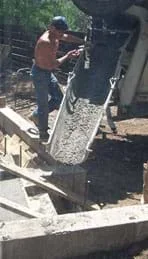 Concrete is made from cement, aggregate and water.Copyright 2003 Denise W. Carlson. Used with permission.
When designing structures such as bridges, engineers carefully choose the materials by anticipating the forces the materials (the structural components) are expected to experience during their lifetimes. Usually, ductile materials such as steel, aluminum and other metals are used for components that experience tensile loads. Brittle materials such as concrete, ceramics and glass are used for components that experience compressive loads.
After this lesson, students should be able to:
- List several common materials used the design and construction of structures.
- Describe several factors that engineers consider when selecting materials for the design of a bridge.
- Explain the advantages and disadvantages of common materials used in engineering structures (steel and concrete).
- 6.1.2.b Fluently add, subtract, multiply, and divide multidigit decimals using standard algorithms for each operation.
Grade 6
Do you agree with this alignment? - 7.4.2.d Solve real-world and mathematical problems involving area, volume and surface area of two- and three-dimensional objects composed of triangles, quadrilaterals, polygons, cubes, and right prisms.
Grade 7
Do you agree with this alignment?
- Predict and evaluate the movement of an object by examining the forces applied to it
Grade 8
Do you agree with this alignment?
- CCSS.Math.Content.6.NS.B.3 Fluently add, subtract, multiply, and divide multi-digit decimals using the standard algorithm for each operation.
Grade 6
Do you agree with this alignment? - CCSS.Math.Content.7.G.B.6 Solve real-world and mathematical problems involving area, volume and surface area of two- and three-dimensional objects composed of triangles, quadrilaterals, polygons, cubes, and right prisms.
Grade 7
Do you agree with this alignment? - CCSS.Math.Practice.MP1 Make sense of problems and persevere in solving them.
Grades K-12
Do you agree with this alignment? - CCSS.Math.Practice.MP2 Reason abstractly and quantitatively.
Grades K-12
Do you agree with this alignment?
- The selection of designs for structures is based on factors such as building laws and codes, style, convenience, cost, climate, and function.
Grades 6-8
Do you agree with this alignment? - Buildings generally contain a variety of subsystems.
Grades 6-8
Do you agree with this alignment?
- CCC.6.6-8.2 Structures can be designed to serve particular functions by taking into account properties of different materials, and how materials can be shaped and used.
Grades 6-8
Do you agree with this alignment? - SEP.12.6-8.1 Use mathematical representations to describe and/or support scientific conclusions and design solutions.
Grades 6-8
Do you agree with this alignment? - CCC.6.6-8.3 Structures can be designed to serve particular functions.
Grades 6-8
Do you agree with this alignment?
- Strength of Materials Worksheet (docx)
- Strength of Materials Worksheet (pdf)
- Strength of Materials Worksheet Answers (docx)
- Strength of Materials Worksheet Answers (pdf)
- Strength of Materials Math Worksheet (docx)
- Strength of Materials Math Worksheet (pdf)
- Strength of Materials Math Worksheet Answers (docx)
- Strength of Materials Math Worksheet Answers (pdf)
It is helpful if students know about several types of bridges, such as beam, arch and suspension bridges. They should also be able to understand the forces of compression and tension that affect the strength of a bridge.
Two basic materials are used to construct modern bridges: steel and concrete. Other types of materials are not as commonly used as steel and concrete. The following section describes in more detail steel, concrete and typical material properties and engineering terms used during the design of a bridge.
Steel
Steel is a form of iron, which is created from iron ore, a rock that contains a high concentration of iron. Common iron ores include hematite (Fe2O3), magnetite (Fe3O4), limonite (Fe2O3), and siderite (FeCO3). All iron ores contain iron combined with oxygen. To make iron from iron ore, the oxygen must be removed. One way to accomplish this is by using a bloomery or a blast furnace (see the Additional Multimedia Support section for a link to a blast furnace animation). From this process comes a crude form of iron, called "pig iron," which contains 4-5% carbon and is so hard and brittle that it is practically useless. From pig iron, either "wrought iron" is created by eliminating most of the carbon, or steel is created by eliminating most of the impurities. The many types of steel are called alloys. For example, adding 10-30% chromium creates stainless steel.
Advantages to using steel:
- Steel is very strong in both tension and compression and therefore has high compressive and tensile strengths.
- Steel is a ductile material and it yields or deflects before failure.
- Steel is usually assembled relatively quickly.
Disadvantages to using steel:
- Steel is expensive compared to concrete and wood.
- Steel can rust when exposed to some environmental conditions thus reducing its strength.
- Steel is a heavy material and thus reduces the allowable span of the member when considered for use as a beam.
Concrete
Concrete is simply a combination of two materials: cement and aggregate. Cement is a powder made of a variety of materials (usually certain types of clay and limestone). When cement is mixed with water a chemical reaction called hydration occurs that causes the cement to harden. Aggregate is a mixture of fine and coarse aggregates. The fine aggregate is typically sand; the coarse aggregate is typically gravel rock. When the cement, aggregate and water are mixed together a hardened mass called concrete results.
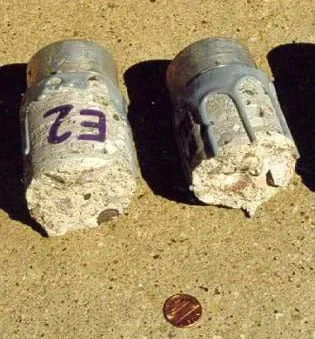 View of fractured surfaces of a concrete core taken from a bridge deck and tested to failure by a huge tensile force.Copyright U.S. Department of Transportation, http://www.fhwa.dot.gov/pavement/concrete/mcl9904.cfm
Advantages to using concrete:
- Concrete is extremely strong in compression and therefore has a high compressive strength.
- Concrete is inexpensive compared to steel.
- Using forms, concrete can be made into practically any shape.
Disadvantages to using concrete:
- Concrete is a brittle material and can crack or break with little warning.
- Concrete is very weak when a tension force is applied to it and therefore has a very low tensile strength. (To address this weakness, steel is often embedded within the concrete at locations where tension forces are known to exist, making reinforced concrete. In a concrete beam, the steel would be placed along the bottom of the beam.)
- Because a certain amount of time is needed for hydration to completely occur, concrete members do not gain their full strength until much time has passed.
Typical Material Properties and Engineering Terms
Structural engineers use material properties when designing bridge members. Stress (σ) is the applied load divided by the material area it is acting on (typically the cross-sectional area of the member). Strain (ε) is the elongation or contraction of a material per unit length of the material. According to Hooke's Law (σ = Eε) stress is dependent on strain in the material. The modulus of elasticity (E) or Young's modulus of a material is a constant associated with Hooke's Law. The modulus of elasticity indicates the stiffness of a material. Tensile strength is the amount of tensile stress that a material can resist before failing. Compressive strength is the amount of compressive stress that a material can resist before failing. A material that exhibits ductile properties can be subjected to large strains before it ruptures or fails. A material that exhibits brittle properties shows little or no yielding before failure.
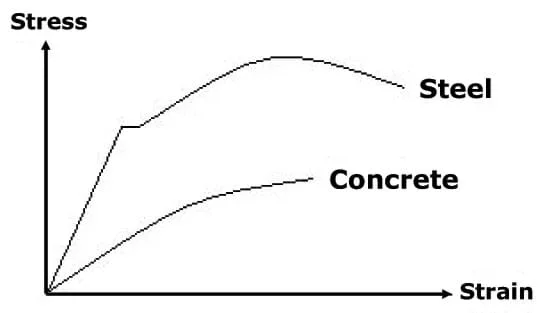 Typical stress-strain diagram for steel and concrete.Copyright ITL Program, University of Colorado at Boulder.
Engineers refer to stress-strain diagrams that graphically display all of these characteristics. In a stress-strain diagram for steel and concrete, the steel curve has a noticeable linear (straight) region; the slope of this linear region is the modulus of elasticity. The end points of these curves represent failure. The concrete curve shows a steady increase in strain and stress before it ruptures. Concrete fails with little or no warning; thus, it is considered a brittle material. Just before steel breaks, it experiences a reduction in stress while strain increases. This is seen on the steel curve as the negative sloping section of the curve. When steel fails, it presents some type of warning, typically in the form of large deflections; thus, steel is considered a ductile material.
As you know, bridges are constructed primarily for the purpose of creating passage from one point to another – this includes connecting people to other places, shortening trip distances, accessing commercial areas, ports, industries, and enabling other types of commerce. In fact, probably every one of us has, at some time or another, constructed bridges of our own. Have you ever placed a wooden board across a stream or ditch, or over a muddy patch of the yard? What materials did you use? (Ask students to share their experiences in which they used available materials to create a bridge between two places.)
Have you ever looked at a bridge and wondered what it was made of and where the materials came from? Imagine our example of a wooden board spanning a small stream; have you noticed how the board bent downward when you walked on it? Would this same material be good for a really long bridge over a large body of water? Maybe not. The materials used for even simple bridges, such as crossing a stream, show us how learning about materials is crucial to the design and construction of bridges.
When designing bridges, engineers must really understand the properties of the materials they have available. And, many things must be considered when selecting the materials for bridge construction. What are some of these things? (Take ideas from students, write them on the board, and discuss each.) The strength of the material is usually the first thing engineers consider. They also think about the cost, the availability, and the suitability of that material for that particular bridge. In some cases, the speed of construction is a factor and that can vary depending on the materials chosen, too. Following the lessson, students can further explore the concept of strength and relevant properties with the hands-on associated activity Breaking the Mold!
What materials are commonly used in bridge construction? (Take ideas from students, write them on the board.) Steel and concrete are the most popular choices for modern bridge construction. Other materials include wood, iron (a different type of steel), plastic and stone. Before the availability of steel and concrete, most bridges were made of wood, rope and/or stone. Stone is only useful in handling compression forces and therefore is most often used in arch bridges. Wood was often used to make bridges that required shorter spans, such crossing streams or ravines. Wood was also used with rope to cross wider rivers and canyons.
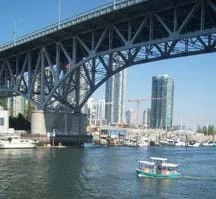 Example steel bridge, False Creek Bridge, Vancouver, Canada.Copyright 2003 Denise W. Carlson. Used with permission.
When humans became skilled at creating iron (hence the "Iron Age"), a new material became available for bridge building. However, iron is a brittle material and can break suddenly without warning. So, people tinkered with it to invent a more refined iron, called steel. Steel is a useful bridge material because of its high strength in both compression and tension. Steel is also a ductile material, meaning that it can be bent or shaped easily into different forms. Steel sounds like the perfect material, but, steel is also expensive.
Concrete is another important material. In 1824, a British stone mason named Joseph Aspdin produced cement in his kitchen. This first type of cement was composed of a heated mixture of finely ground limestone and clay that was further ground into a powder. When this powder was mixed with water, it hardened. With this invention, Aspdin laid the foundation for today's cement industry (pun intended!). What does cement have to do with concrete? Cement is an ingredient required to make concrete. Concrete is made of cement plus water, sand and coarse aggregate (or gravel rock). Combining cement and water makes a paste that coats the surface of the fine (sand) and coarse aggregates (gravel rock). Through a chemical reaction called hydration, the paste hardens and gains strength to form the rock-like mass known as concrete. Concrete is a versatile material that can be shaped easily with the use of forms (much like molds). While concrete is extremely strong in compression, it is extremely weak in tension. When designing concrete structures, engineers often do not allow for any tension forces in a concrete part. To compensate for the weak tensile properties of concrete, steel is often embedded in the concrete to handle any tensile forces. This combination of concrete with embedded steel is called reinforced concrete.
 Bridge over Tempe Town Lake, Tempe, AZ.Copyright Tempe Town Lake, AZ, http://www.tempe.gov/lake/Events/.
Sometimes, engineers must design bridges with as few materials as possible. One example of a bridge system with minimal use of materials that provides important links between people, communities and resources is the wire bridge technology used in rural Nepal — called eco bridges. These bridges are used for personal and material transport and serve as an efficient bridge link between communities and inaccessible areas.
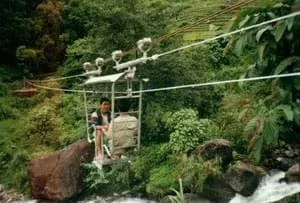 Crossing the Kamro River in Nepal on a wire bridge.Copyright Ecosystems Pvt. Ltd. http://www.ecosystemsnepal.com/wire.php.
What might be benefits of this type of bridge? (Take ideas from students and discuss each.) (Possible answers: Relatively low cost, minimal material requirements, minimal impact on the environment, low maintenance requirements and cost, safe, portable, and supports pedestrian modes of transport.) Wire bridges have minimal impact on the surrounding environment, habitats and natural landscapes. They require little maintenance, have few (if any) accidents or fatalities, and are quite portable. The wire bridge also encourages pedestrian modes of transportation, which is better for personal health and maintaining a sustainable society. What might be some disadvantages of simple wire bridge in some situations? (Possible answers: Not as suitable for heavy-load, high vehicle or railroad transport.)
In review, what are some of the materials engineers use for designing and building bridges in our towns and cities? (Possible answers: Concrete for foundations and anchoring, steel for beams and cables, etc.)
Think of bridges around your home, and along roadways, bike paths or walking paths that you use. What do the bridges look like? What types of materials were used to construct them? Many types of materials have been used to create modern bridges, including concrete, steel, wood, iron, plastic and stone.
Today, we learned that concrete and steel are the most commonly used materials in large modern bridges. What is an advantage to using steel? (Answer: Steel has high strength in both compression and tension. Steel can be bent or shaped easily into different forms.) Concrete? (Answer: Concrete can be shaped easily with the use of forms [much like molds]. Concrete is also extremely strong in compression.) How about a disadvantage to steel? (Answer: Steel is expensive.) Concrete? (Answer: Concrete is very weak in tension.)
Engineers consider all the advantages and disadvantages of materials when deciding which to incorporate into their bridge designs. What are other things that engineers must consider when selecting materials for construction of a bridge? (Answer: The strength of the material is usually the most important factor engineers consider. They also think about the cost, availability, speed of construction, and suitability of that material for that particular bridge.)
- brittle
- The ability of a material to show little or no yielding before failure.
- cement
- A powder made of a variety of materials (usually certain types of clay and limestone) that when mixed with water hardens. Cement is an ingredient of concrete.
- compressive strength
- The amount of compressive stress that a material can resist before failing.
- concrete
- A combination of cement and aggregate into one solid mass. Example: Gravel, sand, cement and water were mixed to create our concrete sidewalk.
- ductile
- The ability of a material to be subjected to large strains before it ruptures or fails.
- engineer
- A person who applies their understanding of science and mathematics to creating things for the benefit of humanity and our world.
- iron ore
- A rock that contains a high concentration of iron.
- member
- A constituent part of any structural or composite whole, such as a subordinate structural beam, column or wall.
- modulus of elasticity
- (E) Indicates the stiffness of a material.
- reinforced concrete
- A concrete member with steel embedded inside it to resist tensile forces.
- steel
- Refined iron that contains virtually no impurities.
- strain
- The elongation or contraction of a material per unit length of the material.
- stress
- Applied load divided by the material area it is acting on.
- tensile strength
- The amount of tensile stress that a material can resist before failing.
Pre-Lesson Assessment
Brainstorming: As a class, have students engage in open discussion. Remind students that in brainstorming, no idea or suggestion is "silly." All ideas should be respectfully heard. Take an uncritical position, encourage wild ideas and discourage criticism of ideas. Have them raise their hands to respond. Write their ideas on the board. Ask the students:
- What things must be considered when selecting materials to be used to make a bridge?
Post-Introduction Assessment
Question/Answer: Ask the students and discuss as a class:
- What are some of the common materials used to create bridges? (Possible answers: Wood, rope, stone, wire, iron, steel, concrete, alloys, plastic.)
Lesson Summary Assessment
Worksheet: Assess students' understanding of the lesson by assigning the attached Strength of Materials Worksheet (PDF) as homework. The worksheet includes a matching activity to reinforce vocabulary and definitions.
Math Worksheet: Assess students' understanding of the lesson by assigning the attached Strength of Materials Math Worksheet (PDF) as homework. The three math problems include solving equations and are of increasing difficulty. Assign younger students only the first question. Add the next problem for older students. Assign the third question as a math challenge to advanced students.
Homework
Bridge Alert: Next time students ride in a car or bus, ask them to notice and record on paper the types of materials used in the bridges they cross. Lead a discussion of findings during the next class period.
Many types of aggregates – such as sand, gravel, pebbles, glass, vermiculite and rubber - have been used to make concrete. One disadvantage to concrete is that it is weak when a tension force is applied to it and therefore has a very low tensile strength. Concrete has a tendency to crack, and special design precautions are often taken to control the cracking. Reinforced concrete often has steel embedded in it. Why might there be so many types of aggregates? (Discussion points: To achieve different purposes in different applications. Sometimes other materials are added to the concrete mix to give it specific characteristics not typical with plain concrete mixes, making the concrete less brittle, stronger, more durable, a better insulator, or less likely to suffer freeze-thaw damage. Examples: Incorporate synthetic fibers to improve elasticity, include bits of colored glass for more decorative applications, recycle glass and rubber waste material from recycling collection or old tires.) Assign internet research to learn more.
Lead students in another Teach Engineering activity on the strength of materials, easily relatable to concrete: Engineering for the Three Little Pigs.
Show students a blast furnace animation at the howstuffworks website: http://www.howstuffworks.com/framed.htm?parent=iron.htm&url=http://www.bbc.co.uk/history/british/victorians/launch_ani_blast_furnace.shtml
Watch a four-minute narrated film clip of the wind-induced collapse of the Tacoma Narrows Bridge in Washington in 1940. Called "Galloping Gertie," this suspension bridge collapsed four months after it was built. See http://www.youtube.com/watch?v=3mclp9QmCGs
ACI Committee 318. Building Code Requirements for Structural Concrete (ACI 318-02) and Commentary (ACI 318R-02): An ACI Standard. American Concrete Institute: Farmington Hills, MI, 2002.
AISC Committee on Manuals and Textbooks. Manual of Steel Construction: Load and Resistance Factor Design, Third Edition. American Institute of Steel Construction, 2001.
Brain, Marshall. How Iron & Steel Work. HowStuffWorks, Inc. Accessed October 16, 2007. http://www.howstuffworks.com/iron.htm
Concrete Basics. Portland Cement Association. Accessed October 16, 2007. (Good overview of concrete and cement) http://www.epa.gov/ttn/chief/old/ap42/ch11/s12/reference/ref_05c11s12_2001.pdf
Concrete in the Classroom: Cement & Concrete Basics. Portland Cement Association. Accessed October 16, 2007. http://www.cement.org/basics/concretebasics_classroom.asp
Dictionary.com. Lexico Publishing Group, LLC. Accessed October 16, 2007. (Source of some vocabulary definitions, with some adaptation) http://www.dictionary.com
EcoSystems – WireBridge Designs. Ecosystems, Pvt. Ltd. Accessed October 16, 2007. http://www.ecosystemsnepal.com/wire.php
Frequently Asked Questions: Cement and Concrete Basics. Portland Cement Association. Accessed October 16, 2007. http://www.cement.org/basics/concretebasics_faqs.asp
Hibbeler, R.C. Mechanics of Materials, Third Edition. Prentice Hall: Upper Saddle River, NJ, 1997.
Nilson, Arthur H. Design of Concrete Structures, Twelfth Edition. WCB McGraw-Hill: Boston, MA, 1997.
Portland Cement Association. Accessed October 16, 2007. http://www.cement.org/
Contributors
Jonathan S. Goode; Joe Friedrichsen; Natalie Mach; Denali Lander; Christopher Valenti; Denise W. Carlson; Malinda Schaefer Zarske
Supporting Program
Integrated Teaching and Learning Program and Laboratory, University of Colorado Boulder
Acknowledgements
The contents of this digital library curriculum were developed under a grant from the Fund for the Improvement of Postsecondary Education (FIPSE), U.S. Department of Education and National Science Foundation GK-12 grant no. 0338326. However, these contents do not necessarily represent the policies of the Department of Education or National Science Foundation, and you should not assume endorsement by the federal government.
Copyright
2006 by Regents of the University of Colorado