
Electromagnetic Radiation
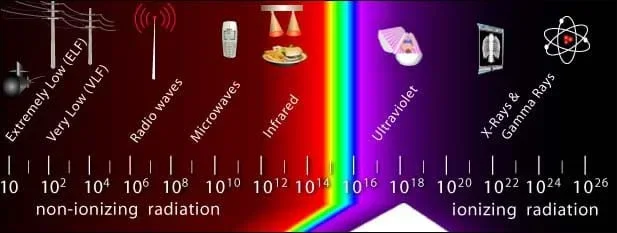 Ultraviolet is a type of electromagnetic radiation that can lead to risks of skin cancer.Copyright 2008 OSHA Safety and Health Topics, Wikimedia Commons http://commons.wikimedia.org/wiki/File:OSHA_radiation_spectrum.jpg
Students are presented with a hypothetical scenario that delivers the unit's Grand Challenge Question: To apply an understanding of nanoparticles to treat, detect and protect against skin cancer. Towards finding a solution, they begin the research phase by investigating the first research question: What is electromagnetic energy? Students learn about the electromagnetic spectrum, ultraviolet radiation (including UVA, UVB and UVC rays), photon energy, the relationship between wave frequency and energy (c = λν), as well as about the Earth's ozone-layer protection and that nanoparticles are being used for medical applications. The lecture material also includes information on photo energy and the dual particle/wave model of light. Students complete a problem set to calculate frequency and energy.
As the first step in the engineering design process, engineers must fully understand the problem. To do this, they research all relevant science and math concepts, as well as all previous and current engineering designs related to the subject. As students tackle the challenge question, they learn background information on the science of ultraviolet light. They also learn about the impact of human-generated pollution on the ozone layer and its connection to public health through increased incidences of skin cancer—an environmental engineering connection. In addition, they learn that biomedical engineers are researching ways to use nanoparticles to diagnose and treat cancer because they are good imaging agents.
After this lesson, students should be able to:
- Calculate frequency or wavelength for electromagnetic radiation.
- Calculate the energy of a photon.
- List components of the electromagnetic spectrum in order of increasing energy.
- Explain that energy given to an electron is quantized.
- Explain what biomedical engineers study.
- CCSS.Math.Content.HSA-REI.B.3 Solve linear equations and inequalities in one variable, including equations with coefficients represented by letters.
Grades 9-12
Do you agree with this alignment?
- Medical technologies include prevention and rehabilitation, vaccines and pharmaceuticals, medical and surgical procedures, genetic engineering, and the systems within which health is protected and maintained.
Grades 9-12
Do you agree with this alignment? - STEL-7AA Illustrate principles, elements, and factors of design.
Grades 9-12
Do you agree with this alignment?
- HS-ETS1-1 Analyze a major global challenge to specify qualitative and quantitative criteria and constraints for solutions that account for societal needs and wants.
Grades 9-12
This resource focuses on the following Three Dimensional Learning aspects of NGSS:
Science & Engineering Practices- Analyze complex real-world problems by specifying criteria and constraints for successful solutions.Do you agree with this alignment?
Disciplinary Core Ideas- Criteria and constraints also include satisfying any requirements set by society, such as taking issues of risk mitigation into account, and they should be quantified to the extent possible and stated in such a way that one can tell if a given design meets them.Do you agree with this alignment?
- Humanity faces major global challenges today, such as the need for supplies of clean water and food or for energy sources that minimize pollution, which can be addressed through engineering. These global challenges also may have manifestations in local communities.Do you agree with this alignment?
Crosscutting Concepts- New technologies can have deep impacts on society and the environment, including some that were not anticipated. Analysis of costs and benefits is a critical aspect of decisions about technology.Do you agree with this alignment?
Do you agree with this alignment? - Analyze complex real-world problems by specifying criteria and constraints for successful solutions.
- HS-ETS1-2 Design a solution to a complex real-world problem by breaking it down into smaller, more manageable problems that can be solved through engineering.
Grades 9-12
This resource focuses on the following Three Dimensional Learning aspects of NGSS:
Science & Engineering Practices- Design a solution to a complex real-world problem, based on scientific knowledge, student-generated sources of evidence, prioritized criteria, and tradeoff considerations.Do you agree with this alignment?
Disciplinary Core Ideas- Criteria may need to be broken down into simpler ones that can be approached systematically, and decisions about the priority of certain criteria over others (trade-offs) may be needed.Do you agree with this alignment?
Do you agree with this alignment? - Design a solution to a complex real-world problem, based on scientific knowledge, student-generated sources of evidence, prioritized criteria, and tradeoff considerations.
- HS-PS4-3 Evaluate the claims, evidence, and reasoning behind the idea that electromagnetic radiation can be described either by a wave model or a particle model, and that for some situations one model is more useful than the other.
Grades 9-12
This resource focuses on the following Three Dimensional Learning aspects of NGSS:
Science & Engineering Practices- Evaluate the claims, evidence, and reasoning behind currently accepted explanations or solutions to determine the merits of arguments.Do you agree with this alignment?
- A scientific theory is a substantiated explanation of some aspect of the natural world, based on a body of facts that have been repeatedly confirmed through observation and experiment and the science community validates each theory before it is accepted. If new evidence is discovered that the theory does not accommodate, the theory is generally modified in light of this new evidence.Do you agree with this alignment?
Disciplinary Core Ideas- [From the 3-5 grade band endpoints] Waves can add or cancel one another as they cross, depending on their relative phase (i.e., relative position of peaks and troughs of the waves), but they emerge unaffected by each other. (Boundary: The discussion at this grade level is qualitative only; it can be based on the fact that two different sounds can pass a location in different directions without getting mixed up.)Do you agree with this alignment?
- Electromagnetic radiation (e.g., radio, microwaves, light) can be modeled as a wave of changing electric and magnetic fields or as particles called photons. The wave model is useful for explaining many features of electromagnetic radiation, and the particle model explains other features.Do you agree with this alignment?
Crosscutting Concepts- Models (e.g., physical, mathematical, computer models) can be used to simulate systems and interactions—including energy, matter, and information flows—within and between systems at different scales.Do you agree with this alignment?
Do you agree with this alignment? - Evaluate the claims, evidence, and reasoning behind currently accepted explanations or solutions to determine the merits of arguments.
- 3222.1.1 Calculate the wavelength, frequency and energy of a photon of electromagnetic radiation.
Grades 9-12
Do you agree with this alignment? - CLE 3221.Math.1 Understand the mathematical principles associated with the science of chemistry.
Grades 9-12
Do you agree with this alignment? - CLE 3221.Math.2 Utilize appropriate mathematical equations and processes to solve chemistry problems.
Grades 9-12
Do you agree with this alignment? - CLE 3221.T/E.4 Describe the dynamic interplay among science, technology, and engineering within living, earth-space, and physical systems.
Grades 9-12
Do you agree with this alignment?
Legacy Cycle Steps for this Lesson
(Generate Ideas) Ask students the following research question: What is electromagnetic radiation? In class, have students write journal entries to answer the following questions:
- What are your initial ideas about how this question can be answered?
- What do you already know about UV light and nanoparticles?
(Multiple Perspectives) As a class, have students share ideas from their journals. Record their ideas on the board.
(Research and Revise) Deliver to students the lecture information on the electromagnetic spectrum, ultraviolet radiation (including UVC, UVB, and UVA rays), photon energy, and the relationship between, frequency, wavelength and energy.
(Test Your Mettle) Assign students to complete the Energy Homework (PDF)questions and problems as homework or classwork.
(Go Public) Upon returning to class or completing the problem set, have students work the problems on the classroom board and discuss the answers if all students are not in agreement.
Following the lesson, students can conduct the hands-on Flame Test: Red, Green, Blue, Violet? activity to expand their understanding by gathering data that helps them identify the chemical makeup of a "mystery solution" based on the visible color the solution burns.
Lecture Information
Ultraviolet light is a form of electromagnetic radiation. Electromagnetic radiation is a form of radiant energy that exhibits wave-like behavior and travels through space at the speed of light in a vacuum. The entire range of frequencies and wavelengths that make up all forms of electromagnetic radiation, including radio waves, gamma rays and ultraviolet waves is called the electromagnetic spectrum.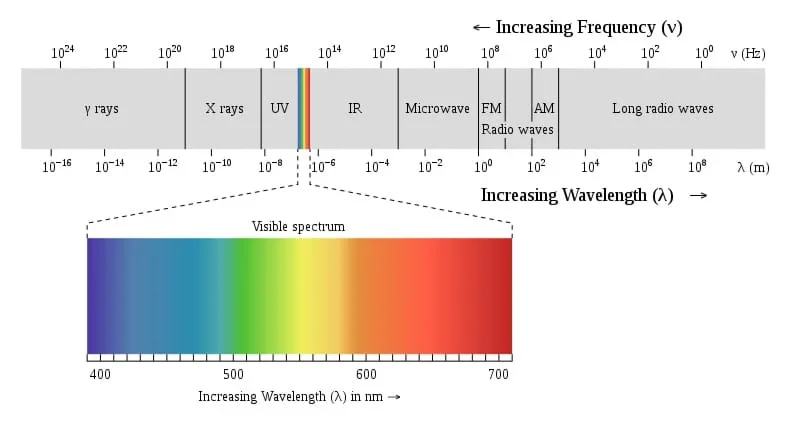 The electromagnetic spectrum.Copyright 2007 Philip Rowan, Wikimedia Commons http://commons.wikimedia.org/wiki/File:EM_spectrum.svg
The relationship between wave frequency, wavelength and energy is described by the equation c = λν, where c = wave speed. Wave speed in a vacuum is 3.00 108 m/s. Wavelength is the shortest distance between points where the wave pattern repeats itself, such as from crest to crest or trough to trough and is represented by the symbol λ (lambda). Wave frequency is the number of complete oscillations that a wave makes each second; it is measured in hertz and is represented by the symbol ν. Thus, the speed of the wave is equal to frequency wavelength of the wave.
In 1900, Max Planck, a German physicist, postulated that energy is quantized and therefore must occur in discrete units of size, hν; thus, ΔE = hν. These units were called quanta of energy. Albert Einstein furthered this postulate through his Nobel Prize-winning analysis of the photoelectric effect. Einstein stated that electromagnetic radiation is also quantized. These discrete packets of electromagnetic radiation were called photons. Energy of a photon of electromagnetic energy is given by Ephoton = hν.
Combining the two equations, c = λν and Ephoton = hν, we see that Ephoton = hc/λ.
Through innovations of the combined work of Arthur Crompton, Planck and Einstein, it became evident that electromagnetic radiation has both wavelike and particle-like properties; this is now referred to as the dual nature of light. Further, Louis DeBroglie proposed that the same must also be true for matter. DeBroglie postulated that one could calculate the wavelength of a particle such as an electron given the mass and speed of the particle, through the equation m = h/λc.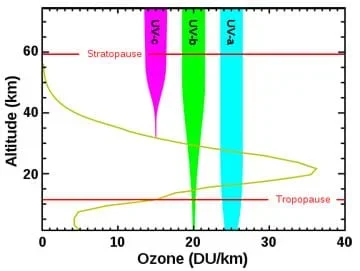 The penetrating power of ultraviolet radiation given sufficient ozone.Copyright 2005 NASA, Wikimedia Commons http://commons.wikimedia.org/wiki/File:Ozone_altitude_UV_graph.jpg
The sun emits three forms of ultraviolet radiation:
- UVA, with a wavelength range of 315-390 nanometers
- UVB, with a wavelength range of 280-315 nanometers
- UVC, with a wavelength range of 100-280 nanometers
A large percentage—98%—of UV radiation is blocked by the ozone layer in regions with sufficient ozone. All UVC and most UVB rays are stopped by the ozone layer naturally. In turn, 90% of the UV radiation that reaches the Earth's surface is UVA. Both UVA and UVB can cause significant health risks (which will be investigated in the next lesson). Before designing any protective products, engineers must first understand the nature of ultraviolet light to understand how these rays cause skin and cancer.
You have just been given the following grand challenge: "Congratulations! You have just won the Nobel Prize in chemistry for your work with nanoparticles! You have now decided to fulfill your lifelong dream of learning how to surf by using your 1.4 million dollar monetary prize to move to Einstein Cove, Australia. However, upon researching your move, you come across the ultraviolet index information for Australia. What does this mean in terms of your potential skin cancer risk as a surfing enthusiast in Einstein Cove? How could you use your expertise in nanoparticles to treat, detect and protect against skin cancer?"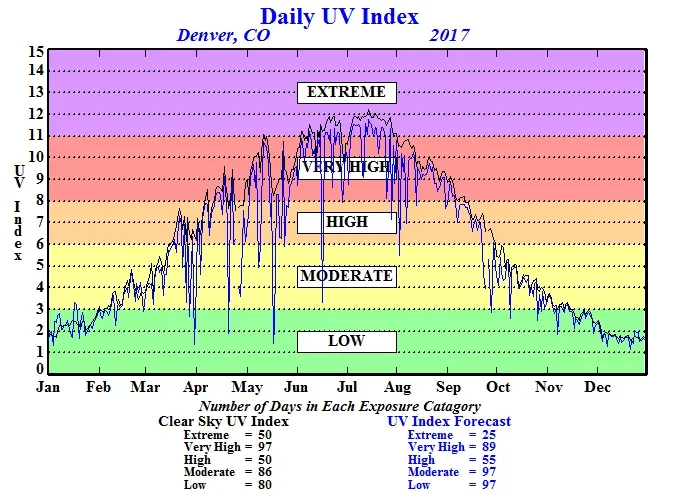 An example daily UV index for Denver, CO, for 2017.Copyright National Weather Service, Climate Prediction Center, NOAA http://www.cpc.ncep.noaa.gov/products/stratosphere/uv_index/gif_files/den_13.png
Biomedical engineers are increasingly looking into nanoparticles to find ways to diagnosis and treat skin cancer because nanoparticles are particularly good imaging agents. What are nanoparticles? And how could they be used to treat, detect and protect against skin cancer? What exactly is skin cancer? And what is the cause? These are just a few of the questions we investigate during the next few days in our lesson on using nanoparticles to detect, treat and protect against skin cancer.
- electromagnetic radiation
- Radiant energy that exhibits wavelike behavior and travels through space at the speed of light in a vacuum.
- electromagnetic spectrum
- The entire range of frequencies and wavelengths that make up all forms of electromagnetic radiation, including radio waves and gamma rays.
- emission spectrum
- A plot of the intensity of light emitted from a hot body over a range of frequencies.
- energy
- The capacity to do work or cause the flow of heat.
- excited state
- The state of an atom with excess energy.
- frequency
- The number of complete oscillations that a wave makes each second; measured in hertz.
- ground state
- The lowest possible energy state of an atom.
- planck constant
- 6.626 X 10 to the power of negative 34 J S
- photoelectric effect
- The emission of electrons by certain metals that is produced when they are exposed to electromagnetic radiation.
- photon
- A discrete, quantized bundle of radiation that travels at the speed of light, has zero mass, and has energy and momentum; a particle of electromagnetic radiation.
- quantized
- Occurring in discrete units of size, in the case of radiant hv.
- quantum
- One quantized packet of energy.
- wavelength
- The shortest distance between points where the wave pattern repeats itself, such as from crest to crest or trough to trough.
Pre-Lesson Assessment
Review: Review with students the concepts about waves, wave properties and vocabulary, such as wavelength, frequency, amplitude, crest and trough. Ask them to name as many types of electromagnetic radiation as possible. (Example answers: Visible light, ultraviolet, infrared, microwaves, radio waves and gamma rays.) Show them a chart of the electromagnetic spectrum.
Post-Introduction Assessment
Research Challenge: Pose this research question to students: What is electromagnetic radiation? Then have students write journal entries to answer the following questions. As students share their answers with the class, write their ideas on the classroom board and use their answers to gauge their comprehension.
- What are your initial ideas about how this question can be answered?
- What do you already know about UV light and nanoparticles?
Lesson Summary Assessment
Brainstorming: Ask students to brainstorm in small groups the connection between electromagnetic radiation and the unit's Grand Challenge Question, as applies to skin cancer, including the potential risks and the use of nanoparticles to protect against skin cancer. Have them record their ideas about how what they learned in the lesson's lecture information could be useful in addressing the Grand Challenge Question.
Homework
Energy Homework: At lesson end, assign students to complete the 10-question Energy Homework (PDF), which requires them to use the equations and other information presented in the lesson to answer the questions and complete the problems. Refer to the Energy Homework Answer Key (PDF). Have students work the problems on the classroom board and discuss the answers if all students are not in agreement. Review students' individual answers to evaluate their depth of comprehension.
Zitzewitz, Paul W., et al. Physics: Principles and Problems. Columbus, OH: McGraw Hill, 2009.
Zumdahl, Steven S. and Zumdahl, Susan A. Chemistry. Seventh edition. Boston, MA: Houghton Miller Company, 2007.
Contributors
Michelle Bell; Amber Spolarich
Supporting Program
VU Bioengineering RET Program, School of Engineering, Vanderbilt University
Acknowledgements
The contents of this digital library curriculum were developed under National Science Foundation RET grant nos. 0338092 and 0742871. However, these contents do not necessarily represent the policies of the NSF, and you should not assume endorsement by the federal government.
Copyright
2013 by Regents of the University of Colorado; original © 2010 Vanderbilt University