
Nanotechnology and Cancer Treatments
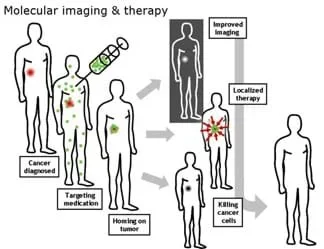 Nanotechnology used in cancer treatment.Copyright 2006 Kristian Molhave, Opensource Handbook of Nanoscience and Nanotechnology, Wikimedia Commons http://commons.wikimedia.org/wiki/File:MolecularImagingTherapy.jpg
Students learn about the biomedical use of nanoparticles in the detection and treatment of cancer, including the use of quantum dots and lasers that heat-activate nanoparticles. They also learn about electrophoresis—a laboratory procedure that uses an electric field to move tiny particles through a channel in order to separate them by size. They complete an online virtual mini-lab, with accompanying worksheet, to better understand gel electrophoresis. This prepares them for the associated activity—to write draft research proposals to use nanoparticles to protect against, detect or treat skin cancer.
Because nanoparticles are very good imaging agents, biomedical engineers are focusing on the use of nanoparticles in cancer diagnosis and treatment. For example, since gold nanoparticles absorb light and produce heat, they design infrared lasers to superheat the gold nanoparticle and destroy cancerous cells through heat. This application shows promise in breast and prostate cancers that are fairly close to the body surface and readily accessed by the laser light. By learning more about this field, students gain a better understanding of current biomedical engineering research, as well as potential solutions to real-world human problems.
After this lesson, students should be able to:
- Define and discuss practical uses of nanoparticles and quantum dots in current biomedical research.
- Complete a virtual laboratory to study electrophoresis, a commonly used laboratory tool.
- Medical technologies include prevention and rehabilitation, vaccines and pharmaceuticals, medical and surgical procedures, genetic engineering, and the systems within which health is protected and maintained.
Grades 9-12
Do you agree with this alignment? - STEL-7AA Illustrate principles, elements, and factors of design.
Grades 9-12
Do you agree with this alignment?
- HS-ETS1-1 Analyze a major global challenge to specify qualitative and quantitative criteria and constraints for solutions that account for societal needs and wants.
Grades 9-12
This resource focuses on the following Three Dimensional Learning aspects of NGSS:
Science & Engineering Practices- Analyze complex real-world problems by specifying criteria and constraints for successful solutions.Do you agree with this alignment?
Disciplinary Core Ideas- Criteria and constraints also include satisfying any requirements set by society, such as taking issues of risk mitigation into account, and they should be quantified to the extent possible and stated in such a way that one can tell if a given design meets them.Do you agree with this alignment?
- Humanity faces major global challenges today, such as the need for supplies of clean water and food or for energy sources that minimize pollution, which can be addressed through engineering. These global challenges also may have manifestations in local communities.Do you agree with this alignment?
Crosscutting Concepts- New technologies can have deep impacts on society and the environment, including some that were not anticipated. Analysis of costs and benefits is a critical aspect of decisions about technology.Do you agree with this alignment?
Do you agree with this alignment? - Analyze complex real-world problems by specifying criteria and constraints for successful solutions.
- HS-ETS1-2 Design a solution to a complex real-world problem by breaking it down into smaller, more manageable problems that can be solved through engineering.
Grades 9-12
This resource focuses on the following Three Dimensional Learning aspects of NGSS:
Science & Engineering Practices- Design a solution to a complex real-world problem, based on scientific knowledge, student-generated sources of evidence, prioritized criteria, and tradeoff considerations.Do you agree with this alignment?
Disciplinary Core Ideas- Criteria may need to be broken down into simpler ones that can be approached systematically, and decisions about the priority of certain criteria over others (trade-offs) may be needed.Do you agree with this alignment?
Do you agree with this alignment? - Design a solution to a complex real-world problem, based on scientific knowledge, student-generated sources of evidence, prioritized criteria, and tradeoff considerations.
- CLE 3221.Inq.1 Recognize that science is a progressive endeavor that reevaluates and extends what is already accepted.
Grades 9-12
Do you agree with this alignment? - CLE 3221.Inq.2 Design and conduct scientific investigations to explore new phenomena, verify previous results, test how well a theory predicts, and compare opposing theories.
Grades 9-12
Do you agree with this alignment? - CLE 3221.T/E.3 Explain the relationship between the properties of a material and the use of the material in the application of a technology.
Grades 9-12
Do you agree with this alignment? - CLE 3221.T/E.4 Describe the dynamic interplay among science, technology, and engineering within living, earth-space, and physical systems.
Grades 9-12
Do you agree with this alignment?
(Present the content below and discuss nanoparticles and quantum dots as a class. Then, have students complete the virtual electrophoresis lab at https://www.classzone.com/books/hs/ca/sc/bio_07/virtual_labs/virtualLabs.html. Each student needs access to a computer or tablet to complete the virtual lab.)
Lecture Information
One application of nanotechnology currently being investigated is the use of quantum dots to deliver cancer treatment to site-specific locations close to cancer tissue. A quantum dot is a semiconductor crystal that exhibits quantum behavior in optical or electrical processes. Traditional cancer treatment causes cytotoxic effects in both cancerous and healthy cells and thus patients may become sick and/or lose their hair and fingernails as a result of the treatment. With a site-specific cancer delivery system, these side effects are greatly reduced. Research is currently being conducted in which zinc sulfide (ZnS) quantum dots are coated with a polyethylene glycol molecule and a cancer cell-specific marker antibody. Then polyethylene glycol (PEG), which is a covalent organic molecule, is attached to the quantum dot to mask the quantum dot (QD) from the body's immune system. The PEG molecules also prevent the QD from delivering the cancer treatment to healthy tissue. Upon encountering the marker present on the surface of the cancer cell, the PEG is cleaved and the treatment is delivered.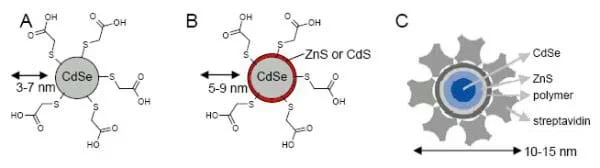 A) The basic structure of a cadmium selenide quantum dot. B) A zinc sulfide-coated quantum dot. C) A quantum dot showing polymer and drug attachments.Copyright U.S. Environmental Protection Agency http://cfpub.epa.gov/ncer_abstracts/INDEX.cfm/fuseaction/display.abstractDetail/abstract/7390/report/F
After attaching the PEG to the quantum dot, engineers verify that the attachment has been successful. One way this is done is through electrophoresis. Electrophoresis is a method of using an electric field to move particles through a channel that then separates them by size. The particles move at a rate inverse to their masses; thus, larger particles are slower than smaller particles and do not migrate as far down the gel. By observing how the particles move in electrophoresis, biomedical engineers can confirm that the PEG molecule is attached to the quantum dot.
Quantum dots are also used for medical applications by taking advantage of their fluorescent properties. DQs can absorb light at one wavelength and give off light at another wavelength in discrete amounts (quanta), which explains the name "quantum" dot. By varying the particle size of the same quantum dot material, it can be made to fluoresce in different colors. The smaller the particle, the more its emission is blue shifted, and conversely, the larger the particle size, the more its emission is red shifted. This characteristic enables multiple factors to be tagged using the same original light source. The fluorescent quantum dots are tagged with a tumor-specific cell marker antibody and a polymer coating, and then are injected into the circulatory system. By a similar mechanism as described above, they primarily accumulate in the area of the tumor, which enables physicians to visualize areas of cancerous tissues and how they have metastasized.
In addition, gold nanoparticles have been designed to absorb light of wavelength slightly more than 800 nm. When coated with a tumor-specific antibody, these nanoparticles aggregate around cancer cells. Since the gold nanoparticles absorb light and produce heat, lasers of wavelengths in the infrared range are used to superheat the gold nanoparticle and destroy the cancerous cells through heat. This application shows promise in breast and prostate cancers that are located fairly close to the body's surface and thus readily accessed by the laser light.
(Be ready to play for the class an online three-minute video, The Nano Song, at https://www.youtube.com/watch?v=LFoC-uxRqCg.)
We have studied how the destruction of the ozone layer in the Earth's atmosphere can lead to an increase in ultraviolet radiation intensity that, in turn, can drastically increase the risks and rate of human skin cancer. In this lesson, we are going to work again to answer our original challenge question:
What does the ultraviolet index information mean in terms of your potential skin cancer risk living as a surfing enthusiast in Einstein Cove? How could you use your expertise in nanoparticles to treat, detect, and protect against skin cancer?
By studying the nanoparticle concept and some current applications of these particles in biomedical engineering research, I bet that you have already started to generate some ideas for better preventing, detecting, and treating skin cancer caused by UV radiation.
Let's review: The term nanoparticle is used to refer to a particle with a diameter between 1 and 100 nanometers. Nano is a prefix of the SI system and is defined as one billionth of its base unit. Other ways to state this: 109 nanometers equal one meter. 1 nanometer is 10-9 of a meter. 10 hydrogen atoms placed side by side equal the length of 1 nanometer!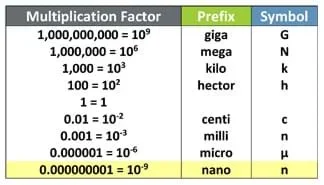 SI prefixes.Copyright Source of information: Washington State Department of Transportation http://www.wsdot.wa.gov/reference/metrics/factors.htm
(Show students The Nano Song video.)
The National Nanotechnology Initiative Committee decided that in order be classified as nanotechnology, the technology must meet three criteria. Nanotechnology:
- involves research and technology development at the 1-100 nanometer range
- creates and uses structures that have novel properties because of their small sizes
- builds on the ability to control or manipulate at the atomic scale
Properties of nanoparticles differ in behavior from larger amounts of the same material. For example, a nanoparticle of silver, gold or iron has different properties than 5 kilogram amounts of the same substances. At the nanoscale, particle behavior abides not only by the physical laws of chemistry, but also the laws of quantum mechanics. You may recall (from the first lesson in the unit, Electromagnetic Radiation) that at the quantum level, both light and matter have a dual wave-particle nature.
Today we will take a deeper look at how biomedical engineers focus on nanotechnology in the use of quantum dots in cancer treatment, and we'll end the lesson by conducting a virtual lab!
(Continue by delivering the content in the Lesson Background section). Following the lesson, conduct the associated activity Nanotechnology Grant Proposal Writing where students apply the knowledge they gained through the unit to write research proposals about the use of nanoparticles to protect against, detect or treat skin cancer
- bioactive material
- A material capable of interacting with living tissues.
- covalent bond
- Atoms that bond sharing two electrons.
- cytotoxic
- Toxic to cells; kills living cells.
- electrophoresis
- A method of using an electric field to move particles through a channel and separate them by size. The particles move at a rate inverse to their masses; thus, larger particles are slower than smaller particles and do not migrate as far down the gel.
- fluorescence
- The property of some molecules to absorb a wavelength of light and then emit light at a higher wavelength.
- nano
- A Greek word meaning dwarf; one billionth.
- nanometer
- One billionth of a meter.
- nanotechnology
- Technology development at the atomic and molecular range (1-100 nm) to create and use structures, devices and system that have novel properties due to their small sizes.
- quantum dot
- A semiconductor crystal that exhibits quantum behavior in optical or electrical processes.
Pre-Lesson Assessment
Prompt Question: Ask students: One of the things we will discuss today is gel electrophoresis. Has anyone ever heard of electrophoresis? How can it be used? How does it work? Do you think it could be used in a way that could help us answer our challenge question for this unit? (Expect that some students may have heard of the use of gel electrophoresis in DNA fingerprinting. Electrophoresis is a way to separate molecules based on their sizes and charges. The process works by applying an electric field, causing molecules to move; smaller molecules move faster, while larger molecules move slower.)
Lesson Summary Assessment
Virtual Electrophoresis Lab: Have students individually conduct the virtual lab at https://www.classzone.com/books/hs/ca/sc/bio_07/virtual_labs/virtualLabs.html, which takes about 15 minutes to complete. In the process, have students answer the questions on the Gel Electrophoresis Virtual Lab Worksheet (PDF) based on the virtual lab. Review students' worksheet answers to gauge their depth of comprehension.
The Nano Song video (3 minutes) at https://www.youtube.com/watch?v=LFoC-uxRqCg.
McDougal Littel's Virtual Biology Labs' gel electrophoresis virtual lab at the ClassZone website: https://www.classzone.com/books/hs/ca/sc/bio_07/virtual_labs/virtualLabs.html (takes about 15 minutes to complete)
An alternate gel electrophoresis virtual lab: Genetic Science Learning Center, University of Utah Health Sciences' Gel Electrophoresis Lab at: http://learn.genetics.utah.edu/content/labs/gel/ (takes 10+ minutes to complete)
Roco, Mihail C., and William S. Bainbridge (eds), National Science Foundation. Converging Technologies for Improving Human Performance: Nanotechnology, Biotechnology, Information Technology and Cognitive Science, Dordrecht, The Netherlands and Boston, MA: Kluwer Academic Publishers (Springer), 2003. http://www.whitehouse.gov/sites/default/files/microsites/ostp/bioecon-(%23%20023SUPP)%20NSF-NBIC.pdf
Frequently Asked Questions, National Nanotechnology Initiative. http://www.nano.gov/nanotech-101/nanotechnology-facts
Contributors
Michelle Bell; Amber Spolarich
Supporting Program
VU Bioengineering RET Program, School of Engineering, Vanderbilt University
Acknowledgements
The contents of this digital library curriculum were developed under National Science Foundation RET grant nos. 0338092 and 0742871. However, these contents do not necessarily represent the policies of the NSF, and you should not assume endorsement by the federal government.
Copyright
2013 by Regents of the University of Colorado; original © 2010 Vanderbilt University