
Hovercraft Racers!
Students gain first-hand experience on how friction affects motion. They build hovercraft using air from balloons to levitate craft made from compact discs (CD), learning that a bed of air under an object significantly reduces the friction as it slides over a surface.
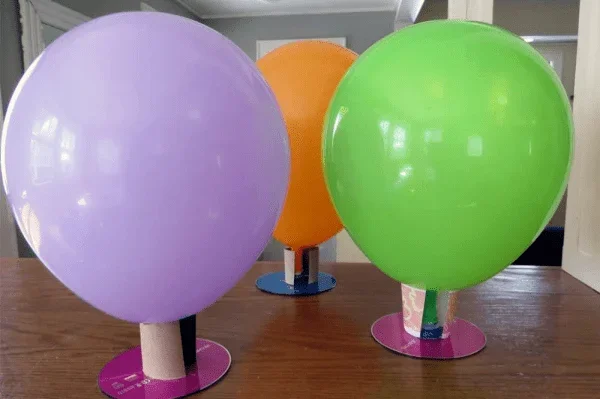 Hovercraft racersCopyright By: Liz Heinecke, Scholastic, 2017, https://www.scholastic.com/parents/school-success/learning-toolkit-blog/make-homemade-hovercraft-your-kids.html
Accessed July 29, 2020
Hovercraft racersCopyright By: Liz Heinecke, Scholastic, 2017, https://www.scholastic.com/parents/school-success/learning-toolkit-blog/make-homemade-hovercraft-your-kids.html
Accessed July 29, 2020
Understanding how friction works helps engineers design moving objects so they can be controlled. Sometimes they design materials to increase the friction and other times to reduce the friction. Snow tires may have metal studs that poke into the snow and ice, creating more friction than rubber alone. Rollerblade wheels must be sticky enough for control, but not so soft that they create too much drag or wear out too fast. Engineers also reduce friction between moving parts so that they run smoothly and do not wear down as quickly.
After this activity, students should be able to:
- Explain that friction slows moving objects, but also allows them to be controlled.
- Describe how a hovercraft moves and why it floats on a pillow of air.
- Predict characteristics of surfaces that might influence the amount of friction.
- Explain how having an understanding of friction works helps engineers design moving objects so they can be controlled.
- Predict and evaluate the movement of an object by examining the forces applied to it
Grade 8
Do you agree with this alignment?
- Students will develop an understanding of the relationships among technologies and the connections between technology and other fields of study.
Grades K-12
Do you agree with this alignment?
- MS-PS2-2 Plan an investigation to provide evidence that the change in an object's motion depends on the sum of the forces on the object and the mass of the object.
Grades 6-8
This resource focuses on the following Three Dimensional Learning aspects of NGSS:
Science & Engineering Practices- Science knowledge is based upon logical and conceptual connections between evidence and explanations.Do you agree with this alignment?
- Conduct an investigation to produce data to serve as the basis for evidence that meet the goals of an investigation.Do you agree with this alignment?
- Develop and use a model to describe phenomena.Do you agree with this alignment?
Disciplinary Core Ideas- The motion of an object is determined by the sum of the forces acting on it; if the total force on the object is not zero, its motion will change. The greater the mass of the object, the greater the force needed to achieve the same change in motion. For any given object, a larger force causes a larger change in motion.Do you agree with this alignment?
- All positions of objects and the directions of forces and motions must be described in an arbitrarily chosen reference frame and arbitrarily chosen units of size. In order to share information with other people, these choices must also be shared.Do you agree with this alignment?
Crosscutting Concepts- Models can be used to represent systems and their interactions.Do you agree with this alignment?
Do you agree with this alignment? - Science knowledge is based upon logical and conceptual connections between evidence and explanations.
Each group needs:
- 1 compact disc (CD); ask students to bring used CDs from home or purchase blank CDs, available online
- 1 plastic bottle with a cap, ~16 oz. size, such as a soda bottle
- 1 balloon
- hacksaw, to cut the top off the plastic bottle
- drill, to put holes in the bottle cap
- hot-glue gun, to be shared among groups
Friction is a force that arises when things rub against each other. Friction can slow things down and eventually make the surfaces wear down. Different objects have different amount of friction when they rub together. However, when surfaces do not rub against each other, there is no friction between them. The best way to reduce friction between two surfaces is to arrange them so that they do not touch!
Boat engineers and builders know that friction between a boat and water is one thing that slows the boat down. Over the years, they have been figuring out ways to design boats so that they do not touch water very much, but still float. In 1877, a British engineer named Sir. John Thornycroft patented a method to design boats to ride on a cushion of air. Basically, his method was to use a large fan powered by a motor to force air down under the craft. Eventually, the air pressure was large enough to lift the vehicle off the surface. Engineers took this idea and built upon it, designing "flying boats" and other airplanes that can lift off of a water surface. Finally, in the early 1950s, British, American and Swiss engineers began to think of new ways to use Sir Thornycroft's air cushion idea. In 1955, a British man named Christopher Cockerell tested a new kind of craft and patented his idea for the first real hovercraft — a vehicle that can travel on a cushion of air over water, ice, dirt, pavement and other surfaces. Hovercrafts are so versatile that the Ford Motor Company even made a "hovercar" called the Glideair in 1959. Now, hovercrafts are used for rescue work on rapidly moving rivers and thin ice, cargo transport and ferrying work (such as across the English Channel), and by the military to transport troops and equipment from boats to the shore. In this activity, we are going to build our own model hovercraft to learn why suspending something on a cushion of air might help it slide over certain surfaces.
Before the Activity
- Gather supplies: Purchase or have the students bring in plastic soda or water bottles with caps and compact discs (CDs) before the activity.
- Prepare materials: Using a hacksaw, cut the top of the bottle at the neck. Save the top and cap, discard the rest of the bottle. Drill 1-3 holes in each bottle cap, with a different number of holes in different caps, so that students can compare the results of hovercraft racers with different numbers of holes in the caps.
With the Students
- Discuss with students the concepts of friction. Ask what happens when you roll an object across the ground over grass vs. the sidewalk. (Answer: Object rolls farther on the smooth concrete surface.) Which is easier to ride your bike on? (Answer: Sidewalk.) Why? (Answer: There is less friction between the bike and the sidewalk vs. the bike and grass.)
- Invite teams of two students each to pick a bottle top and cap. Have them attach a balloon to the cap, over the cut neck (see Figure 1).
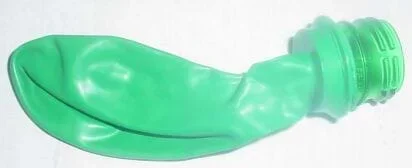 Figure 1: Attach the balloon to the cut-off top of a plastic bottle.Copyright 2003 Ben Heavner, Integrated Teaching and Learning Program, College of Engineering, University of Colorado Boulder
- Making sure they have caps that fit their bottle tops, have students use hot glue to attach the caps to the shiny side of their compact discs (see Figure 2), with the holes in the caps centered over the holes in the middle of the CDs. Be sure to use enough hot glue to completely seal the space between the cap and the CD.
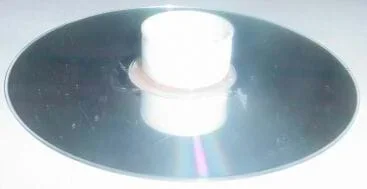 Figure 2: Use hot glue to attach the bottle cap to the shiny side of a CD.Copyright 2003 Ben Heavner, Integrated Teaching and Learning Program, College of Engineering, University of Colorado Boulder
- Once the hot glue cools, the hovercraft racers are ready for final assembly. Have the students blow up their balloon through the bottle tops, then pinch the neck so that air does not escape while they screw the top into their cap, which is attached to the compact disc (see Figure 3).
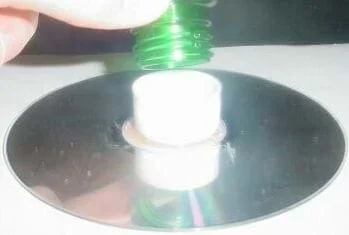 Figure 3: Screw the blown-up balloon into the bottle cap, which is glued onto the CD.Copyright 2003 Ben Heavner, Integrated Teaching and Learning Program, College of Engineering, University of Colorado Boulder
- Place the hovercraft racer on a smooth, flat surface and release the neck of the balloon, allowing air to escape. Tap the side of the hovercraft racer, and see how it glides over the surface! (See Figure 4) To gather comparison data on the different hovercraft versions, set up a starting line, and collect measurements of distance and time traveled.
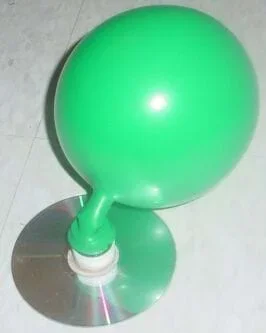 Figure 4: A hovercraft racer slides across the floor.Copyright 2003 Ben Heavner, Integrated Teaching and Learning Program, College of Engineering, University of Colorado Boulder
Pre-Activity Assessment
Discussion Question: Solicit, integrate and summarize student responses.
- How can two surfaces have no friction between them? (Answer: If they are not touching.)
Activity Embedded Assessment
Discussion Questions: Solicit, integrate and summarize student responses.
- How well does the hovercraft racer slide when the balloon is out of air? (Answer: Not well.)
- How well does the hovercraft racer slide over rough surfaces, such as a carpeted floor? (Answer: Not well.) Why do you think that is? (Answer: The air can escape through spaces between the carpet fibers, and so does not hold up the compact disc as well.)
Pairs Check: After students finish creating their team's hovercraft, have them work with another group to compare the performance of the hovercraft built with a cap with one hole vs. a hovercraft built with a cap containing two or three holes.
- What are the advantages of having multiple holes? (Answer: Air can escape more quickly, so the compact disc is lifted further away from the surface and glides better.)
- What are the advantages of having only one hole? (Answer: Air escapes more slowly, and so lasts longer.)
Explore force and motion: Have the students conduct a brief investigation on the forces acting on their hover craft in order to explore how those forces sum to change the motion of the object.
- First, have the students draw two free body diagrams of their hovercraft in the following scenarios. Remind students that a free body diagram should include arrows that indicate the general magnitude and direction of the forces acting on a body, which, in this case, is the hovercraft.
- What are the forces acting on the hovercraft when it is sitting on the table surface, not moving.
- How do these forces change when the hovercraft is pushed?
Then, as a class, draw a diagram similar to the following Figure 5. Have the students help fill in the different forces they thought of. Things to point out:
- A normal force (the perpendicular contact force exerted from the surface) exists when the hovercraft is sitting on the table. This is equal and opposite to the downward weight force of the hovercraft.
- When the hovercraft is pushed, the forward motion is the balance between four main forces: the upward thrust from the air coming out, the downward force of the weight of the hovercraft, the magnitude of the push, and the air resistance pushing back on the forward moving hovercraft.
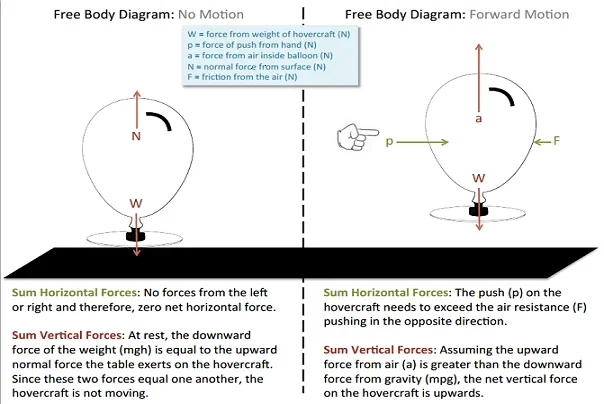 Figure 5. An example of the free-body diagrams that can be presented to students.Copyright Science Bob http://www.sciencebob.com/experiments/cd_hovercraft.php
Post-Activity Assessment
Brainstorming: Have students engage in open discussion and list their ideas on the board. Remind them that no idea or suggestion is "silly." Encourage wild ideas and discourage criticism of any ideas. All ideas should be respectfully heard. Ask the students:
- Now that you have experimented with hovercraft, can you think of any ways to improve your design? (If no student responds, try to encourage ideas with: How about a way to keep air flowing because the balloon runs out quickly?)
- What changes would you make if you wanted to build a hovercraft that could carry a heavy cargo? (Note: Modern hovercraft ferry cars across the English Channel!) (If no student responds, try to encourage ideas with: How much cargo could your hovercraft have carried? How would you carry cargo?)
Design Homework: As homework, assign students to each create a blueprint of a new hovercraft design that is capable of lifting heavy loads. Suggest that they consider using any of the ideas listed on the board from the brainstorming assessment activity.
Hot glue can burn, so closely supervise the students when they use the hot glue gun. Or, the teacher can do the gluing for the students.
The hacksaw and drill also present risks and could cut the person preparing the bottle tops and caps. It is sometimes best to prepare the bottle tops and caps before the activity begins.
The hovercraft racers work much better on smooth surfaces such as a tabletop, desktop or linoleum floor compared to a carpeted surface. It may take some experimentation to find the best surface for a hovercraft race.
The hovercraft racers work best if the bottle cap is glued to the shiny surface of the compact disc so that the labeled side of the disc is down.
Ask students to research the history and uses of hovercraft. Who was Christopher Cockerell? How did he make his first model of a hovercraft? How are hovercraft used today?
For upper grades, students may be able to drill the holes in the caps themselves (with supervision) and thus be able to experiment with their hovercraft by first drilling one hole, and then adding more holes and experimenting again. Have the students write a hypothesis on how more than one hole will change the motion of the hovercraft, record their observations, and write a short paragraph comparing and contrasting the hovercraft behavior with one hole vs. more.
See great photographs of hovercrafts at the Universal Hovercraft manufacturer's site: http://www.hovercraft.com/.
Potter, Chris. Hovercraft History & Hovercraft Museum. January 11, 2004. The Hovercraft Museum Trust, 1997-2004. Accessed January 23, 2004. http://www.hovercraft-museum.org
More information and figures at http://www.sciencebob.com/experiments/cd_hovercraft.php. Figure used in Activity Embedded Assessment was obtained from this site on July 30, 2014.
Contributors
Ben Heavner; Malinda Schaefer Zarske; Denise W. Carlson
Supporting Program
Integrated Teaching and Learning Program, College of Engineering, University of Colorado Boulder
Acknowledgements
The contents of this digital library curriculum were developed under grants from the Fund for the Improvement of Postsecondary Education (FIPSE), U.S. Department of Education, and National Science Foundation (GK-12 grant no 0338326). However, these contents do not necessarily represent the policies of the Department of Education or National Science Foundation, and you should not assume endorsement by the federal government.
Copyright
2004 by Regents of the University of Colorado