
What a Drag
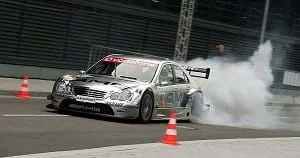 Students explore friction and drag and the energy associated with bothCopyright https://simple.wikipedia.org/wiki/Burnout#/media/File:DTM_car_mercedes2006_burnOut.jpg
Students learn about friction and drag — two different forces that convert energy of motion to heat. Both forces can act on a moving object and decrease its velocity. Students learn examples of friction and drag, and suggest ways to reduce the impact of these forces. The equation that governs common frictional forces is introduced, and during a hands-on activity, students experimentally measure a coefficient of friction.
If you take a car built before 1970 and place it next to a car built today, they look incredibly different. The older cars tend to be boxy with abrupt edges; newer cars are designed with rounded corners, edges and smooth curves. Mechanical and aerospace engineers have designed vehicles to be more aerodynamic to reduce drag force, and thus improve gas mileage.
After this lesson, students should be able to:
- Recognize the different types of friction: static friction, kinetic friction, and drag
- Understand how friction and drag work
- Learn how to calculate friction and drag
- Give examples of friction and drag
- HS.2.4.c.i Solve linear equations and inequalities in one variable, including equations with coefficients represented by letters.
Grades 9-12
Do you agree with this alignment? - 7.1.2.c Solve real-world and mathematical problems involving the four operations with rational numbers.
Grade 7
Do you agree with this alignment?
- Predict and evaluate the movement of an object by examining the forces applied to it
Grade 8
Do you agree with this alignment? - Use mathematical expressions to describe the movement of an object
Grade 8
Do you agree with this alignment?
- CCSS.Math.Content.6.NS.B.2 Fluently divide multi-digit numbers using the standard algorithm.
Grade 6
Do you agree with this alignment? - CCSS.Math.Content.6.NS.B.3 Fluently add, subtract, multiply, and divide multi-digit decimals using the standard algorithm for each operation.
Grade 6
Do you agree with this alignment? - CCSS.Math.Content.HSA-CED.A.4 Rearrange formulas to highlight a quantity of interest, using the same reasoning as in solving equations.
Grades 9-12
Do you agree with this alignment? - CCSS.Math.Content.HSA-SSE.B.3 Choose and produce an equivalent form of an expression to reveal and explain properties of the quantity represented by the expression.
Grades 9-12
Do you agree with this alignment?
- Energy is the capacity to do work.
Grades 6-8
Do you agree with this alignment?
- MS-PS3-5 Construct, use, and present arguments to support the claim that when the kinetic energy of an object changes, energy is transferred to or from the object.
Grades 6-8
This resource focuses on the following Three Dimensional Learning aspects of NGSS:
Science & Engineering Practices- Construct, use, and present oral and written arguments supported by empirical evidence and scientific reasoning to support or refute an explanation or a model for a phenomenon.Do you agree with this alignment?
- Science knowledge is based upon logical and conceptual connections between evidence and explanations.Do you agree with this alignment?
Disciplinary Core Ideas- When the motion energy of an object changes, there is inevitably some other change in energy at the same time.Do you agree with this alignment?
Crosscutting Concepts- Energy may take different forms (e.g. energy in fields, thermal energy, energy of motion).Do you agree with this alignment?
Do you agree with this alignment? - Construct, use, and present oral and written arguments supported by empirical evidence and scientific reasoning to support or refute an explanation or a model for a phenomenon.
Friction is a lot like a little brother or sister that never cooperates with you. If you want to go somewhere, they want you to sit still. If you want to move forward, they are pulling you backward, and so on. There are two types of friction: static friction and kinetic friction. Static friction resists an object to start moving or sliding, which is a good thing when you start walking. If static friction didn't exist, it would be like you were constantly walking on ice! Kinetic friction resists an object that is already moving and always acts in a direction opposite of motion. Kinetic friction is the reason that anything moving or sliding will eventually come to a stop. It is important to note that static friction is always stronger than kinetic friction. For example, try sliding a heavy box across the floor. You should notice that it takes more force to start sliding the box than to keep the box sliding.
The concept of friction is an important consideration engineers must account for when designing parts that will rub against each other. The friction between two objects is primarily dependent on two things: how hard are the objects pressing against each other and the coefficient of friction (μ)(pronounced "mu") between the objects. For example, the coefficient of friction of a dry water slide is much higher than one with water on it. A measurement of the coefficient of friction is usually determined experimentally. A common equation used to determine the amount of friction an object experiences on a flat surface is:
FF = μ x W
where FF is the force of friction measured in Newtons (N) or pounds (lbs), μ is the coefficient of friction which is unit-less, and W is the weight of the object.
Drag is a special kind of friction that affects objects moving though any type of fluid. Air and water are two example fluids that vehicles move through. The amount of drag depends both on the shape and speed of an object. Drag has a greater effect on objects that move quickly. Aerodynamic shapes have smooth edges and small profiles to reduce the effects of drag. Drag and friction play an important roll in races. Professional cyclists position their bodies a certain way and wear tight clothing, racecars are made with aerodynamic shapes, and bobsledders tuck themselves into a very sleek sled, all in an effort to reduce drag.
Ask the students: "Would you slide further on a sidewalk, on the grass or on a frozen lake? Why?" (Answer: On a frozen lake, because the ice provides less friction than the sidewalk or grass.) Next, show photographs of bobsledders to the class. Point out that the sleds have a very smooth shape and that the riders tuck themselves down very low in the sled. Ask the students, "Why do the bobsledders crouch down so low?" (Answer: To reduce friction and make the sled go faster.) Explain that the scientific reason is to reduce drag, or make the sled more aerodynamic. Describe to the students that the drag force depends upon the shape of the object. Ask for some other examples of objects that are designed to move very quickly (such as, racecars, rockets, airplanes, etc). What do they have in common? (Answer: They are all shaped with smooth edges.) Explain that the position the athletes (such as, speed skaters, cyclists, ski jumpers, etc.) hold is important and determines how fast they can go. Students may be familiar with this and other examples from watching the Winter Olympics.
Friction also plays an important role in all the previous examples. Ask the students, "What would happen if they sprinkled sand on the bobsled track?" (Answer: The sleds would go much slower.) What if the tracks were made out of concrete? (Answer: The sleds would probably not slide at all, but if you pushed hard enough to move the sled, the metal skids on the sled would probably get hot.) Friction changes the energy of motion (kinetic energy) into heat. You can experience this by rubbing your hands together very quickly. Friction on ice is very low, which means that the sleds can move quickly. Many of us know that ice is very slippery, which you know if you have ever slipped and fallen on a patch of ice! In a brainstorming session, ask the students to suggest sports in which friction and drag are factors. Following the lesson have students conduct the hands-on associated activity Sliders to experimentally measure a coefficient of static friction. Refer to the associated activity Sliders (for High School) for older ages.
Mechanical and aerospace engineers work together when designing automobiles or airplanes. Mechanical engineers must be careful in designing engines because they have many parts that are constantly moving and rubbing against each other. If enough friction occurs, the engine could overheat and lockup or wear down and break. We add oil to engines to reduce friction and prevent such a disaster. Aerospace engineers design low-drag airplanes and cars to improve gas mileage. Drag wastes energy by making planes and cars harder to move forward. Friction and drag dissipate useful energy, forcing us to pay for more gasoline, oil and maintenance.
Friction is not always a bad thing; sometimes engineers use friction to their advantage. For example, anti-lock brakes (ABS) were designed to take advantage of static friction. Recall that static friction is always stronger than kinetic friction. ABS prevents the wheels from locking up and causing the tires to slide against the road. It keeps the tires on the brink of sliding, maximizing their static friction, and brings a car to a stop faster. Another example of engineers taking advantage of friction is in the design of parachutes. By maximizing drag, the skydiver can land on the ground safely, which is much better than the alternative of minimizing their drag.
- friction
- The force that resists the motion of two objects pressed against each other.
- static friction
- The resistance against an object to start moving or sliding.
- kinetic friction
- The resistance against an object already moving or sliding.
- coefficient of friction
- An experimentally determined value that helps determine the amount of friction experienced between two objects.
- drag
- The frictional force that a fluid exerts upon an object traveling though it.
Pre-Lesson Assessment
Voting: Ask the students to vote by a show of hands on the following question:
- Where would you slide further: on a sidewalk, on the grass, or on a frozen lake? (Answer: Frozen lake.)
Discussion Question: Ask the students and discuss as a class:
- Why would you slide further on a frozen lake? Explain. (Answer: You slide further on the ice because it provides less friction than the sidewalk or grass.)
Post-Introduction Assessment
Brainstorming: In small groups, have the students engage in open discussion. Remind students that no idea or suggestion is "silly." All ideas should be respectfully heard. Ask the students to:
- Name sports in which friction and drag are factors. (Possible answers: Racing — friction-tires on the road, drag-shape of car. Skiing — friction-skis on the snow, drag-position of skier.)
Lesson Summary Assessment
Numbered Heads: In teams of three to five, have the students pick numbers (or number off) so each member has a different number. Ask the students a question (give them a time frame for solving it, if desired). The members of each team should work together on the question. Everyone on the team must know the answer. Call a number at random. Students with that number should raise their hands to answer the question. If not all the students with that number raise their hands, allow the teams to work a little longer. Ask the students:
- Who would go faster? A girl on a bicycle who is not pedaling and is standing up or a girl on a bicycle who is not pedaling and is crouched over her handlebars? (Answer: Crouched down, due to less drag from the air.)
- How much frictional force is available from a bike's tires while sliding if μ = .6 and the bike weighs 150 lbs with the person riding it? Write the equation on the board. Have the students do the calculation. (Answer: FF = .6 x 150 lbs = 90 lbs.)
- What problems are most likely to occur in an engine that runs out of oil and is not properly lubricated? (Answers: The engine will heat up and possibly overheat, the heat could cause the engine to expand and lockup, the engine will wear down and eventually cause parts to break, all because of increased friction.)
- How much frictional force is available from a bike's tires when not sliding if μ = .8 and the bike weighs 150 lbs with a person riding it? What does this mean compared to the value when sliding? Have the students do the calculation. (Answer: FF = .8 x 150 lbs = 120 lbs. Compared to sliding, you have 30 lbs more frictional force to help bring the bike to a stop or keep the bike on the road.)
- If the frictional force from the bike's tires is 100 lbs, and the person on the bike weighs 140 lbs, what is the coefficient of friction? Write the equation on the board, and have the students rearrange it to solve the question. (Answer: μ = 100/150 = .714)
Open-Ended Design Question: Tell the students they have been contracted by the US Olympic Cycling Team to suggest ways to make the cyclists go faster. Aside from peddling faster, what other ways could improve the team's performance? Have the students write down their responses, draw a picture of their improved design, and turn them in. (Possible answers: Use grease or graphite lubricant to reduce friction between the wheels and axles, make the bike more aerodynamic, and make the cyclists' helmets more aerodynamic.)
Assign the students the following activity as a way to verify that static friction is stronger than kinetic friction. Fill a box with books or other heavy items and have the students try to slide it across the floor. Have the students describe the amount of effort it took to move the box. To initially move the box, they will find they must gradually increase how hard they are pushing on the box until it starts sliding. Once the box is moving, the students should feel how it takes less force to keep the box sliding than to start it sliding. Have the students write a journal entry explaining which type of friction is stronger and why.
The effects of lubrication can be felt in a simple demonstration. Have the students rub their hands together quickly. They should feel heat being generated by the friction. Now give the students a small amount of hand lotion or wet their hands with water. It should be easier to rub their hands together and produce less heat (due to reduced friction).
Kahan, Peter. Science Explorer: Motion, Forces, and Energy. Upper Saddle River, NJ: Prentice Hall, 2000.
Contributors
Chris Yakacki; Bailey Jones; Matt Lundberg; Malinda Schaefer Zarske; Denise Carlson
Supporting Program
Integrated Teaching and Learning Program, College of Engineering, University of Colorado Boulder
Acknowledgements
The contents of this digital library curriculum were developed under a grant from the Fund for the Improvement of Postsecondary Education (FIPSE), U.S. Department of Education and National Science Foundation GK-12 grant no. 0338326. However, these contents do not necessarily represent the policies of the Department of Education or National Science Foundation, and you should not assume endorsement by the federal government.
Copyright
2004 by Regents of the University of Colorado.