
How Far? Measuring Friction Using Different Materials
To learn how friction affects motion, students explore how different textures provide varying amounts of friction to objects moving across them. They build a tool to measure the amount of friction between a note card and various surfaces by measuring the distance that a rubber band stretches. They experiment with a range of materials to determine which provides the least/most friction.
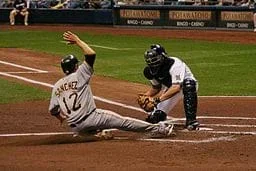 Friction is generated as the baseball player slides, slowing him down.Copyright Wikimedia Commons http://commons.wikimedia.org/wiki/File:Sliding_Into_Home.jpg
Engineers consider friction when determining materials for tires, runways, shoe soles, motors or hip replacements. Chemical engineers consider friction when they design compounds for glues, bubble gum or brake pads. Some bicycle tires use a mix of materials because friction is different on the flat of the tire vs. the curve of the tire. Engineers also consider the consequences of frictional forces. For example, friction on the thin brake disks of performance cars can raise the temperature of the disk high enough to warp it, so engineers design the brake disk with holes so it cools down faster.
After this activity, students should be able to:
- Understand that friction is stronger between some surfaces than others.
- Be able to suggest methods of affecting the friction between surfaces.
- Understand why friction is an important consideration in many areas of engineering design.
- 7.1.1.c Identify and represent proportional relationships between quantities.
Grade 7
Do you agree with this alignment?
- Predict and evaluate the movement of an object by examining the forces applied to it
Grade 8
Do you agree with this alignment? - Use mathematical expressions to describe the movement of an object
Grade 8
Do you agree with this alignment?
- CCSS.Math.Content.HSS-ID.A.1 Represent data with plots on the real number line (dot plots, histograms, and box plots).
Grades 9-12
Do you agree with this alignment? - CCSS.Math.Practice.MP2 Reason abstractly and quantitatively.
Grades K-12
Do you agree with this alignment?
- Some technological problems are best solved through experimentation.
Grades 6-8
Do you agree with this alignment?
- MS-PS2-2 Plan an investigation to provide evidence that the change in an object's motion depends on the sum of the forces on the object and the mass of the object.
Grades 6-8
This resource focuses on the following Three Dimensional Learning aspects of NGSS:
Science & Engineering Practices- Plan an investigation individually and collaboratively, and in the design: identify independent and dependent variables and controls, what tools are needed to do the gathering, how measurements will be recorded, and how many data are needed to support a claim.Do you agree with this alignment?
- Science knowledge is based upon logical and conceptual connections between evidence and explanations.Do you agree with this alignment?
- Use mathematical representations to describe and/or support scientific conclusions and design solutions.Do you agree with this alignment?
Disciplinary Core Ideas- The motion of an object is determined by the sum of the forces acting on it; if the total force on the object is not zero, its motion will change. The greater the mass of the object, the greater the force needed to achieve the same change in motion. For any given object, a larger force causes a larger change in motion.Do you agree with this alignment?
- All positions of objects and the directions of forces and motions must be described in an arbitrarily chosen reference frame and arbitrarily chosen units of size. In order to share information with other people, these choices must also be shared.Do you agree with this alignment?
Crosscutting Concepts- Explanations of stability and change in natural or designed systems can be constructed by examining the changes over time and forces at different scales.Do you agree with this alignment?
Do you agree with this alignment? - Plan an investigation individually and collaboratively, and in the design: identify independent and dependent variables and controls, what tools are needed to do the gathering, how measurements will be recorded, and how many data are needed to support a claim.
Each group needs:
- Note card
- Paper clip
- Rubber band
- Bottle of glue (8 oz., serving as a weight)
- String
- Wax paper
- Sandpaper
- Ruler
- Scissors
- Pen
- Tape
- Suggestions for additional materials: Saran Wrap, aluminum foil, cloth or any other material on hand with an interesting texture.
Friction is a force that arises when things rub against each other. For example, if you rub your hands together very quickly, they get warmer. This is a result of the friction between your moving hands. Different items have different levels of friction when they rub together. In fact, every object has unique characteristics in terms of friction. Engineers are very interested in friction because friction affects how smoothly things work. When surfaces grind against each other with lots of friction, they tend to wear out. For example, if the grinding surfaces are gears in a machine, the machine would wear out faster, and need to be replaced sooner than if there was minimal friction in the machine.
Fortunately, we can measure the amount of friction between surfaces. In this activity, we create an instrument to explore the amount friction between a note card and various other surfaces. As you measure the friction, observe the properties of the surfaces. Which properties might affect the amount of friction?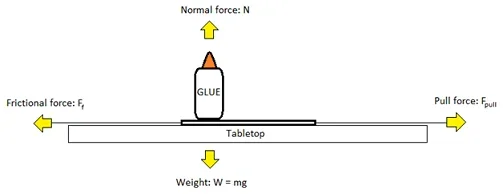
The image above shows the four forces acting upon the note card as it is being pulled. When the note card is being pulled but doesn't move, the pulling force (Fpull) is counteracted by an equal and opposite frictional force (Fforce). The note card then begins to move when the pull force is larger than the frictional force. These horizontal forces can be thought of as acting along the x-axis. Mathematically speaking:
- When the note card is stationary: Fpull = Ff
- When the note card moves to the right: Fpull > Ff
The vertical forces (or the forces acting along the y-axis) are always equal. The weight of the glue bottle (or whatever the object is) is equal to its mass multiplied by gravity (W = mg). This is counteracted by a force from the tabletop, known as the normal force (N). The normal force pushes up as the weight of the glue bottle pushes down. These two vertical forces must be equal because the glue bottle doesn't move in the vertical direction (up or down), it only moves right (horizontally along the x-axis). Mathematically speaking:
- Always: N = W (= mg)
The mass of the glue bottle is significant because the frictional force is dependent upon the normal force (and thus indirectly dependent upon the mass). This is why a heavier object is harder to move than a lighter object (assuming that they have the same size and contact with the ground) – the frictional force increases as the mass increases.
Before the Activity
- Make 1 copy of the worksheet for each group of two students.
With the Students
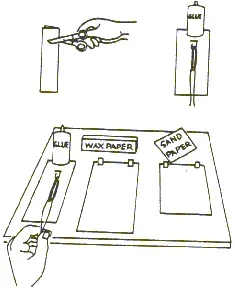 Activity set up to conduct experiments with friction.Copyright VanCleave, Janice. Physics for Every Kid: 101 Easy Experiments in Motion, Heat, Light, Machines and Sound. NewYork, NY: John Wiley and Sons Inc., 1991.
- Discuss with students the concepts of friction. Ask what happens when you slide across the ground on mud vs. concrete. Which is easier? (Answer: Mud.) Why? (Answer: There is less friction between your feet and mud vs. your feet and concrete.)
- Pass out worksheets to each group of two students and have them answer the questions as they perform the experiments.
- Have the students fold the note card and cut a slit 1 cm (approx. ½ in.) long 5 cm (approx. 2 in.) from the end of the card.
- Put the paper clip in the slit and slide the rubber band onto the paper clip.
- Cut a piece of string 25 cm (10 in.) long and loop it through the rubber band.
- Place the glue bottle at the end of the note card.
- Gently pull the string just enough to straighten out the rubber band. Mark the point at the end of the straight rubber band "Start."
- Pull on the string until the card moves along the table. Measure and record on the worksheet the distance the rubber band stretches.
- Tape a piece of wax paper and a piece of sandpaper to the table.
- Move the card along these materials by pulling on the string, once again recording how far the rubber band stretches (and keeping the glue bottle on the card).
- Explain that friction is something engineers often try to avoid or minimize. Ask them why? (Possible answers: Wastes energy, wears on parts, etc.) When would engineers not want to avoid friction? (Possible answers: To slow things down, such as with brake pads, or to prevent slipping by choosing a material with high friction.)
- While all the students are finishing, have them pair up with another group, who has finished, and compare answers.
- Have students engage in the I Spy! activity described in Assessment section.
Pre-Activity Assessment
Discussion Questions: Solicit, integrate and summarize student responses.
- What happens when you try to slide across the ground on mud? What happens when you try to slide across concrete? Which is easier? (Answer: Mud.) Why? (Answer: Less friction.)
Activity Embedded Assessment
Worksheet: Have the students complete the activity worksheet; review their answers to gauge their mastery of the subject.
Post-Activity Assessment
Pairs Check: After students teams finish working on their worksheets, have them compare answers with another group, giving remaining teams time to finish the worksheet.
I Spy: Have student teams look around the room and find one object that demonstrates friction at work. Tell them to be creative. Play a game of I Spy! with the class by asking one team to start by saying "I spy with my little eye..." and have the rest of the class guess at the object that is demonstrating friction. When the object is guessed, the person who guessed it has to explain how the object demonstrates friction. The team who found the object can decide if the explanation is correct or give their own.
Discussion: Pose the following questions to students:
- Which forces act on the note card in the horizontal direction (or along the x-axis)? (Answer: the pull force and the frictional force.)
- Which forces act on the note card in the vertical direction (or along the y-axis)? (Answer: the weight of the glue bottle/other object and the normal force.)
- When the mass of the glue bottle/object decreases, what happens to the frictional force? (Answer; It also decreases.)
- When does the notecard begin to move? (Answer: When the pull force becomes greater than the frictional force.)
Students need to be careful when using scissors.
One of the keys to the activity is having enough weight on the note card. The greater the weight, the greater the difference in the amount the rubber band stretches for various surfaces. For example, the glue bottle must be full enough to exert sufficient force on the card.
Have the students repeat the same experiment with other variables: Different-shaped cards, different-sized cards, different weights, other surfaces. Ask them to describe their results and how the results relate to friction. Some results can be very surprising; for example, a card with a large surface area may have more friction with one surface, but less with another.
- For lower grades, collect measured values from the students and work together to make a single bar graph.
- For upper grades, have the students share their measured values and construct the bar graphs using averages. Have students to do the Activity Extension.
VanCleve, Janice. Physics for Every Kid: 101 Easy Experiments in Motion, Heat, Light, Machines and Sound. NewYork, NY: John Wiley and Sons Inc., 1991. (Activity adapted from VanCleave.)
- Forces: Friction
- What a Drag
- Red Light, Green Light: Forces of Friction, Roads & Tires
- Hovercraft Racers!
- How Far? Measuring Friction Using Different Materials
- It Takes Two to Tangle
Contributors
Sabre Duren; Ben Heavner; Malinda Schaefer Zarske; Denise Carlson
Supporting Program
Integrated Teaching and Learning Program, College of Engineering, University of Colorado Boulder
Acknowledgements
The contents of this digital library curriculum were developed under a grant from the Fund for the Improvement of Postsecondary Education (FIPSE), U.S. Department of Education, and National Science Foundation GK-12 grant no 0338326. However, these contents do not necessarily represent the policies of the Department of Education or National Science Foundation, and you should not assume endorsement by the federal government.
Copyright
2004 by Regents of the University of Colorado.