
It Takes Two to Tangle
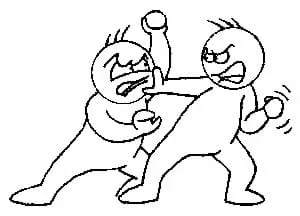 A different kind of friction. It takes two to tangle.Copyright Department of Foreign Languages and Literatures, Purdue University, 2004, http://clear.msu.edu:16080/dennie/clipart/.
Students explore the theme of conflict in literature. They learn the difference between internal and external conflict and various types of conflicts, including self against self, self against other, and self against nature or machine. Stories are used to discuss methods of managing and resolving conflict and interpersonal friction. Note: The literacy activities for the Mechanics unit are based on physical themes that have broad application to our experience in the world — concepts of rhythm, balance, spin, gravity, levity, inertia, momentum, friction, stress and tension.
Friction — as it relates to people — plays a role in engineering design teams. While conflict among team members can be disruptive to forward progress on a tight schedule, it is occasionally advantageous because it stirs up issues and brings out varying points-of-view that contribute to a better end solution. Good engineering teamwork depends on people having the ability to understand and respect each others' viewpoints. Valuable are the team members who can elicit constructive project contributions from friction and conflict.
After this activity, students should be able to:
- Students apply skills in analysis, synthesis, evaluation and explanation to their writing and speaking.
- Write and speak in the content areas using the technical vocabulary of the subject accurately.
- Understand that good engineering teamwork depends on people having the ability to understand and respect each others' viewpoints
- STEL-3D Explain how various relationships can exist between technology and engineering and other content areas.
Grades 3-5
Do you agree with this alignment?
- Paper and pencils
- Access to the Internet
General familiarity with the concept of friction
 Copyright Department of Foreign Languages and Literatures, Purdue University, 2004.
 Copyright Department of Foreign Languages and Literatures, Purdue University, 2004.Would life be easier in a friction-free environment? Think of a car skidding wildly on an icy road. Without friction the car goes out of control.
What would life be like without obstacles, without competition, without challenges, without "friction"? What would life be like if everyone were the same and no one disagreed? Probably pretty dull.
The price we pay for those differences is conflict. A little friction can be good — the kind of challenge that stimulates creativity, gives us something to work with or against and just enough stress to strengthen a muscle. But when conflict gets out of control, we have quarrels, fights and wars.
The challenge is to manage conflict without wounding or killing each other: to benefit from challenges, to gain inspiration from sources of difference.
In this activity we examine literature to discover ways to resolve conflict intelligently.
In a previous lesson (Mechanics unit, Lesson 4), students learned about friction. They learned that even though engineers work to minimize the effects of friction, some friction is essential to control movement. In this literacy activity, students are encouraged to think about how they can work with the "friction" in their own lives — in the form of obstacles, challenges, stress, tension and conflict — to develop self-control and a sense of accomplishment.
Students learn that literature — drama, novels, short stories, epic poems or story poems — typically turn on the resolution of some form of conflict and can inspire us to discover creative ways to resolve conflict in our own lives. The structure of the short story discussed below under the Observing section also applies to the overall structure of the novel. The focus in all the selections should be on how the characters deal with conflict.
As time permits, students may read one or more of the novels or short stories in the collections listed below. The novel Holes is recommended because it so vividly portrays multiple types of conflict. Links to study guides and lesson plans for this selection are provided in references.
Many schools have adopted or developed conflict resolution and mediation programs. Supplementary background materials on conflict resolution issues listed in the References section may be used to develop the connection between themes of the literary works studied and students' own experiences.
Observing
As you read one of the novels or some of the stories in the collections suggested below, observe how the plot develops. Does it follow the classic pattern of Freytag's Modified Triangle (see two diagrams) with the emotional level rising as the conflict develops in the protagonist's experience? To learn more about story structure and the role that conflict plays in the development of stories, search the Internet for one of the many useful resources available.
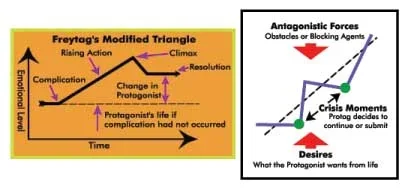 Freytag's Modified Triangle represents the classic pattern of plot development, or the emotional structure of the story, via complication, reaching a climax and resolution. The Rising Action image shows the conflict between desires and antagonistic forces, and the impact of crisis moments, all influencing the story line.Copyright 2003 by David E. Rogers. Reprinted by permission. http://faculty.valencia.cc.fl.us/drogers/Fiction/storyst2.htm
Thinking
- Who is the main protagonist of the story or novel you read?
- Who are the antagonists?
- What types of conflict does the protagonist face:
- Self against other?
- Self against nature?
- Self against fate or destiny?
- Self against machine?
- Self against self?
- Are there any other types of conflict you can identify?
- Are the sources of conflict primarily external or internal?
- What are the main crisis moments?
- How does the protagonist react in these moments of crisis?
- What is the climactic moment, the climax, when the action of the plot or emotions of the characters become most intense?
- How is the conflict in the story resolved?
- Are their any mediating influences? Does anyone act in the role of mediator?
- How is the protagonist changed? Does he or she seem stronger for having overcome obstacles? What has the protagonist learned about dealing with conflict?
- What did you learn from the protagonist's experience? Was his or her experience similar to your own in any way? Did you learn anything new about ways to resolve conflict in your own life? Did you learn anything about self-control?
Writing
Write a story based on your own experience of dealing with conflict. For inspiration, read some of the suggested stories in the collection listed below.
Suggested Readings
- Bridge to Terabithia, available online
- From One Experience to Another: Award-Winning Authors Sharing Real-Life Experiences Through Fiction, available online
- Holes, available online
- On the Fringe: Stories, available online
- Shelf Life: Stories by the Book, available online
- Stay True: Short Stories for Strong Girls, available online
- A Wrinkle in Time, available online
- antagonist
- 1) One who opposes and contends against another; an adversary. 2) The principal character in opposition to the protagonist or hero of a narrative or drama.
- antithesis
- Direct contrast; opposition. The direct or exact opposite: Hope is the antithesis of despair. The second stage of the Hegelian dialectic process, representing the opposite of the thesis.
- conflict
- 1) A state of open, often prolonged fighting; a battle or war. 2) A state of disharmony between incompatible or antithetical persons, ideas or interests; a clash. 3) Psychology. A psychic struggle, often unconscious, resulting from the opposition or simultaneous functioning of mutually exclusive impulses, desires or tendencies. 4) Opposition between characters or forces in a work of drama or fiction, especially opposition that motivates or shapes the action of the plot.
- climax
- 1) The point of greatest intensity or force in an ascending series or progression; a culmination. 2) A series of statements or ideas in an ascending order of rhetorical force or intensity. 3) A moment of great or culminating intensity in a narrative or drama, especially the conclusion of a crisis. The turning point in a plot or dramatic action.
- dialectic
- 1) The art or practice of arriving at the truth by the exchange of logical arguments. 2) The process especially associated with the philosopher Hegel of arriving at the truth by stating a thesis, developing a contradictory antithesis, and combining and resolving them into a coherent synthesis.
- external
- Relating to, existing on, or connected with the outside or an outer part; exterior.
- friction
- 1) A force that arises when surfaces rub together. 2) A state of conflict between persons; clash; as between persons having dissimilar ideas or interests.
- internal
- Of, relating to, or located within the limits or surface; inner. Residing in or dependent on essential nature. Intrinsic: the internal contradictions of the theory.
- manage
- 1) To direct or control the use of, handle: manage a complex machine tool or manage emotions. 2) To exert control over: "Managing the news... is the oldest game in town" (Source: James Reston). "A major crisis to be managed loomed on the horizon." (Source: Time magazine) To make submissive to one's authority, discipline or persuasion.
- mediate
- To resolve or settle (differences) by working with all the conflicting parties: mediate a labor-management dispute or mediate a playground quarrel.
- plot
- The pattern of events or main story in a narrative or drama.
- protagonist
- The main character in a drama or other literary work.
- resolve
- To find a solution; solve. To bring to a usually successful conclusion: resolve a conflict.
- status quo
- The existing condition or state of affairs.
- synthesis
- The combining of separate elements or substances to form a coherent whole. The combination of thesis and antithesis in the Hegelian dialectical process whereby a new and higher level of truth is produced.
- theme
- 1) A topic of discourse or discussion. 2) A subject of artistic representation. 3) An implicit or recurrent idea, a motif: a theme of powerlessness that runs through the diary.
- thesis
- A proposition that is maintained by argument. The first stage of the Hegelian dialectic process.
Pre-Activity Assessment
Vocabulary Quiz: Reinforce the basic vocabulary introduced during the Observing activity with a vocabulary quiz.
Activity Embedded Assessment
Discussion or Test Questions: Customize the discussion questions under the Thinking activity for the novel or story read by the students; they also may be converted into test questions.
Post-Activity Assessment
Expressive Writing: Evaluate the students' stories in terms of how well they develop a true plot line for their own experience and demonstrate understanding of the significance of the experience.
Discussion Questions: Ask the students, and discuss as a class.
- A little friction can be good. How is the friction a person feels in a situation with other people similar and dissimilar to the physical force of friction? (Answer: Both refer to the interaction between two bodies. The scientific [mechanics, physics] definition of friction is a force that arises when surfaces rub together. In everyday, interpersonal situations, friction refers to a state of conflict between persons, as between persons having dissimilar ideas or interests.)
- If an engineer was designing a rubber tire or the motor for a scooter, which definition of friction would apply to her/his work? (Answer: The scientific one. Friction is a force that arises when surfaces rub together.)
- Suggest examples of interpersonal friction in your own life. (Possible answers: Various obstacles, challenges, stress, tension or conflict.)
- Suggest examples in which you want to minimize the effects of friction with other people. (Possible answers: You want to work cooperatively with your teammates on a school project, to create the best work with everyone's good ideas [results in a sense of accomplishment]. You don't want to have a fight on the playground [develop self control]. You don't want to argue with your siblings [family harmony].)
- Suggest examples in which engineers want to minimize the effects of friction, or in which engineers incorporate the existence of friction into their mechanical designs. (Possible answers: In an engine, oil serves as a lubricant, reducing friction, so moving parts do not wear on each other. When designing the tread pattern on a rubber tire, engineers want the tire to create the right amount of friction with the road surface, because it is essential to control movement of the car, truck or bicycle. Engineers need to know about air resistance [type of friction] when designing planes, weather balloons, roller coasters and skyscrapers. In sports [skates, skis, sleds, swimming suits], designers take friction [or reducing friction] into account to improve speeds.)
- Provide examples using each definition of friction. (Possible answers: Friction kept the wheels from sliding all over the road. The team members had lots of ideas and there was some friction when they tried to agree on a plan of action.)
- Ultimately, this activity is about improving students' safety by helping them become better able to deal with conflict.
This activity is about conflict, a touchy subject for some students and one that can be treated sensitively using literary models. Although recommendations are provided, the teacher is the best judge of selections appropriate to the interests and abilities of individual classes.
Plan on one 50-minute class to introduce concepts, and one 50-minute class for discussion.
Hegelian Dialectic (an advanced activity) — Although the name sounds intimidating, the concept itself is quite basic and can be useful in discussing conflict. Hegel (1770-1831) was a philosopher who believed that history developed through a process of change in which a view or concept of the status quo, which he called the thesis, was criticized or challenged by an alternative view or concept, the antithesis. Through the debate or struggle of these ideas, a new concept emerged, the synthesis, which was thought to resolve the conflicting elements of the thesis and antithesis. This synthesis in turn formed a new thesis, with a new challenge from a new antithesis, continuing the process of the dialectic. Sometimes the synthesis is a form of compromise in which both sides of the debate get the essentials of what they want and give up the inessentials through a process of mediation.
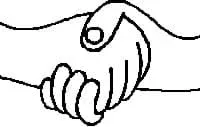 Copyright Department of Foreign Languages and Literatures, Purdue University.
Why do we shake hands? Learn about the greeting customs of different countries. Kiss, Bow or Shake Hands: How to Do Business in Sixty Countries by Terri Morrison or Gestures: The Do's and Taboos of Body Language Around the World by Roger Axtell, available online. Students may demonstrate the various types of greetings for the class, wearing hats or costumes to represent different countries or ethnicities.
- According to their ability, students may read one or more stories or novels. The study questions and methods of evaluation may be easily adapted.
- For upper grades, conduct the Hegelian Dialectic described in the Activity Extensions section.
Armstrong, Jennifer. Shattered: Stories of Children and War. Westminster, MD: Knopf Books for Young Readers, 2002.
The Chalk Tray, The Dialectic. J.C. Harmon High School, Kansas City, KS.
Conflict Resolution in the Classroom. Educating for Peace: Classroom Resources, http://www.global-ed.org/e4p/rm-conflict.htm, accessed May 20, 2004.
Conflict Resolution through Literature. Conflict Resolution & Mediation Training & Services, http://www.peaceroots.com/crliterature.htm, accessed May 5, 2004.
Gallo, Donald R. On the Fringe. New York, NY: Dial Books for Young Readers, 2001.
Holes: Literature Guides. Updated 1999. Nancy Polette's Children's Literature Site, http://www.nancypolette.com/LitGuidesText/holes.htm, accessed May 20, 2004.
King, Kathleen. Chapter Five: In Trouble and Out Again. Updated 2001. Idaho State University, http://www.isu.edu/~kingkath/ch5.html, accessed May 20, 2004.
L'Engle, Madeleine. A Wrinkle in Time. Yearling Books, 1998.
Letwin, Alita Zurav. Literature for Children and Young Adults, Examining Issues of Violence and Conflict Resolution. Center for Civic Education, http://www.civied.org/, accessed May 21, 2004.
Morrison, Terri. Kiss, Bow or Shake Hands: How to Do Business in Sixty Countries. Holbrook, MA: B. Adams, 1994.
Paterson, Katherine. Bridge to Terabithia. HarperTrophy, 1987.
Paulsen, Gary. Shelf Life: Stories by the Book. Simon & Schuster Children's Publishing, 2003.
Rochman, Hazel and Darlene Z. McCampbell. Who Do You Think You Are? Stories of Friends & Enemies. Little, Brown & Company, 1997.
Sachar, Louis. Holes. Yearling Books, 2003.
Safier, Fannie. Impact: Fifty Short Stories. Holt Rinehart & Winston, 1996.
Singer, Marilyn. Stay True: Short Stories for Strong Girls. New York, NY: Scholastic, 1999.
Weiss, M. Jerry and Helen S. Weiss. From One Experience To Another: Award-Winning Authors Sharing Real-Life Experiences Through Fiction. New York, NY: Tor, 1997.
Contributors
Jane Evenson; Malinda Schaefer Zarske; Denise Carlson
Supporting Program
Integrated Teaching and Learning Program, College of Engineering, University of Colorado Boulder
Acknowledgements
The contents of this digital library curriculum were developed under a grant from the Fund for the Improvement of Postsecondary Education (FIPSE), U.S. Department of Education, and National Science Foundation GK-12 grant no 0338326. However, these contents do not necessarily represent the policies of the Department of Education or National Science Foundation, and you should not assume endorsement by the federal government.
Copyright
2004 by Regents of the University of Colorado.