
Soapy Stress
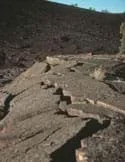 This rock surface is broken from tensional stress. You can tell because it looks like it is being pulled apart.Copyright National Park Service http://www.nps.gov/crmo/glossary/pressure-ridge.jpg
To experience the three types of material stress related to rocks—tensional, compressional and shear—students break bars of soap using only their hands. They apply force created by the muscles in their own hands to put pressure on the soap, a model for the larger scale, real-world phenomena that forms, shapes and moves the rocks of our planet. They also learn the real-life implications of understanding stress in rocks, both for predicting natural hazards and building safe structures.
Geotechnical engineers are concerned with the properties of earth materials. Their understanding of how rock behaves under stress is important for safety in our modern world. Engineers investigate above and below ground rock and soil to determine its characteristics, and then design foundations for human-made structures, such as bridges and stadiums. Their expertise helps build secure foundations for structures such as footings, piles, drilled piers and retaining walls. Their knowledge assures well-built dams, embankments, levees, mines and tunnels—all structures built with or in rocks and soil. Engineers also apply their expertise to assess the natural hazards risk to humans, property and the environment.
After this activity, students should be able to:
- Describe stress as it relates to materials, such as rocks.
- Identify and distinguish between the three types of stress.
- Describe why engineers must understand the properties of earth materials.
- Predict and evaluate the movement of an object by examining the forces applied to it
Grade 8
Do you agree with this alignment?
- STEL-2N Illustrate how systems thinking involves considering relationships between every part, as well as how the system interacts with the environment in which it is used.
Grades 6-8
Do you agree with this alignment?
Each group needs:
- 1 regular-size bar of Ivory soap (Ivory is soft enough to break easily)
- Soapy Stress Worksheet (PDF), one per student
- plus, a few spare bars of soap available, in case they are needed
Students should have some familiarity with stress and its three different types. See the Rock Solid lesson in the Rock Cycle unit for an introduction to rocks and stress; as a review, show students that lesson's Rock Solid Introduction (PPT) PowerPoint® file.
Rocks cover the entire earth, and we need to know how they break. Who can tell me why? If we know how rocks break, then we can predict many types of natural hazards, which can, in turn, save structures or even our lives. Also, because we live on the earth and build structures on and in the earth, we need to know about how rocks break. Geotechnical engineers know all about rocks in the earth's crust. They know how to identify different rocks, and determine if a certain rock is likely to break. They do tests and simulations to predict volcanoes, earthquakes or rockslides. Geotechnical engineers also need to know how rocks break so that other engineers can excavate or dig into them to build the deep foundations or basements of buildings such as parking garages, bridge piers or skyscrapers.
Do you know how rocks break? Well, rocks break from stress. Stress is when pressure is applied to an area, such as a rock. There are three types of stress. Compressional stress is when something is pressed together, like when mountains form. Tensional stress is when something is pulled apart, like when a ridge such as the Mid-Atlantic Ridge is formed. Shear stress is when something is pulled one way on one side and the other way on the other side, like the San Andreas Fault.
Now that we've reviewed how rocks break, let's demonstrate these types of stresses ourselves! Using our own hands, do you think we could create enough stress to break a rock? Probably not! What are some things that we can break with our hands? Soap is a good model because with it, we can show the three different types of stress. Since we are not strong enough to break rocks, we can imagine that the bars of soap are rocks, and break them in different ways.
Before the Activity
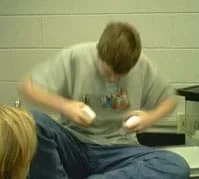 Figure 1: Pulling soap apart using tensional stress.Copyright 2005 Megan Podlogar, ITL Program, College of Engineering, University of Colorado Boulder
- Gather materials and make copies of the Soapy Stress Worksheet (PDF).
With the Students
- Review the three types of stress with the class. Conduct the pre-activity assessment activity as described in the Assessment section.
- Divide the class into teams of three students each.
- Pass out one bar of soap to each group.
- For each demonstration, have one team member break the soap (for example, see Figure 1). Rotate this student role for each demonstration.
- Ask the class how they might demonstrate tensional stress using a bar of soap.
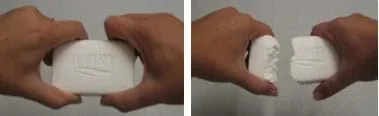 Figure 2. Using tension (pulling apart movement) to break a bar of soap.Copyright 2005 Megan Podlogar, ITL Program, College of Engineering, University of Colorado Boulder
- Tell the teams to have one person from each group try to pull a bar of soap apart with their hands, but tell them not to twist or bend, just pull (see Figure 2, see Troubleshooting Tips if problems pulling apart). Have students experiment and make observations, following along and completing their worksheets as they go.
- Ask the class how they might demonstrate compressional stress using a piece of soap.
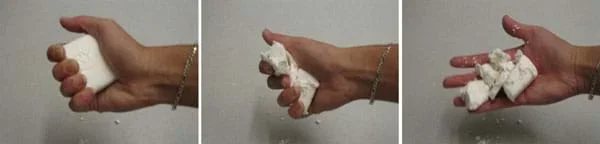 Figure 3. Using compression (pressed together pressure) to break soap.Copyright 2005 Megan Podlogar, ITL Program, College of Engineering, University of Colorado Boulder
 Figure 4. Pushing soap together.Copyright 2005 Megan Podlogar, ITL Program, College of Engineering, University of Colorado Boulder
- Tell the teams to have one person from each group use one of the smaller pieces that resulted from the tensional demonstration, and press or squeeze it into smaller pieces, using either one (see Figure 3) or two hands (see Figure 4). Have students experiment and make observations, completing their worksheets as they go.
- Ask the class how they might show shear stress using a piece of soap.
- Instruct the class to have the third team member from each group break a piece of soap by pushing one way with his/her left hand and the other way with his/her right hand (see Figure 5). Have students experiment and make observations, completing their worksheets as they go.
 Figure 5. Using shear stress to break soap. One hand pulls up, the other hand pulls down.Copyright 2005 Megan Podlogar, ITL Program, College of Engineering, University of Colorado Boulder
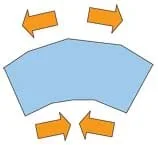 Figure 6. Bending the soap causes combination stresses, both tension and compression forces.Copyright 2005 Megan Podlogar, ITL Program, College of Engineering, University of Colorado Boulder
- Bonus Problem (optional, for more advanced students). Ask the class how they might show combination stresses using a piece of soap. Have students experiment and make observations, completing the bonus problem on their worksheets. (Clue: Try bending a bar of soap to cause both compressional and tensional stresses, see Figure 6.)
- If time permits, have students use their soap to demonstrate weathering and sedimentation of rocks, as described in the Activity Extensions section.
- Conclude by holding a class discussion to compare results. Conduct the post-activity journal-writing assessment as described in the Assessment section.
- compressional stress
- When something is being pressed together. Causes a rock to shorten.
- earth's crust
- (geology) The exterior surface of the earth.
- erosion
- Natural processes that wear away material. Includes weathering, dissolution, abrasion, corrosion and transportation.
- geotechnical engineer
- A person concerned with the engineering properties of earth materials. They investigate the soil and rock below ground to determine its properties, and then design foundations for human-made structures built on the ground, such as buildings or bridges. They design structures built in or of soil or rock. They also assess the risk to humans, property and the environment from natural hazards such as landslides, debris flows and rock falls.
- godel
- A small object that represents another, often larger object. Often used in testing or perfecting a final product.
- rock
- A naturally-formed aggregate of mineral matter constituting a significant part of the earth's crust.
- sedimentary rock
- (geology) A rock made by the deposition of sediment (small bits of old rock). Examples: sandstone, siltstone, limestone and shale.
- shear stress
- When something is being pulled one way on one side, and the opposite way on the other side. Causes rocks to slip past each other.
- stress
- Pressure applied to an area. The three types are compressional, tensional and shear.
- tensional stress
- When something is being pulled apart. Causes a rock to elongate, or pull apart.
- weathering
- Breaking down of rocks, due to such things as water, wind, acid rain and plants.
Pre-Activity Assessment
Matching: On the classroom board, randomly write the three types of stress on the left side, the definitions in the middle of the board, and arrow diagrams for each stress on the right side of the board (see Figure 8). As a class, have the students match the correct pieces together (see Figure 8).
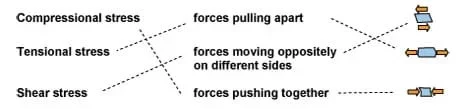 Figure 8. Example Matching pre-activity assessment activity.Copyright 2005 Megan Podlogar, ITL Program, College of Engineering, University of Colorado Boulder
Activity Embedded Assessment
Worksheet: Have students record their observations on the Soapy Stress Worksheet (PDF); review their answers to gauge their mastery of the subject.
Post-Activity Assessment
Journaling: Have students answer the following questions in a short paragraph:
- Today we demonstrated the three different types of stress. How would some of these stresses occur on a bigger scale in the natural world? (Possible answers: Tectonic plate movement, earthquakes, volcanoes, landslides, rockslides, rock falls, etc.)
- Why do geotechnical engineers need to understand stress in rocks? (Possible answers: To predict many types of natural hazards. To take steps to save structures and lives from natural disasters. To figure out the best way to excavate or dig into the earth and rocks, so we can construct deep foundations, retaining walls or basements for large structures such as bridges, dams, skyscrapers, stadiums and parking garages. To protect people from tunnel and mine cave-ins. Because we live on the earth and build structures on and in the earth.)
- Do not rub eyes after handling soap.
- Rinse hands after handling soap.
- Make sure to have spare bars of soap for groups that break their soap into pieces too small to continue.
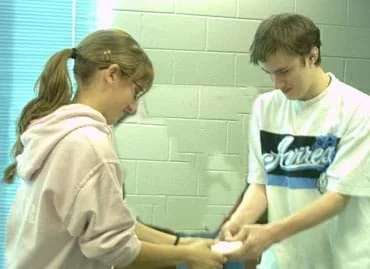 Figure 7. Pulling soap apart with two people.Copyright 2005 Megan Podlogar, ITL Program, College of Engineering, University of Colorado Boulder
- For the tensional demonstration, if students cannot break the soap by pulling it straight, have them try it with two people (see Figure 7). If they still cannot pull the soap apart straight, tell them to try bending it while pulling. Explain that the tensional stress is only present in the part of the soap that is being pulled apart. Bending the soap makes the top pull apart, while the bottom is pushed together. Where the soap is pushed together, there is compressional stress (see Figure 6). Bending the soap is an example of combination stresses (bonus problem).
Weathering Soap: Have students demonstrate weathering on their bar of soap by holding a sharp corner of the soap under running water. Over time, the sharp corner becomes rounded. Discuss how this is one way that a rock can be weathered by water—with an outcome of smoothing the rock. Have students seen examples of rocks weathered by water?
Sedimentary Soap: Have students attempt to create a sedimentary layer by smashing some of the small flakes of their soap together (compressional stress) to make a bigger piece of soap. Discuss how sedimentary rocks are made the same way, but from sediments instead of soap flakes.
Soap-Breaking Force: Ask students develop a way to compare or measure the amount of force needed for each type of stress in breaking of the soap. Have students think about which type of stress required the most force and how this relates to the amount of pressure needed to form different types of rocks.
Big Engineering Projects: Have students research the huge, human-made engineering projects currently under construction around the world right now, reporting to the class on what provisions were made to work with the site's natural earth, soil and rock conditions. To start, look at the Big Project Watch at the Civil Engineering Portal (http://www.icivilengineer.com/Big_Project_Watch/Big_Dig/) for links to amazing projects in progress around the world (tunnels, airports, river diversions, transportation systems, rail lines, highways, bridges, towers, sewer systems, irrigation systems, dams, tide barriers, nuclear waste repositories).
- For lower grades, break the soap yourself along with the students, so they can watch the teacher before attempting to do it themselves, ensuring that they do it successfully. Also, eliminate the combination stresses challenge and explanation.
- For upper grades, include a short discussion about the combination of stresses. Include this stress combination in the pre-activity assessment matching activity (see Figure 9). Also, make it a fourth challenge in the activity and require that students complete the worksheet Bonus Problem.
 Figure 8. Pre-activity assessment: combination stresses Matching diagram.Copyright 2005 Megan Podlogar, ITL Program, College of Engineering, University of Colorado Boulder
Big Project Watch. The Civil Engineering Portal, The Internet for Civil Engineers. Accessed April 19, 2006. http://www.icivilengineer.com/Big_Project_Watch/Big_Dig/
Dictionary.com. Lexico Publishing Group, LLC. Accessed April 19, 2006. (Source of some vocabulary definitions, with some adaptation)
Glasscoe, Maggi. Forces in the Earth. Updated August 13, 1998. The Southern California Integrated GPS Network (SCIGN) Education Model. Accessed April 19, 2006. (Excellent simple animation showing compressional, tensional and shear stress) http://scign.jpl.nasa.gov/learn/plate5.htm
Contributors
Megan Podlogar; Jacquelyn Sullivan; Malinda Schaefer Zarske; Denise W. Carlson
Supporting Program
Integrated Teaching and Learning Program, College of Engineering, University of Colorado Boulder
Acknowledgements
The contents of these digital library curricula were developed by the Integrated Teaching and Learning Program under National Science Foundation GK-12 grant no. 0338326. However, these contents do not necessarily represent the policies of the National Science Foundation, and you should not assume endorsement by the federal government.
Copyright
2006 by Regents of the University of Colorado