
Soil Core Sampling
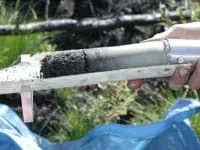 A soil core.Copyright USGS Soil Carbon Research, US Dept. of the Interior http://carbon.wr.usgs.gov/
Students learn about one method used in environmental site assessments. They practice soil sampling by creating soil cores, studying soil profiles and characterizing soil profiles in borehole logs. They use their analyses to make predictions about what is going on in the soil and what it might mean to engineers developing the area.
Geotechnical engineers are involved in environmental site assessments that analyze the impact of development on the land. To make recommendations based on soil quality, engineers drill small-diameter boreholes into the ground to collect soil samples. Soil is removed from boreholes in long clear tubes called soil cores. Soil cores permit engineers to examine many feet of the below-ground soil profile. Engineers use the soil cores to characterize the soil profile using borehole logs. They also take soil samples and further analyze them for characteristics, quality, water content, and pollutant or pesticide contamination.
After this activity, students should be able to:
- Describe how soil samples are taken by engineers for site assessment.
- Analyze a model soil core sample and make recommendations for development on similar areas of soil.
- 6.1.1.c.iv Find a percent of a quantity as a rate per 100.
Grade 6
Do you agree with this alignment? - 6.3.1.d.ii.2 Describe the nature of the attribute under investigation, including how it was measured and its units of measurement.
Grade 6
Do you agree with this alignment?
- CCSS.Math.Content.6.RP.A.3c Find a percent of a quantity as a rate per 100 (e.g., 30% of a quantity means 30/100 times the quantity); solve problems involving finding the whole, given a part and the percent.
Grade 6
Do you agree with this alignment? - CCSS.Math.Content.6.SP.B.5b Describing the nature of the attribute under investigation, including how it was measured and its units of measurement.
Grade 6
Do you agree with this alignment?
- Students will develop an understanding of engineering design.
Grades K-12
Do you agree with this alignment?
- MS-ETS1-1 Define the criteria and constraints of a design problem with sufficient precision to ensure a successful solution, taking into account relevant scientific principles and potential impacts on people and the natural environment that may limit possible solutions.
Grades 6-8
This resource focuses on the following Three Dimensional Learning aspects of NGSS:
Science & Engineering Practices- Define a design problem that can be solved through the development of an object, tool, process or system and includes multiple criteria and constraints, including scientific knowledge that may limit possible solutions.Do you agree with this alignment?
Disciplinary Core Ideas- The more precisely a design task's criteria and constraints can be defined, the more likely it is that the designed solution will be successful. Specification of constraints includes consideration of scientific principles and other relevant knowledge that is likely to limit possible solutions.Do you agree with this alignment?
Crosscutting Concepts- The uses of technologies and any limitations on their use are driven by individual or societal needs, desires, and values; by the findings of scientific research; and by differences in such factors as climate, natural resources, and economic conditions.Do you agree with this alignment?
- All human activity draws on natural resources and has both short and long-term consequences, positive as well as negative, for the health of people and the natural environment.Do you agree with this alignment?
Do you agree with this alignment? - Define a design problem that can be solved through the development of an object, tool, process or system and includes multiple criteria and constraints, including scientific knowledge that may limit possible solutions.
Each group needs:
- ruler
- 6-inch (15-cm) clear test tube, or any long, cylindrical object, so long as it is clear (so the soil layers can be seen), even plastic soda and water bottles with the top necks cut off
- Soil Core Worksheet (PDF), one per team
For the entire class to share:
- pipe cleaners or wire
- tape
- cardboard
- 1 cardboard box (or plastic box or bin), at least 30cm wide x 45cm long x 20 cm high, in which to layer soil types
- sand, such as playground sand
- gravel, such as pea-sized playground gravel
- soil, such as potting soil
- dirt
- clay
Note: Exact material quantities necessary for the activity will vary depending upon class size. Obtain enough materials to create a layered soil sample in the box.
Basic knowledge of rock and soil types.
What would happen if your house or this school was built on unstable soils? If part of the soil started sinking, the building might crack or move. Engineers help us make sure that buildings and other structures are built on stable soils, decreasing the risk of building failure due to unstable soil.
Before a restaurant, office tower, house, bridge or any other building is constructed, geotechnical engineers conduct environmental site assessments, which include soil tests, in the areas proposed for development. They examine soil samples to learn about the underground composition of the soils in the area, and make predictions of the long-term effects the soil at the site might have on the walls, foundation, septic system or any other components to the proposed structure. Some soils, such as clays, have a tendency to shrink and swell when their water content changes. This expansive property can put pressure on structure and foundation walls and cause them damage. Other soils are poor at settling or sinking under weight, causing uneven ground. Foundations that are built on these soils are at risk for cracking or bending.
How do you suppose they find out what type of soil is in the area? (Take suggestions from students.) They drill into the ground and look at the layers of Earth in the form of soil cores. A soil core is a vertical view (or soil profile) of everything below ground, contained in a long clear tube. The core tube contains soil that is removed from a hole drilled in the ground, or a borehole. In real life, each soil core is usually only several feet in length. However, the drill rig used to take the soil core can take more than one in the same place. For example, if a company was drilling a 20-ft (6-m) borehole, and each soil core tube was 3-ft (1-m) in length, the drill rig would take about seven soil cores during the drilling.
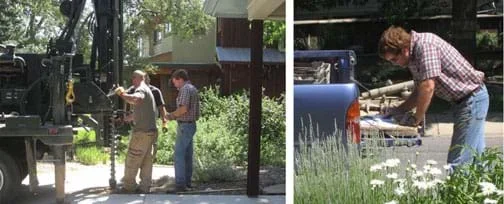 At this Colorado home, soil cores are taken to a depth of 25 feet (7.6 m) and examined to look for expansive bentonite clays before digging a basement and pouring a concrete foundation.Copyright 2008 Denise W. Carlson. Used with permission.
Soil cores are taken whenever someone needs to look at the properties and types of soil in an area. Environmental engineers may study soil cores to determine where the water table is located in the ground (for water resources), or how fast a chemical or contaminant spill has soaked into the ground during contaminant cleanup. These engineers can also tell how fast the contaminant is spreading through the different layers of Earth by taking multiple soil cores in and around an area and measuring the amount of contamination as it moves further away from the spill site.
Today, we are going to take soil cores from a sample piece of Earth and analyze the different soils in our sample. We will use what we find to answer some questions about the area during a site assessment.
Before the Activity
- Create a model piece of Earth by filling a box (or bin) to approximately 6-8 inches (15 cm) deep with layers of various soil materials. Start with a layer of clay or denser soil at the bottom of the box, so that the rest of the layers stay in the test tube when removed. (The clay or dense/damp soil acts as a stopper for the test tube.) A suggestion: At the bottom, start with one-inch (2.5-cm) layers each of clay, then dirt. Then alternate layers of the rest of the materials on top of them.
- Gather the rest of the materials and make copies of the Soil Core Worksheet (PDF), one per team.
With the Students
- Divide the class into teams of two students each.
- Distribute one worksheet and one clear test tube to each group.
- Explain to students that as engineers, they will be taking a soil core form the box of Earth that you have created. They start by using wire, tape and cardboard to create a device (with a handle and wedge) to help them insert the test tube into the soil. (Engineers design tools all the time!)
- Give the students 30 minutes to design and build their test tube inserting devices. Have them follow along with this process on their worksheet.
- Guide students to discuss and evaluate their tool design. How will they evaluate their tool design? What criteria? Did their tool work effectively? Is it a good size? How long does it take to use the device? Was it strong enough? Did it break? Etc.
- Next, have student teams take turns retrieving a soil core from the box. Have them return to their seats and complete the analysis portion of their worksheets by filling out the borehole logs while examining their test tube samples. A borehole log (see Figure 1) is what soil engineers use to describe soil cores so that they have a written record of what the inside of a borehole looks like, so they do not need to take the actual sample back to the office.
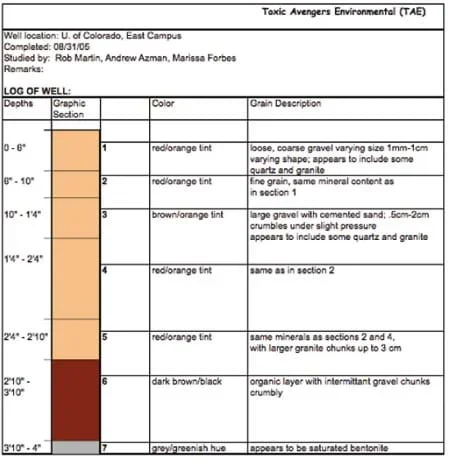 Figure 1. Example completed borehole log.Copyright 2006 ITL Program, College of Engineering, University of Colorado Boulder
- Have students measure each layer of their soil cores, visually representing them in the Graphic Section columns of the borehole logs, as well as describing in words each layer's color and grain. Also direct students to calculate the fraction (percentage) of the soil that was composed by each layer.
- Have students complete the questions at the bottom of the worksheets, imagining that they are engineers doing a site assessment for a development company.
- Lead a class discussion to review the students' analysis. What would they change if they were to redesign their sampling device/tool? Would they recommend constructing a housing community on this type of soil? Why or why not? (Answers will vary, depending on the model's soil composition.)
- Conclude by conducting the post-activity assessment activity described in the Assessment section.
- borehole
- A hole drilled in the ground.
- borehole log
- A method of detailing a soil core profile.
- drill rig
- Equipment used to make a hole in the ground.
- model
- (noun) A representation of something, sometimes on a smaller scale. (verb) To simulate, make or construct something to help visualize or learn about something else (such as a machine, structure, process or system), often something that cannot be directly observed or experimented upon.
- soil core
- Tube containing soil removed from borehole during drilling process.
Pre-Activity Assessment
Discussion: Have students engage in open discussion about the different types of rocks and soils that they have learned about. Why might an engineer need to know about the type of rocks or soil in an area?
Activity Embedded Assessment
Worksheet: Have student teams complete the attached Soil Core Worksheet (PDF); review their answers to gauge their mastery of the subject.
Post-Activity Assessment
Roundtable: Have the class form into teams of 3-5 students each. Ask the class a question with several possible answers. Have students on each team make a list of answers by taking turns writing down ideas on a piece of paper. Students pass the list around the group until all ideas are exhausted. Have teams read aloud the answers and write them on the board. Ask the students:
- What are properties of soil that you can learn from a soil core sample? (Possible answers: Color, density, porosity, type of soil, water content, rock and mineral content and sizes, presence of pollutants or contaminants, etc.)
- Why are soil core samples useful to development of an area? (Possible answers: To determine what type of foundation material to use, know how deep to build, find hazards or obstacles to development in the area, predict the impact on the environment from building, make sure contaminants are not present, etc.)
- How do engineers use soil core samples? (Possible answers: To determine the type of soil, make recommendations for foundations, locate underground water resources, look for contaminants, etc.)
Be sure students do not push their test tubes into the soil with too much force; they may break.
Test tube soil sampling is less messy if the lowest layers of the model box of Earth are made of clay and/or dense/damp soil, as opposed to sand or gravel.
Have each team write letters to (hypothetical) development companies describing the findings from their borehole logs. What did the borehole log tell them about the soil in that area? What recommendations would they make to a development company who was planning to create a housing development on that piece of land?
Have students calculate the amount of soil each layer would occupy if the total soil core was 10 meters instead of 15 cm. How far down would the clay layer start?
Environmental engineers use soil cores to analyze the presence and spread of pollution contamination in soils and groundwater. For an activity that has students look at a contaminant plume in groundwater, see Groundwater Detectives.
Have students think about the water table in their soil sample. At what depth do they think the water table might be found? Add moisture to some soil core layers to show moisture. (Soil cores should be moist from bedrock up to the top of the water table. Depth to the water table, or DTW, from the surface always varies by location.)
The Tower of Pisa is a widely-recognized foundation failure. Extend this activity with A Good Foundation lesson and Shallow and Deep Foundations activity in the Bridges unit, in which students explore the effects of regional geology on bridge foundation, including the variety of soil conditions found beneath foundations. They learn about shallow and deep foundations, as well as the concepts of soil profiles, bearing pressure and settlement.
For lower grades, do not require completion of fractions calculations on the worksheet. And, complete the worksheet results questions (Part 3) together, as a class discussion.
Contributors
Marissa Hagan Forbes; Malinda Schaefer Zarske; Denise W. Carlson
Supporting Program
Integrated Teaching and Learning Program, College of Engineering, University of Colorado Boulder
Acknowledgements
The contents of these digital library curricula were developed by the Integrated Teaching and Learning Program under National Science Foundation GK-12 grant no. 0338326. However, these contents do not necessarily represent the policies of the National Science Foundation, and you should not assume endorsement by the federal government.
Copyright
2008 by Regents of the University of Colorado