
Rock Solid
Rocks cover the earth's surface, including what is below or near human-made structures. With rocks everywhere, breaking rocks can be hazardous and potentially disastrous to people. Students are introduced to three types of material stress related to rocks: compressional, torsional and shear. They learn about rock types (sedimentary, igneous and metamorphic), and about the occurrence of stresses and weathering in nature, including physical, chemical and biological weathering.
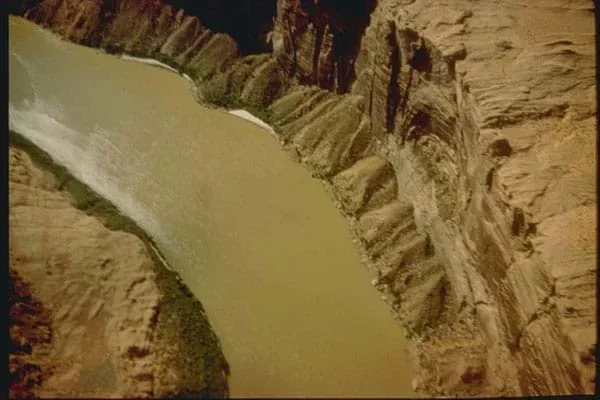 Talus Cones in Glen Canyon, AZ. This formation was made from rock falls, which are when weathering breaks rocks from the surface of a cliff.Copyright NOAA http://www.ngdc.noaa.gov/seg/cdroms/geohazards_v3/document/647006.htm
Geotechnical engineers study rocks in the earth's crust. They conduct tests and simulations to predict volcanoes, earthquakes and rockslides. To avoid potential disasters that might occur if rocks fail, engineers routinely apply their understanding of rocks and soils prior to the construction of complex and costly structures such as airports, roads, dams, skyscrapers and tunnels. They identify underground rock types and predict their behavior under stress, as well as determine the best way to excavate them as part of the construction process.
After this lesson, students should be able to:
- Describe the basic ideas of stress.
- List the three different types of weathering.
- Explain that not all rocks break the same way or with the same amount of pressure.
- Describe how engineers are able to evaluate the strength of rocks.
- Develop a model of the rock cycle
- Predict and evaluate the movement of an object by examining the forces applied to it
Grade 8
Do you agree with this alignment? - Gather, analyze, and communicate an evidence-based explanation for the complex interaction between Earth's constructive and destructive forces
Grade 6
Do you agree with this alignment?
- STEL-7S Create solutions to problems by identifying and applying human factors in design.
Grades 6-8
Do you agree with this alignment?
- MS-ESS2-1 Develop a model to describe the cycling of Earth's materials and the flow of energy that drives this process.
Grades 6-8
This resource focuses on the following Three Dimensional Learning aspects of NGSS:
Science & Engineering Practices- Develop and use a model to describe phenomena.Do you agree with this alignment?
Disciplinary Core Ideas- All Earth processes are the result of energy flowing and matter cycling within and among the planet's systems. This energy is derived from the sun and Earth's hot interior. The energy that flows and matter that cycles produce chemical and physical changes in Earth's materials and living organisms.Do you agree with this alignment?
Crosscutting Concepts- Explanations of stability and change in natural or designed systems can be constructed by examining the changes over time and processes at different scales, including the atomic scale.Do you agree with this alignment?
Do you agree with this alignment? - Develop and use a model to describe phenomena.
What Makes Up Rocks?
Knowing what makes up rocks might help us understand their strength. Rocks are made of minerals. Rocks are classified into different types, depending upon their mineral composition and formation. First let's look at minerals.
A mineral is a solid material that exists naturally on earth, and is made of only one substance. Most minerals are made up of crystals, which are solid, 3D patterns made by the molecular structure. There are hundreds of different minerals, and they are classified by their chemical makeup and crystal shape. Some familiar minerals include: gold, silver, platinum, mercury, sulfur, graphite, mercury, diamond, talc, halite (table salt), calcite, galena (lead), magnetite, hematite, quartz and mica.
Minerals can be identified by conducting a series of tests, and comparing the results to charts of known mineral characteristics. The tests include finding their color, streak (the color of the mark they leave when you rub them on something), transparency, hardness, luster (shininess), cleavage (the specific way that they break) and crystal shape. Students can further investigate these properties with the associated activity Rocks, Rocks, Rocks: Test, Identify Properties & Classify.
What is the difference between a rock and a mineral? Rocks are made of two or more minerals. For example granite, a very common rock, is made of the minerals, feldspar, quartz, mica and hornblende, which can actually be distinctly seen in granite (see Figure 3).
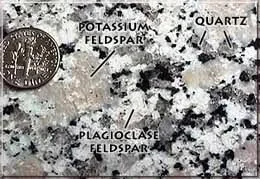 Figure 3. The minerals that compose some rocks, like granite, are distinct and easily visible.Copyright U.S. Geological Survey http://geology.wr.usgs.gov/docs/usgsnps/rxmin/rock.html
How are Rocks Made?
Besides its mineral components, a rock type is also determined by the way it was formed. The three basic ways that rocks are made are grouped as the three rock families: sedimentary, igneous and metamorphic.
- Sedimentary rocks are made of sediments (small bits of old rock). Sediments come from the weathering and erosion of old rocks. Weathering is how rocks are broken down, usually from influences such as water and air. Erosion is the breaking down and movement of parts of the earth's surface (weathering is a type of erosion). Once sediments are broken apart from weathering and erosion, then pressure pushes them together (called compaction) to make a layer of rock. Cementation also holds sediments together, which is when salts crystallize as water is squeezed out. Later, other sediments get pushed into another layer of rock and eventually the layering, or bedding, continues to make one bigger rock. This process creates layers that are characteristic to sedimentary rocks (see Figure 4). Some common sedimentary rocks are sandstone, siltstone, limestone, conglomerate and shale.
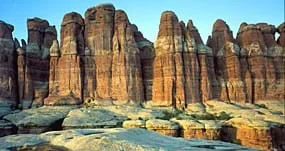 Figure 4. Bedding, or layers, are characteristic to sedimentary rocks, such as those at Sandstone Needles in Canyonlands National Park, UT.Copyright National Park Service http://www.nps.gov/cany/needles/
- Igneous rocks are made of magma, which is molten rock (old rock that has been melted from pressure and heat under the earth's crust). Magma is called lava after it comes out of the crust (for example, when it comes out of a volcano). When the liquid magma or lava cools, it becomes hard, forming an igneous rock. The name "igneous" comes from the Latin word "ignis," which means fire. Different types of igneous rocks are formed if they cool slowly below the earth's surface (called intrusive) or quickly above the earth's surface (called extrusive). Some common igneous rocks are basalt, gabbro, granite (see Figure 3), pumice and obsidian.
- Metamorphic rocks are formed from any type of existing rock. Pressure and heat change the actual molecules of a rock's minerals so that it becomes an entirely different rock (without melting, which would make it an igneous rock). The type of metamorphic rock formed depends on what type of rock it started out as. Foliation is when the pressure squeezes the minerals in a rock to create lines or layers. Foliation is a typical metamorphic rock characteristic (see Figure 5). Some common metamorphic rocks are gneiss, slate, marble and schist.
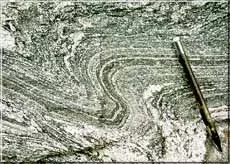 Figure 5. Foliation, which is when minerals are squeezed into lines, is characteristic to metamorphic rocks, like this gneiss.Copyright Edward P. Klimasauskas, U.S. Geological Survey http://wrgis.wr.usgs.gov/docs/usgsnps/rxmin/rock3.html
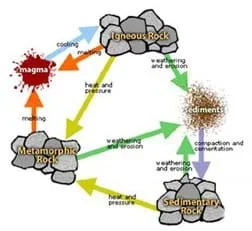 Figure 6. Rock cycle. All new rocks are created from old rocks. Different rock types depend on their forming process.Copyright U.S. Geological Survey http://www.cr.usgs.gov/rtr/2004/2004ppt/slide4.htm
Rock Cycle
You may have noticed in learning about the different rock families that all new rocks are made from old rocks. This is the idea behind the rock cycle (see Figure 6). For example, under certain geophysical processes, a metamorphic rock can be formed from a sedimentary and/or igneous rock. Likewise, all rocks can become every other type of rock given the right circumstances. The rock cycle describes the processes that allow the creation of new rocks from old rocks. [See the Develop Your Own Rock Cycle Worksheet (PDF) that allows students to develop their own rock cycle].
(Optional: Introduce the lesson using the Rock Solid Introduction (PPT) PowerPoint presentation. Use the written text below as a script, with each idea correlating to one slide.)
We see rocks outside everyday, in both landscaping and nature. In fact, the entire earth is basically one gigantic rock! The earth's crust is entirely made of solid rocks, so there are huge rocks in the ground covering the entire planet! We cannot see many of these rocks. Sometimes dirt covers them and we must dig very deep to find them, but huge rocks cover the entire earth's crust, even under the oceans. That means that all of our buildings, all of our bridges, all of our roads, and even your home, are sitting on rock.
What might happen if some of these huge rocks broke? What types of natural disasters might be caused? What would happen to the bridge or skyscraper resting upon one of those massive rocks? These are questions that geotechnical engineers think about when determining locations to place structures. Geotechnical engineers understand what causes rocks to break. They know how to identify different types of rocks, and determine if a certain rock is likely to break. They work with structural engineers to plan the best way to build structures in different rock conditions.
Why Care about the Strength of a Rock?
The most important reason why we care about the strength of a rock is that when a large rock breaks, it can be a hazard and possibly cause a disaster. There are many different disasters caused by breaking rocks, including earthquakes, tsunamis, volcanoes, rock falls, and landslides. To protect structures and people, we want to be able to predict or prevent such disasters. If an engineer knows the characteristics of a particular rock type, she may be able to predict or prevent disasters.
Furthermore, a less serious reason why we care about the strength of rocks is for development, which means building and expanding the use of land (such as new shopping centers, schools or homes being built in a town). Many building plans require deep foundations, making it necessary to excavate or dig out rock. An engineer provides information about the best way to excavate the rock, so as to build an adequate foundation.
What Can Break Rocks?
When pressure is applied to an area, such as a rock, it is called stress. If you press your hands together, you can feel the forces of stress. In nature, stress can cause rocks to break, and one way that stress occurs is by the natural movements of the earth's crust (remember that the earth's crust is basically floating on liquid magma, and so it moves often). Refer to the associated activity Soapy Stress for a fun and hands-on approach to learn more about stress! There are three types of stress (see Figure 1).
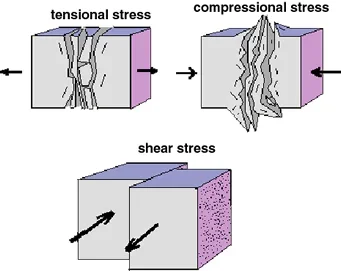 Figure 1. Three types of stresses in rocks.Copyright Michael Kimberly, North Carolina State University, U.S. Geological Survey http://earthquake.usgs.gov/learning/glossary.php?termID=191&alpha=S
Compressional stress is when a rock is pressed together into itself, like when crust movements cause two rocks to squeeze another one between them. Another example is when mountains are formed at a convergent boundary, like the Rocky Mountains. Press your hands together again. You can feel that the inner parts of your hands are being smashed by compressional stress from the muscles in your hands pushing inward.
T ensional stress is when a rock is pulled apart. For example, if a rock wedged itself into the crack of another rock, and movement of the earth's crust caused it to wedge even further until the rock broke apart. Another example is a divergent boundary, like the Mid-Atlantic Ridge, which is formed by two tectonic plates pulling apart from each other to allow lava to flow upward. Use one of your hands to pull a finger on your other hand. You can feel the tensional stress because your hand is pulling your finger one way, and your other hand is attached to your finger, pulling it the other way by holding it in place.
Shear stress is when a rock is pulled on one side but pushed on the other side. This can happen if the crust movements on one side of a rock are opposite of those on the other side of the rock. An example of this is the San Andreas Fault, which is on a transform boundary, with the California plate moving southward and the Pacific Ocean plate moving northward. Put your hands together again, but this time press upward with your right hand and downward with your left hand. If you press hard, you should notice that the skin on your right hand is being pulled down because of the forces from your left hand pulling down, and the skin on your left hand is being pulled up because of your right hand. (It may be easier to see the skin being pulled if you use an area on your body where the skin is looser, such as your hand pressing upward against your arm or cheek.)
In addition to stress due to the movement of the earth's crust, stress can come from weathering. Weathering is the breaking down of rocks into sediments (small bits of rock), due to conditions in nature. There are many types of weathering:
- Physical weathering is when a physical action breaks the rock, such as the forces of wind or water. A common example is the freeze/thaw action of water in rock cracks. As the water freezes, it expands, causing stress (pressure) that breaks the rock. (Note: If students ask what kind of stress this is, tell them that the process is complicated and includes both tensional and compressional stress.)
- Chemical weathering is when the rock is chemically broken down. Some common examples of this are rust forming on granite or acid rain breaking down limestone. This type of weathering is not considered a type of stress because there is no pressure on the rock (remember that stress is pressure applied to an area).
- Biological weathering is when living organisms break the rock. A typical example is a tree root breaking a rock due to the stress caused by its pressure. (Note: If students ask what kind of stress this is, tell them that the process is complicated and includes both tensional and compressional stress.)
So, rocks in the earth are usually broken by either the stress from the movement of the crust or the stress from weathering.
Upon What Does the Strength of Rock Depend?
Not all rocks break from the same amount of pressure. Some rocks are easier to break than others. The strength of a particular rock depends on that rock's type, texture and chemical composition. It also depends on the presence or absence of fluids, or if there are internal structures.
Sometimes, it is possible to predict where a rock will break. Rocks often break along a plane of weakness, which is the weakest part of the rock's structure. Sedimentary rocks have planes of weakness along their bedding planes, or between the layers of sediment. Metamorphic rocks have planes of weakness along their foliation planes, which are layers or stripes formed from pressure. Observing these aspects helps us predict where a rock will break!
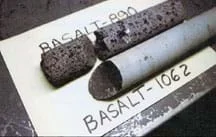 Figure 2. Geotechnical engineers drill to get rock core samples like these so that they can make observations and perform tests.Copyright Geological Survey http://capp.water.usgs.gov/gwa/ch_h/H-Pliocene1.html
How Do Engineers Find the Strength of a Rock?
To discover all the factors that determine whether a rock might break, engineers use certain methods and equipment. They examine the rock's texture and structure. They drill to get rock samples, called core samples (see Figure 2). They test the sample's response to stress using special (and expensive) machinery. As a side note, one problem with testing samples is that rocks are not homogeneous, meaning one sample's response to the test may not necessarily be identical to the response of another sample taken elsewhere. After an engineer has fully examined and tested a rock, she gives it a safety factor for others to consider when building near the rock.
So, why do we care about how rocks break? Rocks make up all of the earth's crust. It is natural for rocks to break, depending upon the stresses on them. When designing structures, engineers carefully examine the underground and above ground rocks before they build roads, homes or towers. How do we know if an area of land is safe to build around? Engineers identify rocks by close examination and testing samples under stresses. Since different rocks have different strengths, engineers can estimate how much stress a particular rock can handle.
In this lesson, we learned about what knowledge geotechnical engineers use to hypothesize about rocks. We learned that rocks break from stress, which can come from the earth's crust moving or weathering. We also learned that whether or not a rock breaks depends on many factors, and we can sometimes guess a rock's plane of weakness. Now that we know all this, we can predict if and how a rock might break, just like a geotechnical engineer!
- compressional stress
- When something is being pressed together.
- earth's crust
- (geology) The outer layer of the earth.
- erosion
- Natural processes that wear away material. Includes weathering, dissolution, abrasion, corrosion and transportation.
- geotechnical engineer
- A person concerned with the engineering properties of earth materials. They investigate the soil and rock below ground to determine its properties, and then design foundations for human-made structures built on the ground, such as buildings or bridges. They design structures built in or of soil or rock. They also assess the risk to humans, property and the environment from natural hazards such as landslides, debris flows and rock falls.
- homogeneous
- Uniform in structure or composition throughout.
- igneous rock
- (geology) A rock made of cooled magma (or lava), which is molten rock melted from pressure and heat under the earth's crust.
- metamorphic rock
- (geology) A rock formed from any type of existing rock, in which minerals are changed in structure or composition by pressure and heat. Examples: basalt, granite, pumice and obsidian.
- mineral
- A naturally-occurring, homogeneous inorganic solid substance having a specific chemical composition and characteristic crystalline structure, color and hardness. Examples: gold, silver, platinum, sulfur, graphite, diamond, talc, quartz and mica.
- plane of weakness
- An area of the weakest part of a rock's structure.
- rock
- A naturally-formed aggregate of mineral matter constituting a significant part of the earth's crust.
- rock cycle
- All new rocks are created from old rocks. Different rock types depend on their forming process.
- rock falls
- A fall of rocks, as from a cliff. Often caused by weathering.
- sedimentary rock
- (geology) A rock made by the deposition of sediment (small bits of old rock). Examples: sandstone, siltstone, limestone and shale.
- shear stress
- When something is being pulled one way on one side, and the opposite way on the other side.
- stress
- Pressure applied to an area. The three types are tensional, compressional and shear.
- tensional stress
- When something is being pulled apart.
- weathering
- Breaking down of rocks, due to such things as water, wind, acid rain and plants.
Pre-Lesson Assessment
Brainstorming: As a class, have students engage in open discussion. Remind them that in brainstorming, no idea or suggestion is "silly." All ideas should be respectfully heard. Take an uncritical position, encourage wild ideas and discourage criticism of ideas. Have students raise their hands to respond. Write their ideas on the board. Ask the students:
- Of what material(s) is the earth's crust made? (Possible answers: Rocks, dirt, etc.)
- How do rocks break in nature? (Possible answers: Pressure, running water, freezing water, plant roots, weathering, rocks falling on rocks, actions of people.)
- How would the breaking of a large rock affect people? (Answer: Lead students to the idea of earthquakes, structures falling, tunnel or foundation collapsing, volcanoes, rockslides, etc.)
Post-Introduction Assessment
Voting: Ask a true/false question and have students vote by holding thumbs up for true and thumbs down for false. Tally the votes and write the totals on the board. Give the right answer.
- True or False: Under the ocean's floor, there are large rocks. (Answer: True. Large rocks cover the entire earth's crust, including under the oceans.)
- True or False: Geotechnical engineers study buildings and how they stand. (Answer: False. They study rocks and the earth.)
- True or False: Geotechnical engineers can guess if a rockslide might occur at a certain location. (Answer: True. These engineers know how to identify rocks and the ways they can break.)
Lesson Summary Assessment
Worksheet: Have students complete the Rock Solid Worksheet (PDF); review their answers to gauge their mastery of the subject.
Drawing: Have students draw a picture of each of the different types of stress. Ask them to draw arrows that show which way the pressure is acting and identify each type of stress. Have them draw another picture illustrating their choice of any example of weathering.
Conduct the Adventure Engineering unit, Asteroid Impact, an 8-lesson unit in which student teams are posed with the scenario of an impending earth-crashing asteroid. They must design the location and size of underground caverns to save people from an earth that will be uninhabitable for one year. Student teams explore general and geological maps, determine the area of their classroom to help determine the cavern size required, learn about map scales, test rocks, identify important and not-so-important rock properties for underground caverns, and choose a final location and size.
Show students the attached Rock Solid Introduction (PPT) PowerPoint slide presentation.
Dictionary.com. Lexico Publishing Group, LLC., www. dictionary.com, accessed April 19, 2006. (Source of some vocabulary definitions, with some adaptation)
Fletcher, Kristin and Hodges, M.K.V. Earth Materials and Earth Cycles, Module 2, Part 1 Environmental Geology. Department of Geology, Idaho State University, http://wapi.isu.edu/envgeo/EG2_earth/EG-mod_2_prt1.htm, accessed April 19, 2006.
Geologic Hazards Slides, Volume 3 – Landslides, Tsunamis and Volcanoes. National Geophysical Data Center, National Oceanic and Atmospheric Association. Accessed April 24, 2006. http://www.ngdc.noaa.gov/
Glasscoe, Maggi. Forces in the Earth. Updated August 13, 1998. The Southern California Integrated GPS Network (SCIGN) Education Model. Accessed April 19, 2006. (Excellent simple animation showing compressional, tensional and shear stress) http://scign.jpl.nasa.gov/
Minerals Lesson. Volcano World, University of North Dakota, http://volcano.und.nodak.edu/vwdocs/vwlessons/Minerals/Minerals2.html, accessed April 19, 2006.
Rock Cycle and Rock Cycle Answers. Moorland School, Clitheroe, Lancashire, UK, http://www.moorlandschool.co.uk/earth/rockcycle.htm, accessed April 19, 2006.
Rocks, USGS Geology in the Parks. Updated January 13, 2004. U.S. Geological Survey, U.S. Department of the Interior. Accessed April 19, 2006. http://geology.wr.usgs.gov/
Contributors
Megan Podlogar; Jacquelyn F. Sullivan; Malinda Schaefer Zarske; Denise W. Carlson
Supporting Program
Integrated Teaching and Learning Program, College of Engineering, University of Colorado Boulder
Acknowledgements
The contents of this digital library curriculum were developed under a grant from the Fund for the Improvement of Postsecondary Education (FIPSE), U.S. Department of Education and National Science Foundation GK-12 grant no. 0338326. However, these contents do not necessarily represent the policies of the Department of Education or National Science Foundation, and you should not assume endorsement by the federal government.
Copyright
2006 by Regents of the University of Colorado.