
Making & Breaking: The Rock Cycle
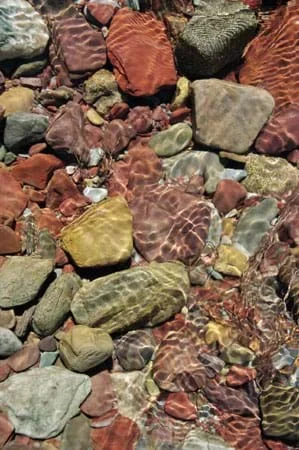 Students examine the rock cycle.Copyright 2004 Microsoft Corporation, One Microsoft Way, Redmond, WA 98052-6399 USA. All rights reserved.
Students learn the components of the rock cycle and how rocks can change over time under the influence of weathering, erosion, pressure and heat. They learn about geotechnical engineering and the role these engineers play in land development, the design and placement of new structures and natural disaster detection.
Geotechnical engineers belong to a branch of civil engineering; these engineers study the rocks and minerals in the earth's crust. They understand the rock cycle and the effects that a change in environment, including heat and pressure, might have on different rocks and soils. They use their knowledge to create technologies to help predict natural hazards, such as landslides and earthquakes, as well as assess the impacts and risks to humans associated with the development of housing and industrial areas.
After this lesson, students should be able to:
- Draw a complete, labeled diagram of the rock cycle.
- Explain why engineers must know about rocks when developing land or designing new structures.
- Geologic time, history, and changing life forms are indicated by fossils and successive sedimentation, folding, faulting, and uplifting of layers of sedimentary rock
Grade 7
Do you agree with this alignment?
- DCI.ESS2.A.6-8.4 All Earth processes are the result of energy flowing and matter cycling within and among the planet's systems. This energy is derived from the sun and Earth's hot interior. The energy that flows and matter that cycles produce chemical and physical changes in Earth's materials and living organisms.
Grades 6-8
Do you agree with this alignment?
Students should be familiar with the different types of stress and weather related to rocks, as presented in the Rock Cycle unit, lesson 1: Rock Solid.
The rock cycle explains the series of changes that rocks go though as they slowly are altered from one form into another. Key concepts for students to understand are that the rock cycle is a slow and continuous process, occurring over thousands of years, and that rocks change from one form to another under heat, weathering, erosion, melting, cooling, pressure, compaction and cementation.
The rock cycle is a continuous series of steps. For example: when igneous rock undergoes weathering and erosion it becomes sediment. Then, when that sediment undergoes compaction and cementation it becomes sedimentary rock. If that sedimentary rock becomes pressed together by heat and pressure, it can turn into metamorphic rock. Metamorphic rock, when it undergoes melting, becomes magma. That magma, when it cools, can become igneous rock—and the cycle continues!
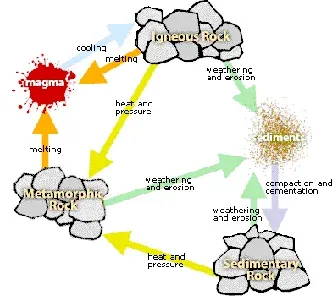 The Rock Cycle.Copyright US Department of Agriculture http://www.nj.nrcs.usda.gov/partnerships/envirothon/soils/images/rockcycle.gif.
In addition to going around the circle, changes in rocks can also occur across the circle—igneous rock can become metamorphic rock under heat and pressure, and metamorphic rock can become sediment under weathering and erosion.
While these concepts are fairly straightforward, it is worth taking the time to make sure that students can both draw the diagram of the rock cycle and explain the different steps. Additionally, you may need to review with the students the different processes that occur in the cycle: heat, pressure, melting, cooling, weathering, erosion, compaction and cementation. Refer to the Vocabulary/Definitions section and lesson 1 of this unit for explanations of several of these terms.
Today we are going to learn more about something that you walk over every day—rocks! To get started, can anyone tell my why engineers need to know about rocks? Engineers must know about rocks, how they are formed, and how strong they are so that they can design safe buildings, tunnels and bridges for us. Engineers also use their knowledge of rocks to help determine and prevent natural disasters to humans from rock falls, landslides and earthquakes. These natural hazards can all be caused by breaking rocks.
How are rocks made? Can they change over time? This can be explained by understanding the rock cycle. Let's look at a diagram of the rock cycle together and talk about the different steps. (By paper handout or overhead projection, show students the rock cycle diagram in the Rock Cycle Handout-Overhead (PDF). Make sure they understand that the rock cycle continually repeats over many, many years.) The cycle of recycling aluminum cans is similar to how the rock cycle works. The same material is continuously changed, reformed and re-used.Copyright 2004 Microsoft Corporation, One Microsoft Way, Redmond, WA 98052-6399 USA. All rights reserved.
Weathering, erosion, cooling, melting, pressure, compaction, cementation, and heat are all factors that affect the breakdown and formation of rocks. Even though rocks seem so strong to us, they can be forced to change when their environmental conditions change. The three main types of rock can all change—igneous, sedimentary and metamorphic rock. All three types can be melted into magma under the earth's surface, which then hardens into igneous rock. Extreme heat or pressure can change rocks into metamorphic rocks. Rocks that are exposed to the atmosphere can undergo weathering and erosion to break into smaller pieces (sediment) that can be affected by pressure or cementation to form sedimentary rocks.
The rock cycle is a very slow cycle. Rocks might take a thousand years to change into another type of rock. In the rock cycle, rocks are continuously (although slowly) being changed from one form to another. The rock cycle proceeds in no particular order. For example, igneous rock can change into metamorphic or sedimentary rock over time, and metamorphic rock can become sedimentary or igneous.
Engineers use the rock cycle to help them understand the geology of region. Geotechnical engineers understand the rock cycle, what causes the rocks to break, and how a rock reacts when exposed to different environmental factors. These engineers are the people to contact when you want to develop a new area of houses or stores on land that has never been built upon before. These engineers are able to identify different types of rocks and soils in an area, and determine if the rocks may break if exposed to new forces, such as the pressure from vehicle traffic, structures and people. These engineers also study how changes to the area might cause unwanted side effects and risks to humans and property, such as landslides, unstable ground, and rock falls. In this way, they keep us safe by predicting and preventing natural hazards. Engineers must consider the environmental effects of their interactions with the earth and rocks, and how the addition of a structure or removal of some rocks might impact the stability of the area, increasing the risk of natural disasters and causing damage to structures over time. Following the lesson, students can play the fun game of Rock Jeopardy! through the associated activity to reinforce their understanding of rocks, the rock cycle and geotechnical engineering.
What have we learned today? What factors can affect rocks? What factors cause the breakdown and formation of rocks? (Collect answers from students: Weathering, erosion, cooling, melting, pressure and heat.) So basically, rocks can be forced to change when their environmental conditions change, and these changes can be described using the rock cycle. What is the order of the rock cycle? (Answer: The rock cycle goes in no particular order.) Explain to me how it works. (Answer: Rocks and minerals can go around the rock cycle in a circle, and changes to rocks can also occur across the circle. For example, igneous rock can become metamorphic rock under heat and pressure, and metamorphic rock can become sediment under weathering and erosion.)
Engineers use the relationships described in the rock cycle to help them understand the geology of an area of land. What do they want to find out? (Answer: Geotechnical engineers study the rock cycle, what causes rocks to break, and what reaction might occur when a rock is exposed to different environmental conditions, including heat and pressure.) Engineers use their knowledge of rocks and the rock cycle to create technologies to help predict and avoid causing natural hazards, such as ____________ and _______________ (Answers: landslides and earthquakes). They also evaluate the impacts and risks to humans and the environment that might be caused by our development of housing and industrial areas.
- cementation
- The act or process of cementing. Another part of how sedimentary rocks are formed is by sediment being glued together by natural glues such as calcite and silica. Compaction and cementation work together to create sedimentary rocks from sediment.
- compaction
- The act of pressing something together. Part of the way sedimentary rocks are formed is by sediment being compacted together.
- erosion
- The process by which the surface of the earth is worn away by the action of water, glaciers, winds, waves, etc.
- magma
- Molten rock inside of the earth.
- sediment
- Material deposited by wind, water or glaciers.
- weathering
- In geology, the various mechanical and chemical processes that cause exposed rock to decompose.
Pre-Lesson Assessment
Warm up Question: Write the following question on the classroom board and have each student take a moment to write down their own answer. Walk around, looking at what students wrote, marking their answers if correct, and gauging the class' understanding of the subject. Consider making the "correct" mark by using a rubber stamp and a colorful ink pad.
- Why do engineers need to know about rocks? (Possible answer: Because engineers must design strong foundations, structures, bridges and tunnels to keep us safe.)
Post-Introduction Assessment
Drawing: Ask students to draw the complete rock cycle, starting with blank paper. Remind them to include all the steps, and label all the arrows between the different parts of the cycle. Hint: Note the five main "stops" along the cycle, and nine arrows (as shown in the Rock Cycle Handout-Overhead (PDF)). Next, review the entire diagram as a class to make sure that everyone has all the parts drawn in and correctly labeled. Help students fill in any missing parts of their rock cycle diagrams and review the entire cycle with the class.
Class Voting: Ask a true/false question and have students vote by holding thumbs up for true and thumbs down for false. Tally the votes and write the total on the board. Give the right answer.
- True or False: Geotechnical engineers study the rock cycle. (Answer: True)
- True or False: The rock cycle can help engineers predict natural hazards. (Answer: True)
- True or False: All engineers use the rock cycle in their work. (Answer: False. Many engineers use the rock cycle, especially civil and geotechnical engineers. However, many other types of engineers do not use the rock cycle in their work.)
- True or False: Engineers use the properties of rocks to determine the best place to build a structure. (Answer: True)
- True or False: Geotechnical engineers determine the risks to humans, property and the environment from natural hazards. (Answer: True)
Lesson Summary Assessment
Where to Build It? Engage students in a discussion about how engineers use their understanding of the properties of rocks and the rock cycle when designing a structure, such as a house, a dam, or even a wind turbine. Have students look at the Rock Cycle Handout-Overhead (PDF). At what place on the rock cycle would provide the best conditions to build a structure? On sedimentary rock in an area that gets lot of rain? All rocks can change over time. As an engineer, what factors should you consider when choosing the best place to build a house? (Possible answers: Weather conditions, range of temperatures, types of rocks, etc.)
Rock Cycle Race: As a timed race, ask two students at a time to volunteer to draw the rock cycle (appropriately labeled) on the board. The first student to correctly draw the entire cycle wins.
Research Project: Have students identify an engineering design (such as a specific bridge, tunnel or building) and research the particular issues its engineers would have needed to know about the rocks underlying the structure. Have students write a one-page report describing the structure, the rock formations under it, and the associated risks to the environment from the development of the structure (if any).
Barker, Rachel M. Collecting Rocks: Rocks Tell the Story of the Earth. Last modified June 24, 21997. U.S. Geological Survey. Accessed August 6, 2008.http://pubs.usgs.gov/gip/collect1/collectgip.html
Colorado Geology. Colorado Geological Survey. Accessed August 6, 2008. http://geosurvey.state.co.us/Pages/CGSHome.aspx
Dictionary.com. Lexico Publishing Group, LLC. Accessed August 6, 2008. (Source of some vocabulary definitions, with some adaptation)http://www.dictionary.com
Earthquake Hazards Program, Southern California, Pasadena, CA Field Office. Last Modified: July 30, 2008. National Earthquake Hazards Program. Accessed August 6, 2008. http://earthquake.usgs.gov/regional/sca/
Merriam-Webster Online. 2005-2006. Merriam-Webster, Incorporated. Accessed July 23, 2007. (Source of some vocabulary definitions, with some adaptation)http://www.m-w.com
The Rock Cycle Web Site: Cementation and Compaction. Last updated December 4, 2000. The Rock Cycle Web Site. Accessed August 6, 2008. http://www.personal.psu.edu/users/c/l/cll161/insys%20441/cementation.htm
The Rock Cycle Web Site for Teachers: The Toughest Sandcastle. Last updated December 4, 2000. The Rock Cycle Web Site. Accessed August 6, 2008. http://www.personal.psu.edu/users/c/l/cll161/insys%20441/sedimentation_act2.htm
Contributors
Abigail Watrous; Malinda Schaefer Zarske; Denise W. Carlson
Supporting Program
Integrated Teaching and Learning Program, College of Engineering, University of Colorado Boulder
Copyright
2008 by Regents of the University of Colorado