
Soil Investigations
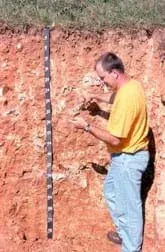 Examining a soil profile in Tennessee.Copyright Natural Resources Conservation Service, USDA http://www.tn.nrcs.usda.gov/technical/soils/pictures/gabe%20in%20christian-pit.jpg
Students learn the basics about soil, including its formation through the cycling of the Earth's materials, as well as its characteristics and importance. They are also introduced to soil profiles and how engineers conduct site investigations to learn about soil quality for development, contamination transport, and assessing the general environmental health of an area.
Geotechnical engineers apply their expertise about soil and rocks to the development of foundations for a variety of structures. In advance of any design or construction, they conduct environmental site assessments in areas proposed for development and make suggestions based on soil properties. They learn about the composition and condition of soil in an area and predict the long-term effects of that soil on walls, foundations, septic systems and countless other structures that are integral to our daily lives. For example, some clay soils have a tendency to shrink and swell as their water content changes, often triggered by changes in seasons and precipitation. This expansive property can put pressure on the walls of structures and damage them.
After this lesson, students should be able to:
- Describe several physical properties of soil.
- Describe how soil is formed through the cycling of Earth's materials.
- Explain what a soil profile is and how engineers use it to determine an area's soil quality.
- 6.1.1.c.iv Find a percent of a quantity as a rate per 100.
Grade 6
Do you agree with this alignment?
- CCSS.Math.Content.6.RP.A.3c Find a percent of a quantity as a rate per 100 (e.g., 30% of a quantity means 30/100 times the quantity); solve problems involving finding the whole, given a part and the percent.
Grade 6
Do you agree with this alignment?
- DCI.ESS2.A.6-8.4 All Earth processes are the result of energy flowing and matter cycling within and among the planet's systems. This energy is derived from the sun and Earth's hot interior. The energy that flows and matter that cycles produce chemical and physical changes in Earth's materials and living organisms.
Grades 6-8
Do you agree with this alignment?
Additional Soil Information
The different processes that determine the properties of soil (as well as minerals and rocks) are the result of the flow of the Earth's energy and the cycling of materials. The energy that drives these processes comes from the sun and the Earth's interior. Weathering is one process that results from this cycle and drives the changes in Earth's materials and organisms. Specifically, two main types of weathering affect the components of soil: physical and chemical. Physical weathering describes the breakdown of rocks and soils due to atmospheric conditions, such as temperature, water or pressure. Chemical weathering describes the impact of chemicals (either produced biologically or by the atmosphere) on the breakdown of rocks and soils.
 Soil rocks!Copyright Goddard Space Flight Center, NASA http://soil.gsfc.nasa.gov/
Humus enables soil to hold more moisture and provides plants with their primary source of carbon and nitrogen, all of which benefit soil by making it better at supporting plant growth. To understand humus, it would be helpful to look at it, but it is difficult to see humus alone because it is bound to larger particles in the soil.
Plant roots located in deeper layers of the soil require air and water for growth and survival. Air and water is present in the topsoil, but must be transferred to the deeper layers by mixing and aeration. This process can occur naturally with the help of earthworms and other insects. Earthworms that spread humus to deeper layers of soil are also paramount in mixing and aeration. In fact, these two phenomena are closely related. The term translocation describes the process in which water moving through soil simultaneously causes other materials in the soil (such as humus) to move and spread.
Various environmental factors impact the color of soil in both the horizontal and vertical directions. For example, a soil that contains more humus is darker than one with a more moderate amount. Iron and aluminum in some soils undergo chemical reactions that cause the soil to turn shades of red and yellow. Many additional coloring materials are found in soils.
What is soil? Where does it come from? Soil develops from a parent rock being broken down into small particles over thousands of years due to two major processes: erosion and weathering. Erosion is when rocks disintegrate due to the movement of elements such as water, wind or ice, caused by the flow of energy and the cycling of the Earth's materials. Weathering is when rocks disintegrate simply due to contact with the atmosphere. Both processes can vary greatly by location and over time, resulting in many different types of soils. In other words, many types of soils exist because of differences in parent rock material, climate, topography and time.
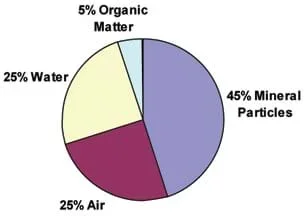 Average soil composition.
What is soil and why is it important? Soil has allowed for the existence of many life forms we know today. It provides plants with a place to grow and meets most of their nutritional needs. Soil that is able to support plant life is made of both organic and inorganic matter. Organic matter is matter that is biological. The soil's organic matter includes materials that are capable of being decayed, like decomposing plants and the remains of once-living organisms. Inorganic matter is matter that comes from mineral. Inorganic matter in soil includes things such as weathered rock and minerals, as well as air and water. An average soil consists of about 95% inorganic matter and 5% organic matter.
Of the 5% organic matter found in average soil, 80% of that organic matter is in the form of humus (with another 10% as roots and 10% as organisms). Humus is a dark brown or black substance naturally found in the soil. So where does humus come from? Organisms living in the soil naturally add organic matter to their surroundings, and when fungi and bacteria decompose, this organic matter, humus is formed. Larger organisms, such as earthworms, later spread the humus into deeper layers, further developing the soil and making it possible for plants to grow.
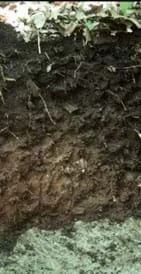 Profile of silty clay loam soil from Cannon County, TN. The limestone bedrock (parent material) begins at a depth of 16 inches (41 cm).Copyright Natural Resources Conservation Service, USDA http://www.tn.nrcs.usda.gov/
Have you ever taken a closer look at soil? Is it the same (homogenous) throughout? Erosion, decomposition and weathering all contribute to soil naturally developing in layers. If you looked at a cross-section of some soil in the ground (when you look at a side view) you might see at least three horizontal layers: the topsoil, sub-soil and bedrock. We call this cross-section view a soil profile. The topsoil is the dark top layer of soil that extends 15 to 20 cm below the surface of the Earth. Air, water and humus are present in the topsoil, helping plants to grow in this layer. The sub-soil layer is found below the topsoil, and has many clay-like characteristics; it acts as a reservoir for storing water that plants need. Below the sub-soil is bedrock. Bedrock is sometimes referred to as parent material because both the topsoil and sub-soil originate from the rocks that make up the bedrock.
Geotechnical engineering is a branch of civil engineering that works with rocks, soils and Earth materials. To make recommendations for building on a specific piece of land, geotechnical engineers first take a look at the surface and subsurface conditions of an area. The engineers might draw a soil profile during a site assessment. Site assessments are investigations of the Earth that take place before some other engineering is performed, such as designing a community of houses or even a research area in a wilderness park. The engineers must find out what types of soils and rock they are working with before they spend the money to design and build something on top of it. Geotechnical engineers look at many soil properties when conducting site investigations. They may look at color, types of mineral present, material weight, porosity (or how much air is in the soil), permeability of the soil (how much water can flow through it), and how much stress or force the soil can undergo without changing.
Besides building large structures or fixing existing structures that are falling down, other reasons exist for why engineers might investigate the soil in an area. Environmental engineers look at soils to determine the health of the area. They may take several soil samples to determine where a toxic contaminant spill is located that is affecting the health of the people in the community. They may also use soil samples to follow the path of water or pollution through the ground, or to search for specific minerals or fossil fuels. Agricultural engineers study soil samples to determine how to help crops grow better. Other engineers investigate soils to see how they are changing and how the change effects threatened wildlife and plant species. Students can act as engineers in the associated activity Soil Core Sampling where they learn more about the benefits and steps of soil sampling. Soils are very important to life on Earth and engineers help us protect those soils and decide where to best grow our communities without destroying the healthy soil.
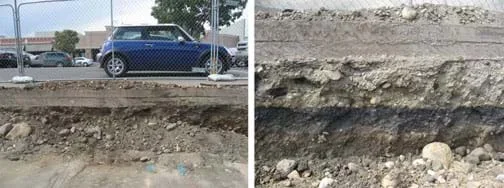 What's the soil like under this parking lot?Copyright 2008 Denise W. Carlson. Used with permission.
Now that you have learned the basics about soil, explain to me what soil is and how it is formed. (Listen to student descriptions.) Soil is able to support plant life; it is made up of both organic and inorganic matter. The three main horizontal layers of soil are: the topsoil, sub-soil and bedrock. Most of the soil we see is topsoil. Topsoil contains amounts of air, water and humus and is a good place for plants to grow.
Geotechnical engineering is a type of civil engineering that specializes in understanding rocks, soils and Earth materials. These engineers take soil samples and create soil profiles to determine if an area is good for the placing a building or structure. Environmental engineers look at soil samples to determine if pollution is in the soil, the effects of developments on soil, or the location of minerals and fossil fuels. They look carefully to see if the changes in soil affect the plants and animals that live in the area. Agricultural engineers study soil samples to make recommendations for growing crops. Soil is an important part of life and engineers help us use the soil to learn about our impact on the Earth.
- chemical weathering
- The disintegration of rocks and soils due to chemicals produced biologically or by the atmosphere.
- erosion
- The disintegration of rocks and soils due to wind, water, ice or other processes. This process occurs with movement.
- horizons
- Layers of a soil profile.
- inorganic matter
- Materials that originate from mineral sources.
- leaching
- The process of extracting a substance.
- organic matter
- Materials of biological origin that are capable of being decayed.
- physical weathering
- The disintegration of rocks and soils due to atmospheric conditions such as heat, water or pressure.
- soil profile
- A cross-section through the soil. This side-view angle shows a soil's layers.
- translocation
- When water moves through soil causing materials in the soil to move and spread.
- weathering
- The disintegration of rocks and soils due to contact with the atmosphere. This process occurs without movement.
Pre-Lesson Assessment
Brainstorming: In small groups, have students engage in open discussion. Remind them that in brainstorming, no idea or suggestion is "silly." All ideas should be respectfully heard. Encourage wild ideas and discourage criticism of ideas. Ask the students:
- What is soil?
- From where does it come?
- What processes form soil?
Post-Introduction Assessment
Drawings: Have students draw a cross-section view of a soil sample. Direct them to label the soil layers and incorporate symbols of what might be found in that layer. For example, draw plants and roots, or use little As for air or Ws for water. Communicate the differences between the soil layers with color or fill patterns to show density of the soil layer. Have students also incorporate what processes could have contributed to the formation of their soil by drawing arrows and labeling possible explanations. Have students estimate what percent each layer makes up the whole. Students should write a percentage next to the soil layer and be able to give an explanation as to why they believe that layer takes up that percentage. Have students explain their soil profiles and the relationship to material cycling and weathering processes to other students in the class.
Lesson Summary Assessment
Soil Investigation: Have students think about the soil in either your area or one that you assign. What is the climate like? How does that affect the topsoil? How does the soil compare to the soil in other parts of the world? If they were geotechnical engineers, what types of things might they communicate about the soil in their areas?
As an extension, consider teaching A Good Foundation lesson and Shallow and Deep Foundations activity in the Bridges unit, in which students explore the effects of regional geology on bridge foundation, including the variety of soil conditions found beneath foundations. They learn about shallow and deep foundations, as well as the concepts of soil profiles, bearing pressure and settlement.
See the Natural Resources Conservation Service webpage with several hands-on lesson extension options: http://soil.gsfc.nasa.gov/
Introduction to Soil. Last updated March 15, 2000. Greater Johannesburg Metropolitan Council. Accessed September 10, 2008. http://ceroi.net/reports/johannesburg/csoe/html/nonjava/Soil/intro.htm
Levine, Elissa. Touch the Earth: Introduction to Soils. Last updated June 2, 2005. Soil Science Education, Goddard Space Flight Center, NASA. Accessed September 10, 2008. http://soil.gsfc.nasa.gov/
Pidwirny, Michael. (2006). Introduction to Soils. Last updated April 17, 2008. Fundamentals of Physical Geography, 2nd Edition. Chapter 10: Introduction to Lithosphere, University of British Columbia, Okanagan. Accessed September 10, 2008. http://www.physicalgeography.net/fundamentals/10t.html
Contributors
Marissa Hagan Forbes; Malinda Schaefer Zarske; Denise W. Carlson
Supporting Program
Integrated Teaching and Learning Program, College of Engineering, University of Colorado Boulder
Acknowledgements
The contents of this digital library curriculum were developed under grants from the Fund for the Improvement of Postsecondary Education (FIPSE), U.S. Department of Education and National Science Foundation (GK-12 grant no. 0338326). However, these contents do not necessarily represent the policies of the Department of Education or National Science Foundation, and you should not assume endorsement by the federal government.
Copyright
2008 by Regents of the University of Colorado