
Adventure Engineering Challenge: Asteroid Impact
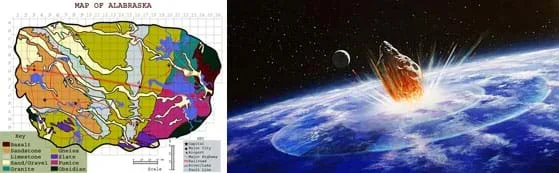 The collision between Earth and an asteroid a few kilometers in diameter would release as much energy as the simultaneous detonation of several million nuclear bombs. Engineers to the rescue!Copyright (left) Adventure Engineering, Colorado School of Mines, (right) 2001 NASA and Wikipedia http://en.wikipedia.org/wiki/File:Collision_d%27une_com%C3%A8te.jpg
Through this earth science curricular unit composed of eight activities, student teams are presented with the scenario that an asteroid will impact the Earth. In response, their challenge is to design the location and size of underground caverns to shelter the people from an uninhabitable Earth for one year.
The Asteroid Impact unit provides a project framework in which student groups act as engineering teams to design underground caverns, following the steps of the engineering design process. Real-world engineers work in teams to invent and develop solutions to problems. Following the steps of the engineering design process, they first identify and define the problem or challenge. They gather pertinent information and conduct research to learn about topics related to the problem, and they brainstorm and propose multiple potential solutions. Engineers then evaluate the various possible solutions and select one that best meets the criteria for success. Testing is often used to verify that the proposed solution will solve the problem or challenge. And the final solution is communicated to others.
- CCSS.Math.Content.6.NS.B.3 Fluently add, subtract, multiply, and divide multi-digit decimals using the standard algorithm for each operation.
Grade 6
Do you agree with this alignment? - CCSS.Math.Content.6.RP.A.3d Use ratio reasoning to convert measurement units; manipulate and transform units appropriately when multiplying or dividing quantities.
Grade 6
Do you agree with this alignment? - CCSS.Math.Content.7.G.B.6 Solve real-world and mathematical problems involving area, volume and surface area of two- and three-dimensional objects composed of triangles, quadrilaterals, polygons, cubes, and right prisms.
Grade 7
Do you agree with this alignment?
- MS-ETS1-1 Define the criteria and constraints of a design problem with sufficient precision to ensure a successful solution, taking into account relevant scientific principles and potential impacts on people and the natural environment that may limit possible solutions.
Grades 6-8
This resource focuses on the following Three Dimensional Learning aspects of NGSS:
Science & Engineering Practices- Define a design problem that can be solved through the development of an object, tool, process or system and includes multiple criteria and constraints, including scientific knowledge that may limit possible solutions.Do you agree with this alignment?
Disciplinary Core Ideas- The more precisely a design task's criteria and constraints can be defined, the more likely it is that the designed solution will be successful. Specification of constraints includes consideration of scientific principles and other relevant knowledge that is likely to limit possible solutions.Do you agree with this alignment?
Crosscutting Concepts- The uses of technologies and any limitations on their use are driven by individual or societal needs, desires, and values; by the findings of scientific research; and by differences in such factors as climate, natural resources, and economic conditions.Do you agree with this alignment?
- All human activity draws on natural resources and has both short and long-term consequences, positive as well as negative, for the health of people and the natural environment.Do you agree with this alignment?
Do you agree with this alignment? - Define a design problem that can be solved through the development of an object, tool, process or system and includes multiple criteria and constraints, including scientific knowledge that may limit possible solutions.
This unit is composed of eight hands-on activities. The unit takes 8-10 class periods (350-450 minutes) total. Conduct the activities in the following order:
- Incoming Asteroid! What's the Problem?
- How Big? Necessary Area & Volume for Shelter
- Using Map Scales to Figure Distances and Areas
- Identifying Possible Underground Cavern Locations
- Rocks, Rocks, Rocks: Test, Identify Properties & Classify
- Ranking the Rocks for Desired Properties
- Recommendations & Presentations: Drum Roll Please
- Building & Testing Model Underground Safety Caverns
Note: The Asteroid Impact Student Workbook (PDF) contains worksheets for all activities in this unit in one pdf file; the same worksheets are also available as individual attachments in each lesson and activity.
- Adventure Engineering Challenge: Asteroid Impact
- Incoming Asteroid! What's the Problem?
- How Big? Necessary Area & Volume for Shelter
- Using Map Scales to Figure Distances and Areas
- Identifying Possible Underground Cavern Locations
- Rocks, Rocks, Rocks: Test, Identify Properties & Classify
- Ranking the Rocks for Desired Properties
- Recommendations & Presentations: Drum Roll Please
- Building & Testing Model Underground Safety Caverns
Supporting Program
Adventure Engineering, Colorado School of Mines
Acknowledgements
Adventure Engineering was supported by National Science Foundation grant nos. DUE 9950660 and GK-12 0086457. However, these contents do not necessarily represent the policies of the National Science Foundation, and you should not assume endorsement by the federal government.
Copyright
2013 by Regents of the University of Colorado; original © 2005 Colorado School of Mines