
Incoming Asteroid! What's the Problem?
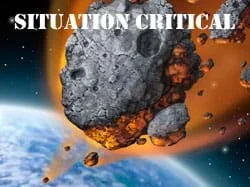 A critical situation requires engineers to first understand the problem and then learn more about topics related to the problem.Copyright Research.gov http://www.research.gov/research-portal/appmanager/base/desktop;jsessionid=2pc9T6LTThZPhs9J0TljfRsQgRjTW9qmCPgYFLBYQQWQ4gT8Q3Cv!66802617!1617966839?_nfpb=true&_windowLabel=researchAreas_11&_urlType=action&researchAreas_11_action=selectAwardDetail&researchAreas_11_id=%2FresearchGov%2FAwardHighlight%2FPublicAffairs%2F18650_MeteoriteasteroidLinkSolved.html
Students are introduced to the Asteroid Impact unit and its engineering challenge: An asteroid is on course to impact the Earth and we must design the location and size of underground caverns to shelter the people from an uninhabitable Earth for one year. Students read the president's memo to receive their "marching orders." They form teams and begin to study the situation in depth. A simple in-class simulation shows them the potential for destruction and disaster. They complete worksheets and look at maps to help them define and understand the problem: What is the needed cavern size and depth? What are the geographical areas and natural features? A homework measurement assignment prepares them for the next activity.
Engineering teams begin the design process by defining the problem, which may include identifying, through group brainstorming, discussion and research, the technical, financial and social criteria for successful solution design.
After this activity, students should be able to:
- Brainstorm, voice and write down potential solutions and questions.
- Read, understand and identify a problem.
- Hypothesize, through group discussion, what information might be required to solve the problem.
- List design constraints (social, environmental, financial, etc.) that must be considered to adequately design a functional solution to the asteroid problem.
- Exhibit basic map-reading skills, such as understanding a legend/key and using a map scale to determine distances.
- The solar system is comprised of various objects that orbit the Sun and are classified based on their characteristics
Grade 8
Do you agree with this alignment?
- Requirements for design are made up of criteria and constraints.
Grades 6-8
Do you agree with this alignment? - Brainstorming is a group problem-solving design process in which each person in the group presents his or her ideas in an open forum.
Grades 6-8
Do you agree with this alignment? - STEL-4Q Critue whether existing and proposed technologies use resources sustainably.
Grades 9-12
Do you agree with this alignment? - STEL-7S Create solutions to problems by identifying and applying human factors in design.
Grades 6-8
Do you agree with this alignment?
- MS-ETS1-1 Define the criteria and constraints of a design problem with sufficient precision to ensure a successful solution, taking into account relevant scientific principles and potential impacts on people and the natural environment that may limit possible solutions.
Grades 6-8
This resource focuses on the following Three Dimensional Learning aspects of NGSS:
Science & Engineering Practices- Define a design problem that can be solved through the development of an object, tool, process or system and includes multiple criteria and constraints, including scientific knowledge that may limit possible solutions.Do you agree with this alignment?
Disciplinary Core Ideas- The more precisely a design task's criteria and constraints can be defined, the more likely it is that the designed solution will be successful. Specification of constraints includes consideration of scientific principles and other relevant knowledge that is likely to limit possible solutions.Do you agree with this alignment?
Crosscutting Concepts- The uses of technologies and any limitations on their use are driven by individual or societal needs, desires, and values; by the findings of scientific research; and by differences in such factors as climate, natural resources, and economic conditions.Do you agree with this alignment?
- All human activity draws on natural resources and has both short and long-term consequences, positive as well as negative, for the health of people and the natural environment.Do you agree with this alignment?
Do you agree with this alignment? - Define a design problem that can be solved through the development of an object, tool, process or system and includes multiple criteria and constraints, including scientific knowledge that may limit possible solutions.
- capability to show the class an online video of an asteroid impact (see the Additional Multimedia Support section)
- (optional) classroom demo of various balls (golf, bowling) dropped from heights into tubs of various materials (flour, sand)
- 4 handouts: President's Memo (PDF), What's the Problem? Worksheet (PDF), Alabraska General Map (PDF), Alabraska Geology Map (PDF)
Fifth-grade reading level, familiarity with the inquiry-based learning process.
(Kick off the unit by showing students the great 10-minute Asteroid Impact Simulation video by Miracle Planet. The narrated simulation dramatically shows what happens when a big asteroid hits the Earth. In this case, besides a big crater, it shows and describes the resulting heat damage to the atmosphere and life on Earth [vaporization of everything] from a 300-mile-wide asteroid striking the Earth.)
Today we're starting a new adventure engineering unit and you will be in engineering teams. This is your engineering challenge: An asteroid is on course to impact the Earth and we must use the engineering design process to design the location and size of underground caverns to shelter the people from an uninhabitable Earth for one year. Let's start by watching this video.
(Next, students read the president's memo to receive their "marching orders"—students are called by the president of Alabraska to design underground caverns to save the state's population from the asteroid impact. Then they form teams, become familiar with the maps, and complete investigative worksheets.)
Before the Activity
- Gather materials and make copies of the handouts. Alternatively, make copies of the entire student workbook, which is a PDF of all worksheets for the Asteroid Impact unit, found as an attachment to the unit document.
- Refer to basic information about asteroids (and additional web links) in the CRFAO Briefing (PDF).
- Prepare to show the online asteroid impact simulation video to the class.
- Decide if you want to conduct a simple demo by dropping golf balls into a bucket of flour or a bowling ball into a big tub of sand; prepare accordingly.
With the Students
- Grab students' attention by showing them the online video simulation of a big asteroid impact on the Earth.
- (optional) Conduct a classroom demo that simulates the destruction caused by an asteroid impact.
- Ask the students if they know what natural disasters are. (Wait for answers.) Explain that a natural disaster is a natural event that causes great damage or loss of life. Explain that an asteroid hitting the Earth falls into this category.
- Divide the class into teams of three or four students each.
- Encourage all students to get involved by assigning team roles, for example, a discussion leader, timekeeper for questions, and a scribe or recorder.
- Give students a few minutes to decide on names for their engineering teams.
- Read the President's Memo to the class. (Alternatively, have a student read it to the class, or have each student read it to themselves. If the latter, provide a copy of the memo for each student.)
- Hand out the worksheet and two maps to each student (or the entire student workbook, if desired).
- Give groups a defined amount of time to discuss and record answers to the worksheet questions.
- Have students generate a list of design constraints that are given or implied in the memo, graphic organizer and maps. If students have already generated the list of constraints, have them review it and decide as a class if anything needs to be added.
- Come together as a class and have each team share their answers. This "idea sharing" helps get the class involved. Tip: Moderate this activity by having the teams report back after each question or at the end.
- (optional) Assign students the homework to each measure his/her bedroom dimensions, as described in the Assessment section.
- natural disaster
- a natural event such as a asteroid, flood, earthquake, or hurricane that causes great damage or loss of life.
Worksheets: Have students work in their groups to complete the What's the Problem? Worksheet (PDF). As necessary, help them generate a list of design constraints, such as the number of people, asteroid size, expected length of stay in the caverns, and environmental considerations. Prompt them to find clues about constraints on their graphic organizer. Students will refer back to this list to complete the activity, so displaying a collaborative list at the front of the classroom may be helpful. Review students' worksheet answers to gauge their comprehension of the material, concepts and engineering challenge. Refer to the Asteroid Impact Student Workbook Example Answers provided in the unit document for example worksheet and homework assignment answers.
Quiz: Verbally quiz students on the content of the President's Memo (PDF) to check their comprension.
(optional) Homework: Assign students to each measure the dimensions (length, width, height) of his/her bedroom. Doing this makes the next activity go more smoothly. When turned in, review the measurements to see if they seem reasonable.
Have students read the CRFAO Briefing (PDF) and:
- Look up one of the provided websites and write a recap report.
- Construct a model of the solar system that includes an asteroid belt.
- Write a paragraph about the importance of studying asteroids and other natural disasters.
Online videos and simulations to show the class:
- Simulated Asteroid Strike (52-second video); slo-mo footage shows small metallic ball bearing fired into sand and ice at 3 miles per second, at http://www.youtube.com/watch?v=GmKWYPWTo9o
- Asteroid Impact Simulation by Miracle Planet (10-minute video); a great visual simulation shows the resulting crater and vaporization damage life from a 300-mile-wide asteroid striking the Earth, at https://www.youtube.com/watch?v=zc4HL_-VT2Y
- Discovery Channel three-episode mini-series called "Hyperspace," hosted by Sam Neill (3 hours total); DVD for $10 at Amazon
- Adventure Engineering Challenge: Asteroid Impact
- Incoming Asteroid! What's the Problem?
- How Big? Necessary Area & Volume for Shelter
- Using Map Scales to Figure Distances and Areas
- Identifying Possible Underground Cavern Locations
- Rocks, Rocks, Rocks: Test, Identify Properties & Classify
- Ranking the Rocks for Desired Properties
- Recommendations & Presentations: Drum Roll Please
- Building & Testing Model Underground Safety Caverns
Supporting Program
Adventure Engineering, Colorado School of Mines
Acknowledgements
Adventure Engineering was supported by National Science Foundation grant nos. DUE 9950660 and GK-12 0086457. However, these contents do not necessarily represent the policies of the National Science Foundation, and you should not assume endorsement by the federal government.
Copyright
2013 by Regents of the University of Colorado; original © 2005 Colorado School of Mines