
Ranking the Rocks for Desired Properties
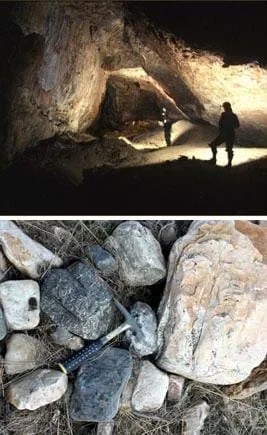 Which rocks are best suited for building caverns?Copyright (cave photo) National Park Service, (rocks & hammer) Utah Geological Survey http://www.nps.gov/jeca/parknews/images/Jewel-Cave-Marc-Ohms-photo.jpg http://geology.utah.gov/surveynotes/gladasked/landscape_rocks/muskratstation.htm
Continuing the Asteroid Impact challenge, student teams assign importance factors called "desirability points" to the rock properties found in the previous activity in order to mathematically determine the overall best rocks for building caverns within. They learn the real-world connections and relationships between the rock properties and the desired engineering properties for designing and building caverns (or tunnels, mines, building foundations, etc.).
Engineers determine the locations and construction methods to create structures such as caverns, tunnels, mines, bridges and foundations. To do this, they look at data from a variety of sources. They consider locations and rock properties as they apply to specific real-world design and construction situations. They make calculations and consider alternative options. They even make calculations to compare solutions to each other. They take all these steps so they make smart decisions that keep people safe.
After this activity, students should be able to:
- Enter data from a graph and into a table.
- Synthesize data from numerous categories and build a concise table of data.
- Relate the relevance of rock properties to real-world design and construction applications.
- Use a mathematical scoring system to rank solutions.
- Synthesize the best rocks with all previous data to update their candidate cavern locations.
- Analyze and interpret data identifying ways Earth's surface is constantly changing through a variety of processes and forces such as plate tectonics, erosion, deposition, solar influences, climate, and human activity
Grade 5
Do you agree with this alignment? - Develop and communicate an evidence based scientific explanation around one or more factors that change Earth's surface
Grade 5
Do you agree with this alignment? - Gather, analyze, and communicate data that explains Earth's plates, plate motions, and the results of plate motions
Grade 7
Do you agree with this alignment?
- STEL-8L Interpret the accuracy of information collected.
Grades 6-8
Do you agree with this alignment? - STEL-8M Use instruments to gather data on the performance of everyday products.
Grades 6-8
Do you agree with this alignment?
- MS-ESS2-2 Construct an explanation based on evidence for how geoscience processes have changed Earth's surface at varying time and spatial scales.
Grades 6-8
This resource focuses on the following Three Dimensional Learning aspects of NGSS:
Science & Engineering Practices- Construct a scientific explanation based on valid and reliable evidence obtained from sources (including the students' own experiments) and the assumption that theories and laws that describe the natural world operate today as they did in the past and will continue to do so in the future.Do you agree with this alignment?
Disciplinary Core Ideas- The planet's systems interact over scales that range from microscopic to global in size, and they operate over fractions of a second to billions of years. These interactions have shaped Earth's history and will determine its future.Do you agree with this alignment?
- Water's movements—both on the land and underground—cause weathering and erosion, which change the land's surface features and create underground formations.Do you agree with this alignment?
Crosscutting Concepts- Time, space, and energy phenomena can be observed at various scales using models to study systems that are too large or too small.Do you agree with this alignment?
Do you agree with this alignment? - Construct a scientific explanation based on valid and reliable evidence obtained from sources (including the students' own experiments) and the assumption that theories and laws that describe the natural world operate today as they did in the past and will continue to do so in the future.
- MS-ETS1-1 Define the criteria and constraints of a design problem with sufficient precision to ensure a successful solution, taking into account relevant scientific principles and potential impacts on people and the natural environment that may limit possible solutions.
Grades 6-8
This resource focuses on the following Three Dimensional Learning aspects of NGSS:
Science & Engineering Practices- Define a design problem that can be solved through the development of an object, tool, process or system and includes multiple criteria and constraints, including scientific knowledge that may limit possible solutions.Do you agree with this alignment?
Disciplinary Core Ideas- The more precisely a design task's criteria and constraints can be defined, the more likely it is that the designed solution will be successful. Specification of constraints includes consideration of scientific principles and other relevant knowledge that is likely to limit possible solutions.Do you agree with this alignment?
Crosscutting Concepts- The uses of technologies and any limitations on their use are driven by individual or societal needs, desires, and values; by the findings of scientific research; and by differences in such factors as climate, natural resources, and economic conditions.Do you agree with this alignment?
- All human activity draws on natural resources and has both short and long-term consequences, positive as well as negative, for the health of people and the natural environment.Do you agree with this alignment?
Do you agree with this alignment? - Define a design problem that can be solved through the development of an object, tool, process or system and includes multiple criteria and constraints, including scientific knowledge that may limit possible solutions.
Ability to read data from a graph, and a fair recollection of knowledge from the previous activities in the Asteroid Impact unit.
How can we learn from all the rock properties data we have collected and recorded (during the previous activities in the unit)?
How can we put it to use to help us find the best location to place our underground caverns?
Remember your goal. You want to make sure that your final cavern location has good properties for construction.
Today's activity will help you determine the best properties as apply to our engineering design objectives.
Background
As necessary, supplement students' understanding of basic rock/mineral testing, rock identification, and rock classification (sedimentary, igneous, metamorphic).
Before the Activity
Make copies of the Ranking the Rocks Worksheet (PDF).
With the Students
- Discuss the relevance of the various rock properties to cavern building through a class question/answer session.
- Explain that "desirability points" are used to rank the rocks from best to worst.
- As necessary, review graphs and what they mean. For example, plot shoe size vs. height and ask students to explain what the graph means. This review helps students understand the desirability graph.
- Have student engineering teams complete the Desirability Points and Rock Ranking Table on the worksheet. Walk them through the process for one rock (such as limestone); then have them finish the rest of the table in their groups.
- Have student teams answer the rest of the worksheet questions.
- Conclude the activity by have each each team share their top location with the rest of the class.
Worksheet: Review students' Ranking the Rocks Worksheet (PDF)answers to gauge their comprehension of the subject matter.
Quiz: As a concluding quiz, give students a dfferent graph for interpretation.
Extension Test: Really test students' ability to consider all factors by conducting the Extension Activity.
Have each group write the grid location of one of their choices on a piece of paper. Have teams swap pieces of paper. Give teams five minutes to find the locations on the map grid and study its location on both maps. Write down reasons why you think it is a good choice and why it is might not be a good choice. Call upon each group to share and discuss their findings. Display the big map in the front of the classroom to show the grid locations.
- Adventure Engineering Challenge: Asteroid Impact
- Incoming Asteroid! What's the Problem?
- How Big? Necessary Area & Volume for Shelter
- Using Map Scales to Figure Distances and Areas
- Identifying Possible Underground Cavern Locations
- Rocks, Rocks, Rocks: Test, Identify Properties & Classify
- Ranking the Rocks for Desired Properties
- Recommendations & Presentations: Drum Roll Please
- Building & Testing Model Underground Safety Caverns
Supporting Program
Adventure Engineering, Colorado School of Mines
Acknowledgements
Adventure Engineering was supported by National Science Foundation grant nos. DUE 9950660 and GK-12 0086457. However, these contents do not necessarily represent the policies of the National Science Foundation, and you should not assume endorsement by the federal government.
Copyright
2013 by Regents of the University of Colorado; original © 2005 Colorado School of Mines