
How Big? Necessary Area & Volume for Shelter
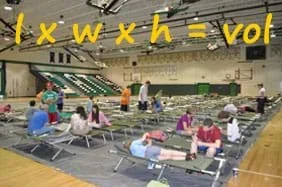 How much cavern space is needed to shelter Alabraska citizens during and after the asteroid impact?Copyright Anne Arundel County, MD http://www.aacounty.org/OEM
Continuing the Asteroid Impact challenge, student teams get good practice in area and volume calculations as they determine the size of the caverns necessary to protect the population of the state of Alabraska from the impending (hypothetical!) asteroid impact. They measure their classroom to determine overall area and volume, determine how many people the space could comfortably sleep, and then scale up their numbers to find the necessary area to house all Alabraskan citizens. They work through problems on a worksheet and perform math conversions between feet/meters and miles/kilometers.
Engineering teams begin the design process by thoroughly defining the problem at hand. This process involves identifying, through group brainstorming, discussion and research, the technical, financial and social criteria for successful design. When designing underground spaces, civil, mining and architectural engineers perform analyses that are similar to what students do in this activity to determine the appropriate space requirements.
After this activity, students should be able to:
- Measure length, width and height of a room using a tape measure or ruler.
- Calculate area and volume from length, width and height measurements.
- Convert simple English units to metric units.
- Determine proportion by comparing a smaller area to a larger area.
- Represent a measurement on graph paper.
- 6.1.1.c.viii Use ratio reasoning to convert measurement units.
Grade 6
Do you agree with this alignment? - 6.1.2.b Fluently add, subtract, multiply, and divide multidigit decimals using standard algorithms for each operation.
Grade 6
Do you agree with this alignment? - 7.1.2.c Solve real-world and mathematical problems involving the four operations with rational numbers.
Grade 7
Do you agree with this alignment? - 7.4.2.d Solve real-world and mathematical problems involving area, volume and surface area of two- and three-dimensional objects composed of triangles, quadrilaterals, polygons, cubes, and right prisms.
Grade 7
Do you agree with this alignment?
- CCSS.Math.Content.5.MD.C.5b Apply the formulas V = l × w × h and V = b × h for rectangular prisms to find volumes of right rectangular prisms with whole-number edge lengths in the context of solving real world and mathematical problems.
Grade 5
Do you agree with this alignment? - CCSS.Math.Content.6.RP.A.3d Use ratio reasoning to convert measurement units; manipulate and transform units appropriately when multiplying or dividing quantities.
Grade 6
Do you agree with this alignment? - CCSS.Math.Content.6.SP.A.1 Recognize a statistical question as one that anticipates variability in the data related to the question and accounts for it in the answers.
Grade 6
Do you agree with this alignment? - CCSS.Math.Content.7.EE.B.4a Solve word problems leading to equations of the form px + q = r and p(x + q) = r, where p, q, and r are specific rational numbers. Solve equations of these forms fluently. Compare an algebraic solution to an arithmetic solution, identifying the sequence of the operations used in each approach.
Grade 7
Do you agree with this alignment? - CCSS.Math.Content.7.G.B.6 Solve real-world and mathematical problems involving area, volume and surface area of two- and three-dimensional objects composed of triangles, quadrilaterals, polygons, cubes, and right prisms.
Grade 7
Do you agree with this alignment? - CCSS.Math.Content.7.SP.A.1 Understand that statistics can be used to gain information about a population by examining a sample of the population; generalizations about a population from a sample are valid only if the sample is representative of that population. Understand that random sampling tends to produce representative samples and support valid inferences.
Grade 7
Do you agree with this alignment?
- Make two-dimensional and three-dimensional representations of the designed solution.
Grades 6-8
Do you agree with this alignment? - STEL-7R Refine design solutions to address criteria and constraints.
Grades 6-8
Do you agree with this alignment?
- rulers, meter sticks, tape measures
- graph paper
- calculators
- (optional) helium balloons, each with ~12 ft (3.7 m) of string (or at least ceiling height amount of string)
- (optional) masking tape, to mark on the floor the dimensions of a bed
- How Big? Worksheet (PDF)
- Reference Page (PDF) (contains 12 vocabulary words and definitions, formulas, unit conversions)
- butcher block paper and colored pencils, for drawing cavern designs
- Fifth-grade reading level
- Some knowledge of length, width, area and volume; metric units; multiplication
- Familiarity with the inquiry-based learning process
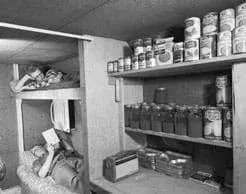 Copyright National Archives http://www.archives.gov/exhibits/picturing_the_century/postwar/postwar_img80.html
Today, the task for you engineering team is to calculate how large the underground cavern needs to be in order to accommodate all the people of Alabraska in order keep them safe from the impending asteroid impact.
We'll be thinking a lot about area and volume. How much space do people need to comfortably sleep and hang out? How big is your bed? How big is your bedroom? After figuring this out, we'll scale up the numbers to find the overall area and voume we need to house all Alabraskan citizens.
Background Information
As necessary, familiarize students with the concepts of area and volume, as well as example units associated with them. Write on the classroom board the formulas for calculating area and volume:
area = length x width
volume = length x width x height
Area examples: a rectangle, a table top, the area of a rug, classroom floor space; such as 6 m x 6 m = 36 square meters.
Volume examples: a cube, the interior space in a box, the space in a classroom; such as 6 m x 6 m x 9 m = 324 cubic meters.
Common size comparisons:
- 1 mile equals ~7.5 city blocks
- 56 city blocks in 1 km2
- School grounds typically take up 4-8 blocks, so if your school takes up 4 blocks, it would take 14 schools to equal 1 mi2
- A football field is ~90 m (300 ft) long x 45 m (150 ft) wide, so it would take ~250 football fields to equal 1 km2
Before the Activity
Gather materials and make copies of the How Big? Worksheet (PDF) and Reference Page (PDF).
With the Students
- Distribute materials to each group, including a ruler or tape measure.
- Have students measure and record on their worksheets the classroom length, width and height. Many ways exist to determine room height. One entertaining way is to give each group a helium balloon with a string tied to it. Let the balloon float to the ceiling, mark on the string where the floor is, then haul in the balloon and measure the string!
- Have students calculate the classroom area (l x w) and volume (l x w x h). As necessary, provide an explanation of a rectangle and a cube. Remind students that area involves multiplying two units of measurements together so the answer will be in units (meter, kilometer) with a raised number 2 ("squared," such as m2, km2). Volume is found by multiplying length by width by height. Since three units are multiplied together, the resulting answer units are cubed (m3).
- Tip: It is helpful to use a ruler or meter stick to draw a square foot or square meter on the classroom board. Also draw an area 1 m x 2 m and explain how it equals 2 m2.
- Tip: If students have not studied area and volume, work these problems with them on the classroom board. It is also beneficial for teams to compare answers, and for the teacher to give them a "correct" answer to move forward with.
- Give student teams time to discuss and answer worksheet questions 3-9. Either let them work through the problems as teams and then discuss as a class -OR- discuss answers as a class after each question. By the nature of the open-ended questions, the answers will vary. This is okay!! Explain that engineering design often leads to many possible correct answers.
- Tip: If students have a hard time conceptualizing how many beds will fit in the classroom, use masking tape to make an outline of a bed (1 m x 2 m) on the floor. This aids students in answering question 3.
- Tip: Teams will use the answer to question 8 in later lessons. Although it is not necessary, you may want to give each team the same answer to move forward with.
- Some common comparisons to help explain question 9:
- 1 mile is equivalent to the length of ~7.5 city blocks
- 56 city blocks in 1 km2
- School grounds typically take up 4 to 8 blocks, so, if your school takes up 4 blocks, it would take 14 schools to equal 1 mi2
- 1 football field is ~90 m (300 ft) long by 45 m (150 ft) wide; it takes ~250 football fields to equal 1 km2
- As time permits (or as a homework assignment), have students draw a plan for their team's cavern design. Give each team a large sheet of butcher block paper and colored pencils. Encourage them be creative and think about what sorts of things they would want in their caverns!
- Tip: Build on this task later by having each team re-create this initial cavern drawing to scale (next activity topic).
Worksheet: Review students' answers on the How Big? Worksheet (PDF)to gauge their math skills and understanding of the engineering challenge. Refer to the Asteroid Impact Student Workbook Example Answers provided in the unit document for example worksheet answers.
Drawing: Examine students' drawings to evaluate their depth of project comprehension.
- Determine the area and volume of rooms in their houses.
- Search the Internet to see where Alabraska would rank in terms of population and size compared to other U.S. states.
- Visit www.asae.org and write a report about agricultural engineers.
- Determine the number of people in their state; then, calculate the necessary cavern size.
- Adventure Engineering Challenge: Asteroid Impact
- Incoming Asteroid! What's the Problem?
- How Big? Necessary Area & Volume for Shelter
- Using Map Scales to Figure Distances and Areas
- Identifying Possible Underground Cavern Locations
- Rocks, Rocks, Rocks: Test, Identify Properties & Classify
- Ranking the Rocks for Desired Properties
- Recommendations & Presentations: Drum Roll Please
- Building & Testing Model Underground Safety Caverns
Supporting Program
Adventure Engineering, Colorado School of Mines
Acknowledgements
Adventure Engineering was supported by National Science Foundation grant nos. DUE 9950660 and GK-12 0086457. However, these contents do not necessarily represent the policies of the National Science Foundation, and you should not assume endorsement by the federal government.
Copyright
2013 by Regents of the University of Colorado; original © 2005 Colorado School of Mines