
Recommendations & Presentations: Drum Roll Please
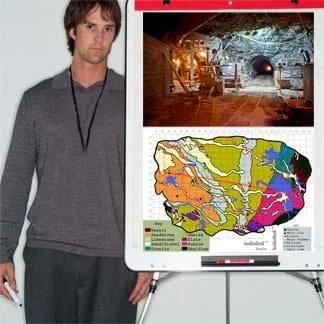 Students present their Asteroid Impact projects with their location recommendations for building underground cavern shelters.Copyright (man with easel) Microsoft Corporation, (cavern) Lawrence Berkeley Lab, (map) Adventure Engineering, Colorado School of Mines http://newscenter.lbl.gov/feature-stories/2012/05/16/surf-intro/
Continuing the Asteroid Impact challenge, student teams analyze their data and commit to final decisions on the locations they recommend for locating safe underground cavern shelters for the citizens of Alabraska. They prepare and deliver final presentations to the class to explain and defend their final recommendations.
In the real world, engineering teams spend much time researching and analyzing so they have the information needed to select the best design option. Then, communication is critical. Engineers routinely prepare final reports and give presentations to clients and customers to explain and defend their recommended design solutions.
After this activity, students should be able to:
- Analyze data from several days' worth of work to make a final decision.
- Use experimental data and logic to explain and defend a decision/recommendation.
- Communicate to an audience via a formal presentation.
- Analyze and interpret data identifying ways Earth's surface is constantly changing through a variety of processes and forces such as plate tectonics, erosion, deposition, solar influences, climate, and human activity
Grade 5
Do you agree with this alignment? - Develop and communicate an evidence based scientific explanation around one or more factors that change Earth's surface
Grade 5
Do you agree with this alignment? - Gather, analyze, and communicate data that explains Earth's plates, plate motions, and the results of plate motions
Grade 7
Do you agree with this alignment?
- Modeling, testing, evaluating, and modifying are used to transform ideas into practical solutions.
Grades 6-8
Do you agree with this alignment? - STEL-1J Develop innovative products and systems that solve problems and extend capabilities based on individual or collective needs and wants.
Grades 6-8
Do you agree with this alignment? - STEL-4Q Critue whether existing and proposed technologies use resources sustainably.
Grades 9-12
Do you agree with this alignment? - STEL-8L Interpret the accuracy of information collected.
Grades 6-8
Do you agree with this alignment? - STEL-8M Use instruments to gather data on the performance of everyday products.
Grades 6-8
Do you agree with this alignment?
- MS-ESS2-2 Construct an explanation based on evidence for how geoscience processes have changed Earth's surface at varying time and spatial scales.
Grades 6-8
This resource focuses on the following Three Dimensional Learning aspects of NGSS:
Science & Engineering Practices- Construct a scientific explanation based on valid and reliable evidence obtained from sources (including the students' own experiments) and the assumption that theories and laws that describe the natural world operate today as they did in the past and will continue to do so in the future.Do you agree with this alignment?
Disciplinary Core Ideas- The planet's systems interact over scales that range from microscopic to global in size, and they operate over fractions of a second to billions of years. These interactions have shaped Earth's history and will determine its future.Do you agree with this alignment?
- Water's movements—both on the land and underground—cause weathering and erosion, which change the land's surface features and create underground formations.Do you agree with this alignment?
Crosscutting Concepts- Time, space, and energy phenomena can be observed at various scales using models to study systems that are too large or too small.Do you agree with this alignment?
Do you agree with this alignment? - Construct a scientific explanation based on valid and reliable evidence obtained from sources (including the students' own experiments) and the assumption that theories and laws that describe the natural world operate today as they did in the past and will continue to do so in the future.
- MS-ETS1-1 Define the criteria and constraints of a design problem with sufficient precision to ensure a successful solution, taking into account relevant scientific principles and potential impacts on people and the natural environment that may limit possible solutions.
Grades 6-8
This resource focuses on the following Three Dimensional Learning aspects of NGSS:
Science & Engineering Practices- Define a design problem that can be solved through the development of an object, tool, process or system and includes multiple criteria and constraints, including scientific knowledge that may limit possible solutions.Do you agree with this alignment?
Disciplinary Core Ideas- The more precisely a design task's criteria and constraints can be defined, the more likely it is that the designed solution will be successful. Specification of constraints includes consideration of scientific principles and other relevant knowledge that is likely to limit possible solutions.Do you agree with this alignment?
Crosscutting Concepts- The uses of technologies and any limitations on their use are driven by individual or societal needs, desires, and values; by the findings of scientific research; and by differences in such factors as climate, natural resources, and economic conditions.Do you agree with this alignment?
- All human activity draws on natural resources and has both short and long-term consequences, positive as well as negative, for the health of people and the natural environment.Do you agree with this alignment?
Do you agree with this alignment? - Define a design problem that can be solved through the development of an object, tool, process or system and includes multiple criteria and constraints, including scientific knowledge that may limit possible solutions.
- MS-ETS1-2 Evaluate competing design solutions using a systematic process to determine how well they meet the criteria and constraints of the problem.
Grades 6-8
This resource focuses on the following Three Dimensional Learning aspects of NGSS:
Science & Engineering Practices- Evaluate competing design solutions based on jointly developed and agreed-upon design criteria.Do you agree with this alignment?
Disciplinary Core Ideas- There are systematic processes for evaluating solutions with respect to how well they meet the criteria and constraints of a problem.Do you agree with this alignment?
Do you agree with this alignment? - Evaluate competing design solutions based on jointly developed and agreed-upon design criteria.
- Drum Roll Please! Worksheet (PDF)
- Design Presentation and Report Guidelines (PDF)
- paper and scissors, to make final cavern cutouts; alternatively, use the ones students created during activity 4 of the unit
- (optional) computers with Microsoft® PowerPoint® application, for slide presentation creation; alternatively, paper, markers and posterboard
- (optional) large-size Alabraska Poster Map (PDF) to post or project at the front of the classroom
- sticky notes or stars, to identify cavern locations on the big map
If available, encourage students to use Microsoft® PowerPoint® to create their presentations. This requires some familiarity with the PowerPoint application.
You have all worked hard to decide the best place for the cavern. The governor of Alabraska will choose only one location though, and she will base her decision on your presentations!
Before the Activity
- Gather materials and make copies of the Drum Roll Please! Worksheet (PDF) and Design Presentation and Report Guidelines (PDF).
- Make available computers, software or other materials to support the presentation and report preparation. If possible, have students prepare their presentations using Microsoft PowerPoint software.
- During the presentations, have the Alabraska Poster Map (PDF) in the front of the classroom, or make available some other way for teams to reference the big map.
With the Students
- Day 1: Start by discussing today's objectives: Today you will analyze your data and make a final decision, figure out how to defend that decision, and prepare a class presentation to explain it.
- Pass out the handouts. Review the report and presentation guidelines with students.
- Give students time to work in their groups, writing a final report and preparing a presentation, guided by the worksheet and guidelines handouts. Facilitate as necessary.
- Make sure all teams have made cavern cutouts to put on the big map at the front of the room before they give their presentations (or some other way to illustrate this information to the class).
- Require reports and presentations to be finished by the end of the class period, or assigned as homework, to be completed by Day 2 of this activity.
- Day 2: Have student engineering teams give their presentations to the class. Call each group individually to place its cutout on the big map and give its presentation.
- After each group presents, leave several minutes for Q&A.
Worksheet: Review students' written reports on the Drum Roll Please! Worksheet (PDF) to gauge their ability to synthesize and summarize the data and information. Refer to the Asteroid Impact Student Workbook Example Answers provided in the unit document for example worksheet answers.
Presentations: Review team oral presentations using a combination of peer and instructor evaluations to gauge their mastery of the concepts.
With what students have learned from other team presentations, critiques and class discussion, have them reflect on how they could improve their cavern designs.
- Adventure Engineering Challenge: Asteroid Impact
- Incoming Asteroid! What's the Problem?
- How Big? Necessary Area & Volume for Shelter
- Using Map Scales to Figure Distances and Areas
- Identifying Possible Underground Cavern Locations
- Rocks, Rocks, Rocks: Test, Identify Properties & Classify
- Ranking the Rocks for Desired Properties
- Recommendations & Presentations: Drum Roll Please
- Building & Testing Model Underground Safety Caverns
Supporting Program
Adventure Engineering, Colorado School of Mines
Acknowledgements
Adventure Engineering was supported by National Science Foundation grant nos. DUE 9950660 and GK-12 0086457. However, these contents do not necessarily represent the policies of the National Science Foundation, and you should not assume endorsement by the federal government.
Copyright
2013 by Regents of the University of Colorado; original © 2005 Colorado School of Mines