
Groundwater Detectives
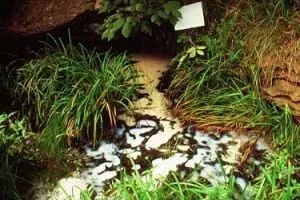 Students examine (hypothetical) groundwater samples to uncover a pollution source location and its movement.Copyright Department for Environmental Protection, Energy and Environment Cabinet, Commonwealth of Kentucky http://water.ky.gov/groundwater/Pages/GroundwaterContaminationIssues.aspx
Student teams locate a contaminant spill in a hypothetical site by measuring the pH of soil samples. Then they predict the direction of groundwater flow using mathematical modeling. They also follow the steps of the engineering design process to come up with alternative treatments for the contaminated water.
Some environmental engineers are hired by communities to locate pollution and devise cleanup solutions. They test to find the concentration of the pollutant or contaminant and use that information to determine how the contaminant has traveled. To do this, engineers drill wells and conduct tests to determine the direction of groundwater flow in the area and the direction the pollutant is moving. Engineers use this information to design remediation for contaminated water. Remediation techniques include excavation and disposal, containment, chemical and biological treatment, phytoremediation, soil vapor extraction, and pumped removal and treatment methods.
After this activity, students should be able to:
- Explain that engineers use mathematical modeling to make predictions about a design problem.
- Describe how engineers take water samples and analyze data to determine where groundwater contaminants come from and where they are going.
- Identify several methods for cleanup of contaminated groundwater used by engineers.
- 6.1.2.b Fluently add, subtract, multiply, and divide multidigit decimals using standard algorithms for each operation.
Grade 6
Do you agree with this alignment? - 8.2.2.a Solve linear equations in one variable.
Grade 8
Do you agree with this alignment?
- Use evidence to model how water is transferred throughout the earth
Grade 6
Do you agree with this alignment? - Identify problems, and propose solutions related to water quality, circulation, and distribution – both locally and worldwide
Grade 6
Do you agree with this alignment?
- CCSS.Math.Content.6.EE.B.7 Solve real-world and mathematical problems by writing and solving equations of the form x + p = q and px = q for cases in which p, q and x are all nonnegative rational numbers.
Grade 6
Do you agree with this alignment? - CCSS.Math.Content.6.NS.B.2 Fluently divide multi-digit numbers using the standard algorithm.
Grade 6
Do you agree with this alignment? - CCSS.Math.Content.6.NS.B.3 Fluently add, subtract, multiply, and divide multi-digit decimals using the standard algorithm for each operation.
Grade 6
Do you agree with this alignment? - CCSS.Math.Content.7.G.A.1 Solve problems involving scale drawings of geometric figures, including computing actual lengths and areas from a scale drawing and reproducing a scale drawing at a different scale.
Grade 7
Do you agree with this alignment?
- Students will develop an understanding of the cultural, social, economic, and political effects of technology.
Grades K-12
Do you agree with this alignment? - STEL-2Q Predict outcomes of a future product or system at the beginning of the design process.
Grades 6-8
Do you agree with this alignment?
- MS-ETS1-1 Define the criteria and constraints of a design problem with sufficient precision to ensure a successful solution, taking into account relevant scientific principles and potential impacts on people and the natural environment that may limit possible solutions.
Grades 6-8
This resource focuses on the following Three Dimensional Learning aspects of NGSS:
Science & Engineering Practices- Define a design problem that can be solved through the development of an object, tool, process or system and includes multiple criteria and constraints, including scientific knowledge that may limit possible solutions.Do you agree with this alignment?
Disciplinary Core Ideas- The more precisely a design task's criteria and constraints can be defined, the more likely it is that the designed solution will be successful. Specification of constraints includes consideration of scientific principles and other relevant knowledge that is likely to limit possible solutions.Do you agree with this alignment?
Crosscutting Concepts- The uses of technologies and any limitations on their use are driven by individual or societal needs, desires, and values; by the findings of scientific research; and by differences in such factors as climate, natural resources, and economic conditions.Do you agree with this alignment?
- All human activity draws on natural resources and has both short and long-term consequences, positive as well as negative, for the health of people and the natural environment.Do you agree with this alignment?
Do you agree with this alignment? - Define a design problem that can be solved through the development of an object, tool, process or system and includes multiple criteria and constraints, including scientific knowledge that may limit possible solutions.
Each group needs:
- 6 strips of wide-range pH paper (litmus paper); it is typical to find 100 strips for less than $5 at chemical supply companies such as Auspex Scientific
- 7 numbered small plastic cups for samples
- plastic spoon for mixing
- Finding Pollution Worksheet (PDF), one per student
- 12-inch ruler
For the class to share:
Part I
- 6 Ziploc® bags or plastic bins
- ~12 cups of playground sand
- 1 marker or Sharpie®
- 1 roll of masking tape
- 6 teaspoons
- 1 container of unsweetened powdered lemonade mix
- 6 soil samples made from sand and lemonade mix; see the preparation instructions in the Procedure section
- jug of water
Part II
- 1 bottle of vegetable oil
- 1 box of baking soda
- 1 bag of (any-sized) cotton balls
- 6-10 coffee filters (any size, kind)
- 6-10 plastic spoons
- 1 bottle of liquid dishwashing soap (any kind)
- (optional) dirt, cocoa or food coloring to make the sample look "muddy"
- (optional) plastic disposable gloves
Basic understanding of how groundwater flows and knowledge of the pH scale is useful. To complete the mathematical modeling, ability to solve basic equations with one variable.
How does the groundwater get polluted and what can we do about it? How exactly does pollution migrate through the ground? How do we prevent the contaminants from affecting our drinking water or the environment?
Pollution can result from any number of chemical spills, leaking tanks or just the use of pesticides or fertilizer on the surface of the ground. Such pollutants can then migrate down into the groundwater over time either by gravity or through the influences of precipitation. But where does it go from there? How can an engineer tell what is happening in groundwater, if they cannot see under the ground? Well, first engineers drill wells and conduct tests to determine the use mathematical modeling to predict of groundwater flow in the area. With this information, engineers can determine in what direction the pollutant is headed. In most cases, the pollutant travels in the same direction as groundwater flow. In addition, engineers can test for concentration of the pollutant or contaminant and use that information to determine how the contaminant has traveled in the past. For example, in most cases, the highest concentration of a contaminant is where the spill originated. Concentrations will usually lower in the direction of groundwater flow.
In real life, engineers must determine not only how pollution has migrated through the ground but also where it is going and how fast.
Once engineers have determined where the pollution is going, they need to think of a strategy to get the contaminants removed or contained. There are many ways that they can do this. Several methods include:
- Containment with physical barriers, or putting something in the ground to stop the groundwater flow.
- Biological treatment, by adding microorganisms like bacteria that break down, or "eat," the pollution to make it less toxic.
- Chemical treatment, by adding chemicals like chlorine or ozone that react with the contaminant to make it less toxic.
- Soil vapor extraction, by moving air and vapors through the groundwater in order to remove the contaminant.
- Constructed wetlands, where several treatment methods are used in a shallow pond-like area.
- Pump and treat methods, where engineers pump the contaminated water out of the ground, treat the water and put it back into the ground.
How do engineers choose which method(s) to use? Well, they begin by researching the type of contaminant that exists, then investigating which treatment methods could work, next, thinking about constraints like cost and environmental impact, and finally, choosing the appropriate clean up/removal method.
Today, we are going to investigate a source of pollution, predict where it is headed, and then think about how to clean it up. Having used a pump and treat method to obtain some contaminated water samples from the source, we will remove the contaminants from our sample using a variety of physical and chemical methods. Through teamwork, we will develop a treatment process, try it out, and then improve on our design. This will take us thorough similar steps that environmental engineers follow as they clean up pollution in real life—an approach called the engineering design process.
Before the Activity
- Using a marker and masking tape, label the six Ziploc® bags (or plastic bins) with the numbers 1-6.
- Create six bags of equal amounts of sand (about 2 cups each) using Ziploc® bags or plastic bins. These are the soil samples.
- Mix the soil samples in the appropriately-numbered bags/containers with different concentrations of lemonade according to the map in Figure 1, that is, label the highest concentrations of lemonade mix with the numbers in the yellow oval on the map. Specifically, make samples 1 and 2 with no lemonade mix, make sample 3 with the highest concentration of lemonade mix, make sample 6 with the lowest lemonade mix concentration, and make samples 4 and 5 equal in lemonade mix concentration, but higher then sample 6 and lower then sample 3.
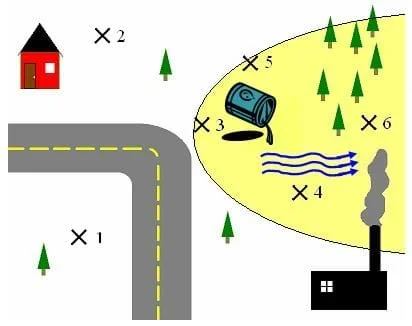 Figure 1. A map showing the direction of groundwater flow.Copyright 2005 Ben Heavner and Janet Yowell, University of Colorado Boulder
- Make the highest and lowest concentration samples, and then test the pH to make sure they are indeed different and in the range of the pH paper.
- Make copies of the Groundwater Pollution Worksheet (PDF), one per student.
- Set up a classroom supply station with the six samples clearly labeled, a teaspoon and a water source for Part I. This station can also have all of the treatment methods for Part II. Alternatively, this can be done at lab stations and each station can have all six samples.
- Next, make a batch of polluted water for Part II by mixing water, lemonade and vegetable oil. Test the water sample to make sure that the pH of the water sample matches the pH of the #3 soil sample. (Note: If desired, add dirt, cocoa or food coloring to make the sample look "muddy.")
With the Students
Part I - Finding the Contaminant Spill
- Explain to the students that as professional environmental engineers they have been asked by the state to detect and treat a contaminant plume. Here is the situation (note: provide as much or as little detail you feel necessary):
A French chemical company created a chemical called Le Chimique. Le Chimique is a highly toxic, highly acidic cleaning agent that became illegal to use in 1990. The company is now bankrupt, and the government wanted to redevelop the land; however, when they started digging, traces of highly acidic Le Chimique were found in the soil. They did some research and found that a spill occurred, but they do not know where or when. The local community heard about the newly discovered spill and is worried that it might affect their water supply. In response, the government has taken several soil samples in the area over the course of the year. They have hired you to test the samples and find where the spill occurred, predict in what direction the groundwater is moving, and how fast, so they can best determine how to clean up the spill. They have taken six soil samples from the groundwater and then dried them to make transport easier.
- Divide the class into student pairs. Then hand out to each group the worksheets, 7 cups, pH (litmus) paper and a plastic teaspoon. Show students where the six soil samples are located.
- Have students label six of the cups #1 – #6. Label the seventh cup "water."
- Explain pH and how to use pH paper. Explain concentration. It is helpful to remind students that the contaminant they are looking for is highly acidic. In other words, if a sample has a low pH, then it is highly acidic, and indicates a high concentration of Le Chimique in that sample.
- Explain and demonstrate the following procedure to the students.
- Take the water cup, plastic spoon and two other cups to the samples station. Fill the water cup with water and the two numbered cups with one teaspoon of the corresponding soil sample. For example, put a teaspoon of sample 1 in cup #1, sample 2 in cup #2.
- Then, return to their seats and add two spoonfuls of water to each sample. M it up and then test it with the pH paper. Record the pH of each sample in the first column on the worksheets. Repeat this process until all their samples are tested.
- After measuring all the samples, fill out the second column of the worksheet with relative concentrations of the contaminant in the sample. Samples that have a high pH have low acidity and a low concentration of Le Chimique. Samples that have a low pH are highly acidic and have a high concentration of Le Chimique.
- Finally, put a star on their maps showing where they think the spill occurred, an arrow indicating direction of groundwater flow and a rough outline of what they think the plume looks like. (This should become apparent with the varying levels of pH.)
- Finally, determine the velocity (v) and flow rate (Q) of the plume, using the distances and times provided on the worksheet. Use this information to predict when the flow will reach the community at point A.
Part II – Remediation of the Contaminated Groundwater
- Now that teams have determined when the contaminant spill might reach community A, they work on treating the spill. Explain that the state has selected a "pump and treat" method of cleaning up the groundwater based on the recommendations of your engineering firm. They have hired your class to remove the contaminated water at the source of the spill and propose methods for cleaning the water before placing it back into the ground. While removing a sample of the contaminated groundwater to test, it was discovered that oil used in the packaging of Le Chimique was also found in the sample. Le Chimique is highly toxic, and special care will need to be taken for cleaning up the water. At the same time, the state has a tight budget for remediation of this site.
- Show students the water sample taken from the source of the spill. Next, show them (hold up for display) the different "tools" (treatment type, as described in the table below) available for removal.
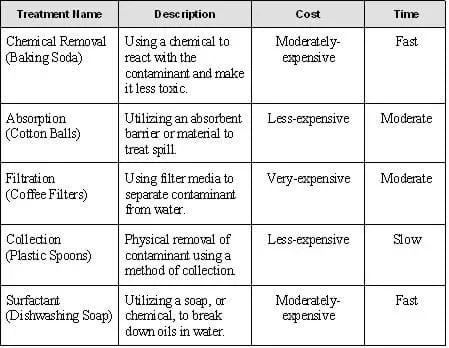
- On the worksheet, have students brainstorm combinations of treatment methods that might clean up the contaminated groundwater.
- Next, have students show the teacher their ideas. Have them obtain a small sample of the contaminated water in one of their plastic cups from Part I.
- Direct teams to try their cleanup methods while following along with the worksheet. If time and material permit, have students improve on their ideas with another sample of contaminated water.
- Lastly, have students discuss as a class what worked well and why. Have them also discuss the possible cost and environmental effects of the chosen treatment methods.
- groundwater
- Water that is beneath the Earth’s surface in soil pore spaces and in the fractures and permeable layers of rock and soil. The source of water in springs and wells.
Pre-Activity Assessment
Concept Review: Review groundwater flow with students. Ask students the following questions to review their previous knowledge of groundwater flow.
- What is an aquifer? (Answer: An aquifer is water under the ground that technically provides a useable amount of water when pumped.)
- Why do engineers and many people care about groundwater? (Answer: because many people and communities get drinking water from groundwater.)
- If a can of oil was spilled on the ground by the school, could it end up in the town well 5 miles south of the school? (Answer: Yes, the oil might infiltrate through the ground and then travel with the groundwater in the direction of groundwater flow. The oil will not end up in the town well, however if the groundwater dose not flow south.)
Activity Embedded Assessment
Worksheet: Have students record pH measurements, and follow along with the activity on their Groundwater Pollution Worksheet (PDF). Review their data and answers to gauge their engagement and depth of understanding.
Treatment Methods Discussion: As a class, discuss the remediation choices listed on their worksheets and why they chose the ones they did (#10). Each treatment option has advantages and disadvantages, including cost, time and environmental effects. Ask which efforts might have the biggest impact on the environment of those listed. (Answer: Chemical treatment and physical barriers.)
Post-Activity Assessment
Pollutant Transport Discussion: Show the class an overhead transparency of the site map or sketch the map on the classroom board. Ask a student from each group to draw on the map where his/her team thinks the plume is located. Once all the data is on the board, discus the results through the following questions.
- Did all the groups get the same exact answer? (Answers may vary.)
- If no, why not? (Answers will vary)
- Do you think this happens in the real world? (Answer: Yes, scientific data is highly variable and sometime yields different answers, especially in the environmental engineering field. The case the students looked examined is very real. Most of the time when pollution has been detected, no one knows when or where it originated, or sometimes, they do not even know what was spilled! Environmental engineers are challenged to clean up spills with not much knowledge of what is under the ground.)
- Often, contaminant plumes spread out in all directions. Why might our plume spread faster in one direction than the other? (Answer: The plume spreads in the direction of the groundwater movement. Perhaps a hill or higher elevation exists on the left side of the map.) Another reason might include the type of soil/substrate, such as high concentrations of clay on the left side of the map.
Groundwater Remediation Discussion: As a class, discuss the treatment process that each team developed. Did it work? Why or why not? What would they do to improve their treatment method? (Answers will vary.) Inform students about how engineers often iterate several different designs when developing a final process or product. In this case, environmental engineers may need to test several different methods of treatment to find one that works with both the highly acidic Le Chimique and the associated oil products. Engineers also often have to design within constraints, such as limited budget (cost) and environmental effects of the treatment process.
- Although made from a lemonade mix, do not eat or drink the samples.
- Have students wear safety goggles.
- Avoid using latex disposable gloves for Part II, as some students may have a latex allergy.
The inverse relationship between pH and acidity can be confusing. It may be helpful to write the following on the board for reference:
low pH = high acidity = high concentration of Le Chimique
high pH = low acidity = low concentration of Le Chimique
Have students research possible environmental effects of contaminant spills and report back to the class.
Have students complete a cost analysis of their design by assigning relative dollar amounts to the treatment components. A cost for the time to complete the treatment methods can also be included.
Have students develop a report for community A that explains the mathematical modeling and predictions of when the contaminant would have reached the houses. Then, have the students report on what remediation techniques were used and the results of those techniques.
Watch the movie, "A Civil Action" (1998, with John Travolta and Robert Duvall), and have students compare and contrast the movie with what they did in the activity. Assign them to write a short essay or in a chart, write two things that were the same and two things that were different.
For lower grades, make new keys for the pH paper that do not just have numbers for pH, but also high, medium and low acidity and high, medium and low concentration. Also, it may help to work through the mathematical modeling as a class or eliminate this part completely.
See images of groundwater contaminants at http://www.epa.gov/Border2012/features/pesticides-collection/index-archive.html
Environmental Health Perspectives, c/o Brogan & Partners, 1001 Winstead Drive, Suite 355, Cary NC 27513 USA. Accessed November 2, 2005. http://ehp03.niehs.nih.gov/home.action
U.S. Department of Justice, U.S. Attorney's Office. Accessed November 2, 2005. www.justice.gov/usao/index.html
U.S. Environmental Protection Agency. Accessed March 29, 2011. http://www.epa.gov/Border2012/features/pesticides-collection/index-archive.html
Contributors
Ben Heavner; Malinda Schaefer Zarske; Janet Yowell; Melissa Straten
Supporting Program
Integrated Teaching and Learning Program, College of Engineering, University of Colorado Boulder
Acknowledgements
The contents of this digital library curriculum were developed under grants from the Fund for the Improvement of Postsecondary Education (FIPSE), U.S. Department of Education and National Science Foundation (GK-12 grant no. 0338326). However, these contents do not necessarily represent the policies of the Department of Education or National Science Foundation, and you should not assume endorsement by the federal government.
Copyright
2005 by Regents of the University of Colorado